Pages

Showing posts with label NATURE. Show all posts

Monday, September 3, 2012

~ the scattering of the dead

Because the seasons are changing, so do the habits of the birds. With Spring, they are more obvious about the place, flirting, fluttering, dive-bombing... and, doubtless, it is this flurry that leads so many to their doom.

For a few years now, there has been a pair of crested pigeons living a few doors down from me on the edge of a park. They are always together when I see them. When I pass, they boost themselves skywards with an unmistakeable alarm call - a rapid mechanical whooping that originates, not from their throats, but from the passage of air through an adapted feather. They are funny birds, even comical. They strut about in search of seeds with expanded chests, bold orange eyes, and what look like circa WW1 German army helmets on their tiny heads (according to Robert).

Polly found one of them in the gutter the other day. It's hard to describe the aching sadness one feels at these widowings in the natural world. I feel for the surviving pigeon especially, I can't help it, I feel its grief, its dumb animal longing and the horror of Nature's indifference...


And then a dead brown thornbill appeared on the driveway. A tiny bird, always busy in the high branches, smaller than a sparrow and dull of plumage, but possessed of a wonderful vocabulary of trills, whirrs, cheeps, chirps and chitters that is an absolute delectation to the ear.


And there were others... among them the creature below:


This luckless red-browed finch met its doom in the grille of a Mercedes owned by my friend Querulous.


*

I was expecting Saturday's reading of Ambergris to leave me worried and despondent, but instead I'm feeling pleasurably neutral. It wasn't hideously long, as I'd feared. My experiment in the complex entwining of multiple plots left no one bemused. And it really seemed to work pretty much as I'd imagined it would. That's good. That means I'm keeping a functional link open to the minds of other people. I would have liked to have watched it rather than been in it, but there's a recording I can access (thanks Bruce) and, besides, thankfully, I don't think there's a hell of a lot I have to do except embark upon the next stage.

Thank you Lynne and La Mama and all who read, particularly Anthea, who was given the hardest job and proved herself an absolute trooper.

Stumble Upon Toolbar DiggIt!

Wednesday, August 22, 2012

~ did mr bunny get some?

Robert's rat – known variously as Mr Bunny, Zebedee or Nipper – has led an indulgent yet cloistered life, feeding hugely from the trough of his owner's kindness, puncturing the hands of strangers who seek to pet him in his nest, set high on a bookshelf in Robert's densely furnished apartment.

When Robert is out and about, Mr Bunny lives in his leather jacket, often peering curiously from a sleeve at supermarket checkouts and bank queues. The pellets he leaves are compact and easily shaken out, but when Mr Bunny needs to urinate he dutifully alerts his doting human companion. If Robert is riding his bike – for example on busy Queen's Rd at peak hour - the rat will crawl onto his shoulder as a signal for him to pull over.

Recently, Robert described a scene I found reminiscent La Grand Bouffe. From the toilet – on which he was perched - he had a clear view of the rat's nest. Presently, Mr Bunny's seeking nose emerged from the skein of rag and newspaper. The rat seemed to peer into the distance. He edged forward a little more, expressionless, apparently mesmerised. Perhaps he was concentrating on some uncomfortable internal process, or perhaps his cognition was stuttering due an overdose of lipids and sugars in his bloodstream...
Time passed and a sudden thought came to Robert's head. Was Mr Bunny having a stroke? Would he fall? Robert leapt up, but too late. The pale unwieldy rodent plummeted eight shelves into the chaos of gas bottles, engineering books and electronic components below.

Thankfully, the fall did no harm and seemed to reboot Mr Bunny's system.

Though only 18 months, Mr Bunny is old in rat years and contented in his simple ways. He is not desexed and two large lightly furred globes swing at the root of his dextrous tail. Robert has mentioned to me that - for Mr Bunny's birthday - he would like to arrange a sexual liaison, as his pet remains a virgin. It seemed a pipe dream until, just recently, I was pleased to inform him that I had met Ellie, a nubile young female rat whose owner was prepared to keep some of the resulting pinkies if Robert returned the favour.

This weekend we travelled to the home of Ellie in the remote town of Barry's Reef. Robert fretted, fearing that Mr Bunny might engage in cannibalism or violent rape - but nothing of the kind ensued. Certainly, his rat proved to be two to three times the size of Ellie and was, by comparison, as lively as a slug - yet Mr Bunny was not entirely disinterested. Ellie spent much of their tryst sleeping on his head, but perhaps, in the dead of night, in the opaque plastic milk bottle that was their private place, magic may have happened.

As the rats engaged in their inscrutable negotiations, I took a walk in the nearby forest, where I sought wisdom from The Green Man.


Shortly afterwards, and perhaps not by accident, I uncovered a vein of fossilised moon jelly.


And afterwards, I saw these three things...


Stumble Upon Toolbar DiggIt!

Saturday, July 16, 2011

~ lichen in the face of adversity

With the last of the light, we drove to Thompson’s Dam, that vast body of water which supplies most of Melbourne’s water. Particularly during the drought, one was repeatedly shown evidence of its declining volume in newspapers and TV. The slopes of dark broken rock and the installation’s various towers and structures were therefore instantly familiar - none more so than the exposed strata along its shore, which, if the lake was not merely 42 per cent full, would not be visible at all.

But there were also the looming, crowded forests - the overwhelming verdancy of nature, everpresent and pure; ferns swarming the sides of the winding roads - ferns which, I am told, need centuries to become so large. Above all, there were the rolling columns of mist - for it was very cold - settling over the surface of the water, propagating among the ancient gums, attenuated in some areas, congested in others; obeying the inscrutable physics of the invisible winds. At any point we could have become characters in The Shining or The Evil Dead, or, perhaps most disturbing of all, that recent adaptation of Steven King’s The Mist.

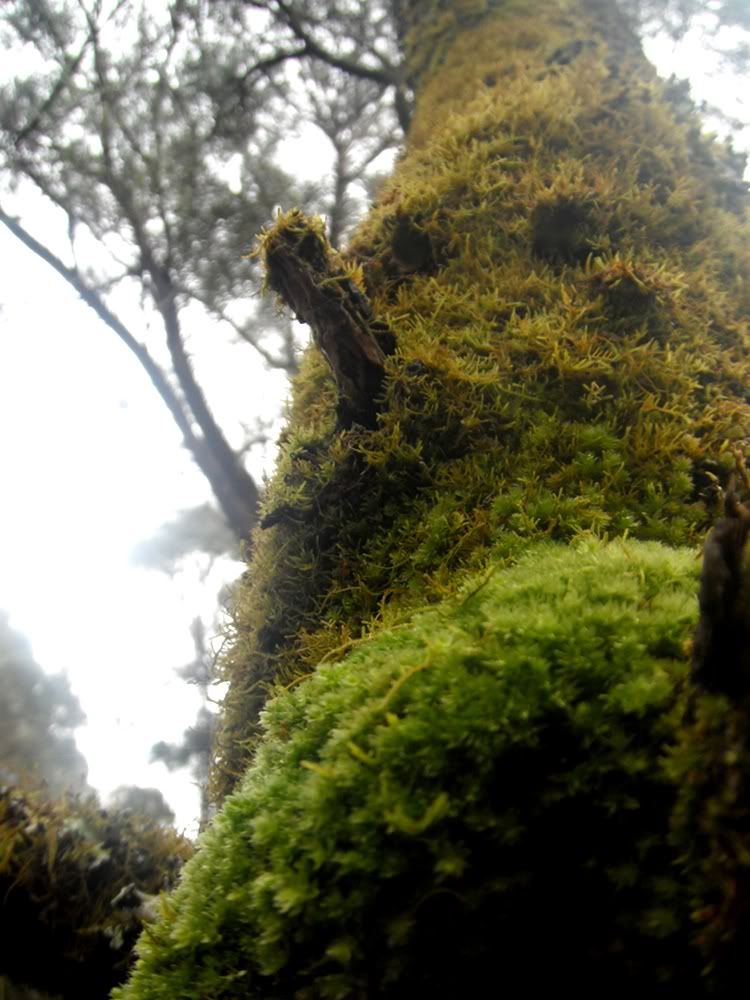
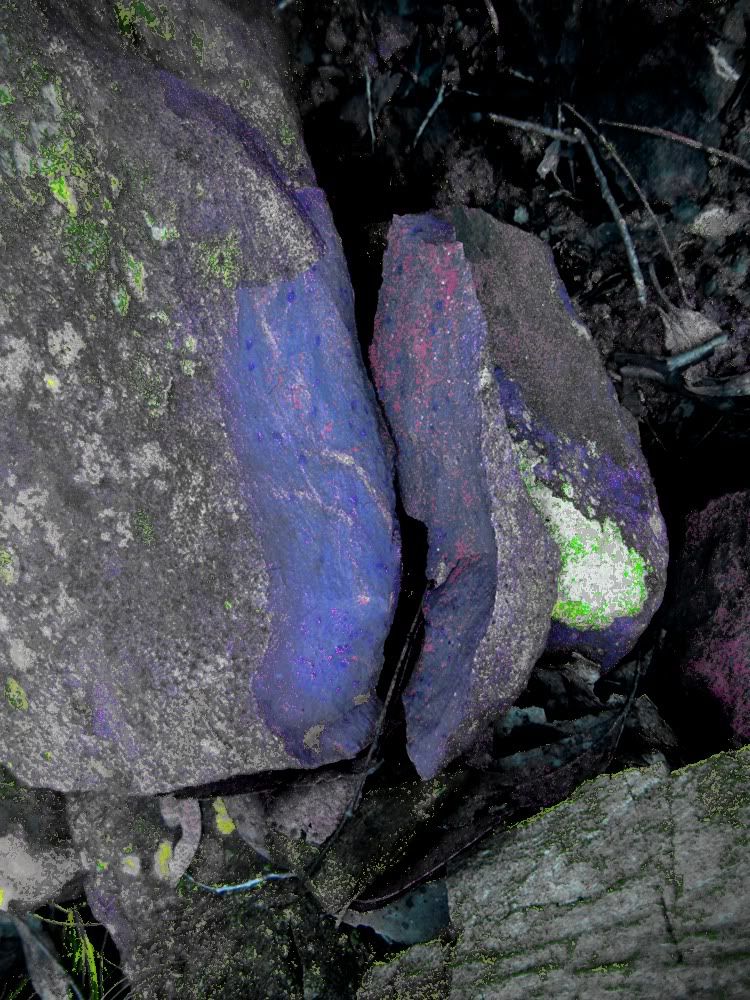
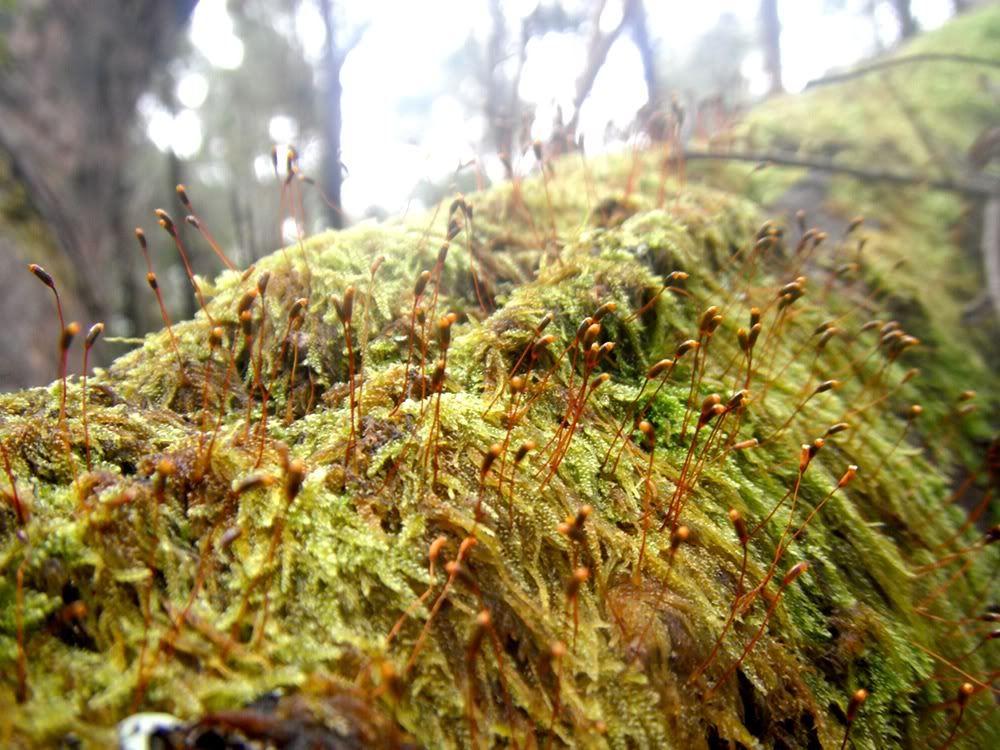
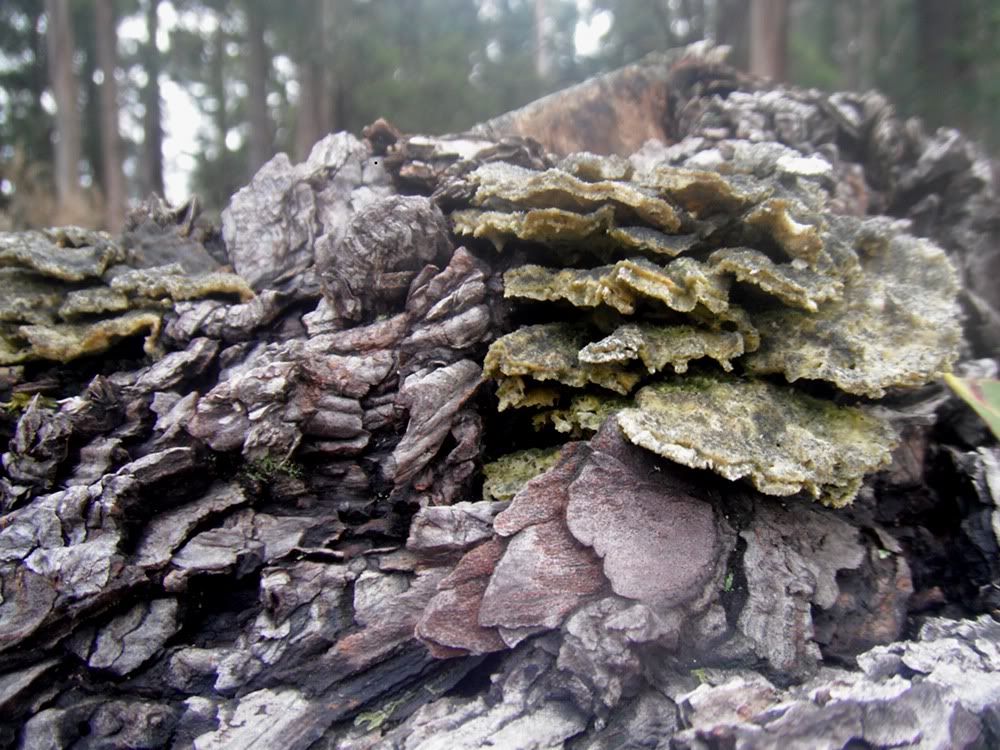
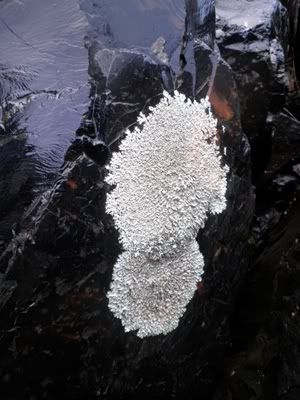
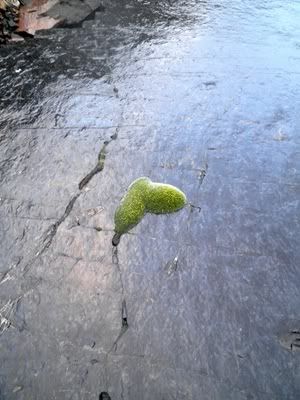
Of course my eyes were drawn, as always, to the little things. The marginal things. Here are some photos. Taken in the rain.


Stumble Upon Toolbar DiggIt!

Saturday, July 9, 2011

~ peripatetic insile

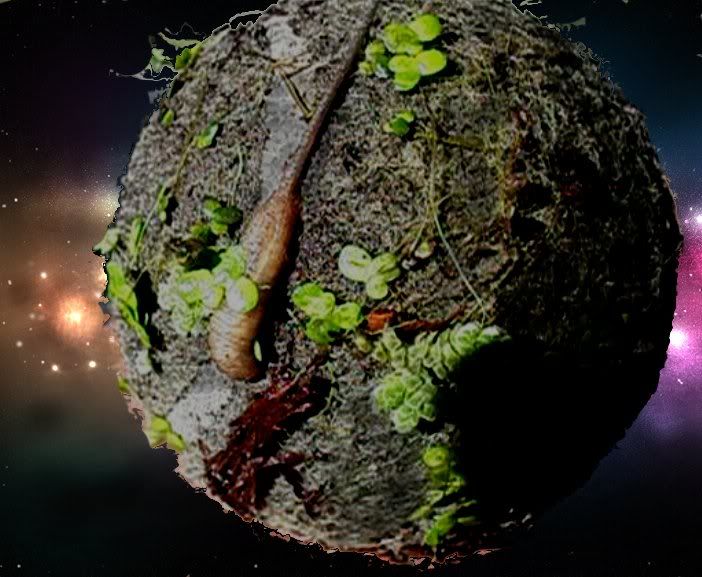
Last night, after catching the final train home from a dreamy night at Cherry watching Steve Kilbey and Ricky Maymi's enigmatic tribute to the mysterious David Neal (in addition to a beautiful set from some unnamed Triffid remnants and a session of ab-zen counseling over liqueur coffee) my sleep was profound and my spirit rose through the upper airs into the realms of the firmament. Here, to my deepest consternation, I witnessed the consumption of a pleasant green world by a Peripatetic Insile (a species of ravenous space-faring gastropod).


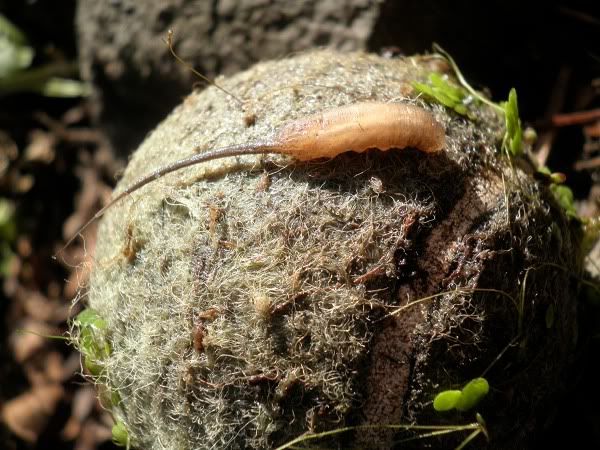
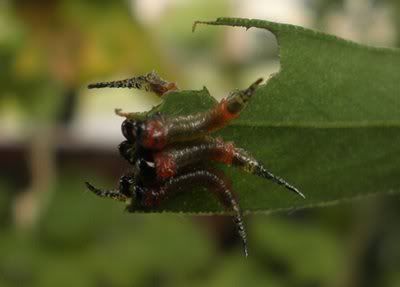
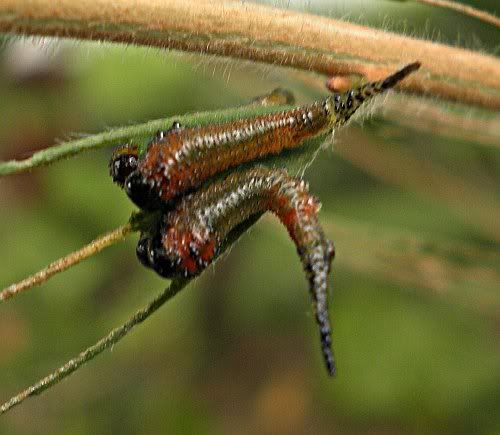
The next morning Polly removed a tennis ball from our new pond (a sunken claw-foot bath) turned it over and discovered this peculiar long-tailed slug-like larvum.


Stumble Upon Toolbar DiggIt!

Friday, June 24, 2011

~ earth stars

This morning on the ABC News Breakfast show, Mal Brough presented us an old chestnut which seems to be coming back into its own : why should Australia lead the world in reducing its carbon emissions (and why should we bother, as we're such a small polluter on the global scale). When Barry Jones responded, I was hoping he'd give the right answer. It would be good to hear the right answer clearly articulated on the airwaves, just once.
By my book, he did pretty well. Among the developed nations, Australia is the world's largest per capita producer of greenhouse gases. While most of the world subsists on trotters and belly pork, we are living high on the hog. Plainly, this places a moral burden upon us, more so than any other nation, to curb our negative influence on the environment. For their own reasons - largely selfish - many conservatives and the much of the business sector do not subscribe to this thinking - but most of us, I feel, would agree that ethically speaking we have an obligation.

Thus Barry Jones replied, adding that Australia has been a world leader in the past and is perfectly capable of being so again.

It is an position of integrity and right. Though certainly nothing Australia does in isolation with its emissions will curb the global pollution problem, it can act to secure the future by influencing the world at large. Australia – unlike the USA - is in no position to strongarm, but it is sufficiently large that its actions are noticed. It can pave the way that others may follow.

As well as the high-minded moral argument, I would not have complained if Barry Jones couched his response in more selfish terms. People are afraid of the coming change. They are confused by the clamouring voices, raised against each other, crying contradictory predictions and positions. And it is the way that when danger looms, humans look to their own.

If the current generation of Australians wish to provide a rosy future for their children and grandchildren, they can act personally but to little overall effect. Yet if they act as one to reduce their emissions, establishing new standards and new economic mechanisms, then they are lighting a beacon for other nations, who might act in turn - until sufficient of us are united in the cause to positively influence the future of the planet.


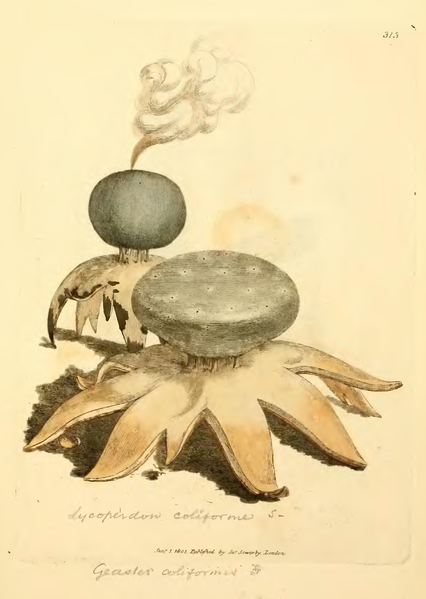
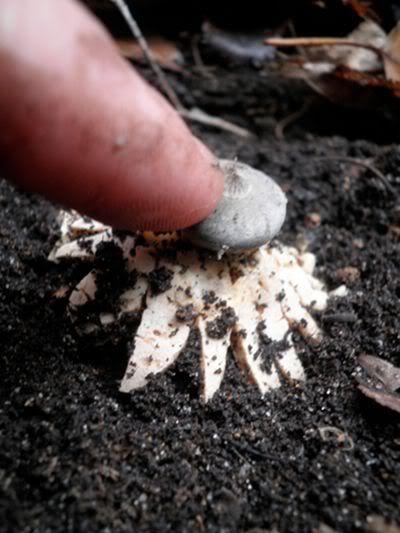
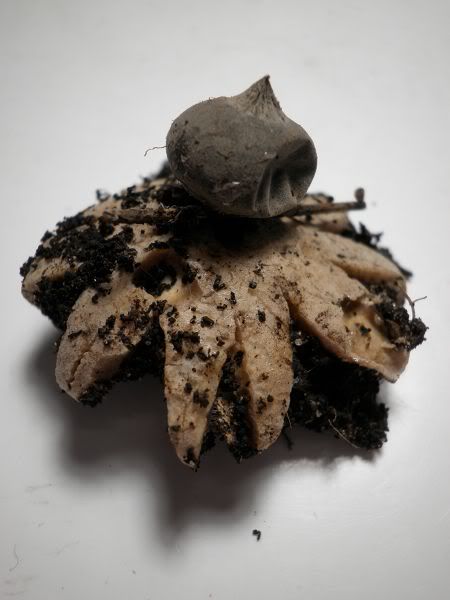
Yesterday, more importantly, while scraping up some mulch for my potted anemones I unearthed what I thought to be some old, partially digested plastic daisies. On closer inspection, I discovered they were ripe earth stars, their 'stomach-shaped sacs' bursting with spores. I've trawled for about half an hour, but can't identify the species, though the family is certainly Geastrum. Over my many decades of turning the earth in Mt Waverley, I have never before encountered earth stars.


Stumble Upon Toolbar DiggIt!

Thursday, April 14, 2011

~ the cupboard moth

It’s taken a few weeks for my black internal weather to disperse - but disperse it appears to be doing. The long long ordeal by law is petering out via an endless series of interviews with agents of Correctional Services Victoria, and no longer do I prepare myself mentally, late at night, for jail.

The other trial, the drug trial, continues ... and, at week twelve, I should know soon if it’s had any significant effect on my viral load; but until then I remain nauseous, gasping for breath and generally deenergised. Heaven knows how I’ll cope tomorrow night. Singing demands a lot of that exact kind of energy I’m lacking at the moment, but we’ll see.

I can think of nothing better than an Ears shows to celebrate the termination of my primary difficulty. Perhaps we’ll do something a bit more significant soon, but for now, tomorrow night at the Lyrebird Lounge, probably at 10.00pm, will have to do. The Ovals are playing at 9ish, if you’re interested, after Josh Lord’s exhibition opening down the street at The Bower.

What’s more, we’ll be playing a new song: The Cupboard Moth ...

I bred a cupboard moth
At some excessive cost
Because it fills my nightly chalice ...

A few doors down the street, there’s an elderly gentleman who breeds native trees. I’ve acquired a great many from him over the years, but have had no luck getting them to survive. Lately, however, fortunes in the garden have changed - even to the point of our new indigenous vegetation luring strange new life forms to the property ...

Stumble Upon Toolbar DiggIt!

Thursday, January 20, 2011

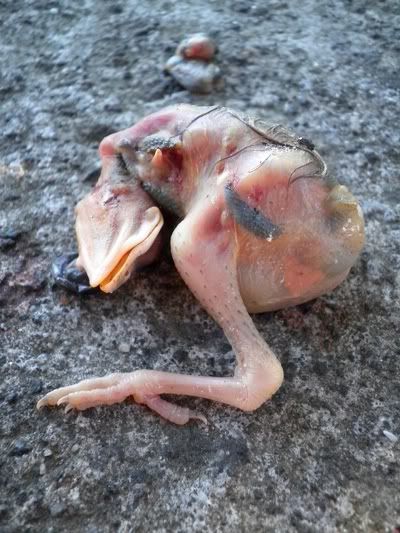
~ dead chick

This is a sad and compelling something, encountered by Polly on our driveway.

"I don't know what it is," she said. "But if I look at it again, I'll vomit."

In a night or two I will have finished reading her Enid Blyton's Faraway Tree trilogy. Next will be Arabel's Raven.


Stumble Upon Toolbar DiggIt!

~ I try my hand at oding

Down at the Grey Creek, since the rain, there is a super-abundance of dragonflies and their smaller cousins the damselflies. In my experience, there have never been so many. They are hovering, flashing bolts of iridescence, almost surreal in their variety, like echoes from J G Ballard’s The Crystal World. They are hypnotic, suggestive of fairy tales, and cousins to the butterflies in that they bring fanciful unexpected colour to the world. At times, as I sit observing them, I feel a shimmer of magic, glimpses of another world briefly seen and then gone.

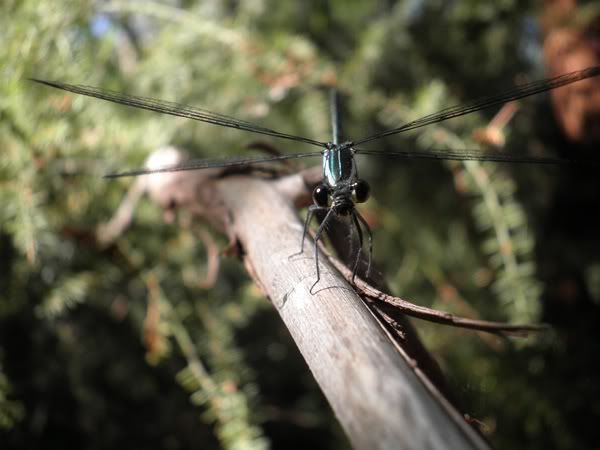
I’ve set about cataloguing them. Thus far, among the damsel flies, blue ringtails are by far the most common, tails striped with sky blue and black. There are common flatwings, a dark metallic green with a lightning bolt on the thorax, and tiny prismatic aurora ringtails. The most populous dragonfly is the tiger-striped tau emerald with its bold green face. There are blue skimmers. And red wandering perchers.

I’m beginning to see variations in their behaviour. Their mode of flight and their habits can be used to identify them, but I’m not quite an oder yet. Oder? Oding is the habit of dragonfly watching. Many of them flit by too fast for my eye to track (They are among the fastest insects) and few stay still long enough for a photo, but I lucked out with this common flatwing ...


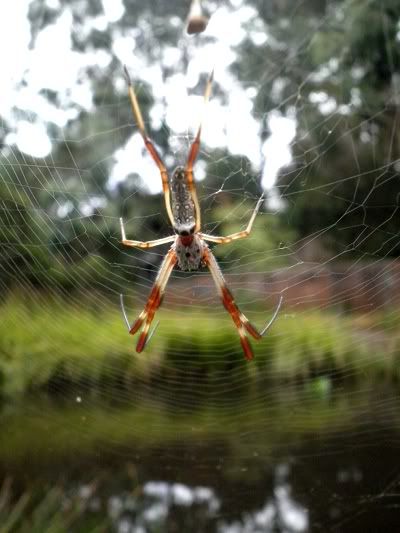
and this wondrous spider, which I’ve been unable to identify. Perhaps, if there is an arachnophile reading this, he or she may be so good as to shine a light on my ignorance ...?


Stumble Upon Toolbar DiggIt!

Thursday, April 1, 2010

~ red rumped parrot

In these lean times, its rare for me to come into possession of precious things, but yesterday, using a book voucher I received for Christmas, I acquired a copy of Pizzey & Knights’ highly respected Field Guide to The Birds of Australia. Since then it has barely left my hands.

I know. My prognosis is doubtful. I may have traveled so far down the birding path that my chances of returning are poor.

But let me share with you some of my ornithological excitement. According to the twitchers, Melbourne is home to many parrots - not just your rainbow lorikeets,
galahs and eastern rosellas - but more obscure varieties like the musk lorikeet, the purple crowned lorikeet and the little lorikeet. My failure to sight any of these has been a source of enduring frustration, but today, at last, things changed ...


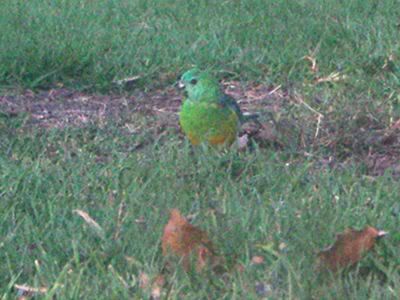
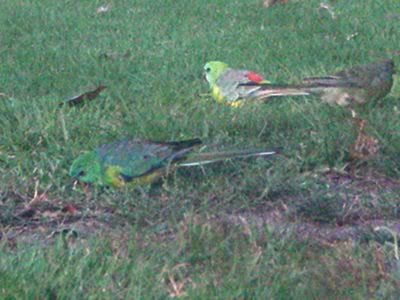
During a break from reading at Vision Australia, one of the workers noticed me poring over my new bird book and informed me that a family of red-rumped parrots was living in the park right next door. Once I’d finished with my work, I walked down to have a look and was far from disappointed.


Please excuse the quality of the photos. My camera is not only cheap but somewhat wonky and I had to take these shots at full zoom. Typically for the bird kingdom, the dull version of the bird is the female. Red-rumped parrots (Psephotus haematonotus) are also known as grass parrots.

Stumble Upon Toolbar DiggIt!

Monday, July 20, 2009

~ the shadow biosphere

What if current conditions on Earth were perfect for the genesis of life? Not life as we know it, but another kind, a different kind starting anew from the inanimate organic soup - while we happily continue on our way, ignorant of a new challenger rising from beneath. Something based on a triple or quadruple helix perhaps, or on plastic, neon and carbon monoxide. Perhaps something congealing in the anoxic depth of the Gulf of Mexico ...

Perhaps the havoc we are wreaking on the planet is making conditions perfect for this new genesis, perhaps our toxic effluents are providing the perfect nutrient mix.

I was going to write a story about this. I have a few scribbled pages in a notebook. But after hearing Paul Davies speak on the Science Show the other week [4 July], I don’t think I’ll bother.

In an absolutely fascinating address, he discusses something he calls the ‘shadow biosphere’. He posits the notion that life may have originated more than once on the Earth, and, asks, if this were the case, how we would go about finding it.

If it was something that has faded away, then we would have to look for ‘ancient biomarkers in the fossil record’ but, if not, if there is indeed a shadow biosphere currently intermingled with our own, he suggests a number of methods by which we could identify it.

Firstly, it would have to be small. If were anything more than microscopic we would have noticed it already. But the vast majority of life on Earth is microscopic and the vast majority is unresearched and unsequenced. If this shadow or ‘weird’ life was ecologically separate, we might find it by subjecting samples to extremes of radiation, acidity, or general contamination, or by looking into extreme environments like the upper atmosphere or around super-hot hydrothermal vents. If it was ‘integrated into our ecology’ we could examine how it cycles carbon [if it is carbon-based], or the chirality [handedness] of the compounds from which it is formed. Davies also suggests that weird life may process arsenic instead of phosphorus.

He presents the enthralling possibility that there may conceivably be, rather than a tree, a forest of life on Earth.

Stumble Upon Toolbar DiggIt!

Thursday, July 16, 2009

~ don't get a drug habit


On my walks I’ve often fantasised about dressing down the dog owners who let their animals swim among the teals and ducks and coots of the Huntingdale Wetlands. Once I imagined dropping a brick on the head of someone I saw yabbying there (though my outrage turned to melancholia as I observed him: an elderly man with his grand-daughter, possibly a European migrant like my father (an excellent yabby-catcher) who may have been used to rivers and streams with slightly less toxicity than ours. Conceivably, the maudlin pair may have caught a microscopic mosquito fish, but the yabbies that once existed in this area now rest in peace beneath the Monash Freeway).

I’ve thought of marking the spots where I find empty bottles and cans with a sign reading;

A complete arsehole casually defiled the planet in this place

Or something along those lines… I’ve even visualised the mass production of these signs and considered carrying them with me in a pack along my route, but deep down, thankfully, I know that my time is better spent in some other fashion.

But of course I applaud the author of the damning reprimand photographed above, although I should really grass him/her up to the Apostrophe Police.

I found the neat little tableau on my way to 3PBS to record an interview with Ruari Currin who hosts Fang It! He’s putting together a special on the forthcoming Dogs In Space/Ears Reunion axis, so look out for it. I think he’ll also be interviewing Ollie Olsen and Hugo Race.

My thinking cap kept falling off during the interview, but I suspect I made a little sense. He asked if I had any advice for young bands starting out. The question took me quite by surprise. I felt old and superannuated. All I could think of saying was ‘don’t get a drug habit.’

I did another interview yesterday with Patrick Donovan from the EG [The Age]. This one was more directly related to the ‘Post Punk’ stream at the film festival, but I think the Sails of Oblivion show will get some exposure from it.

And this morning, I woke to the sound of currawongs high in the peppermint gum in the front yard.


Stumble Upon Toolbar DiggIt!

Saturday, July 11, 2009

~ falls the shadow


It’s a demanding old life, is it not?

Things have been riotous, strange and extreme. I’ve been challenged with calamity, yet somehow, from the chaos, with the help of friends and family, using resources I didn’t know I possessed, I’ve been able to confront the encroaching darkness - just by living my life.

In fact, it’s turning out to be a wildly interesting year. The Ears reunion. Who could have predicted that? I’m spending more time with old friends than I could possibly have forseen, and no friend is better than an old friend. Richard is re-releasing Dogs in Space, a mere two weeks prior to the show, together with We’re Living on Dog Food, a 'doco that explores the making of the film and the scene in early Eighties
Melbourne which inspired it. Providence walks before me, seeding my trail with stardust. I’ve even scored a ticket to the opening night of the film festival.

And the granite-bodied men of St Kilda Football Club have won fourteen games without a loss and look set to challenge for the premiership.

And the light of my life, my daughter, is happy and growing. We’ve just returned from three days in Bairnsdale with Tosie and her son Kyowa, who is just a little older than Polly. I really needed the time; I was getting a little frayed at the ends, and Polly loves Kyowa, and vice versa.


We saw fat koalas lodged in the forks of trees, regarding us with the inscrutable expressions of the profoundly stoned. We rode a ‘fairy’ to Raymond Island. We explored a secret place
- a mossy rainforest gully of tumbled granite boulders in the deep shadows of water gums. We had dinner at the property of an old bushie called Mick, where the smell of burning bracken was as evocative as Proust’s biscuit, where we turned a giant fallen stringybark into an adventure playground, and where I explained that Betelgeuse, in the constellation of Orion, has recently reduced in size by fifteen percent and may be about to explode, turning our nights into day for the first time in a millennium. Elsewhere, we fed crimson rosellas and king parrots. I saw a bronzewing pigeon, the kind which leaps into flight with a characteristic flapping sound caused by the particular shape of its wings. I saw a male satin bowerbird, the kind that collects blue things for its prospective lovers.


But, almost inevitably, I received a call from Melbourne. My wife, who was not too well to begin with, was in hospital, having taken a decided turn for the worse. As with my legal problems, I can’t be too straightforward here. Suffice to say another heavy weight of responsibility and potential stress has been hefted upon my shoulders.

But never mind. No fear.

Many don’t make it through times like this. Often, it's simply the pressure that defeats them. Tosie’s brother recently died of a heart attack. He was in his early forties .He was brought low by the stress of a bitter struggle with the evil mother of his young daughter. Me, I will work towards tranquility. I know there is only so much I can do. There is no profit in savaging myself over things I can’t control. And in the end ...?

With the beautiful people on my side, I know it will turn out well.


Stumble Upon Toolbar DiggIt!

Thursday, July 2, 2009

~ quintessential beauty in a North Carolina sewer

Allow me to share with you the current object of my professional interest. This footage brushes the thematic core of all my work. It is said to have been taken with a snake-cam in the sewers of North Carolina


These clits of pink mucilage might have been spat from the bronchial tubes of a tuberculosis victim, yet they are plainly, horribly alive - as their weird peristaltic spasms attest. Notice how their substance seems to melt beneath the light, then recombine, always moving, writhing. Each a wet succulent bolus of undeniable charisma ... Performing unknowable functions, describing secret processes, slow emulsive calculations in the darkness and moisture, latent meaning in the clotted, palpitating slime... I particularly like the second creature, which, rather than flinching, appears to actually threaten the source of illumination. (Notice that the controller of the camera is aware of their photosensitivity and positions the light for effect.) Regard the extrusions of striated flesh with which the creatures attach themselves to the concrete; this is how human muscle fixes to the bone.

In the undisturbed dark, growing fat and strong on the rich never-failing stream of effluent, on the slow seepage of human waste… In an environment so abundant, so wonderfully replete with the building blocks of life … I can imagine that these creatures originated here and nowhere else. That the spark of life from which they have evolved is not the spark from which the rest of nature descends.

Forgive my language. The subject compels me to lyricism ...

Feasting. Growing fat and strong…

Or were they once creatures of another order, forced into the deeps by predators or environmental cataclysm. At what point did they abandon their skin? Or if not their skin, their shells?

Indeed, if forced to guess, I would have said they were molluscs which had abandoned their shells. Others, excluding the breathless cryptozoologists, have suggested that the entities are, variously, bryozoans (something like coral), cnidarians ( the phylum containing jellyfish, sea anemones and coral) or slime molds. Some suggest the video is promoting what could only be a horror movie.

For some prosaic background info try here.

For an expert opinion, courtesy of Deep Sea News, try this:

“They are clumps of annelid worms, almost certainly tubificids. Normally these occur in soil and sediment, especially at the bottom and edges of polluted streams. In the photo they have apparently entered a pipeline somehow, and in the absence of soil they are coiling around each other. The contractions you see are the result of a single worm contracting and then stimulating all the others to do the same almost simultaneously, so it looks like a single big muscle contracting.”

Hmmn …

Or were they once … men?

Stumble Upon Toolbar DiggIt!

Tuesday, May 26, 2009

~ spider sac

Circumstances have forced me back into that most cruel of tasks: selling books on Ebay. I have reassumed the identity of ‘Lampsucker’ and am diligently slaving away, as I expect to be for at least the next year.

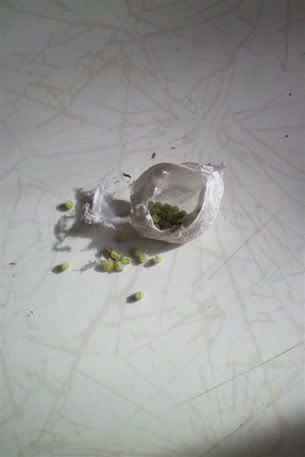
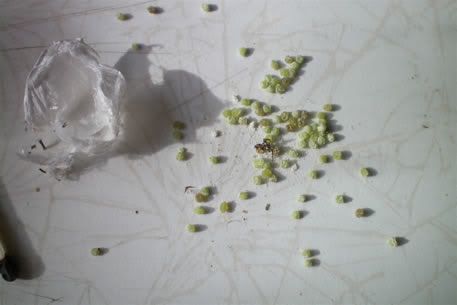
While burrowing through my stock the other day, I found the egg sack of a spider attached to an Isabel Allende biography. Though it was slightly torn, it seemed quite full, so I investigated further, to find it was filled with tiny spherical eggs of a light green colour.


The eggs seemed to have crystallised. If you crush a crystal of sugar under the end of a spoon you are left with the same type of powder residue I was left with when I crushed one of these eggs. Only
pale green instead of white.

I’m pretty certain the sac was the work of a huntsman of the holconia group – the species which most commonly inhabits houses here in Melbourne. They produce ‘a flat, oval egg sac of white papery silk, and lay up to 200 eggs’. Well there were about fifty eggs in this one, but otherwise it fits the facts. Also the ‘spiderlings are pale brown or green in colour’, so perhaps this was one of the green batches.

I was also surprised to learn that huntsmen have lifespans of about two years.


The other possibility was the dreaded white-tail (Lampona cylindrata or Lampona murina). Its saccing habits were described thus: ‘they make temporary silk retreats and spin disc-shaped egg sacs which contain as many as 90 eggs’. I saw no evidence of a silk retreat and there was nothing particularly disc-like about the sac

But I did learn something interesting.

My wife hates white-tails with a passion and is always checking Polly’s sheets for them. (They like clean linen.) Her mother, Di, was bitten once and reacted very badly, perhaps experiencing the necrosis that their bites are said to cause. I have spoken to a woman who claimed a white-tail bite caused her to lose two years of her life in the mists of chronic fatigue syndrome. Without really thinking about it, feeble sceptic that I am, I was quite prepared to believe that these spider bites could cause seeping wounds that never heal – a condition named "necrotising arachnidism". (“Occasionally, the reaction is so severe that the person loses large amounts of skin and needs extensive skin grafts.”)

It appears this is something of an urban myth or at least a vast exaggeration.

I myself first heard of white-tails around the time my wife moved in, around 2000, and it surprised me that I’d been ignorant of such a seemingly perilous threat. And apparently it has only been since the 1980s that reports of severe skin lesions have been reported.

Here are a few random quotes from the web:

A recent study has monitored the medical outcomes of over 100 verified White-tailed Spider bites and found not a single case of ulceration (confirming the results of an earlier study). www.austmus.gov.au

The University of Adelaide’s Clinical Toxinology Resources (www.toxinology.com) have an excellent run down of the venoms of all sorts of Aussie fauna and their effects. The entry on white-tails says that necrosis “does not occur, based on current clinical evidence”. bencruachan.org

Bites from these spiders have been reported to cause necrosis (decomposition of the skin). This has only been verified in 14 spider bites over the past 10 years, and none of the victims could confirm the type of spider responsible. This reaction is considered to be rare. However, bacteria on the fangs of the spiders may cause severe infection or other allergic reactions.

I’m getting the feeling that the white tail thing has been blown out of proportion. In their favour, they’re an arachnovore, hunting other spiders (like red-backs and daddy-long-legs) for food.

*

If you’ve stayed with me this long, you might be interested to know that there’s been some movement on the Save Sam’s Neck effort, coming principally from my guru to the north, Steve Kilbey. I was thinking about arranging a theatrical-style benefit, that being the scene I move in these days, but Steve’s suggested, and offered to be part of, a musical benefit.

It’s early days yet, but it will probably be in August and legendary promoter Dolores San Miguel has offered a hand. Also, unless the sky falls in, The Ears will be doing a reformation.

I’ll leave you with this still by Marc Morel from The Goitre Birds, performed at Snatches a little over a week ago.

Stumble Upon Toolbar DiggIt!

Sunday, September 14, 2008

~ extraordinary things

Life used to be flush with excitement. Awesome things used to happen all the time.

But these days, not only is my existence monotonous, predictable and unexceptional, but I would fight tooth and claw to keep it that way. Sure, those ever advancing years are at least partly to blame. And yes, my life is probably a little more interesting than I make it out to be – but reasonable certainty that tomorrow will be pretty much like today is a large part of what keeps me together, helps me stave off depression, be a consistent father, obey the orders of my beautiful wife - and work.

If you’re writing a novel, you need to work pretty much every day, and for hours – in my case at least four. The days go by. The words get written. And I find I’m spending a good part of my mental life in the chaotic fantasy world of Nonesuch.

That’s how I’ve replaced the madness of my youth. That’s how I get my jollies these days. In the mind. The mind.

In Nonesuch. In Alastair Reynolds' space opera House of Suns. In David Mitchell’s Cloud Atlas. In my library, where thousands of books, accumulated over decades, emanate an aura of profound comfort and potential … I can go anywhere … what's more, in the next room, the internet, and you ...

Did you read the article about cognition and exercise last week? An experimental study strongly suggests that regular daily exercise leads to improved mental function. It makes sense to me, gives me even more impetus for my exercise regime. What's more, a few days ago I discovered
Dr Norman Doidge and the concept of neuroplasticity. The act of thinking actually involves synaptic growth and can even turn genes on and off. Believe me, I’m back doing my crosswords. I'm an immediate convert. No doubt, cerebral exercise is at least as important as physical. Particularly – as I repeat myself like a weary, warped, worn-out record – if the years are accumulating behind you.

They say your mind goes as you die from liver cancer. What a harrowing thought. I’ll have to put something in my will about that. I want to be turned off before my wits go. Just pump me to the eyeballs with morphine and let the sisters of mercy call down the birds ….

Lately, you see, I've had this thing with birds … And I feel I’m about to have a thing with fungus … It’s my way of going deeper, finding the Breugelian phantasmagoria beneath every rock, brick and decaying log … Imagine how much there is to learn about those strange growths … imagine knowing the name of even the humblest toadstool ... Who cares if they’re a hundred feet from the Monash freeway … My god, I’m shivering with excitement!

There’s a whole boring old suburb out there, full of boring old people; there are mundane parks and common species … but when you get into the detail, well, it can transform into a wonderland… That’s what I started out trying to say. I’ve learned to take delight in the little things. I'm learning to find community in the place I live, rather than where I go mental.

Howard Arkley, the artist who lived and died not far from here, was unearthing something similar in his work. Lounge suites, common as muck, burning with neon intensity. But when drugs intervened, then his sense of wonder was whisked away - and he was left with shabby old furniture and a rafter from which to hang himself.

Here are the lyrics to a song I wrote in the nineties. It was for Lynne, the woman who taught me that ordinary could be astonishing.

*

extraordinary thing

she likes terrifying things.
she likes death-defying things
beware her paperclip and her useless piece of string.
beware the texture of her skin.

he loves convoluting things
he loves interwoven things
M.C. Escher folds his hands under his chin
enthralled by the deployment of her limbs

that girl who lies beside you -
has got the strangest idols

she likes ordinary things,
but she’s no ordinary thing.

she likes mortifying things.
she likes nauseating things.
beware her laser beams and her paralysing sting.
beware her vanities and sins.

she likes aggravating things
she likes modifying things
she wants a murky world where logic is a sin
and where confusion reigns, she’s king.

that girl who lies beside you -
has got the strangest idols

she likes ordinary things,
but she’s no ordinary thing.

extraordinary thing
extraordinary thing

(From Sweet Secretions by Fact. Available in your local remainder bin or op-shop.)

*

A final note. I've added an important update to the post titled Blue Streaks of Paranoia


Stumble Upon Toolbar DiggIt!

Wednesday, September 3, 2008

~ the hanging tree

I’m stricken with a particularly bad chest cold – the sort of thing that inevitably happens after a few weeks of healthy living. Despite the fever, the headache, the burning throat and the hacking cough, I managed to queue up for the all important tickets to the Geelong vs. St Kilda final, and to retrieve my beautiful reincarnated Renault 12 stationcar from dear Don Shaw, the greatest mechanic in the world.

The whole of my yesterday was consumed with an attempt to save a tree. There are some units being built on a block behind us and a particularly wonderful tree is at threat. Usually I miss the opportunity to say my piece on these occasions, but this time I was determined not to let it slide by.

Here’s my submission. I was in a hurry, so some of it is a bit inelegant and repetitive – but I think I get the point across without sounding insane and/or obsessive.


Attention: Senior Statutory Planner, Nick Sakolevas
Re: TPA/36426
Property: 14 Russell Crescent, Mt Waverley, 3140

On behalf of myself, my wife and daughter, I am asking that plans for the proposed development at 14 Russell Crescent be amended to include the majestic pre-existing tree at the rear of the property.

Though not terribly obvious from Russell Crescent, the tree dominates my property at 3 French St, where I have lived for forty-eight years. It is a source of great pleasure and atmosphere for both myself and my family. Looking out from the rear of the house, it covers about a quarter of the sky and is one of the few visible trees remaining which are not in our own backyard.

Though plainly not a native, I contend that it adds enormous environmental and aesthetic value to the surrounding properties. It’s presence allows us to visualise ourselves in a forest [or at least a leafy suburb]. It flavours the ambience of warm Summer afternoons. It draws bird-life from the nearby parklands. Watching the wind buffet its leaves in the breeze is a tonic for the soul. It is healthy, mature and beautiful and should be preserved – even if it was only for these reasons alone.

In recent years, many large, mature trees have been removed in our near vicinity, reducing the natural amenity of the area. There has been a loss of cooling arboreal transpiration and summer shade. The line of great pines that followed the rear of houses on the Foster’s Rd side of Howell Drive, and which loomed magnificently over my property has been removed tree by tree over the years. A large scenic tree opposite me at 4 French St was removed in the last few years and next door, at 5 French St, a number of large mature trees have recently been felled. Plans for 7 French St allow for the extraction of more large native trees.

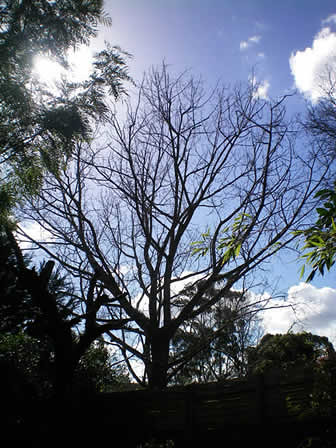
What was once a very leafy environment is fast becoming dominated by artificial structures, and I ask that this particular tree, so important to the amenity of our house, and all those backing onto the Russell St property, be preserved. Though deciduous and currently leafless, it is a spectacular, inspiring sight in the Spring/Summer months and, hopefully without sounding too overblown, we would deeply mourn its passing.

Monash Council prides itself on its environmental values. Here is one instance where it can act to help preserve the environmental integrity of an area in which the greenery is fast being depleted by development. The block bordered by Foster’s, Stephenson’s and Waverley Rd is undergoing a level of new construction unprecedented in my memory and few trees appear to be being saved - in what until recently has been a very green zone.

Secondary to the case I have stated above, the tree has importance of another nature. Some years ago, the son of the previous owner, Paul Love, committed suicide, under tragic circumstances, hanging himself from the tree at issue. Paul Love was a childhood friend of mine, who lived a short troubled life in a troubled family, and the tree has a degree of memorial value, at least for me. Watching it being felled - by workers entirely ignorant of its history - would be a very sad experience.

To conclude, I have no objection to the construction of units on the site, but I feel very strongly that the tree in question ought to be preserved, not only for my own and my family’s sake, but for all the residents, and future residents who live in its abiding presence, for the general atmosphere and health of the suburb, and by extension the world.

Stumble Upon Toolbar DiggIt!

Thursday, August 7, 2008

~ red in tooth and claw

My small family succeeded in breaching the psychological barrier constraining movement beyond the city of Melbourne. We traveled east with Emely McCord to a region near Bairnsdale and a house of mud brick and galvanised iron occupied by her mother Tosie and her younger brother Kyowa.

Inevitably, when Tosie sees Kyowa playing with Polly, she smiles dreamily and says, “They will grow up to be lovers”. Her tone… sounding not like a prediction… but a natural truth…


In recent years, the Rainbow Lorikeet has become common in my zone and I am continually surprised by the beauty of its plumage. But I had forgotten that the Eastern Rosella can be equally as striking - and there were plenty of these at Tosie’s, perched along the barbed wire fences, coats plumped up in the cold. They are tremendously beautiful birds.


Also, there were Welcome Swallows, darting and weaving over the bracken and the long dry grass, snatching up insects on the wing. Such is the manner of its flight, it is almost impossible to get a decent look before the bird spirals, dives or immelmanns in precisely the least expected direction. They flutter more than fly, like supercharged butterflies.

[If it isn’t obvious by now, I’m engaged in a bird obsession. I can tell you that in the wetlands adjoining the Grey Creek there are Purple Swamphens, Eurasian Coots, Pacific Black Ducks, Chestnut Teals and Dusky Moorhens. In the habitat at the end of the street I’ve seen Australian Wood Ducks, Laughing Kookaburras and Crested Pigeons. In our yard, somewhere high in a huge peppermint gum, there is a Tawny Frogmouth and in a park not two kilometres distant, so it is said, there resides a Powerful Owl.]

Walking through the fields surrounding Tosie’s property, we encountered the deep workings of dour wombats, the skeleton of a cow and the freshly dismembered carcass of a wallaby; [on the end of one bloody, discarded leg, there was a talon worthy of a velociraptor].


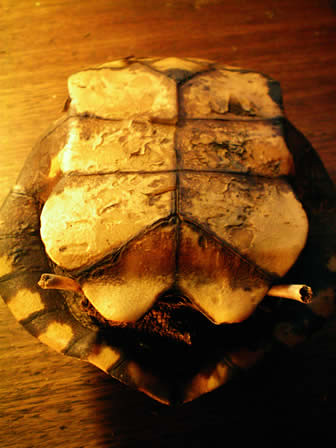
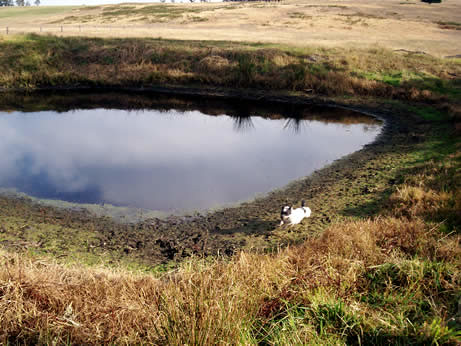
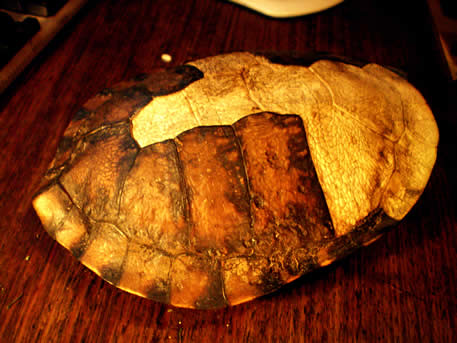
By a remote near-empty dam, we discovered two turtle shells, not far from each other. Each was about six inches in length. Desiccated leather curled away to reveal sutured white bone. Little white stumps extruded where the legs and head had been. Naturally, we brought them back home.


“Oh, you found those guys,” was Tosie’s reaction.

It transpired that the turtles had a history.

Emely had been first to discover them, shortly after their demise. Tosie had passed by their remains more recently.

Now, the important thing about Tosie is her deep affinity with Nature. She is in league with it, coiled within it, witness to its cryptic secrets. When she speaks, she sometimes sounds like a flaked out hippy, but her understanding of the bush and its underlying principles is profound. One would be foolish to discount her opinions on the subject.

I asked if the turtles - akin to some testudinal Burke & Wills - had almost made it to the dam, only to perish on the brink. Or had they died shortly after departure?

Drought in the region, Tosie explained, had caused the few remaining bodies of water to become overcrowded. With turtles. Conditions in the dam would have been very poor. Few resources. High levels of disease, toxicity. Our two ill-fated specimens would have been asked to leave by the others. To find somewhere else, or die. To sacrifice themselves for the survival of the community.

“Do turtles mate for life?” asked my wife, characteristically.

“I don’t know,” answered Tosie.


“What language did the turtles use?” I asked.

“The language of the forest,” answered Tosie.

Immediately, I thought of M. Night Shyamalan’s The Happening. And of The Swarm by Frank Schätzing.

I accept that it is within the realm of possibility for the forest to have a language, and certainly I would like it to have one …

Subtle chemical signals in the currents of the air, passed from leaf to caterpillar, from wombat bolus to dung beetle and thence to the blind nuzzling head of the earthworm …from gnarled parrot beak to witchetty grub … from pollen cloud to the tarsal combs of the bee … from diatom to rotifer to amoeba … from water-skimming spider to - at last - the murky consciousness of the turtles.

“Honourable citizen of the terrestrial biome. It has fallen to you [and your husband] to make the ultimate sacrifice.”


A signal, a demand, an imperative to which all creatures submit, which every organism, sentient or not, may interpret. To actually term it a language may be a superposition of our own thought patterns over something very different. Anthropomorphism may be the applicable word. Perhaps, the turtles were subject to something more simply described as the law of nature, red in tooth and claw.


The following week, Polly took one of the turtle shells to school for show-and-tell.
Doing her best to explain ‘the language of the forest, my wife penned a short explanatory note for Mrs Hobson to read aloud. I sealed the shell in plastic, predicting a possible violation of Education Department hygiene strictures. Indeed, it was redolent with ongoing decay and I didn’t want to unnecessarily put the children off turtles. Perhaps forever …

ps: Tessie, the little dog in the picture of the dam, was run over and killed a week after we left. She had gotten herself under the wheels of Tosie's car as it backed out the driveway. Tessie was one of the sweetest dogs I think I've ever met.

Stumble Upon Toolbar DiggIt!