
Pages

Showing posts with label Addiction. Show all posts

Monday, March 24, 2008

~ the legs of the mighty

Days pass. Little changes. I clutch at my routines as if they are all that prevents my fall into the abyss.

Since I’ve been attempting to correct my financial situation by selling on ebay, I’ve had to actively search for stock. Books. My wife is incredulous about my need to keep buying, when the house is littered with ziggurats of piled books. She doesn’t understand. Those great mounds are composed of incomplete trilogies or series, which I am waiting to complete. You get a better result that way. There are also an awful lot of books on which I’m undecided. They look like they might sell… but I need to do a little research… and rarely do I have time… What I really need is have a market stall to clear everything out…

Then there are the books I want to keep. Every time I’ve abandoned or sold my library down the years, I’ve bitterly regretted it. I feel peace in a house full of books. A library has an aura, it emanates a gentle bookish radiance. It is a great seam of potential, there for the realisation. I love scanning shelves, head tilted sideways, waiting for a title or author’s name to leap out at me. I love it most when the books are mine, and I know that every one of them was chosen for a reason. I love having so many books that I can’t keep track of them. I love being surprised by what I’ve forgotten.

But, of course, it’s also a burden. A great weight of material for which I am responsible and which I must keep in order. At present there’s anarchy. I have nowhere near the amount of shelving I need. My ebay stock bleeds through my personal collection. The kitten knocks over the teetering columns, and time turns my neat arrangements into kipple.

I didn’t mean to talk so much about books.

Currently, my wife has a debilitating virus. Of course, I’m suspicious, but my instincts are telling me it’s not the kind of ‘virus’ one gets from consuming too much [or too little] of the soporific honeycomb.

Indeed, she’s been reasonably controlled of late. I believe I have managed to expunge the Romanian’s phone number from her phonebook – though in the past he has shown a nasty tendency to ring out of the blue, just because ‘he’s in the area’. Thankfully, without his number, her ability to ‘just pop out for a second’ is massively reduced.

Strangely, with the easing of my own enslavement to drugs, I find it increasingly difficult to ascertain my wife’s state. I have hacked my way clear, I think, to another plane, where priorities and potentials are very different. Perhaps that’s why my first knowledge of any flare up on my wife’s part comes only when the problem has gotten out of hand. Mind you, she is now on a mind-numbing dose of Spasmo-Dromoran - meaning she needs a hell of a blast of high-grade honeycomb to become visibly stoned. She openly admits feeling little or nothing when she does it - so why does she do it? Such are the mysteries of addiction – though needle fixation and simple habituation I’m sure play a part.

But trust is a problem. Since I can no longer rely on my senses, I find myself automatically assuming the worst, assuming that any explanation is a lie, that any trip to the supermarket is a scoring expedition …

*

Depending on luck, Camberwell market can be a good place to find the kind of books I sell. I’ve taught myself to ignore the things I might be at risk of purchasing for myself, [ie stuffed animals, general grotesquerie], and concentrate on my task. It’s frustrating how prices vary. One or two dollars is the normal market price for a paperback, but there are stallholders who charge over ten…

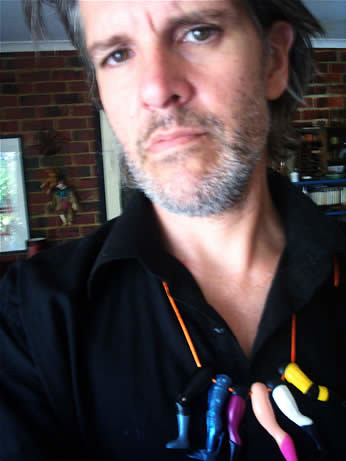
Yesterday was the first time in ages I’d been at the market. I encountered two faces from Erin and Hendrik’s wedding – Kerry and Linda – working a small conceptual jewellery stall. Seated comfortably in the shade with drills, snippers and glue they do all their work on site, creating freaked-out accessories from materials sourced only at the market itself.

They were kind enough to present me with a necklace recombobulated from the legs of plastic superheroes.


Stumble Upon Toolbar DiggIt!

Saturday, February 2, 2008

~ hark! a fusty old cupboard moth!

In the latest episode of Counterpoint on ABC radio there is an extraordinary interview with a sententious old arch-conservative named Theodore Dalrymple, [a nom de plume. His real name is Anthony Daniels]. He is interviewed by global-warming sceptic and ‘right-wing Phillip Adams’ Michael Duffy on a programme that sprang from the Howard government’s push to dilute the perceived leftist culture of the ABC. Dalrymple himself is aligned with the Manhattan Institute, a US conservative think tank, and his ideas are frighteningly atavistic.

For fourteen years, he has been treating addicts in British prison hospitals and feels the need to speak out regarding certain myths which he believes are misleading public policy on drug treatment.

In his book, Romancing Opiates, he argues that opiate withdrawal is neither severe nor dangerous and ‘not much worse than the flu in a healthy person’. He claims to have seen long term addicts stop using with ‘no adverse effects whatsoever’.

I must admit, from personal experience, that the fear of physical withdrawal has sometimes been worse than the experience itself. Nevertheless, the night sweats, the horrific dreams, the bone aches and muscle cramps, the misery, the whole body discomfort, the crawling skin and mind-fucking restiveness add up to something a considerably worse than your average flu. And from what I have heard of others’ experiences, I can count myself lucky.

I get the feeling that Dr Dalrymple has been taking blood pressure, checking body temperature and a few other gross physical indicators, then using these to understate and oversimplify the condition. However, I do agree with his contention that the physiological aspect of withdrawal tends to be overstated in popular literature.

When asked where these exaggerated ideas about addiction and withdrawal came from, he moves into a scathing attack on heroin-related literature. ‘Self-serving liars’ DeQuincey and Coleridge began a trend that has continued without pause ever since. William Burroughs [a ‘psychopath’ and ‘obviously a bad man from the beginning’] is singled out. We hear of films like The Man With The Golden Arm and more recently Trainspotting.

I have no difficulties with the claim that certain works of art attract people to drug use. How can I disagree? I am one of those people myself. I have seen many people acting out their romantic fantasies in heroin addiction [again, myself included]. I have even heard many people claiming to be addicts who weren’t. I suppose it is one way of getting a life, of defining yourself - as something dark, forbidden and dangerous.

But to generalise the function of art and creativity, as he does, is weasel work. Drugs have historically played a part in artistic creation, contributing to some of the greatest works of the human imagination. In much the same way as they are used in Shamanic religions, drugs have inspired and guided certain artists and thinkers. Creative types are far more likely to experience manic depression and other ‘personality disorders’, art can be their expression and their release and our benefit. The use of drugs and the description of drug use by arts contributes to a very complex social equation which cannot be effortlessly explained away in a slow reasoned tone by the fusty old Mr Dalrymple.

As regards the question of how heroin withdrawal, [and addiction generally], became so exaggerated and feared – I would answer it rather differently. Throughout the twentieth century, manipulation of the drug issue was systematically used by politicians and other leaders in the USA to stimulate fear in the community. Again and again it was evoked to distract voters from embarrassing scandals, to paint candidates as uncompromising, and to prepare the public for more draconian control. It has even been selected as an issue by politicians who had nothing else with which to characterise their campaigns. Because drugs were railed against repeatedly down the decades, the effect became cumulative. Heroin entered the mass subconscious as a ravening demon. Parents became terrified for their children. The meme became self-sustaining throughout the world – and an element of it was the nightmare of withdrawal. Certainly, the popular arts play their part – but the buck really stops in the corridors of power.

After evoking Quincy and Coleridge, Dalrymple speaks of how the overwhelming majority of addicts are from the undereducated lower class. There are problems with this contention because it’s really an assumption. Nobody knows the figures. Poorer addicts are the most visible addicts; richer addicts can hide their usage. But how many of this underclass [or the general population for that matter] have read or even heard of Coleridge or Burroughs? There is not much awareness of the classics out there. How else could a bed sold for little girls at Woolworth’s in the US have been branded a ‘Lolita’? If they are influenced, it is by very different media in which the idea of drug-related illumination of the mind and spirit is absent.

Though not everything he says is rubbish, it is all painted with a tone of condescension. He makes the point that people from desperate circumstances often turn to addiction as a way of filling their lives, and indeed ‘the life of an addict is full of incident…. In a sense it imposes regime and routine; they like it, dismal as it is.’ Well, as they say, children crave structure. I think Mr Dalrymple should think further on this point; youths in desperate circumstances are not just being drama queens in taking heroin, sometimes it offers some sweet respite from an unendurable reality.

Heroin does of course impose a routine. With an iron fist. ‘The Algebra of Need', as Burroughs would put it. [‘Burroughs was a criminal long before he became a Junkie’.]

Not that I’m advocating this, but Mao Tse Tung was the greatest therapist in the history of drug treatment because he threatened to shoot people if they didn’t give up – and lo and behold twenty million people did give up.

Dalrymple goes on to say that this wouldn’t work with, say, bowel cancer; seeming to think this proves that addiction is a choice, not a disease.

Because addiction to a large degree is rooted in the workings of the mind, it is not disqualified as a disease. You cannot divorce the body from the head. A lot of very complex changes occur in the brain of an addict, physical changes which researchers are only beginning to understand. Dalrymple, the old cupboard moth, is attempting to turn back the tide on our evolving comprehension of a very complicated condition. He views are deeply right-wing, immediately appealing to the conservative thinker. It is the addict’s fault. He can stop if he wants. He chooses to commit crimes. And elite arty-farty types are responsible for all our misconceptions ….

I’m not wholly against rehabilitation, as long as it’s understood it’s not a medical procedure. As long as you don’t treat it as an illness.’ He suggests some form of ‘asylum’ in which the recovering addict can build up their lives again after the wasted years. Again, he shuns the idea of addiction as a disease – a concept that our best informed practitioners have spent decades working to illuminate in the public eye, and to include in social policy.

He coughs up a number of other hot potatoes. He claims ‘the inclination to criminality causes addiction, not the other way round.’ He has learnt from prisoners in jails that the vast majority of addicts were criminals long before they turned to heroin. [He did not say anything about whether it was in jail that they began taking it.]

He tells us it is a myth that drugs are filling our prisons. I’m no expert on this, but I feel strongly about legalisation, and I’ve known plenty of otherwise law-abiding people who have broken the law to feed their habits. I couldn’t begin to count the number of girls [and boys] I’ve seen use prostitution for the same reason.

My instinct here is that his contention is wrong, but again laced with fragments of truth. I also resist, even resent, his using the words addict and criminal in the same breath. There are bad thieving junkies in this world, and it’s sensible to beware of them. But there are those who would never in a million years commit a crime against person or property just for a fix.

Dalrymple is petrified in a previous age where mind and body were disassociated. He cannot abide the fact that addiction is holistic. It is true that the mind is a very prominent component, but that does not disqualify it from medical attention - it merely makes it harder to understand and treat. It is also a social disease, channelled and fuelled by inappropriate laws and attitudes, which the opinions of Dr Dalrymple can only serve to exacerbate.

God forbid this is the leading edge of current conservative thinking!

Stumble Upon Toolbar DiggIt!

Sunday, January 27, 2008

~ the high echelons

It seems that Heath Ledger had his problems with drugs. Well, so what?

As the information leaked out about his sad demise, one could sense the efforts, on one side, to play down the sordid elements. Scattered pills found their way back into the bottle. A rolled up note was found to have no residue. From the other side – that of the ravenous and voyeuristic – we learned that he had just left rehab, was battling addictions to heroin, xanax and stilnox, that he was distressed and sleep-deprived.

Tasty. But why do drugs so often become the centrepiece?

Well, some of us like to watch the mighty descend into the abyss. It reassures us to learn that they are as weak and as freaked out as us. It makes us feeler closer to them. And, of course, we love scandal for its own sake. That’s simply in our nature.

We’re ghoulishly curious when it comes to the stars – those public assets in which we all have a stake. Every detail of Ledger’s death scene has been described in the media, interpreted, analysed and spin doctored by publicists. But with the mention of drugs our interest ramped to a whole other level. This betrays us, just as drugs betray the personal struggles of the famous.

During the Heath Ledger coverage, I read the comment that fame is a sort of mental illness. Perhaps the sensitive, troubled Ledger turned to drugs as a way of self medicating this illness. Perhaps that’s the reason so many celebrated people do take drugs.

It’s like having Alzheimer’s Disease. You don’t know anyone, but they all know you,” said Tony Curtis. But that’s just part of the story. There’s pressure, stress, loss of freedom, alienation, loneliness, and a tendency for people to become friends with your fame, not with you.

In David Gritten’s book ‘Fame’ he claims that ‘celebrity behaviour is rooted in a type of personality disorder’. Histrionic Personality Disorder to be exact, defined as ‘a pervasive pattern of excessive emotionality and attention seeking’. Some of the symptoms are the ‘display of rapidly shifting and shallow expressions of emotions’, behaviour ‘being directed towards obtaining immediate satisfaction, with no tolerance for the frustration of delayed gratification,’ and ‘a style of speech that is excessively impressionistic and lacking in detail [e.g. when asked to describe mother, can be no more specific than “she was a beautiful person”’.

You have your Britney Spears, and her sordid public fall from innocence. She’s a red raw case of the fame disease. You have all those actors – Owen Wilson, Steve Coogan, Brad Renfro, River Phoenix, Robert Downey Junior etc., who have or have had relationships with heroin. Musicians in even greater numbers, writers too, models and sportsmen. And I’m not including cocaine.

It’s so rife, this affliction of our idols and role models, that ‘rehab’ has somehow evolved into a pretty cool concept. In the hip crowd, among the high echelons, and on the press release, well it’s getting kind of groovy, isn’t it?

It would be good to shrug off the prejudice and the stigma associated with drug use, but that’s not really what happening here.

On one side you have the prohibitionists and on the other you have people who admire drug use in their heroes because it’s a la mode. Both are in error. And of all the reasons for taking drugs, imitating the beloved famous is one of the most insidious. I have a particular dislike for it because that’s pretty much what started me off

Hearing that an artist has a drug history, automatically perks my interest. Even now. I can’t help it. And I’m not the only one.

[No matter how great a song it was, I really wish that Lou Reed had never written ‘Heroin’.]

I won’t get into details now, but the creative soul is far more likely to experiment with mind altering drugs. Sometimes, it’s just part and parcel of the thing: the quest for new vistas, for an undiscovered viewpoint, for mystery – and sometimes the result of a painful sensitivity to a crass and blaring world.

It’s true. Often the most interesting ones are the ones who engage with drugs. And when they get famous, we imitate their behaviour.

And when they are infected with fame – well, that can push them deeper. The artistic temperament can be overfed, the ego may rear like the Whore of Babylon. Money and freedom and reputation can increase creative freedom, but expectations, fear of failure and commercial pressures can close it down. Doubts can arise over ones integrity. I’m not sure if Hollywood-grade fame is ever good for an artist, unless he’s one of the few that it actually suits.

Give me Emily Dickinson any day.

The reputation of Heath Ledger will not suffer by his exposure as a drug addict. People will understand how sensitive an artistic soul he was, how troubled, how he missed his daughter, and was deeply disturbed after immersing himself in the role of The Joker. [a claim only a Hollywood actor could make, no?] Probably the only truly damaging revelation was that he was friends with Mary-Kate Olsen.

Lynne suggested that his lack of classical training may have been an influence. A lot of actors, these days, become so deeply immersed in a role that they cannot dissociate themselves. They engage in intense research, force massive weight changes, and wind up misplacing their sense of self. They don’t isolate a personal centre to keep themselves sane.

Anyway, what about the man on the street? Being exposed as drug addict is a entirely different thing for him, isn’t it? We don’t quite get the same level of compassionate understanding.

Our gods of Mt Olympus are not subject to the same laws as we. If they are revealed as drug addicts, we create a moving backstory with which to enrich their posthumous biographies [and the lurid pages of the gossip mags].

[And, by the way, how do they get these drugs? Do they see a doctor? Or is it all done by a PA? Do you think they get their hands dirty like the rest of us?]

There are also the prominent users who are never exposed in the tabloids; who need to keep it quiet and are rich enough to do so. But sometimes rumours filter down. James Packer and Laughlin Murdoch; tight friends who spent a good swathe of time on heroin. Kate Fischer got in on it too, it is said, and only when Packer divorced her and married ‘ex-escort’ Jodhi Meares did he clean up. [Scientology was a factor there too, it is said.] Then you have Elle McPherson, cleanest of the clean, who wouldn’t do a photo shoot unless the coke was laid on. It is said. And Sonia McMahon? Well it’s not relevant at all, but I’ve been told that before she became our first lady, she was an escort too. [I couldn’t resist putting that in.]

All ‘rumours’ of course, but among certain of the high echelons hard drugs will always be de rigeur. The modern aristocracy is isolated from petty considerations that the ordinary populace has to face – like. say, waiting for hours in dark carparks, or doing without for lack of money. Occasionally, the vices of a luminary will be bared to a voracious public, but again you’ll have the backstory and once more our considerate understanding.

Stumble Upon Toolbar DiggIt!

Thursday, January 10, 2008

~ the mind parasites

The human race, unbeknownst to itself, is under the complete control of a race of repulsive parasitic entities, who drink our mental energies and prevent us from evolving into super-beings.

Every few years, I find myself rereading Colin Wilson’s The Mind Parasites. I’m half way through it as I write. It’s a very odd novel. Unique. Genuinely peculiar. Badly flawed by any reasonable standard. But really interesting.


Wilson is a bone fide thinker. He first came to prominence with ‘The Outsider’ a philosophical work that established him as one of the so-called Angry Young Men of the late fifties literary scene in England. [John Osbourne [Look Back in Anger] was another of these].

But from that point on Wilson’s ideas grew stranger - though never any less well thought through or researched.

I became a fan after reading The Occult – the big green paperback that was half history of the paranormal and half philosophical treatise. Then I swallowed up his back catalogue and attended his lectures whenever he came to town.

[Allow me to diverge. It was John Murphy, the brilliant and arcane drummer of such bands as WhirlyWirld and The Associates who really put me onto Wilson. Now, John, at this time, had the most pungent odour problem I have ever experienced. I saved a seat for him at the Northcote town hall where Wilson was due to speak. He arrived, sat down and, slowly, one by one, the people around us began to relocate, creating a buffer zone of two or three empty chairs around the wellspring of an astonishing stench. I don’t know if John even noticed]

Wilson was perfect for me. I’ve always been a disappointed sceptic. I’m too rational to believe in superstition or higher powers but, nonetheless, I am drawn, inexorably, to the mystical and paranormal. Almost like Mulder: I want to believe – but not if the evidence is lacking

Wilson is similar - but he has reasoned his way into a conviction that there is a untapped reservoir of possibility in the human mind. In the realm of instinct and intuition. Or, in his words, Faculty X. He believes we are so immersed in the day to day, in habitual life that we can never realise our true potential - or find what the psychologist Maslow would call ‘Peak Experience’.

He has pointed a finger at the bicameral mind, suggesting that the two very different hemispheres of our brains are consistently out of sync, and that to bring the creative and the rational sides into harmony would force our whole lives into focus. We would see the beauty radiating from every moment of our existence. We would never feel tired. We would instinctively make the right decisions. And even have access to paranormal powers.

The Mind Parasites, on first glance, appears to be a shoddy little science-fiction paperback. It’s set in a very roughly drawn future in which there is rocket flight between continents and people holidaying on the Moon. Here, Wilson is a little like Philip K Dick; he uses a populist genre to present original, quite complex ideas.

Interestingly, it has a Lovecraftian edge too. The protagonist, Austin, an archaeologist, is an expert on pre-Hittite civilization and is digging in Turkey at a place called The Black Mountain. Impossibly deep beneath the Earth, he discovers a vast stone city built by giants and compares it openly with the cyclopean ramped cities of The Great Old Ones described by Lovecraft. Indeed, the book describes Lovecraft as a visionary, who has somehow accurately predicted the future. Perhaps The Mind Parasites ought be considered a peculiar, rather tangential addition to the Cthulhu Mythos.

Austin comes into possession of the papers of a colleague who suicided in peculiar circumstances. The papers describe a race of beings, not of flesh but mental energy, who, around the time of Beethoven and Goethe, took residence in the human mind and proceeded to control it utterly. These ‘Tsathogguans’ feed off our life force, preventing us from realising our true potential by deliberately nurturing depression and perversion. We are a slave race. The work of artists such as De Sade, described as warped in the book, are a direct consequence of the Parasite’s short-circuiting of our natural intellectual and sexual energies.

The book tracks Austin’s bizarre efforts to defeat the Parasites using Husserl’s techniques of Phenomenology. He trains his mind to fully understand itself – and in the process he and his colleagues develop parakinetic talents, telepathy, mind-control and the ability to sync up their consciousnesses. They come to live their lives as one continuous Peak Experience. In effect, they become super-beings doing battle with a cunning extraterrestrial adversary.

Though most of the book is either dissertation or situated deep within the mind, it is still a weirdly pacy read - as these urbane scientists try and ultimately succeed in convincing the world of this madness and then set about defeating it.

I do wonder about these Mind Parasites. It would explain a great deal. If they were real.

I know I have something lurking in the depths of my consciousness, advising me to do things which could have no conceivable benefit. I know I’m always tired. I know I have difficulty thinking clearly. And I can only guess when I last had a Peak Experience.

Could it be these Tsathogguans, who urge me go out and get on – despite the fact that the heroin experience is no longer a pleasurable one for me. Not only have I ceased to enjoy the drug itself, but taking it wracks me with guilt and makes me sick for at least a week afterwards. Yet the urges, the cravings continue – reasonlessly, with nothing but self-destructive intent.

Are the Parasites in residence? Deep in those murky waters? it would make sense.

That oleaginous voice begs most when I am at my weakest. When I am alone in the house and have money. When it’s a certain temperature outside. When I go to Richmond or St Kilda. When I see someone using on the TV. When I go to funerals, or to a band … At these times it is raised its loudest. It knows when I am vulnerable.

The craving voice, researchers say, is the result of a rewiring in the brain of addicted persons. No longer is the pleasure-related dopamine system in play, but the excitatory glutamate system. One uses not for pleasure, but to stop feeling pain. And later, when the whole issue seems resolved? The voice keeps barking out its hollow commands.

Perhaps I could counsel myself in the techniques of Phenomenology, enter the country of the mind and root out this babbling idiot who distracts me from my life? But if long habit has hard-wired it in, what am I to do? At least, if it was an malign alien entity, then I would have something obvious to fight.

And who’s to say that it is not?

Who’s to say The Deadly Spores themselves are not under malign alien control?

Stumble Upon Toolbar DiggIt!

Thursday, December 20, 2007

~ she had a dream

They have agreed that he should look after the money when it comes every second Wednesday – as the lure of the glistening honeycomb is too strong for her to bear. She loses control of herself too easily and surrenders to the dark vicissitudes of the Deadly Spores. She spends money she does not have. Money that ought be directed toward better purposes.

By Tuesday night, her mind is already probing the psychic net the Spores hold in place above the city. Her eyes are closed; she is seeking inspiration. How can his hold on the money be loosened? Can he be tricked? She hates herself for thinking this way. But it is not her thinking, it is the Spores, who have gained control of a section of her brain known as the nucleus accumbens.

On this night in her dreams there is a shallow puddle with a fish in it. And a rock. She turns the rock over to discover it is, indeed, an ancient turtle-like creature. Disturbed from its sleep of centuries, it begins to feed, voraciously, immediately consuming the nearby fish. Once satisfied it transforms into a different creature and begins to feed again, to grow again. This cycle is repeated, until she sees a monstrous pigeon approaching the house. At first, she is daunted by its terrible size, but then she consoles herself – it is only a pigeon and even if gigantic could not possibly be a threat. But then, she wonders, will it peck her family, unthinkingly, as it would peck at worms…?

Wednesday begins badly. He is busy with his work, but must also distribute her money quickly before he is outsmarted. He is tense because he is fighting a vast adversary in the guise of his lover; he knows she will leap at any hint of weakness, so he must be stern. She is tense because there is a battle inside her, and because she wants her honeycomb, but cannot get it.

Bickering breaks out, scattered flares of nastiness; she cannot control her tongue when she feels like this … he becomes frantic and cannot think straight …

But the day is a success. Almost all the money lands in the correct places, save a little that is kept aside for basic survival over the coming fortnight. He allows himself to relax. He walks the cat around the block with his daughter. He allows himself a glass of wine or two ... And then the Deadly Spores strike with the force of a hammer in his face

She wants honeycomb and now she will not let him keep it from her.

She becomes undeniable, yet he remains strong. He will not give her the food money. Or the the bill money. She will not accept refusal. She will not give up. He will not give in. The process takes about an hour, but the battle is lost when the first germ of desire enters his heart…

Ten minutes later, or so, he relents. They will share this vicious product of the spores … and ignore the consequences …

There is only one way I can do this, he thinks. I must become like steel. I cannot lapse. When the sweet voice of the Deadly Spores begins to issue from her mouth, I must leave and not return until I know am powerful enough to resist it.

Stumble Upon Toolbar DiggIt!

Friday, November 2, 2007

§ the junky dream


Once

I was lured, in a dream.
To that dark webbed territory
where pale, seeking fingers
offer sticky grey honeycomb
from the shadows.

Where sweet honey oozes
From the teat-like glands
Of vast slave creatures
in the shadows.

There I wandered.
Endlessly t
hrough the Devil's Hexagons,
Marveling at the abundance
And then was torn away,

Before I could taste.

To be be there again
To be torn away
Again.
And once again.


Each time more despairing,
More agonising than the last.
Each time my lips a little closer
to that atramental cup -
That poisoned mead
a little closer to my lips.

To wake, in sweat
From a dream peculiar to those
Devilled by their deadly master

A dream of wild goose chases,
Through striated city-scapes,
With treacherous collaborators,
And eyes staring from the ditches.
Slithering without limbs or hair,
Through a brown, hazy chaos,
Deprived of senses
Shrinking with panic.

Centipedes are milling on the powerlines
Polishing the copper with mucilage,
Bitter pearly drops, fattening
On the wires...

Rarely, do I have this dream today.
It is replaced by another,
Which wakes me as remorselessly,
Crabbed, in knotty sheets.

I am a powerless onlooker,
As she washes, barely conscious,
Upon those reasonless shores;
As she ventures without will,
Or strength,
Into those same starving marshes,
Into those same lethal mists;
Returning changed
And defiant:
Outwardly vigorous, inwardly helpless.

There is damage to her feet
From stumbling there,
From the stinging insects of the waste ground.
Crusts and lesions, bites and stings.
Wounds that become scabs,
Then falling leaves,
Which evaporate to sewer gas.


My paralysis is a nail through the heart.
And I feel the future dithering,
Truncating. Before me,
The beautiful machine in which her soul resides,
Spits and crackles
Shudders to a halt.
And by its slow ruination
Returns to the earth.

When the horizontal hold is lost,
Her body flattens to a slash of light.
When the vertical hold is lost,
She is a mote,
glowing,
that will take time to fade.

Stumble Upon Toolbar DiggIt!

Thursday, October 25, 2007

~ abnormal petting zoo

She has a dream in which she is half-fish half-slug half-horse. She is swimming around and around in an enclosed body of water, unable to escape.

The Spores are in abeyance, but the humdrum is coming into its own - and the humdrum has secret alliances with ancient demons. Now is a dangerous time, and - knowing she carries a neural implant that can steamroll her resolution at any time - I observe all things with great care.

I offer to look after her bank card, as she's getting paid the next morning. She complains that she feels like a child when other people look after her money. I stick to my guns. She suggests that we not pay off the Romanian tomorrow, but leave it a little while. I suggest that makes no sense. An argument ensues, and grows sufficiently intense to justify her spending the night at her mother's. I am left alone watching Blades of Glory, confused, miserable and unable to stop myself laughing. When she arrives home the next day, she reveals that she has her period. She admits that she was worried by her behaviour, thought she was actually going mad - but realised, thankfully, that it was only PMT, a condition that can affect her strongly.

- It's amazing what hormones can do, she says.

Later, I will find out if this entire scenario was a carefully drafted plan to facilitate a monstrous licking of the deadly honeycomb. Would she engineer an argument like that? Endanger the relationship? Just to seek traffic with the Spores? Am I paranoid? She is still asleep at 10.30 - a worrying sign. We shall see. ...

With Polly, I rode the train into town to participate in Children's Week festivities. The only thing of merit was an above average petting zoo. A penned in area lined with astroturf, teeming with highly exited children and resigned, almost soporific animals. I picked up a baby chicken for Polly when another set of little hands expertly divested me, briefly manipulated the chick, then threw it into the plastic yellow wading pool that was home to a turtle - a turtle whose head remained extended throughout the ordeal. What turtle would not take advantage of its natural abilities in such a perilous environment? A drugged turtle? A diseased turtle? Whatever. I plucked the chicken from the water.

Later, as I closed my briefcase, an official checked to see if I was stealing a bird or animal. I explained that a goat had been eating my papers. Polly really loved the rabbits. I liked the turkeys. I was kicked by a small cow.

Thinking about it, there was something off-beat about that petting zoo. There in the wildly post modern Federation Square Atrium - enslaved beasts; brought to the heart of Man's empire to be fondled by his young. Regard these creatures, any of you who doubt that we are the dominant species. We are superior to these guinea pigs in so very many ways. This turtle has developed none of the magnificent technologies we have. Our social structures are vastly more complex than anything these gobbling turkeys have in place.

Later, Polly told me that she had never seen a clown. Would that this state of purity shall last.


Stumble Upon Toolbar DiggIt!

Thursday, September 27, 2007

The Secrets of NuVanilla

After thirty grueling years, the war effort finds me drained spiritually and financially. Once, my writing - even my acting and singing - were decently lucrative concerns, (and may be again, some day,) but as the conflict has broadened, and with the addition of Polly to my life, I have been unable to work as once I did. I have scrabbled for cash, once even resorting to the delivery of printed advertisements to the inhabitants of my Zone. Over time, I have found that my fair knowledge of books and their value can provide an intermittent income - which the appearance of Ebay has enhanced, and which, combined with my veteran's pension, can allow my family and I to subsist.

I have told you of the awful troubles that befell Jenny over the weeks she spent unprotected in South Melbourne. By now you must understand that I simply cannot afford to take my eyes off the enemy in order to make money. Yet, sometimes fate does lend a hand and one day, some years ago now, while gloomily trudging the aisles of a local
supermarket, I found myself the subject of inspiration.

Idly, I was scanning the shelves containing herbs and spices, when my attention was caught by a cellophane package containing a single pod of vanilla. The price - in the region of five or six AUD - surprised me. I had not known that vanilla was such an extravagance. And the essence, I wondered next? It transpired that the store stocked only the ersatz vanilla essence - the authentic product being, perhaps, beyond the means of my local demographic, or else too precious to thusly render down.


I sensed opportunity and researched the subject. I learned why fruit of the hermaphroditic vanilla planifolia, a tropical life-form native to Mexico, commands such prices in temperate Melbourne. Then, with the assistance of Robert - the scientist who works in our car-port - we stripped down its genome and shrewdly altered its phenotype - employing techniques I would be a fool to reveal here.

Consequently, I now can supply the needs of my community with a cheaper product that is not only superior in size and vanillin-content, but also a pleasurable CNS stimulant. Though it has some addictive properties, they are mild, on par with caffeine, and, of course, are a useful inducement to purchase. NuVanilla has proved popular with the consumers of my Zone, and allows me to conduct my war efforts in some semblance of comfort.

On another subject, the redemption of my wife goes well, and, though she has yet to return home, her mother, Diane, is now present to protect and nurse her. (Diane and I have formed many a united front over the years, and - though she can be slow to recognise infiltration and is sometimes overly credulous to the wiles of the Deadly Spores - all told, she is a better soldier than I.) The extent of Jenny's recent defeat is becoming more apparent as further bulletins arrive from the front. Doyle, I have heard, claims to have secretly observed her in the company of known collaborators: sly and abhorrent creatures, feared for their blind greed and careless cruelty. I shudder at the extent of her fall. If this was a less complex war, I could act precipitously, drive these vermin out with main force and drag my wife to safety. This I would dearly love - but the Black Spores are subtle, and often a head-on attack will rebound re-doubled upon the attacker. If I am to have victory, for my family, for my friends, I must too be subtle.

Stumble Upon Toolbar DiggIt!