Pages

Showing posts with label MARIJUANA. Show all posts

Sunday, April 6, 2008

~ the curing

On Sunday at Camberwell Market, feeling wretched and foolish, I lost a beautiful facsimile edition of Poe’s Tales. Just mislaid it. As I do so often with so many things. Twice I’ve left my phone on the roof of my car. I’ve left my coffee there at least… on a googolplex of occasions. Like my mother – even in her non-declining years – I put inappropriate things in the fridge: TV remotes, laundry powder, money, bills, scissors, face cream, turpentine … I could never remember all the things I forget.

Is it dementia? My mother exhibited signs before she died at the age of seventy-two, but she’d been putting shoe-polish in the Frigidaire even when I was small. I haven’t started doing crosswords yet, trusting that my line of work provides sufficient neural exercise. I just hope that my chronic absent-mindedness is not a symptom of something dreadful on the horizon.

I was at Camberwell Market, wasn’t I? Losing things … Becoming disheartened … After all, I was there to make money, to find books to hawk on ebay, not to leave lying about. Because of the daylight savings shift, I arrived early and didn’t have a good morning. Stall-holders were still hoping for the prices they’d imagined.

For me it’s best to go after I’ve metabolised my Spasmo-Nemigron, after my system has normalised. Then I can enjoy the process.

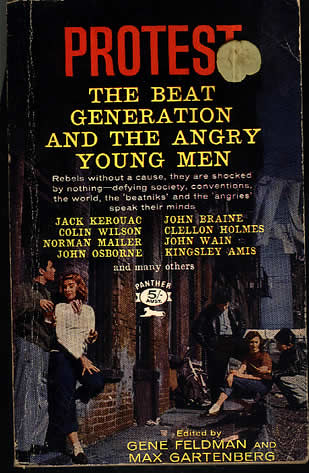
I found one particularly interesting thing: an old paperback in good condition called ‘Protest: the Beat generation & The Angry Young Men”. These were ‘rebels without a cause, they are shocked by nothing – defying society, conventions, the world, the ‘beatniks’ and the ‘Angries’ speak their minds’.


A bit iffy, comparing these two movements. The Beats were something wild and new, the Angry Young Men were comparatively polite and, well, British. Colin Wilson was the only truly interesting one, and mainly because of his marvellous erudition and his ability to present his subversive ideas in a manner that didn’t too badly offend public decorum. He was not tearing at the very fabric of society as the Beats most assuredly were. The other ‘Angries’ – John Braine, John Osborne, Kingsley Amis, J P Donleavy – were distinguished writers, but we certainly don’t associate them with literary revolution. Indeed they appear starchy and wan compared to Burroughs, Ginsberg and Kerouac, who were the principal Beat contributors.

The book was published in 1960, early enough for William S Burrough’s contribution to still fall under his original nom de plume ‘William Lee’:

A scion of one of America’s most illustrious families, he has not transgressed against established law because of poverty or lack of personal opportunity … Yet ‘by his own description, the author is a drug addict, thief, pusher and pimp.

What follows is an except from his first novel ‘Junkie’, [later to be retitled ‘Junky’]. It’s been ages since I last read it and I encountered a short passage that piqued my curiosity …

“To me, teaheads are unfathomable.

“There are a lot of trade secrets in the tea business, and teaheads guard these trade secrets with imbecilic slyness. For example, tea must be cured, or it is green and rasps the throat. But ask a teahead how to cure weed and he will give you a sly, stupid look and come-on with some doubletalk. Perhaps weed does affect the brain with constant use, or maybe teaheads are naturally silly.

“The tea I had was green, so I put it in a double boiler and set the boiler in the oven until the tea got the greenish-brown look it should have. This is the secret of curing tea, or at least one way to do it.”

I’ve also noticed a certain mythology associated with the curing of pot. It is always spoken of vaguely; one can never get clear answers, yet some will claim it is of critical importance - but as far as I have been able to judge all that is necessary is to let the vegetable matter dry slowly and naturally in a well ventilated room. Upside-down is good, as the leaves dry to form a natural protective sheath for the delicate heads. Various subtle techniques can be employed during the drying, but in the end they make little or no difference, [although practices like ‘sweat-curing’ can help speed things up].

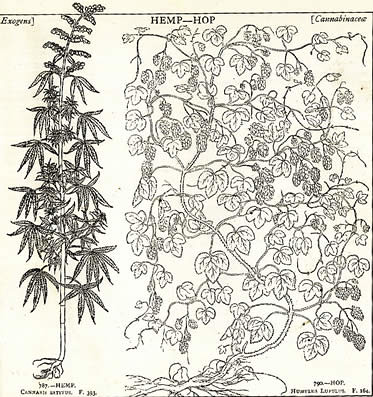
So That’s all there is to it. No great secret. Curing is more or less a synonym for drying. People also speak of immersing the root ball in a sugar solution, but that’s just piffle on a level with the very tempting myth that hops, a near relative of cannabis, can be grafted onto cannabis rootstock and made to produce THC – so creating the appearance of a perfectly innocent, legal crop.


During WW2 the US Government attempted to create a ‘cannabis strain that would yield a superior quality fibre … that would tie up ships without turning on the troops’*. A man named H E Warmke was front-man for the project, which also unearthed a useful means of producing polyploid plants by soaking seeds in colchicine [the toxic derivative of a beautiful flower bulb]. It was Warmke who claimed that hop flowers grown from cannabis roots contained equal levels of THC to standard weed.

A pipe dream, if ever I heard one

* From The Connoisseur’s Handbook of Marijuana
Stumble Upon Toolbar DiggIt!

Tuesday, December 11, 2007

~ the land of the free

An interesting story has come to light thanks to my friend the lustrous Emely McCord, pictured below.


Just two weeks ago, her sister Annie was travelling in Canada with her boyfriend Jim. They had crossed the border from the States and were attempting to return when they ran into a little strife.

Since they looked like a couple of unscrubbed, long-haired hopheads, the border cops singled them out. Because of her dual citizenship [Aust/US], Annie was partially protected, but Jim, an Australian, was subject to the gamut of intrusive search techniques – he was stripped, x-rayed and probed; the van too was inspected, then their luggage.

When it came to contraband, they were clean as a whistle - but certain incriminating photographs were found in their possession. Officials identified the pair in various poses - cavorting, gambolling and generally showing off in the presence of a large, vigorous crop of cannabis sativa.

Annie and Jim explained that, prior to their journey to Canada, they had done some work in California, picking medi-marijuana for the pharmaceuticals industry. But their explanation fell on deaf ears. These authorities, I was told, were paid by the arrest. Annie was cut loose, but – despite all their protestations – the full force of zany American law enforcement descended like an anvil on poor Jim.

He was handcuffed, clothed as a felon and locked in a badly-ventilated metal shed with about seventy-five others. And it was scary in there. A guy was using a bottle top to carve bloody crosses into his forehead. And when the lights went out, these crazed, disorientated individuals began to fight, uncaring of who they dragged into the affray.

Jim had no recourse. No lawyer. At that point, he might as well have disappeared from the face of the Earth. Annie could find out nothing.

At some point, he was transported to an immigration detention centre in Tacoma, near Seattle, Washington State - which from its description sounds very similar to camps in Australia which the new Labor government has promised to dismantle.

His original garments had been confiscated, presumably as evidence, and he was provided with what Emely described as op-shop clothes [‘thrift shops’ in the US]. Second-hand jocks, sandals four sizes too large. And after the first laundry run, he was left with a single sock, no t-shirt and yet another pair of used jocks.

Once a week, they were allowed two hours of sunlight - to walk around a small fenced yard in imitation of exercise. Every day at five they were served gruel.

One guy had been there two years. He had arrived in the US legally when he was four. He had grown up there and now had a house, a wife and kids. But after a minor change in the laws, some forms had been sent for him to fill. For some reason he had not returned them and, in time, the police arrived on his doorstep and dragged him away.

Reminiscent of the last few years of Australian Immigration policy, no?

Jim was in custody for ten days before he managed to borrow a phone card and contact a lawyer. The lawyer put pressure on his case worker and the wheels began to grind. [His case worker had 199 other clients]. Jim, as you would expect, just wanted out; he acquired a ticket home and begged for what they term rapid deportation. It was granted, along with a ten year ban from entering the USA.

He was outfitted in a classic US prison uniform with something like ‘State Penitentiary Victim’ printed boldly on the back and taken to LAX. Officers led him out onto the tarmac - fully visible to the public through those wide windows they have at airports - and removed the manacles just prior to his boarding the flying kangaroo.

Makes you even more wary of visiting the US, doesn’t it? Makes you wonder if Ruddock and Vanstone and Andrews were following the example of the Americans when they ramped the severity of our immigration laws. Of all the countries to imitate! September 11 really let the dogs out, didn’t it?

Stumble Upon Toolbar DiggIt!

Sunday, October 28, 2007

~ a hostess of unalloyed magnificence

Often, you have no idea how entangled you are with humdrum of daily life, until you step outside it. I've just spent an elysian weekend in Shoreham with Polly, Jenny, and various components of her family.

Jenny's mother, Di, recently sold her half share in a house down there, which had been in the family since the Seventies. It's been thoroughly renovated since, but still retains its special charm and its healing properties. We had only one night, but it did the trick, releasing the sour stale air from the grossly over-inflated balloon that was my soul.

The artist Joy Peck once owned the house and left her mark with a half dozen beautifully painted windows and a fridge that beggars belief it is so lovely - even if it no longer operates. Joy is very ill now, closing on an end to her earthly residency.


Di is a hostess of unalloyed magnificence. Ostensibly in celebration of her daughter Sarah's birthday, she prepared an extraordinary feast - prawns, trout, chicken - which in combination with alcohol & THC made for an evening of refined decadence. [In stark relief to the other coarser kind.]

Most of us wandered down the seaside track afterwards. It was a black night lit only by stars and a small white dog. I talked to Polly about the stars. About the planets that orbit many of them. About the alien civilisations that must exist out there, but which we will probably never meet.

- There's always astral travel, offered Jenny

Polly was frightened of the dark and we took the opportunity to explain that everything was the same as it was when we'd been down there earlier in the day - except there was no light. She told us she had once seen a 'skeleton with red' in the dark. Then we explained how the imagination can create monsters from the shadows of trees and branches... You forget what a young mind might or might not know. It's awe-inspiring that we are the ones gifted with the responsibility of educating her.

And then I think of the ecclesiastical vermin in the US who indoctrinate their young with creeds of fear, hate and mindless obedience ...

On that same walk, I thought I heard an owl. I went to say - that's a powerful owl - but I thought again and went to say - that's a boobook owl. What I actually came out with was - that's a powerbook owl. Jenny told me it was a seagull.

Over dinner, Di reminisced on the subject of deluxe cigarettes. She spoke lovingly of a brand named Passing Clouds which her husband had once smoked. They were oval, rather than cylindrical, and came in seductive pink packaging. She believed their provenance to be Greek. Her daughters spoke of gold-banded cocktail Sobranies with their delicate pastel shades of blue, green, pink and yellow. I remembered the filtered Gitanes I use to smoke, the swirling blue figure of the gypsy on the packet. Luxury cigarettes aren't what they were, at least where I live. Perhaps it's my age, my level of jadedness or my social status, but more likely it's the new outlook on cigarettes as ushers of death...

Allow me to be corrected by a brief look on the web. In 2000, Treasurer,
'the world's most expensive cigarettes' were released in Britain at something like AUD40 for a brushed soft-metal packet of twenty.

Stumble Upon Toolbar DiggIt!