Pages

Showing posts with label THE GREY CREEK. Show all posts

Thursday, January 20, 2011

~ I try my hand at oding

Down at the Grey Creek, since the rain, there is a super-abundance of dragonflies and their smaller cousins the damselflies. In my experience, there have never been so many. They are hovering, flashing bolts of iridescence, almost surreal in their variety, like echoes from J G Ballard’s The Crystal World. They are hypnotic, suggestive of fairy tales, and cousins to the butterflies in that they bring fanciful unexpected colour to the world. At times, as I sit observing them, I feel a shimmer of magic, glimpses of another world briefly seen and then gone.

I’ve set about cataloguing them. Thus far, among the damsel flies, blue ringtails are by far the most common, tails striped with sky blue and black. There are common flatwings, a dark metallic green with a lightning bolt on the thorax, and tiny prismatic aurora ringtails. The most populous dragonfly is the tiger-striped tau emerald with its bold green face. There are blue skimmers. And red wandering perchers.

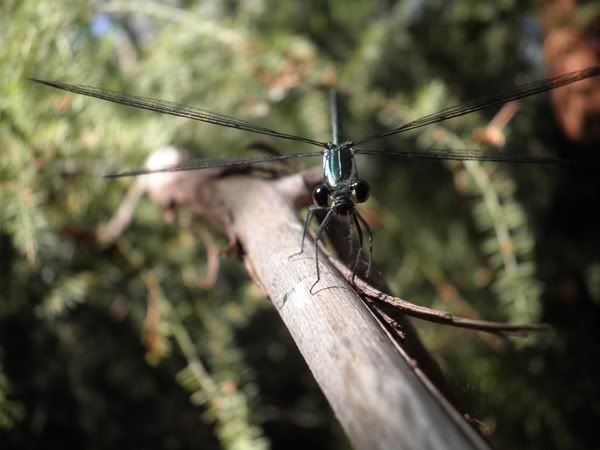
I’m beginning to see variations in their behaviour. Their mode of flight and their habits can be used to identify them, but I’m not quite an oder yet. Oder? Oding is the habit of dragonfly watching. Many of them flit by too fast for my eye to track (They are among the fastest insects) and few stay still long enough for a photo, but I lucked out with this common flatwing ...


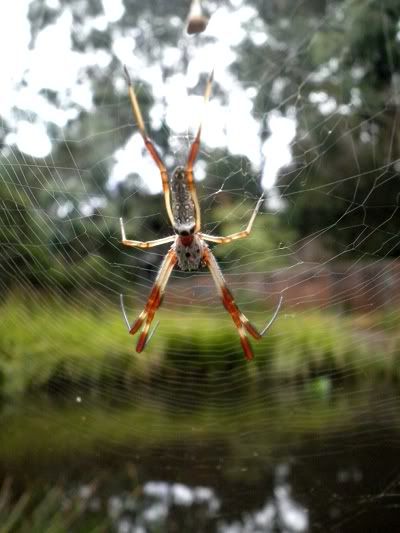
and this wondrous spider, which I’ve been unable to identify. Perhaps, if there is an arachnophile reading this, he or she may be so good as to shine a light on my ignorance ...?


Stumble Upon Toolbar DiggIt!

Sunday, March 21, 2010

~ intense psychological presences

The Huntingdale Wetlands, a small regenerated wetlands site which I pass on my near-daily walks, was host to a white-faced heron today. Last week there was a pelican and a pair of masked lapwings. There’s an old pied cormorant that perches on a dead branch extruding from the not too healthy water. There’s a family of superb fairy wrens near the dank tunnel beneath the freeway and a group of raucous yellow tailed cockatoos on the other side.

Apparently, the yellow flashes on the cheeks and tails of these cockatoos are explained by their having travelled, like Icarus, very close to the sun. I learnt this from the book of poetry I’ve been narrating of late, which happens to include an unusual amount of bird poems. Birds are the perfect subject for poems. Robert Adamson, the editor of this poetry book, The Best Australian Poems 2009, explains it in this way:

“I have a theory: we miss having poets among us who can imagine that a soul can ‘clap its hands and sing, and louder sing’, that we need to acknowledge visitations by intense psychological presences, and that birds are the closest things we have, more or less, to angels.”

Stumble Upon Toolbar DiggIt!

Tuesday, June 16, 2009

~ the passing of immaculata

I’ve spent much of the last three weeks writing an article on naltrexone implants. Too long for a simple article. I get buried in the research, and in polishing the text, and lastly in reducing the text by half because I inevitably write twice as much as what’s needed. I should be quicker by now, but I’m not.

Naltrexone is a drug that blocks the effects of opiates. Usually, it’s taken in tablet form by recovered junkies to prevent relapse, but there’s also a slow-release delivery module that is inserted under the skin and which can last months. It’s unproven and unsafe, but many desperate users are turning to it as a last resort. A lot of politics are wound up in this story, a lot of overdoses too, and a lot of infected incisions.

If you’re interested, the article will hopefully be in the next issue of Whack!, the magazine of Harm Reduction Victoria. Perhaps along with another article I’ve written on the shamanic drug ibogaine.

On the ornithological front, it is my sad duty to report the disappearance of the white duck Immaculata. She has been missing from the Grey Creek for at least a month now, and I fear the worst. The last few times I saw her, she seemed uninterested in food and I think she was already fading as winter descended.


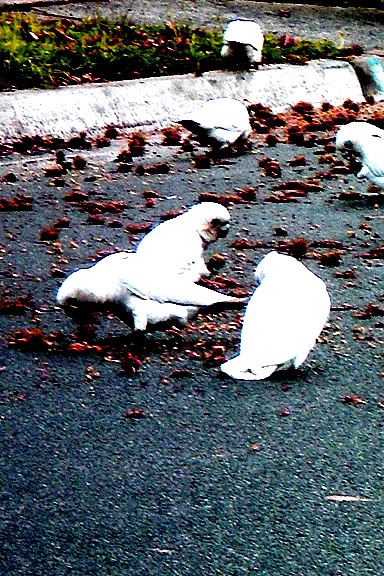
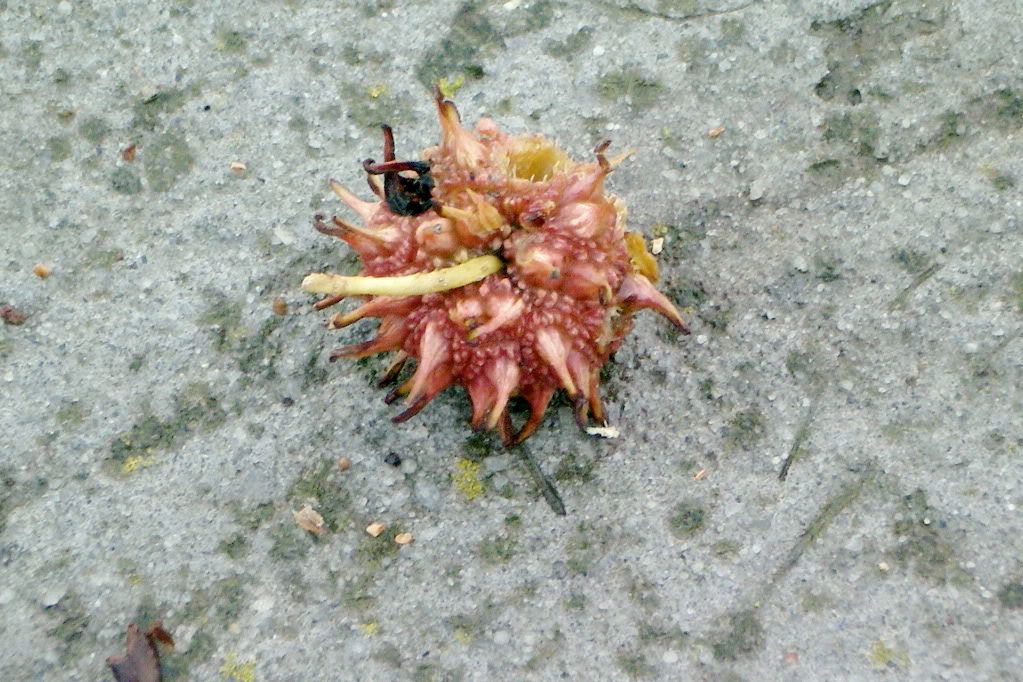
Lat week, there was a huge flock of sulphur crested cockatoos feasting on the spiky balls that fall from the liquid amber trees at this time of year.


But more exciting by far was my sighting of about a dozen black cockatoos by the grey creek. Identifying them has been hard.. There are five types of black cockatoo. Glossy black cockatoos don’t live here. They weren’t gang gangs. Red and yellow tailed black cockatoos do live in Victoria but I didn’t see enough colour to tell … It must have been one of these two.

The Sails of Oblivion Gig surges on. Dolores, the promoter is a force to be reckoned with. We’ll have facebook and myspace pages set up within the next few days.

Stumble Upon Toolbar DiggIt!

Wednesday, December 24, 2008

~ decompositions of the season

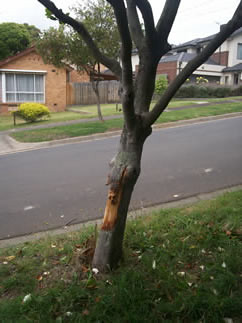
THEYesterday a small car ploughed into the venerable magnolia tree on our nature strip. My wife arrived home from a free solarium treatment, (shared in its entirety with a fluttering moth) to find the car abandoned, two vacant child restraints and the neighbours milling about. Someone called the police, who were at a loss as to how a vehicle could have generated the necessary speed to destroy itself so thoroughly, coming up a steep hill on a perfectly straight, short and narrow suburban street ... A momentary suicidal urge, perhaps?


A lady from Somalia was found at her house around the corner, presumably in shock. The magnolia tree is noticeably canted and almost ring-barked. It’s been there as long as I have, the poor thing, I have seen it flower every year of my life, and to be struck like that ... out of the blue ...


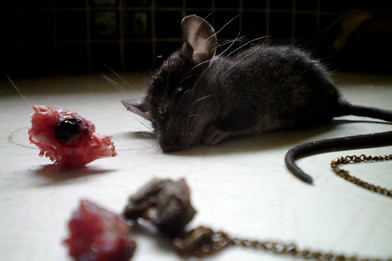
Greyish Blackish seems to have caught her first mouse - though it may previously have been partially incapacitated by Tweety Bird, the Jack Ketch of the household. GB is a very sweet natured cat and appeared unaware that the object of the exercise was to kill.

The mouse in the image below is accompanied by a item of biological refuse discovered by my wife in the shower. Tweety Bird seems to have have chewed off the outer coating of something’s head and left the remains as her customary matutinal gift.


(Just now, as I was writing, my wife called me to see this morning’s offering: another bio-hazard on the shower floor, this one resembling a grub-shaped grey-green kidney. Can’t find the camera ...)

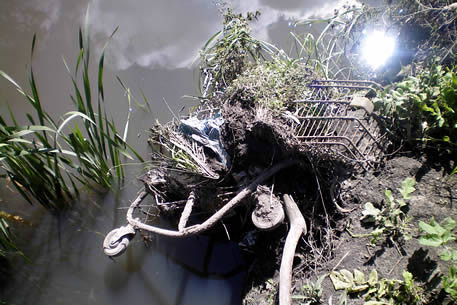
Recent rains have eroded the banks of the Grey Creek, revealing an item of archaeological curiosity. This shopping trolley was surely buried long ago, possibly during earthworks associated with the laying down of the abutting Monash freeway. It might have sedately decomposed down the aeons, but no, the elements have thrust its ghastly corroded form back into the light, to further pollute the habitat of Immaculata, that pure white duck.


I’ll let you know how the supermarket responds, when I report the trolley for collection.

And by the way: the best wishes of this dread season to you all. Thanks for reading, [and commenting upon,] my meandering, probably perplexing diary. I hope you all get as focused and happy and prolific in this next year as I am determined to be. Sorry, as usual, for the unpredictable timing of my posts.Usually, it's concomitant with my state of mind. [William Burroughs despised the word concomitant.) When the the posts dry up, I am either in a slough of despond or so obsessively busy with my life that I can’t pause to reflect ... Anyway ...

I hope you get something really good for Christmas. May the wind fill your sails.

Stumble Upon Toolbar DiggIt!

Sunday, November 23, 2008

~ immaculata

On my walks, I pass a place where the Grey Creek briefly swells into a pool. It was once a surprisingly picturesque spot, but since the council removed the ancient shady willows it has lost its character. The exposed grey mud is speckled with shards of coloured plastic, faded whiskey cans and lost lime tennis balls; it bakes in the pitiless sun, releasing the earthy, septic smell that is characteristic of the Grey Creek. The odour is toxic and would not be present if the creek flowed through pristine lands, yet it has always been there and I associate it, almost fondly, with my childhood.


When she first moved into the region, the beautiful white duck Immaculata chose this pool for its beauty. Now, despite the changes, she does not leave. She has come to know the place. Experience has taught her that it is defensible against her enemies. The struggling ecology of the Grey Creek is just rich enough to afford her a staple diet and walkers on the nearby path will sometimes stop to feed her bread.

She is far from being a gregarious creature. I have seen her fight the native black ducks for bread and she is capable of a frightening display of ferocity. I can imagine her defending her chicks in the same way, but a family is something that is denied her. It is unlikely that she will ever find a mate. Yet she is prepared to do everything she can to survive, regardless of the hand that fate has dealt her.

The odds do not lie in her favour. For beginners, she is perfectly white. Foxes, dogs and cats can see her at a distance, even at night, but she seems to have developed a survival strategy that works. Because she is not native to anything outside a farm, she lives under constant threat – just like the willows – of being removed from a habitat reserved for native species. And there is always the chance that a low man will attempt to take her for food. That is why her reticence with people is encouraging.

Despite everything, she is strong, healthy and beautiful. And she wags her tail in a very endearing manner. She does seem a little flustered and stressed, but that is to be expected given her circumstances. I feel a great deal of sadness and respect for Immaculata, defending her tiny cul-de-sac between the motorway and suburbia, forgotten, abandoned by nature, excluded by the plans of humankind.

Happily, over the last week, she seems to have formed an alliance with a pair of chestnut teals and a pair of black ducks, with who she sits with in the shade of the creek bank.

Stumble Upon Toolbar DiggIt!

Thursday, August 7, 2008

~ red in tooth and claw

My small family succeeded in breaching the psychological barrier constraining movement beyond the city of Melbourne. We traveled east with Emely McCord to a region near Bairnsdale and a house of mud brick and galvanised iron occupied by her mother Tosie and her younger brother Kyowa.

Inevitably, when Tosie sees Kyowa playing with Polly, she smiles dreamily and says, “They will grow up to be lovers”. Her tone… sounding not like a prediction… but a natural truth…


In recent years, the Rainbow Lorikeet has become common in my zone and I am continually surprised by the beauty of its plumage. But I had forgotten that the Eastern Rosella can be equally as striking - and there were plenty of these at Tosie’s, perched along the barbed wire fences, coats plumped up in the cold. They are tremendously beautiful birds.


Also, there were Welcome Swallows, darting and weaving over the bracken and the long dry grass, snatching up insects on the wing. Such is the manner of its flight, it is almost impossible to get a decent look before the bird spirals, dives or immelmanns in precisely the least expected direction. They flutter more than fly, like supercharged butterflies.

[If it isn’t obvious by now, I’m engaged in a bird obsession. I can tell you that in the wetlands adjoining the Grey Creek there are Purple Swamphens, Eurasian Coots, Pacific Black Ducks, Chestnut Teals and Dusky Moorhens. In the habitat at the end of the street I’ve seen Australian Wood Ducks, Laughing Kookaburras and Crested Pigeons. In our yard, somewhere high in a huge peppermint gum, there is a Tawny Frogmouth and in a park not two kilometres distant, so it is said, there resides a Powerful Owl.]

Walking through the fields surrounding Tosie’s property, we encountered the deep workings of dour wombats, the skeleton of a cow and the freshly dismembered carcass of a wallaby; [on the end of one bloody, discarded leg, there was a talon worthy of a velociraptor].


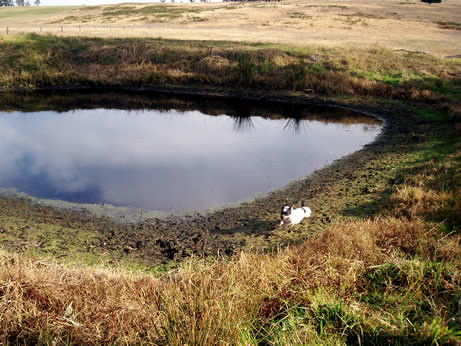
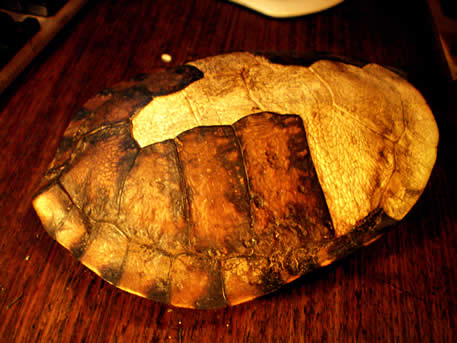
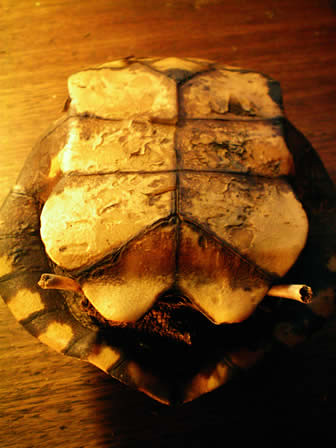
By a remote near-empty dam, we discovered two turtle shells, not far from each other. Each was about six inches in length. Desiccated leather curled away to reveal sutured white bone. Little white stumps extruded where the legs and head had been. Naturally, we brought them back home.


“Oh, you found those guys,” was Tosie’s reaction.

It transpired that the turtles had a history.

Emely had been first to discover them, shortly after their demise. Tosie had passed by their remains more recently.

Now, the important thing about Tosie is her deep affinity with Nature. She is in league with it, coiled within it, witness to its cryptic secrets. When she speaks, she sometimes sounds like a flaked out hippy, but her understanding of the bush and its underlying principles is profound. One would be foolish to discount her opinions on the subject.

I asked if the turtles - akin to some testudinal Burke & Wills - had almost made it to the dam, only to perish on the brink. Or had they died shortly after departure?

Drought in the region, Tosie explained, had caused the few remaining bodies of water to become overcrowded. With turtles. Conditions in the dam would have been very poor. Few resources. High levels of disease, toxicity. Our two ill-fated specimens would have been asked to leave by the others. To find somewhere else, or die. To sacrifice themselves for the survival of the community.

“Do turtles mate for life?” asked my wife, characteristically.

“I don’t know,” answered Tosie.


“What language did the turtles use?” I asked.

“The language of the forest,” answered Tosie.

Immediately, I thought of M. Night Shyamalan’s The Happening. And of The Swarm by Frank Schätzing.

I accept that it is within the realm of possibility for the forest to have a language, and certainly I would like it to have one …

Subtle chemical signals in the currents of the air, passed from leaf to caterpillar, from wombat bolus to dung beetle and thence to the blind nuzzling head of the earthworm …from gnarled parrot beak to witchetty grub … from pollen cloud to the tarsal combs of the bee … from diatom to rotifer to amoeba … from water-skimming spider to - at last - the murky consciousness of the turtles.

“Honourable citizen of the terrestrial biome. It has fallen to you [and your husband] to make the ultimate sacrifice.”


A signal, a demand, an imperative to which all creatures submit, which every organism, sentient or not, may interpret. To actually term it a language may be a superposition of our own thought patterns over something very different. Anthropomorphism may be the applicable word. Perhaps, the turtles were subject to something more simply described as the law of nature, red in tooth and claw.


The following week, Polly took one of the turtle shells to school for show-and-tell.
Doing her best to explain ‘the language of the forest’, my wife penned a short explanatory note for Mrs Hobson to read aloud. I sealed the shell in plastic, predicting a possible violation of Education Department hygiene strictures. Indeed, it was redolent with ongoing decay and I didn’t want to unnecessarily put the children off turtles. Perhaps forever …

ps: Tessie, the little dog in the picture of the dam, was run over and killed a week after we left. She had gotten herself under the wheels of Tosie's car as it backed out the driveway. Tessie was one of the sweetest dogs I think I've ever met.

Stumble Upon Toolbar DiggIt!

Monday, September 24, 2007

The Grey Creek

I am doing all the right things; I am taking long walks along the Grey Creek; I am swallowing fish oil and regulating my intake of red wine; daily, I vitamize many wholesome ingredients into a nutritious drink - yet the workings of my mind remain sluggish and without direction.

In nine days time I am performing the role of Prospero in a production of The Tempest and I have a massive quantity of lines, few of which I have by heart. As quickly as I learn them, my mind releases them. It's like handling a slimy fish. There's no traction there. Yet, learn them I must. I cannot disappoint Lynne, the director, nor the others involved. No matter that it is a small student production. No matter that its standards are not quite professional and that there's no payment. I must yet prevail. I urge myself with the image of my wonderful costume - the shimmering silver jumpsuit, the towering silver boots... I shall be the cynosure! All shall cower at my majesty!

So, as I follow the meanderings of the Grey Creek, I mumble to myself, concentrating on my task. The creek exists in the buffer zone between a howling motorway and the dormitory suburb of Mt Waverley. I have known this creek all my life. I knew it before it was landscaped, formed into wetlands and filtration ponds, before it hosted at least five species of water-birds. When I was a child it was a pungent sudsy vein transporting vile substances through poisoned quagmires, bestrewn with blackberries and rusted machinery, to the Yarra and thence to the Bay. When I dream of the Grey Creek and its surrounds, they are always in this original state.

Soon, my wife will be home and I must show, not only strength, but compassion. She has been labouring desperately against the Spores, and has found the will to form a battle plan. It is a poor one, I think, for it relies on strengths I doubt she has - but some independent will remains and that is something to be thankful for. I'll wind up fifty and looking like one of your old girlfriends, she said today. A wise observance. Many of my dearest friends, both male and female, have been slowly mutilated in long and strenuous conflict with the Deadly Spores. The Spores treat their enemies and their slaves with an equal lack of pity - and it is not just the flesh they sour ...

>As with age their bodies uglier grow, so their minds canker ...

Then there are those who will never live to suffer old age.

Stumble Upon Toolbar DiggIt!