Pages

Showing posts with label SCIENCE-FICTION. Show all posts

Saturday, August 30, 2008

~ the wad

It came to me at the bottom of a cold dark well. I would write a fantasy novel. In fact three, a trilogy, something as surreal and rabelaisian as China Mieville, but which would sell like Terry Pratchett.

A month later and I haven’t yet got bored of the idea. In fact it’s going rather well. Slow, but well. I can’t imagine how I will ever complete it, but I’m not letting that get in the way. I’m going to send some finished chapters around the place and get some reaction, then I’ll either bite the bullet and write the whole thing, or do something else.

The novel is set in two interconnected worlds: Nonesuch, dominated by a planet-girdling forest called (at this stage) The Weald, and Telesium, the spirit world, accessible by Séance, by the herb sleither, and by rites of the shrouded Velleity. So far, I’ve spent most of the time building the universe, naming the plants and animals, the seasons, the rules of Nature, the history of human civilisation … making a map, the all-important map. Though, as is my way, I still waste time with intricate, richly textured details that may never see the light of print, I have been uncharacteristically strict with myself. I have a believable world, three or four chapters in draft and one polished off.

At present I’m worried about the name of the male protagonist, Lamarc. It’s not bad, but it’s not of the rank of, say, Alsace, his father, or Teasel, his mother, or Tetany, the evil queen. If you’ve got any suggestions? The victim of the recent light plane crash in Moorabbin had a beautiful name: Akash Ananth. Either would be better than Lamarc, I think. But I’m not sure. Perhaps too sub-continental …

Anyway, here’s a snippet ... Unknowingly drawn by the mysterious discorporate entity Almathea, the child Lamarc is venturing perilously into the phantasmagoric Weald …

*

Deeper in the wildness, in close musty pockets where the sun scarcely penetrated, he had observed a very curious and poorly understood creature - or perhaps part of creature, or perhaps plant - known as the wad. It was a cube roughly the size of a human head, composed of a moist translucent meat-like substance, veined with something blackish that could be seen to flow and packed with pebble-sized organelles in pale shades of red, blue and grey. Behaviourally, the wad was elementary. It fell; unexpectedly and from on high - from no visible resting place or eyrie, seeming to materialize in mid-air. It would slap into the earth, scattering leaves and mulch, then proceed to decay in natural order, offering its stored minerals and energy to the Weald. No doubt the wad could kill, if one was caught beneath it, but to Lamarc’s knowledge no one had yet had such tremendous bad luck.

The wad was a very strange thing, but it was a useful reminder that everything to do with the Weald was fundamentally strange. If Lamarc was ever in danger of acclimatising to the outlandishness of life in the forest, the wad was always there to pull him up. A queer thing in its essence. No apparent rhyme or reason. Brute strangeness.

In these congested areas, he could feel the Weald in everything. It transfused from soil to air, from leaf to root to thallus, from rain to tongue; everything swollen and heated with the workings of the ecome.

*

Some other news … The re-release of the Beargarden album All That Fall is looming. The delay has been my fault. I’ve insisted on writing liner notes that contain a potted history of the band, and since I’ve been hiding under a rock until recently, nothing has got done. Now I’m working again and the biography is almost ready. It’s long and full of dirt.

We’ve been spurred to action by word of movement regarding the long awaited Dogs in Space DVD release. We want to release an Ears album around the same time, but, according to our schedule, we can’t do that until the Beargarden is done and dusted.

Apparently, commentary tracks are being prepared for the DVD, so Mick Lewis (Ears guitarist) and I have decided to our services to R. Lowenstein. We’re so excited about it, we may do it whether it’s included or not.

Stumble Upon Toolbar DiggIt!

Saturday, April 12, 2008

~ my brain on drugs in the year 2045


For those of you with access to the Vivaids magazine ‘Whack’, my article ‘The Mysteries of Opiophobia’ has appeared in the latest edition.

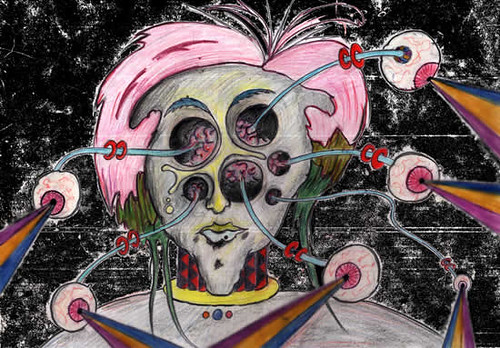
The magazine has announced a cover design competition and the prize is $200. What you see above is my first effort.

Stumble Upon Toolbar DiggIt!

Sunday, March 9, 2008

~ the phlegom


Scientists are outraged at the lack of quarantine employed by Australian security services at the first official meeting between an Earthly leader and ambassadors of the alien race calling itself The Phlegom. Dr Amelia Rogerson of MIT claimed, ‘such a wanton display of sheer ignorance could easily lead to the extinction of the human race. Has Mr Rudd not seen The War of The Worlds?

This aside, the meeting was deemed a success. Though the Phlegomatic language remains impenetrable to linguists, [some even claiming that the entities’ constant wet squeezing sounds are not vocalisations at all, but a simple by-product of their physiology,] some communication seems to have been achieved through simple mathematical exchanges involving coloured blocks. When presented with a laptop computer, their leader became profoundly alarmed and - in what we are told was a benevolent act of mutual defence - obliterated the device with the enormous bone that designates his authority. When confronted with a pencil and paper, his reaction was similar but xenobiologists warn not to make the mistake of judging The Phlegom by our standards. Dr Rogerson said that ‘to underestimate The Phlegom merely because they appear obtuse or perhaps absurd would be a grave, potentially fatal mistake’.

Although the Phlegomatic craft, which landed in Central Australia on Tuesday, remains at the epicentre of a tight military cordon, some second hand reports have filtered through. There is general agreement that it is constructed of a material resembling leaves and that it has visibly decayed over the past days with huge cracks appearing in its fuselage. There is also said to be an accompanying odour variously described as that of decaying food scraps and burning hair.

Dr Jackson Smith of Parkes Observatory in NSW has suggested that it may be a single-use vehicle and that if The Phlegom decide to depart they may simply construct another. Other sources have suggested that the race appears to lack the necessary scientific and cultural sophistication to have developed a star-faring culture – although this is somewhat belied by their astonishing ability to raise vast rotating donuts of wet mud high into the atmosphere by power of thought alone.


Stumble Upon Toolbar DiggIt!

Friday, February 29, 2008

Ω the sensor shell of the urograffin

The excruciating sound of stretching rubber told us that we were emerging from crepus-space.

I rose from my bed and rubbed sleep from my eyes. I did not know how long I had been asleep. I donned my ship suit and seated myself at the control console. The bluish light of Elixesse was still faint. We must have been in the very outer reaches of the system

The Ørn broke its silence.

- We’ve encountered an obstacle. A sensor shell.

- Transmitted from the fourth planet?

- It is almost certainly reporting to the Urograffin. And it is extremely sophisticated, extremely sensitive. There is no way a ship of my bulk can pass undetected.

- Even in crepus-space?

- It monitors normal space, crepus-space and the cryptic Urschleim.

- They have something to hide, clearly.

- If you were casually eviscerating a rare and truly beautiful lifeform - certainly the only one of its kind in the galaxy - you might also be sensitive about being observed.

- How far out are we? I asked.

- The sensory construct is ten AU in radius and we are anchored at its edge. We must decide now whether to penetrate openly and invite a hostile reaction – or find a quiet way through.

- The latter, I would say. Ultimately, it may allow us more options.

The Ørn readied a Penetrator which Robert had recently serviced in the hold and named Lorraine. It was abyssal black in colour. Its smooth organic lines resolved into an arrow-like form at the front and dissolved into a cluster of Urschleim flutes at the rear that, even now, were waving gently in the unseen winds of the universe’s underlying chaos. Every surface of the Lorraine was dotted with disc-like crepus organs. More than anything the vessel resembled a terrestrial squid. It was small, with no room for a flesh and blood pilot.

I eased on a virtuality balloon, clipping the breathing and feeding attachments into place. To the unknowing, it would have appeared that my head was enclosed by free floating sphere of grey dish water.

I entered the sensorium of the shuttle.


*

It took days to reach orbit with Elixesse Quaternary. Days of tedium broken by sudden, wrenching manoeuvres and moments of agonising tension.

After piercing the sensor shell - a delicate action that at times found the Lorraine simultaneously occupying the three known phases of space-time – I encountered potent layers of defence, one after the other.

Swarms of reticulate mines, resembling nets of delicate silver, undulating with an eerie life and drawn like leeches to any source of mass, light, heat or metal. Then a membrane of invisible submolecular femtomachinery, programmed to absorb baryonic matter at touch and excrete it as energy, Pinpointing this defensive shell were calculation engines, directing the esoteric machinery like a vast distributed limb. These controllers hulked in the dark; giant black hourglasses, thick with antennae, unreflective and pitted with micrometeorites. More often than not, I felt their lurking presence against the stars, long before I saw them.

At last, there was a sphere of more conventional military hardware: dormant micromissiles drifting in schools awaiting the command to seek and destroy, huge solar accumulators spiked with laser emplacements, sizzling with barely constrained energies, and massive rotating capacitors resembling luminous trumpets, primed to deliver disabling EMP pulses. All in synchrony with a sly governing intelligence.

But the subtle mind of the Lorraine, guided by the mentality of the distant Ørn, avoided every pitfall. Appearing as little more than a sliver of vacuum or a spray of alpha particles, it brought me safely through.

The Urograffin were defending something, that was obvious - but I had to wonder if their exploitation of Elixesse Quaternary was sufficient a transgression to warrant such extreme measures. If they were so painfully aware of their crime, then perhaps it was not merely greed that was driving them, but desperation? And who did they think would be bringing them to task? I felt sure, even at this early stage, that there was more to this scenario than was apparent.

Stumble Upon Toolbar DiggIt!

Tuesday, February 12, 2008

~ the pharmacopoeia of imaginary drugs #2

[… continued from the previous post]

Then there are the literal opiates of the masses – drugs utilised by the powers that be to control or homogenise society. First that comes to mind is Soma, from Brave New World by Aldous Huxley. Used across the board by citizens of a putative utopia, Soma seems to enhance every aspect of life, distracting the populace with unrestricted pleasures, deliberately short circuiting the possibility of discontent.

Huxley borrowed the name Soma from the divine drug of the ancient Vedic scripts. Knowledge of the plant from which the original Soma was extracted has been lost and it’s true nature is debated to this day. It was believed to have been a drink which, like the Greek ambrosia, endowed the deities with their god-like powers. It is also said to have been an elixir of immortality. William Burroughs speaks of it as the ultimate opiate, comparing its effects to a cool blue ocean, but academic opinion suggests it was probably an hallucinatory entheogen, Today it is the brand name of a muscle-relaxant called Carisoprodol.

Whilst on the subject of substances reserved for gods, it might be worth mentioning The Food of the Gods and How It Came to Earth by H. G. Wells. In this novel scientists develop an artificial food which they name Herakleophorbia IV. The substance proves to be a growth accelerator and giant laboratory specimens break free to ravage the countryside. Humans who take it grow to massive proportions and become, in effect, gods.

For Island - the utopian companion to dystopian Brave New World - Huxley invented Moksha – a psilocybin like drug derived from mushrooms. Intensifying religious experience and inducing mystical insights, Moksha is the very definition of an ‘entheogen’. In real life, Huxley experimented widely with the hallucinogens and saw a benefit for humanity in their use.

In the film Equilibrium, a drug called Prozium was used to subdue the emotions of the populace. Delivering society from ‘the deepest chasms of melancholy and hate’, it was described as ‘the great nepenthe’.

Nepenthe is a beautiful word, sometimes used today to describe soporifics or opiates. It originated in Homer’s Odyssey. Literally ‘the one that chases away sorrow’, nepenthe was consumed by Helen, the daughter of Zeus, ‘to lull all pain and anger, and bring forgetfulness of every sorrow’. Weirdly, the passage was quoted as a form of ‘evidence’ during the passage of the 1937 Taxation of Marijuana Act in the US.

An interesting subset of the imaginary pharmacopoeia is the drug that wakes you up to how things really are. Consider: we are under attack from Lizard Men from Venus [or Blue Lobster Men, whatever the case may be] but none of us are aware because a subtle drug has been introduced into the water supply, [or perhaps because we’d rather just not know]. Defenders of the Earth develop a counter agent, a yellow pill that reacquaints us with reality and gives us the motivation to resist. There are plenty of tales with such a plot, or similar.

In Silverberg’s Downward to Earth human colonists find that the venom of an alien snake can assist in the regeneration of body parts. But taken in high doses it transforms one into a kind of sentient elephant that proves to be the planet’s dominant species. And remember those pills in The Matrix which wake the user to the nightmare of humanity’s future?

One interesting drug came from a book the name of which I cannot recall. I am not even sure they were referred to to Death Eggs, but they were scary enough to lodge in my mind. I think they were found in an abyss that had formed beneath an urban building site; they were ovoid, black, smooth and matte. They took you to a place that was shadowy and deep. And users usually died after only a few doses.

It’s hard to imagine why you would even take some of these drugs. But then people are full of surprises. I, for one, have ill-advisedly consumed some very unlikely things in the quest for oblivion. Substance D, at the heart of Philip K Dick’s A Scanner Darkly fragments the consciousness to such an extent that its appeal is difficult to see. Schismatrix, [the source of Green Rapture], also includes Shatter, a drug procured from the alien Outsiders. In a contest of wills, two characters use the drug to generate a folie a deux. They enter the unspeakably alien minds and bodies of an extinct race of cyclopean beetles – and there do battle. Even the victor takes years to recover.

Some authors have created drugs that entwine the user with predominant social trends and new technologies. In White Noise, Don DeLillo posits a drug called Dylar, which is taken to remove the fear of death - but proves to have side-effects linked inextricably with the watching of television. In Neal Stephenson’s Snow Crash, the eponymous drug is more than just a drug. In cyberspace it manifests as a computer virus but develops the ability to cross the barrier into reality – where it causes mind-altering effects in the minds of hackers. These effects comprise an attack on the nature of our communal reality – and have a weird ancient Sumerian flavour.

MDT-48 appears in The Dark Fields by Alan Glynn and brings its user up to speed with the ceaseless flood of data that assails us in the information age – later turning him into a homicidal maniac.

Perhaps the most comprehensive futuristic drug scenario is proposed by Iain M Banks in his Culture cycle. Citizens of the Culture are genofixed for beauty, health, sexual talent and longevity. Additionally, they are gifted a suite of drug glands at the base of the skull which they may ‘gland’ at will. Secretions include Snap! [the Culture’s favourite breakfast drug] Diffuse, Crystal, Quicken, Gain and Somnabsolute.

The nineties UK mocumentary series Brass Eye investigated a terribly terribly dangerous drug from Czechoslovakia called Cake. A potent disturbile cranabolic amphetamoid called Dimesmeric Andersonphosphate, it acts upon the area of the brain known as ‘Shatner’s Bassoon’. Under its influence, one may cry all the water out of the body or puke up ones own pelvis. Another effect may be the gradual swelling of the neck which, according to Rolf Harris, can expand ‘to engulf the mouth and nose’ and ultimately shatter the skull. In one horrendous incident ‘thirteen teenagers were trampled to death in a cow field on the stuff’. On the street it is also known as Loony Toad Quack, Rustledust and Ponce on the Heath.

For writers of the fantastic, drugs are a useful tool, a magic wand to bend their characters or their worlds in whatever way they wish. It’s no wonder there are so many of them out there. In science-fiction particularly the sophistication of the drugs represents the sophistication [and the possibilities] of science. As Robert Silverberg would put it, ‘by offering his characters a vial of green pills or a flask of mysterious blue fluid the author is able to work wonders as easily as a sorcerer’.

In Larry Niven’s Known Space drugs per se are disposed of entirely. Hedonists connect their brains to ‘tasps’ which directly stimulate the seat of pleasure.

Because science-fiction is invariably a mirror to the society in which it is produced, it is tempting to wonder at the greater significance of many of the drugs described above - the attitudes they reflect, the hopes they engender - but this is just a list, and by no means complete. I’ll save the analysis for some other time.

Hope you enjoyed it.

Stumble Upon Toolbar DiggIt!

Monday, February 11, 2008

~ the pharmacopoeia of imaginary drugs #1

After recounting the fantastic properties of Green Rapture in the previous post, I began to realise just how vast and wonderful a pharmacopeia of imaginary drugs has been described by the fantasists of this Earth.

Of course, there are lists. There are lists of everything on the internet. This time I think I’d like to do my own.

As is to be expected, most fictional drugs are merely elaborations u
pon drugs with which we are already familiar. Consider nuke in Robocop – it’s just future coke with a snappy name. Or omegendorph in Kim Stanley Robinson’s Martian series – the ultimate opiate engineered out of a comprehensive knowledge of human endorphins. Outland [the movie starring Sean Connery] featured a drug called polydichloric euthimal - a ravening giga-amphetamine, like tetrameth in Richard Morgan’s Altered Carbon. Malajusted Alex and his droogs. from the classic A Clockwork Orange, visit Milk Bars for Drencrom or Synthemesc ‘to sharpen the senses for the old ultra violence’. And longbottom leaf? Well, that was just pot, wasn’t it?

And Slurm, from the planet Wormulon? It was just Coke, wasn't it?

My play Lord of Misrule was premised upon the exudate of an illicit fungus, [similar to kom-bu-cha], which was socially and in physical effect directly analogous to heroin, but possessed of its own intelligence. And whether it’s the extract of a giant centipede, bug powder or the cerebro-spinal fluid of the mugwamp, all of William Burroughs’ marvellous addictive chemicals are essentially heroin, or facets thereof.

Remember this? ‘Hank’s on junk; he doesn’t come. I’m on bug powder; I don’t need to come.’

But beyond the simple metaphors, there are a host of imaginary drugs with truly novel effects.

Philip K Dick was responsible for some of the best. Can-D and Chew-Z feature in The Three Stigmata of Palmer Eldritch. Chew-Z, the instrument of a sinister alien power, allows the user to leave his body and spend an indefinite period of time in the environment of his choice – returning to find no real time has passed. [I used to fantasise about this one as a teenager.] After consuming Can-D one enters what was called a ‘Perky Pat Layout’ – this commercially acquired tableau resembled a doll’s house occupied by a scaled-down cast of The Bold and The Beautiful. Martian colonists, living in hellish conditions, spent all the time they could immersed in the normality [and hypersexuality] of Perky Pat’s virtual world.

In Dick’s Now Wait For Last Year, JJ-180 is in effect a time-travel agent, allowing the consciousness of the user to navigate in either direction through time, settling in whatever era takes his whim for the duration of the trip. We can Remember It For You Wholesale, [filmed as Total Recall], includes the hypnotic narkidrine, used to install false memories in the human brain.

Time travel drugs crop up repeatedly in fantastic literature. In a tale from 1964, Doris Pitkin Buck describes the use of Protoceratops Tabs, which transport the mind back through time into the dim consciousness of a saurian in the Mesozoic Era.

Then there are drugs with grosser effects. Like Pallidine in Thomas Disch’s Camp Concentration. Derived from syphilis spirochetes, it boosts intelligence and turns users into short-term supermen, who eventually succumb to disease. Herogyn from Norman Spinrad’s Men in The Jungle is similar. The protagonist/dictator employs it to fan his troops into a frenzy before action. Battle drugs are a category in themselves, and not all of them are imaginary.

Probably the most well-known of all science-fiction drugs is Spice, or Melange - the cinnamon-like secretion of the great sand worms of Dune. In Frank Herbert’s universe it is as valuable as gold and its addicts have ‘blue within blue’ eyes.

But the effects are hard to put a finger on - even after reading most of the series. Largely, it’s almost a shamanic, entheogenic thing. One may see into the future, the past. If you are Muad’Dib you can prophesy. If you are a Space Guild Navigator you can ‘fold space’. Spice increases the lifespan, raises awareness and general vitality. Since it is largely a metaphor for oil, the political effects tend to be more interesting than the physical. Dune also mentions sapho juice, used by mentats to multiply their cerebral processing power, and colouring their lips with a distinctive cranberry stain.

During the sixties, with the advent of psychedelia, many forward-thinking writers began to imagine drugs that went beyond the effects of the known hallucinogens. Another book by Herbert - actually my favourite of his - is The Santaroga Barrier. In an isolated village, somewhere in America, the residents all consume a substance named Jaspers which is mined from the surrounding countryside [rather like The Stuff]. They form an uncommonly well-balanced society, but it is their immunity to marketing of all kinds that leads to their notice by the outside world. An investigator discovers that Jaspers has united them on a subconscious level, and that they have developed a highly-evolved understanding of the world and its underpinnings.

In Robert Silverberg’s A Time of Changes (1971) a drug acquired from a native culture on an alien world proves to have telepathic qualities and ultimately transforms an uptight society into a caring sharing near-utopia. Another drug, in R A Lafferty’s story Skyprovide sensations of mastery and union-with-cosmos’, but ‘especially during parachute drops’. Deaths occur when users try freefall for the ultimate high. The far more recent novel ‘Vurt’ by Jeff Noon describes an England in which the habit of sucking variously coloured Vurt Feathers is widespread. To put it simply, Vurt allows users to descend communally into the shared unconscious of humanity, investing our dreams with a certain objective reality.

[This article continues here]

Stumble Upon Toolbar DiggIt!

Sunday, February 10, 2008

~ green rapture: the king of imaginary drugs

‘Lindsay’s attention was sharpened to a cutting edge by a drug known …. as Green Rapture … without volition, his eyes glazed over. a long moment passed in which he was silent, empty, thinking nothing at all … at last, blinking, he came back to himself. He reached reflexively into his jacket pocket and produced an enamelled inhaler. Two long whiffs of Green Rapture brought interest back into the world ..

Green Rapture washed gently over Lindsay, a tingling wave of curiosity. Green Rapture was the ultimate anti-boredom drug, the biochemical basis of wonder boiled down to its complex essence. with enough gr a man could find a wealth of interest in his own hands. Lindsay smiled with unfeigned delight.

‘Marvellous,’ he said.

From Schismatrix by Bruce Sterling

*

There have been many outlandish substances described in books and film - but if I was given the chance to actually consume one, it would be Green Rapture.

Bug powder? I can take it or leave it.

Melange? Vurt feathers? Polydichloric euthimal? Mandrapordeum? Hellflower? Omegendorph? Drencrom? Nuke? Can-D? Certainly, they sound intriguing …

But I want Green Rapture.

Curiosity is the air that I breathe. If I lose it, as I often do - in the grey days after using heroin or too much alcohol, or after some catastrophe - I feel worthless, an ineffectual husk. Indeed, my level of interest in things is a good indicator of my health overall. When I suffer depression, nothing is worth investigation; if I read, I read to escape not to learn. When I’m sprightly, then the world gets fascinating.


Early in the nineties I began to hear the first whispers of Prozac. I crossed my fingers. Could they really have developed a drug that did nothing else but make you happy? I bought a hardback copy of Kramer’s ‘Listening to Prozac’ and read it cover to cover. I nodded with approval at the cries of outrage from the CCHR [Citizens Commission for Human Rights]: if the Scientologists were so worried, then it was a good sign. They consider effective psychiatric drugs [and psychiatrists] a threat to their bottom line and will do anything in their power to malign them.

Thoroughly inculcated by Roche’s pre-publicity, I organised a medical appointment. I recall Lynne’s amused expression as I assumed a mantle of deep depression before entering the doctor’s room, where I was to obtain the precious script for a drug which at that time required special authorisation.

Ten days later, the effects kicked in. I woke on the grey couch in my office and the world was glistening with wonder. It was much like a trip, but without the paranoia, or any heavy physical effects that might leave you with a hangover. A subtle, clarifying filter had been placed over the world.

In this state, I wandered out of my office, on to the street and down to river where Moomba was in full flight. I must have spent hours there, exhilarated by the colour and the noise, fascinated by faces, trees, and scintillating metallic balloons.

Oddly, the only actual image I recall is that of a man putting something in a rubbish bin …

But with each day the effect faded, until I felt normal. Better, but normal. I could never achieve that same state again with Prozac or its cousins. I use Zoloft at the moment, and every so often, upon waking, I feel an echo of that fantastic morning.

I hadn’t found my Green Rapture, and I doubt I ever will. I’ll have to rely on natural means to generate the curiosity I need.

I worry about my wife, though. So often, she complains of being unmotivated, of not being interested in anything, of jealousy at how obsessed I get by things. Generally, she seems to prefer physical over mental pleasures - and the more easily come by the better. I worry that if she cannot develop a life of the mind – beyond the phantasmagorical world of her fantasies – then she’ll never be able to fully exploit her tremendous talents as an artist. Certainly, she is more intuitive than cerebral with her work; it comes from the heart and soul rather than the mind – but the heart and soul have interests too. And if she’s interested in nothing, then how will she even get brush to paper?

Depression has a lot to do with it; but depression can work both ways. It can lead to the loss of engagement, but when it’s resolved and things seem normal, then realising you have no abiding interests in life can lead you straight back into the black room.

She needs Green Rapture as much as I crave it. Curiosity is an elemental human quality; it led us to become what we are. Lose it and you lose an element of your soul.

Stumble Upon Toolbar DiggIt!