Pages

Showing posts with label PHILIP K DICK. Show all posts

Friday, December 19, 2008

~ a mould of note

These last weeks, my mentality has been feverishly occupied.


Many of my ideas have sunk, slowly, like a poisonous dustfall through the Glimmung’s phantasmagoric ocean, past the sunken cathedral of aeons past - and still deeper to that place where bad thoughts go to die.

But some have served to feed the ever burgeoning Encyclopaedia of Nonesuch. Choices for the name of my protagonist have been whittled down from about twenty to two: Alsus and Alsace. At present I am leaning towards the latter.

Alsace has a new tutor, a tall unsmiling man named Northy, who is more bodyguard than pedagogue - sent from afar by Alsace’s father, Ashen, as the political situation rapidly deteriorates. Touched while still a babe, Northy is formed from canon-tree wood. Another new character has emerged: Jequirity Pea, a girl from a local tribe of Emeraldim whose tattoos - with their eldritch geometries - strike to the heart of Alsace's’ sexual instinct. Jequirity is the only person with the ability to perceive Almathea, the blue spirit who walks behind Alsace. Jequirity, like all women of the Emeraldim has pale green teeth and an intriguing tablier Egyptien ...

But now, to the point:

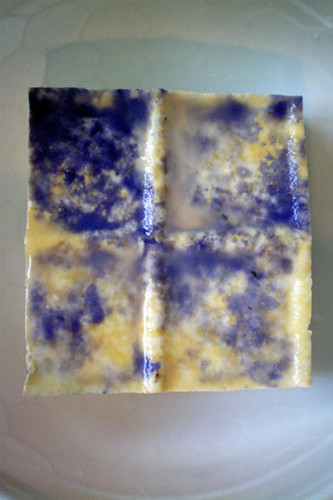
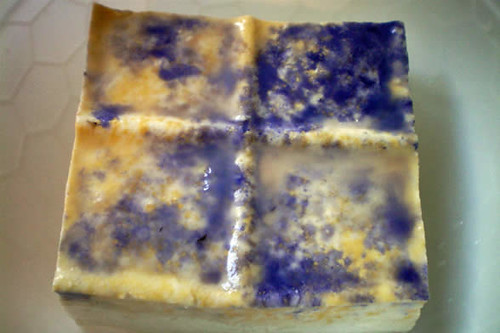
Please observe this section of soft refrigerated tofu, abandoned for an indeterminate period in a zone reserved for non-preferred mustards, 99% fat-free French salad dressing, blue cheese salad dressing and Outback Brand lime, chilli and ginger sauce.


Mould comes in many colours - green, grey, blue etc. – which are often specific to the substance on which it grows. But upon this block of tofu there appeared an outcrop of almost fluorescent purple, which my camera could not perfectly reproduce. I made repeated attempts with different backgrounds, in various light conditions, but you’ll have to trust me that it was even brighter, even more purple and iridescent than it appears in these images.

Purple mould. Livid ultraviolet mould. Perhaps I have seen too little rancid tofu in my time, but I do find this extraordinary.

I ask myself, since the species appears so unnatural, could it perhaps be unnatural. Might some outrageous additive have spurred a providential mutation?

Further to the dreadful food-industry practices I described in a previous post, some recently announced Chinese food safety protocols have outlawed a swathe of other stomach-turning activities. Boron (among other things, an insecticide) has been used to increase the elasticity of meatballs and noodles. Formaldehyde and/or lye are routinely ‘added to water in which seafood is soaked to make the produce appear fresher and bigger’. Also banned, interestingly, is the traditional use of ‘an addictive substance made from the poppy plant ... used in hot pot, a Chinese dish where meat, vegetables and tofu are cooked at the table’.

In a culture where food colourings seem interchangeable with industrial dyes, increased regulation is certainly good news but, typically, I have veered from the subject of my post: this novel and uncommonly beautiful mycelium.


I won’t prattle on further, except to pose a series of questions.

Is the steady increase in the size of the strawberry a reflection on our society? Perhaps even on our humanity? What is the meaning behind our urge to force the species so far beyond its natural size? This very day, if one wished, one could go out and purchase a strawberry approaching the size of an apple. Why have we worked so hard to grant ourselves this dubious boon? What lies behind this strange imperative?


As the strawberry bloated under the devious hands of the food-scientists, initially the flavour did not keep pace – but now this hurdle seems to have been overcome. The hydrocephalic supermarket strains are becoming as sweet and densely-flavoured as the strawberries of yesteryear – though not, of course, the wild strawberry, which now tastes like an entirely different species.

As the concept of the punnet becomes increasingly ridiculous, broad trays of strawberries are becoming more common. Soon perhaps, we will purchase them in something akin to egg-cartons. Commercial Fruit Behemoths will develop a hardier skin, allowing the strawberry to enter the aisles, if not of golden delicious and fuji, then of the stone-fruit which it has already begun to dwarf.

And, as their genomes are mapped and turned inside-out, will raspberries and blueberries also become subject to the same process of forced gigantism?
Stumble Upon Toolbar DiggIt!

Tuesday, February 12, 2008

~ the pharmacopoeia of imaginary drugs #2

[… continued from the previous post]

Then there are the literal opiates of the masses – drugs utilised by the powers that be to control or homogenise society. First that comes to mind is Soma, from Brave New World by Aldous Huxley. Used across the board by citizens of a putative utopia, Soma seems to enhance every aspect of life, distracting the populace with unrestricted pleasures, deliberately short circuiting the possibility of discontent.

Huxley borrowed the name Soma from the divine drug of the ancient Vedic scripts. Knowledge of the plant from which the original Soma was extracted has been lost and it’s true nature is debated to this day. It was believed to have been a drink which, like the Greek ambrosia, endowed the deities with their god-like powers. It is also said to have been an elixir of immortality. William Burroughs speaks of it as the ultimate opiate, comparing its effects to a cool blue ocean, but academic opinion suggests it was probably an hallucinatory entheogen, Today it is the brand name of a muscle-relaxant called Carisoprodol.

Whilst on the subject of substances reserved for gods, it might be worth mentioning The Food of the Gods and How It Came to Earth by H. G. Wells. In this novel scientists develop an artificial food which they name Herakleophorbia IV. The substance proves to be a growth accelerator and giant laboratory specimens break free to ravage the countryside. Humans who take it grow to massive proportions and become, in effect, gods.

For Island - the utopian companion to dystopian Brave New World - Huxley invented Moksha – a psilocybin like drug derived from mushrooms. Intensifying religious experience and inducing mystical insights, Moksha is the very definition of an ‘entheogen’. In real life, Huxley experimented widely with the hallucinogens and saw a benefit for humanity in their use.

In the film Equilibrium, a drug called Prozium was used to subdue the emotions of the populace. Delivering society from ‘the deepest chasms of melancholy and hate’, it was described as ‘the great nepenthe’.

Nepenthe is a beautiful word, sometimes used today to describe soporifics or opiates. It originated in Homer’s Odyssey. Literally ‘the one that chases away sorrow’, nepenthe was consumed by Helen, the daughter of Zeus, ‘to lull all pain and anger, and bring forgetfulness of every sorrow’. Weirdly, the passage was quoted as a form of ‘evidence’ during the passage of the 1937 Taxation of Marijuana Act in the US.

An interesting subset of the imaginary pharmacopoeia is the drug that wakes you up to how things really are. Consider: we are under attack from Lizard Men from Venus [or Blue Lobster Men, whatever the case may be] but none of us are aware because a subtle drug has been introduced into the water supply, [or perhaps because we’d rather just not know]. Defenders of the Earth develop a counter agent, a yellow pill that reacquaints us with reality and gives us the motivation to resist. There are plenty of tales with such a plot, or similar.

In Silverberg’s Downward to Earth human colonists find that the venom of an alien snake can assist in the regeneration of body parts. But taken in high doses it transforms one into a kind of sentient elephant that proves to be the planet’s dominant species. And remember those pills in The Matrix which wake the user to the nightmare of humanity’s future?

One interesting drug came from a book the name of which I cannot recall. I am not even sure they were referred to to Death Eggs, but they were scary enough to lodge in my mind. I think they were found in an abyss that had formed beneath an urban building site; they were ovoid, black, smooth and matte. They took you to a place that was shadowy and deep. And users usually died after only a few doses.

It’s hard to imagine why you would even take some of these drugs. But then people are full of surprises. I, for one, have ill-advisedly consumed some very unlikely things in the quest for oblivion. Substance D, at the heart of Philip K Dick’s A Scanner Darkly fragments the consciousness to such an extent that its appeal is difficult to see. Schismatrix, [the source of Green Rapture], also includes Shatter, a drug procured from the alien Outsiders. In a contest of wills, two characters use the drug to generate a folie a deux. They enter the unspeakably alien minds and bodies of an extinct race of cyclopean beetles – and there do battle. Even the victor takes years to recover.

Some authors have created drugs that entwine the user with predominant social trends and new technologies. In White Noise, Don DeLillo posits a drug called Dylar, which is taken to remove the fear of death - but proves to have side-effects linked inextricably with the watching of television. In Neal Stephenson’s Snow Crash, the eponymous drug is more than just a drug. In cyberspace it manifests as a computer virus but develops the ability to cross the barrier into reality – where it causes mind-altering effects in the minds of hackers. These effects comprise an attack on the nature of our communal reality – and have a weird ancient Sumerian flavour.

MDT-48 appears in The Dark Fields by Alan Glynn and brings its user up to speed with the ceaseless flood of data that assails us in the information age – later turning him into a homicidal maniac.

Perhaps the most comprehensive futuristic drug scenario is proposed by Iain M Banks in his Culture cycle. Citizens of the Culture are genofixed for beauty, health, sexual talent and longevity. Additionally, they are gifted a suite of drug glands at the base of the skull which they may ‘gland’ at will. Secretions include Snap! [the Culture’s favourite breakfast drug] Diffuse, Crystal, Quicken, Gain and Somnabsolute.

The nineties UK mocumentary series Brass Eye investigated a terribly terribly dangerous drug from Czechoslovakia called Cake. A potent disturbile cranabolic amphetamoid called Dimesmeric Andersonphosphate, it acts upon the area of the brain known as ‘Shatner’s Bassoon’. Under its influence, one may cry all the water out of the body or puke up ones own pelvis. Another effect may be the gradual swelling of the neck which, according to Rolf Harris, can expand ‘to engulf the mouth and nose’ and ultimately shatter the skull. In one horrendous incident ‘thirteen teenagers were trampled to death in a cow field on the stuff’. On the street it is also known as Loony Toad Quack, Rustledust and Ponce on the Heath.

For writers of the fantastic, drugs are a useful tool, a magic wand to bend their characters or their worlds in whatever way they wish. It’s no wonder there are so many of them out there. In science-fiction particularly the sophistication of the drugs represents the sophistication [and the possibilities] of science. As Robert Silverberg would put it, ‘by offering his characters a vial of green pills or a flask of mysterious blue fluid the author is able to work wonders as easily as a sorcerer’.

In Larry Niven’s Known Space drugs per se are disposed of entirely. Hedonists connect their brains to ‘tasps’ which directly stimulate the seat of pleasure.

Because science-fiction is invariably a mirror to the society in which it is produced, it is tempting to wonder at the greater significance of many of the drugs described above - the attitudes they reflect, the hopes they engender - but this is just a list, and by no means complete. I’ll save the analysis for some other time.

Hope you enjoyed it.

Stumble Upon Toolbar DiggIt!

Monday, February 11, 2008

~ the pharmacopoeia of imaginary drugs #1

After recounting the fantastic properties of Green Rapture in the previous post, I began to realise just how vast and wonderful a pharmacopeia of imaginary drugs has been described by the fantasists of this Earth.

Of course, there are lists. There are lists of everything on the internet. This time I think I’d like to do my own.

As is to be expected, most fictional drugs are merely elaborations u
pon drugs with which we are already familiar. Consider nuke in Robocop – it’s just future coke with a snappy name. Or omegendorph in Kim Stanley Robinson’s Martian series – the ultimate opiate engineered out of a comprehensive knowledge of human endorphins. Outland [the movie starring Sean Connery] featured a drug called polydichloric euthimal - a ravening giga-amphetamine, like tetrameth in Richard Morgan’s Altered Carbon. Malajusted Alex and his droogs. from the classic A Clockwork Orange, visit Milk Bars for Drencrom or Synthemesc ‘to sharpen the senses for the old ultra violence’. And longbottom leaf? Well, that was just pot, wasn’t it?

And Slurm, from the planet Wormulon? It was just Coke, wasn't it?

My play Lord of Misrule was premised upon the exudate of an illicit fungus, [similar to kom-bu-cha], which was socially and in physical effect directly analogous to heroin, but possessed of its own intelligence. And whether it’s the extract of a giant centipede, bug powder or the cerebro-spinal fluid of the mugwamp, all of William Burroughs’ marvellous addictive chemicals are essentially heroin, or facets thereof.

Remember this? ‘Hank’s on junk; he doesn’t come. I’m on bug powder; I don’t need to come.’

But beyond the simple metaphors, there are a host of imaginary drugs with truly novel effects.

Philip K Dick was responsible for some of the best. Can-D and Chew-Z feature in The Three Stigmata of Palmer Eldritch. Chew-Z, the instrument of a sinister alien power, allows the user to leave his body and spend an indefinite period of time in the environment of his choice – returning to find no real time has passed. [I used to fantasise about this one as a teenager.] After consuming Can-D one enters what was called a ‘Perky Pat Layout’ – this commercially acquired tableau resembled a doll’s house occupied by a scaled-down cast of The Bold and The Beautiful. Martian colonists, living in hellish conditions, spent all the time they could immersed in the normality [and hypersexuality] of Perky Pat’s virtual world.

In Dick’s Now Wait For Last Year, JJ-180 is in effect a time-travel agent, allowing the consciousness of the user to navigate in either direction through time, settling in whatever era takes his whim for the duration of the trip. We can Remember It For You Wholesale, [filmed as Total Recall], includes the hypnotic narkidrine, used to install false memories in the human brain.

Time travel drugs crop up repeatedly in fantastic literature. In a tale from 1964, Doris Pitkin Buck describes the use of Protoceratops Tabs, which transport the mind back through time into the dim consciousness of a saurian in the Mesozoic Era.

Then there are drugs with grosser effects. Like Pallidine in Thomas Disch’s Camp Concentration. Derived from syphilis spirochetes, it boosts intelligence and turns users into short-term supermen, who eventually succumb to disease. Herogyn from Norman Spinrad’s Men in The Jungle is similar. The protagonist/dictator employs it to fan his troops into a frenzy before action. Battle drugs are a category in themselves, and not all of them are imaginary.

Probably the most well-known of all science-fiction drugs is Spice, or Melange - the cinnamon-like secretion of the great sand worms of Dune. In Frank Herbert’s universe it is as valuable as gold and its addicts have ‘blue within blue’ eyes.

But the effects are hard to put a finger on - even after reading most of the series. Largely, it’s almost a shamanic, entheogenic thing. One may see into the future, the past. If you are Muad’Dib you can prophesy. If you are a Space Guild Navigator you can ‘fold space’. Spice increases the lifespan, raises awareness and general vitality. Since it is largely a metaphor for oil, the political effects tend to be more interesting than the physical. Dune also mentions sapho juice, used by mentats to multiply their cerebral processing power, and colouring their lips with a distinctive cranberry stain.

During the sixties, with the advent of psychedelia, many forward-thinking writers began to imagine drugs that went beyond the effects of the known hallucinogens. Another book by Herbert - actually my favourite of his - is The Santaroga Barrier. In an isolated village, somewhere in America, the residents all consume a substance named Jaspers which is mined from the surrounding countryside [rather like The Stuff]. They form an uncommonly well-balanced society, but it is their immunity to marketing of all kinds that leads to their notice by the outside world. An investigator discovers that Jaspers has united them on a subconscious level, and that they have developed a highly-evolved understanding of the world and its underpinnings.

In Robert Silverberg’s A Time of Changes (1971) a drug acquired from a native culture on an alien world proves to have telepathic qualities and ultimately transforms an uptight society into a caring sharing near-utopia. Another drug, in R A Lafferty’s story Skyprovide sensations of mastery and union-with-cosmos’, but ‘especially during parachute drops’. Deaths occur when users try freefall for the ultimate high. The far more recent novel ‘Vurt’ by Jeff Noon describes an England in which the habit of sucking variously coloured Vurt Feathers is widespread. To put it simply, Vurt allows users to descend communally into the shared unconscious of humanity, investing our dreams with a certain objective reality.

[This article continues here]

Stumble Upon Toolbar DiggIt!

Tuesday, January 22, 2008

~ a bodiless revenant

There is a long cycle that rises from relative calm to acute crisis and back again. Currently, thankfully, I’m enjoying one of those more peaceful times.

As usually happens, when I have time to reflect, I begin to worry about my health. I’m too mentally disorganised [and sick] to become a genuine hypochondriac, but I give it a decent shove.

[The origins of the word hypochondriac are described in the book on Mesmerism I’m reading. Mesmer placed the body’s ‘equator’ and ‘common sensorium’ at the hypochondria on the sides of the upper abdomen. Hypochondriacs were people with unbalanced humours who ‘elicited sympathy, not the scorn reserved for malades imaginaires’.]


First, I attempt to reign in my Nicorette habit. I gave up smoking aeons ago, replacing cigarettes with chewing gum. But I’ve been unable to shrug the actual nicotine addiction. If I don’t watch it, I’ll grind up a forty dollar packet of 4 mg gum in less than a week, and that’s not good for the health or the budget. It results in palpitations and bad head. My answer is to snip the tabs into four pieces and ration these out, with the vague intention of one day giving them up entirely …

Then I begin to worry about my fitness and my heart. I have a membership at the Monash Uni pool, which I maintain whether I go or not. Lately, I’ve been badly remiss in that area. My stomach is sagging. I have little endurance. But at last I’ve returned to the water, where I feel the most alive. I’ve been swimming all week and am just beginning to feel less like a bodiless revenant.

Then I will dwell upon my liver, my Achilles heel. Over time, I’ve endured three long and nightmarish interferon treatments in an attempt to rid my system of the HCV virus, but only the last – a combination therapy with ribavirin - came close to doing any permanent good. Tantalisingly close, actually. I’m sure that the next improvement in treatment will see a cure - so with that in mind I’m returning to the liver clinic, to once more bite the bullet.


My appointment is in a few months and in that time I’ll work to prepare myself. Though these days I’m generally an abstemious drinker, even smaller amounts can worry the liver. I’m determined to teetotal. And I’m going to enforce a dietary regime which I’ve tried and failed to maintain for decades. Minimal animal fats. Water by the bucket load. Ersatz coffee …

All these ersatz substances. Ersatz cigarettes. Ersatz heroin. Ersatz cheese. Ersatz peace of mind … I can deal with it, if it helps me feel human… I love the word ersatz by the way. I learnt it from Philip K Dick, who had a fascination with the German language. Literally, it means replacement or substitute, but it came into English use during the World Wars, when the desperate Germans, deprived of raw materials, used what they had to develop substitutes: ersatz rubber, ersatz heating-oil, ersatz tea, ersatz coffee …

People describe one of the symptoms of Hep C as ‘brain fog’. Well I’ve got that in spades and it erodes my ‘basal hedonic tone’ [this describes whether you feel happy or sad]. I’m sure it interferes with my work, and I’m sure that my daily dose of Spasmo-Nemigron [aka suboxone] is also partly to blame. And that’s another thing I have to address.

It was around this time last year that I decided I’d had enough of the sleepy emotionless cotton-wool world of buprenorphine and tried to come off. Obviously, I failed, but the urge is uprearing again and I’m hot to make another attempt. If things can stay commonsensical and calm in my life, then I might have a chance.

Stumble Upon Toolbar DiggIt!

Friday, January 18, 2008

~ kipple

Everything is aging.

The stacks of books in my room – ebay stock carefully sorted less than a month ago – have begun to fall into each other and form a large muddled pile on which I have begun to lay dirty clothes and newspapers.

Order requires effort to maintain. Entropy is a law of the universe. A system will naturally increase in disorder unless energy is expended to halt the process.

My car is spattered with deep orange possum urine and greasy road dust. I love my old Renault, but at present it looks as decrepit as I feel. Everywhere I settle, there is an immediate accumulation of semi-discarded objects; receipts, nicorette packets, paper bags, coke bottles, plastic doodads … all subject to the slow, steady and eternal rain of dust.

I look at myself in the mirror and see the same thing. I am unshaven, my eyes are rimmed with sleep, my hair is senseless, my clothes are random and speckled with unidentified pollutants.

Clearly, I have failed to maintain these systems. When I regard myself and my decaying environment, I feel an overwhelming sense of futility. I cannot imagine where I will find the drive to set things aright.

As a teenager, I attended a lecture by Quentin Crisp at Melbourne Uni. I took away what I thought was a pearl of wisdom:

Crisp claimed that cleaning one’s room or house was a pointless exercise, as it would merely get dirty again. He had found that after four years the mess finds a plateau and never gets any worse.

Writing this now, I wonder if he was serious, but I took him at his word. Entropy drives ordered systems to chaos – and eventually a state of complete and stable disorder is reached. I believed Crisp when he claimed that the critical period was four years.

But his claim was far from true; there are deeper levels of decay and degradation, dark abysms of filth and debris, nightmarish funnels of choking dust into which the chronically unclean may be sucked with ease. I pity the householders singled out by A Current Affair. The ‘neighbours from hell’ with the ‘filthiest houses in Australia’ … They would sympathise with my plight. Like me, they struggle to source sufficient energy to keep ahead of the laws of nature.

This slow accretion of junk that builds like plaque. Where does it come from? Some of it I do not even recognise … though I know my hands have placed it there …

Philip K Dick, in his wisdom, described it as ‘kipple’. The ‘chickenhead’ John Isidore in Do Androids Dream of Electric Sheep? lives in the abandoned suburbs of a future San Francisco. His apartment falls ‘day by day into greater entropic ruin.’ Things ‘sag in mutual ruin, victims of the despotic force of time. And abandonment.’

Kipple is useless objects, like junk mail or match folders or gum wrappers of yesterday’s homeopape. When nobody’s around kipple reproduces itself … if you go to bed leaving any kipple around your apartment, when you wake up the next morning there’s twice as much of it.

The first law of kipple: ‘kipple drives out non-kipple’. ‘The entire universe is moving toward a final state of total, absolute kippleisation.’

So, am I doomed? Am I already defeated in this war? Or will I find the energy to impose order on my existence?

Stay tuned.

Stumble Upon Toolbar DiggIt!

Thursday, January 10, 2008

~ the mind parasites

The human race, unbeknownst to itself, is under the complete control of a race of repulsive parasitic entities, who drink our mental energies and prevent us from evolving into super-beings.

Every few years, I find myself rereading Colin Wilson’s The Mind Parasites. I’m half way through it as I write. It’s a very odd novel. Unique. Genuinely peculiar. Badly flawed by any reasonable standard. But really interesting.


Wilson is a bone fide thinker. He first came to prominence with ‘The Outsider’ a philosophical work that established him as one of the so-called Angry Young Men of the late fifties literary scene in England. [John Osbourne [Look Back in Anger] was another of these].

But from that point on Wilson’s ideas grew stranger - though never any less well thought through or researched.

I became a fan after reading The Occult – the big green paperback that was half history of the paranormal and half philosophical treatise. Then I swallowed up his back catalogue and attended his lectures whenever he came to town.

[Allow me to diverge. It was John Murphy, the brilliant and arcane drummer of such bands as WhirlyWirld and The Associates who really put me onto Wilson. Now, John, at this time, had the most pungent odour problem I have ever experienced. I saved a seat for him at the Northcote town hall where Wilson was due to speak. He arrived, sat down and, slowly, one by one, the people around us began to relocate, creating a buffer zone of two or three empty chairs around the wellspring of an astonishing stench. I don’t know if John even noticed]

Wilson was perfect for me. I’ve always been a disappointed sceptic. I’m too rational to believe in superstition or higher powers but, nonetheless, I am drawn, inexorably, to the mystical and paranormal. Almost like Mulder: I want to believe – but not if the evidence is lacking

Wilson is similar - but he has reasoned his way into a conviction that there is a untapped reservoir of possibility in the human mind. In the realm of instinct and intuition. Or, in his words, Faculty X. He believes we are so immersed in the day to day, in habitual life that we can never realise our true potential - or find what the psychologist Maslow would call ‘Peak Experience’.

He has pointed a finger at the bicameral mind, suggesting that the two very different hemispheres of our brains are consistently out of sync, and that to bring the creative and the rational sides into harmony would force our whole lives into focus. We would see the beauty radiating from every moment of our existence. We would never feel tired. We would instinctively make the right decisions. And even have access to paranormal powers.

The Mind Parasites, on first glance, appears to be a shoddy little science-fiction paperback. It’s set in a very roughly drawn future in which there is rocket flight between continents and people holidaying on the Moon. Here, Wilson is a little like Philip K Dick; he uses a populist genre to present original, quite complex ideas.

Interestingly, it has a Lovecraftian edge too. The protagonist, Austin, an archaeologist, is an expert on pre-Hittite civilization and is digging in Turkey at a place called The Black Mountain. Impossibly deep beneath the Earth, he discovers a vast stone city built by giants and compares it openly with the cyclopean ramped cities of The Great Old Ones described by Lovecraft. Indeed, the book describes Lovecraft as a visionary, who has somehow accurately predicted the future. Perhaps The Mind Parasites ought be considered a peculiar, rather tangential addition to the Cthulhu Mythos.

Austin comes into possession of the papers of a colleague who suicided in peculiar circumstances. The papers describe a race of beings, not of flesh but mental energy, who, around the time of Beethoven and Goethe, took residence in the human mind and proceeded to control it utterly. These ‘Tsathogguans’ feed off our life force, preventing us from realising our true potential by deliberately nurturing depression and perversion. We are a slave race. The work of artists such as De Sade, described as warped in the book, are a direct consequence of the Parasite’s short-circuiting of our natural intellectual and sexual energies.

The book tracks Austin’s bizarre efforts to defeat the Parasites using Husserl’s techniques of Phenomenology. He trains his mind to fully understand itself – and in the process he and his colleagues develop parakinetic talents, telepathy, mind-control and the ability to sync up their consciousnesses. They come to live their lives as one continuous Peak Experience. In effect, they become super-beings doing battle with a cunning extraterrestrial adversary.

Though most of the book is either dissertation or situated deep within the mind, it is still a weirdly pacy read - as these urbane scientists try and ultimately succeed in convincing the world of this madness and then set about defeating it.

I do wonder about these Mind Parasites. It would explain a great deal. If they were real.

I know I have something lurking in the depths of my consciousness, advising me to do things which could have no conceivable benefit. I know I’m always tired. I know I have difficulty thinking clearly. And I can only guess when I last had a Peak Experience.

Could it be these Tsathogguans, who urge me go out and get on – despite the fact that the heroin experience is no longer a pleasurable one for me. Not only have I ceased to enjoy the drug itself, but taking it wracks me with guilt and makes me sick for at least a week afterwards. Yet the urges, the cravings continue – reasonlessly, with nothing but self-destructive intent.

Are the Parasites in residence? Deep in those murky waters? it would make sense.

That oleaginous voice begs most when I am at my weakest. When I am alone in the house and have money. When it’s a certain temperature outside. When I go to Richmond or St Kilda. When I see someone using on the TV. When I go to funerals, or to a band … At these times it is raised its loudest. It knows when I am vulnerable.

The craving voice, researchers say, is the result of a rewiring in the brain of addicted persons. No longer is the pleasure-related dopamine system in play, but the excitatory glutamate system. One uses not for pleasure, but to stop feeling pain. And later, when the whole issue seems resolved? The voice keeps barking out its hollow commands.

Perhaps I could counsel myself in the techniques of Phenomenology, enter the country of the mind and root out this babbling idiot who distracts me from my life? But if long habit has hard-wired it in, what am I to do? At least, if it was an malign alien entity, then I would have something obvious to fight.

And who’s to say that it is not?

Who’s to say The Deadly Spores themselves are not under malign alien control?

Stumble Upon Toolbar DiggIt!

Tuesday, December 18, 2007

* 21 February 1981, 11.13am

The following appears to have been written under the influence of amphetamines – therefore I’ve made an editorial judgment to amend some of the crazed grammar that fizzed from my young mind.

Speed was then amphetamine sulphate, not the methamphetamine we have today. Traditionally, it came in small translucent red
capsules worth twenty dollars. Heroin came in half clear/half red capsules referred to as double oh’s. The caps were sourced, I think, from a cold medicine and if the smack was not served up in a double oh, it was instantly suspect. Later, foil and paper folds came into fashion. Later still, balloons. In 1981 a ‘cap’ was fifty dollars – and, unless things have changed just recently, the price remains the same.

*


I went off to the Crystal Ballroom last night, though I can remember little of it. Afterwards, we visited Constance at his petrol station, and some friends came over to Milton St. – Jane, Leia & Cathy [a visitor from Adelaide]. We drank a huge amount of vodka and wound up being very sick. At about 9.00 we awoke from our stupor …

The Ballroom was full of friends. Even Warren Coleman was there - he dropped by with [Paul] Storm at four yesterday morning and yapped… and yapped …

I found myself in a very lurid mood. The girl Tobsha was giving me the eye, I’m sure, and I was returning it. My recollections of the night are full of skirt-filled flashes … Sometimes I’m like that; most of th
e time in fact, but never wholeheartedly. When I think of Christine, I lose any active interest.

I am on speed and have not slept a wink.

It was probably a foolish thing to do, taking it, but it was kind of fun.

There’s a lot I have to say, but I’ve little inclination to say it.
I’m experiencing that dreadful speed state in which you are forever teetering on the edge of a ghastly chasm*, waiting for your life to crumble around you…

Somebody asked me to write a story for a magazine last night… Mmm … perhaps ... It will feature a pallbearer and be called ‘The Pallbearer’.

Christine is going to live here for a month, she thinks, before
she moves in with Craig Elrick. In my paranoid state I can’t help being worried about that… We may be going to Adelaide. That visitor I mentioned, Cathy, she would be arranging it.

Wally is sweeping the path outside. A slow fly is on this book. Christine is in bed, awake, and probably grumpy….

*


Paul Storm, a school friend, was living around the corner around this time. I remember running to borrow money off him for a cab, after cops – called by my mother - came to my door and alerted me to my father’s terrible stroke. It was only a few months previous to this diary that he died.

I see Paul often these days.
He has a daughter Polly’s age, Caitlyn, and as we’re all Sainters, we catch quite a few games together.

1982 beargarden

Constance working at a petrol station … I believe he would die if he knew this information was publicly available. He’s a serious [and I think successful] visual artist now - whom I last encountered at Troy’s wake.

Warren Coleman was another school friend. He was one of the boys in The Devil’s Playground and a co-writer, I understand, of Happy Feet. I don’t know much of what fell between, but we used to share very similar tastes and it was he who came to school with an Aladdin Sane haircut and he who introduced me to The Three Stigmata of Palmer Eldritch, and thence to Philip K Dick … My parents hated him, blamed him for the incident when I took Bowie’s Young Americans record cover to the hairdresser and asked them to duplicate it. [The Gitane I could arrange myself.]

And Tobsha. Hmmn… A strange game of sexual chess stretched for years before burning out sans consummation. Then a VCA sculptress living at the end of the street, now she lives in LA and writes erotic novels with names like Quiver and Tremble and The Witch of Cologne. I’ve always been jealous of her success, principally because once I was far superior at spelling.

* Wasn’t someone teetering on a brink in my last post? I wonder how often I use that metaphor? Possibly a lot – I always seems to be treading the edge of some abyss or chasm or whatnot ...

Diary of 1981 - index

Stumble Upon Toolbar DiggIt!

Sunday, November 18, 2007

~ the twilight of the vilp

Usually, when I visit here, I sleep on the back porch beneath a slap-dash roof which has collapsed on me at least once in my memory. This time, however, I’m in the shed. It’s been cleared out, finally, and I have a very pleasant place in which to lurk – and it’s easy to avoid getting in the way of Nikki and Sid’s daily life. The chickens and the dogs wander in and out. At night, the porcine grunts and senseless giggles of the schoolies carry from the park across the street.

I generally fall into some kind of mindless routine after a few days here. I wake, walk to the Point, buy coffee, read the paper - the Courier Mail has gone from broadsheet to tabloid in my absence - swim, read on the beach… Though this time, it’s taking me a little longer to find a rhythm. I’m walking a lot, that’s for certain, and I’m fruitlessly attempting to take photos of very small things…. Crabs, barnacles, beautiful micro-fish darting in rock pools… I counted five species this morning, all lavishly coloured or patterned… I really have to get a better camera…

I’ve been going to the pub too, [where I am writing this]. The Straddie pub has metamorphosed from a typical and slightly dangerous Queensland hotel into a hulking complex with restaurants, accommodation, etc. that might easily have been transported whole from the Brisbane CBD. But there’s still the panoramic view of Moreton Bay out over Cylinder Beach…

I’ll walk back along the beach soon, as the sun sets, maybe watch some television, sleep…

Nikki has a bookcase dedicated to old science-fiction. All the books are dusty, the pages yellow, brittle, the bindings loose. She buys many of them for the covers alone, but there’s good reading too. She is a Philip K Dick aficionado and has a half dozen of his novels. There’s a lot of Clifford D Simak, some Badger Books and five treasured copies of The Twilight of The Vilp. I myself have at least ten. This is a hangover from a period during the Eighties when our Vilp Libraries vied for supremacy. I am certain I possessed at least forty copies at one stage…

I recall throwing out the page-blocks and keeping the covers, then later throwing out the covers… I don’t remember why… But almost immediately I started collecting them again. And of course they’re a lot harder to find these days…

I haven’t actually read the book, but Nikki claims it’s extraordinary. I have my doubts …

Andre Norton was a favourite writer of my childhood. I found a novel of hers in the bookcase and have just finished reading it. ‘Voorloper’. Quite enchanting …

With the walking, the swimming, the sea air, I’m already feeling healthier and have been able to steadily reduce my daily dosage of Spasmo-Nemigron. One senses the occasional breath of Spore activity… shreds of evil drifting over from the mainland… But for the most part this zone is clean.

One last thought on the election… from Tony Wright of The Age …

Aunty’s floral prints, which once saw sunny days, have all gone drab now in the musty dark of the wardrobe

The trepidation mounts as we enter, one hopes, the real twilight of the Vilp

Stumble Upon Toolbar DiggIt!

Sunday, October 21, 2007

* 10 february 1981.

Over the course of my life, I have kept diaries. Sometimes in beautifully bound journals with marbled endpapers, sometimes on butcher’s paper. I start them, stop them, and start them again. Most I have preserved, and all, to my [almost] certain belief, have been read by no eyes save my own.

From time to time, I will include them in this blog. I’ll edit them as little as necessary, and provide an epilogue to put them in context.

I will begin 26 years ago. I am 20 years of age and in love.

*

February 10 1981.

It's nine in the morning; I am tired and disinclined to leave my bed. Christine has recently departed for her job. She is a nurse. I am contemplating what I can do with my day - perhaps paint? My bathroom's gaudy colour scheme is almost complete ... Perhaps I’ll call my mother and go shopping with her.

I am obsessed, to a degree, with my flat. I think that somewhere, deep down, I believe my mental and social state will improve as it improves. As Dick Hamer furnishes Victoria with Olympic bids, Art Centres and underground rail loops, so I will furnish my rooms.

Most likely I'll ring Lewis [Mick] and arrange a band practice, but first I shall certainly lie in bed and finish Deus Irae [by Dick & Zelazny]. Existentialists believe we may infer our states from our actions. Mine must be a ghastly and dissipated state indeed; unrelated actions leading to no common goal, executed with no conviction. But then, 'What takes place in love is beyond good and evil' And I am certainly in love. More intensely and more bewilderingly than ever before.

It has initiated some confusing changes in me. I am now a victim of such frustrating emotions as jealousy & masculine pride. [Not since my times with Margaret Waldron in the sandpit, have I felt driven to shield a girl from danger] Christine [Harding] is actually Margaret’s cousin and knew her well. Margaret is recently married. [She couldn’t have been more than twenty]

I more or less live with Christine at the moment - a new experience which has thrilled me, but also caused me to doubt. It's been so long since August 30, 1980 - almost 6 months have passed. So, thenceforth this shall be known as my longest and most important relationship…

… I have been contemplating writing a story, perhaps this diary is my way of getting round to it... But Terry has bookings already for after Cathy's return, and we're mixing down our tape on Thursday - things will start rolling again soon.

Last night I cooked a meal and my hands still smell of curry. I do things like this for Christine. My manners, my personal habits, are becoming vastly more sophisticated.

The day before yesterday, I came home sweating, and cleaned the whole flat in anticipation of Christine’s return from work. As I cleaned the fireplace, I continually glanced over my shoulder, hoping she would not come till I was finished

Where is the old scrambled, confused, palpitating Sam? He is still there, I think. Only he is happy.

But he’s neglecting his god-given gifts.

*

I can actually remember how good I felt the day I wrote that. And I am still trying to make women happy by doing housework. It is a technique that has rarely failed me.

The flat was in Milton St, Elwood. I moved there from the Berry St house immortalized in Dogs in Space. A friend, Leigh Hooper had been the previous tenant

Leigh was in with the Turkish Book Club who imported Turkish language books with the centres cut out and filled with heroin. One time, someone on the Turkish end mixed the gear with something brown that became a silty gloop when mixed with water. Strictly speaking, it was uninjectable, but that stopped no one. It became known as The Mud. For a time, peoples arms were covered with hideous weeping sores, Leigh’s more so than anyone’s. She appeared to have advanced leprosy. [Those interested in strangely adulterated drugs, click here.]

Anyway, the flat was on the ground floor of a once magnificent mansion. It was in pretty bad shape and the odour of Elwood Canal emanated from the sink, but I loved it. A gay couple lived at the back, and Troy was my immediate neighbour. Troy, I will speak of again, and soon. [He has recently perished from AIDS]. A warlock lived in the mansion next door and his crow could often be seen, perched at the front of our drive.

The band referred to is The Ears. Cathy McQuade was the bass-player. Terry Rogers, the manager. The fireplace had beautiful green art deco tiles. All gone


Diary of 1981 - index

Stumble Upon Toolbar DiggIt!