Pages

Showing posts with label FILM. Show all posts

Thursday, April 22, 2010

~ how to get distracted


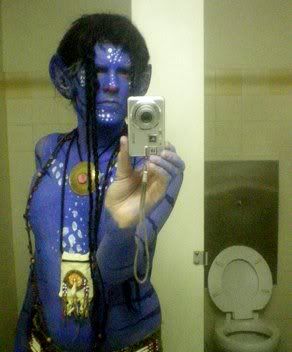
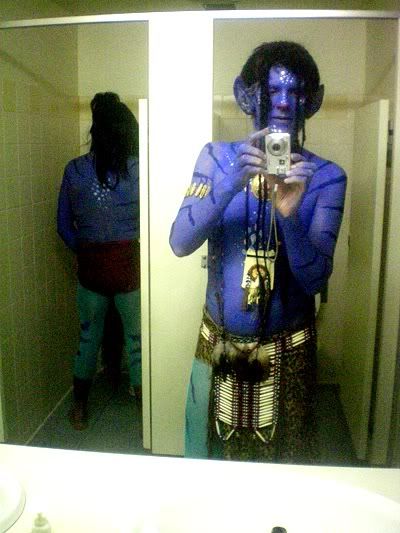
I was spending every available second on my play, desperately working to ply some shape into tens of thousands of words of dialogue, when, without too much warning, I am in some toilet, daubed in body paint, presenting as a Na’vi tribesperson. Again, the vicissitudes ...

With others of my species, I spent time outside Rio Tinto’s Lair of Evil in Collins Street, generally protesting the cruel, ethic-poor behaviour displayed by the company in their ravening quest to wring unobtainium from the flesh of the Earth - and, in particular, their outrageous, but unsurprising, action in locking five hundred workers out of a vast, open-cut borax mine in California and bussing in masked scabs.

To paraphrase Jenny: they make the most successful film in history. It’s seen by a vast number of people. It comes down very hard on the side of the environment, scolds corporate greed, compares the barking violence of the machines to the encompassing beauty of nature ... and what changes? They walk out of the cinema and nothing changes ...

Well, at least by planting ourselves, thus attired, outside the offices of one of our more conspicuous Resource Development Administrations we might go a little way towards helping people recognise a link between reality and what they see on screen.


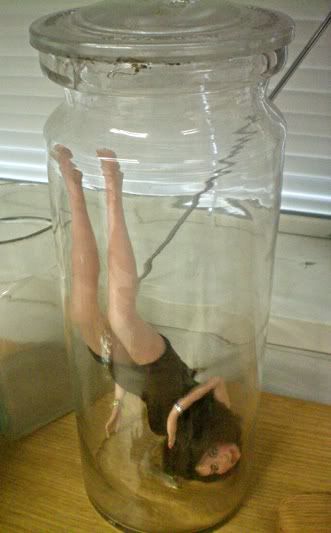
And .... something I photographed in the tea-room of the Melbourne Museum Moreland annexe.


Stumble Upon Toolbar DiggIt!

Saturday, August 1, 2009

~ and what shall I wear?

I missed the original première of Dogs in Space. I had seething issues with the film and nothing would have dragged me out in its support. There was an article in The Age the next day titled something like – Dark Premiere for Dark Film – accompanied by a photo of black-clad people mounting the stairs into the cinema. Edward Clayton-Jones of The Wreckery was among them, I remember that, and I also remember suppressing my visceral regret at not having been there.

Well, tonight, decades later, I have my second chance to show my face at a public screening of a film that’s been a constant presence in my life since it was released. Over the years since, I don’t think I’ve done more than a handful of interviews - whether theatrical, literary, operatic or band-related - in which Dogs in Space hasn’t come up. Inevitably, it’s the angle which journalists choose. Somehow it still manages to overshadow whatever I’m doing at the time. And I won’t even try to describe the effects it’s had on me in a social context.

I’ve never seen the film in a cinema. The first time I watched Dogs in Space was in a darkened room at a production house. I emerged speechless and in tears, then walked around the block about ten times. I did see it again, later, but several blue moons have passed since I’ve viewed more than a snippet.

I think that tonight, with all the raw emotions eroded by time, it will probably be like revisiting an old friend. One among many - as I imagine the audience will be writhing with degenerated eighties contemporaries.

Yet the question remains: what shall I wear?

~ the resurrection of dogs in space

Stumble Upon Toolbar DiggIt!

Saturday, July 25, 2009

~ balibo

Last night, I went to the opening of the film festival at the Arts Centre. A huge event, the like of which I haven’t been to in ages. A great many speeches, seen from a great distance – Geoffrey Rush, John Brumby - and the premiere screening of Robert Connolly’s Balibo.

The sound unfortunately was terrible, doubly so for me with my blasted out ears, but the film about the five Australian journalists killed during the 1975 Indonesian invasion of East Timor (or Timor Leste as it now seems to be called) was a pretty reasonable effort.

It told two stories: that of the Five and the events leading to their deaths, and that of an older journalist named Roger East (played by Anthony LaPaglia), who, with the help of a young, freedom-fighting Jose Ramos Horta, travels to Balibo to ascertain their fates. East’s story comes across in clear focus - it’s the spine of the film - but the Five’s experiences felt strangely spectral. Again, this may be due to my blasted senses but these sections seemed to be coloured differently, as if shot on aged stock, or long ago, with higher contrast and saturation; their time felt far more remote than the experiences of East just three weeks later.

The characters of the Five never fully congealed for me, they always remained a group rather than individuals. They were like ghosts, reprinted newspaper photos brought to life and doomed to die. Their actual deaths were rendered with horrific simplicity and inevitability – there was no mercy for these living dead, and only a sharp horrifying glimpse, through the ashes of their burnt bodies, of the horror of their last moments.

Innocent young Australians utterly at sea in a vicious alien world they did not understand, which did not recognise their ideals, and to which they expected to be immune - simply because they were Australians.

Naturally, the iconic painting of the word Australia on the side of the Balibo house was included. The word became a protective talisman, and, in the end, was just as ineffective as any rabbit’s foot or monkey’s claw. Even East shared this mindset to a degree. His last words, immediately before he was machine-gunned, delivered with a final surprised bewilderment, were ‘But I’m Australian!”

Afterwards, more speeches, including fine words from Ramos Horta who stood with a uniformed bodyguard behind and to his right. The families of the dead journalists were invited on stage, the actors too. Oddly, there was no mention of Xanana Gusmao at any point in the proceedings.

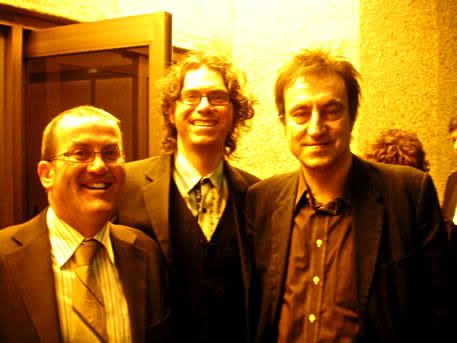
A massive party afterwards, packing every level of the Arts Centre. I got chatting and almost missed the last train to Mount Waverley. Here are a few old cronies I haven’t seen in decades …


Stumble Upon Toolbar DiggIt!

Wednesday, May 6, 2009

~ the resurrection of dogs in space

A few days ago, Mick Lewis and I delivered ourselves into the hands of Richard Lowenstein at his studio in St. Kilda.

For a long time now, Richard has been labouring over the DVD release of his Melbourne cult movie. (You know the one. It stars the sadly missed Michael Hutchence playing a character with distinct similarities to the writer of this blog in his tumultuous youth.) I’m not certain what the delay has been, but it appears that the long awaited release is near.

Mick and I were member of The Ears, the band whose story was used as the basis of the film. We lived, with all the others, in that ratty, shambolic, dangerous, vigorous household of ancient Richmond.

Rather than simply putting a restored copy of the film on a disc, Richard seems to be assembling a comprehensive document of the era itself, collecting a great amount of material in various media to include as extras: photos, posters, all that; some footage from the set of the film, (including my acerbic interview with Michael Hutchence). There are old Ears film clips too, plus the interviews he’s currently doing with a mix of surviving stalwarts from the early Eighties scene. These include other Ears members Tim McLaughlan and Chuck Meo (who played himself in the movie), legendary Birthday Party guitarist Rowland Howard, Ollie Olsen and Dolores San Miguel, promoter of the famous Exford Hotel.

Mick and I must have spoken with Richard for two hours. Sometimes it’s nice to have permission to be nostalgic. I enjoyed dredging back through that time. Despite our courageous dedication to drunken partying and general intoxication, a surprising number of recollections survive. Much of what we recounted sounded, in retrospect, like some scatterbrained, completely arbitrary art project, though it was certainly never intended as such. Magically, bleating lambs appeared overnight in bedrooms. Rattling gumball machines were dragged through the dead of night. Sombre dialogues were held with patient eight-foot roosters on busy Wattletree Rd. After speed-fuelled Space Invader marathons the pixelated aliens would march remorselessly across the inside of our eyelids as we threshed in our beds. Once I spent hours on my hands and knees crawling around someone’s house, entirely disoriented, desperately trying to stand up after injecting a vial of liquid phenergan which someone had appeared with ...

Through the interview, Richard didn’t concentrate strictly on the events which inspired the film, but attempted to steer things towards the broader context of the time.

When you’re young, everything is exciting, that’s a given. If you’re out there doing things, making the scene, it’s easy to feel like you’re the centre of the world, the cynosure. It may feel like it’s the first time in the history of the Earth that such fantastic new sounds have been heard, but really all that’s in play is the arrogance and naïveté of youth.

I have always suspected that the claims made by contributors to the early eighties scene in Melbourne have been overly subjective, and that, however brilliant it all seemed at the time, it was still more or less the same thing which every generation goes through. As for myself, I’ve always been reticent to suggest that I was part of something particularly unique.

But, after the interview. After listening to Rowland, Dolores and all the rest, I began to suspect that there might really have been a special something about the scene back then.

Twenty five years ago, it was a smaller, greyer, far more conservative city. There were no street cafes. Restaurants rarely had bars and you could count on two hands the number of 24 hour establishments. You’d be hassled for wearing hats in pubs and chastised by war veterans for wearing second hand medals on the tram. You could get beaten up as a poofter for wearing anything even remotely peculiar. The only alternative scenes were the sluggish festering hippies in Carlton and Fitzroy, a gaggle of Maori drag-queens in Fitzroy St, and the tribes of skinheads and sharpies in Holmesglen and Bayswater. Musical offerings included pub rock, more pub rock and maybe a bit of flaccid folk rock.

Into this dead zone stepped a new generation inspired by the punk movement in London, New York and Detroit. But it was not just the music. Because the city was smaller, because it was so disobliging of strangeness, there was a tendency for the weirdos to find each other and congregate for safety. The David Bowie queue portrayed in Dogs in Space was one catalyst for this. It was there that Mick and I and the rest of the Ears discovered a host of like minded souls who became our friends, collaborators and fans.

An example I like to use involves the freakish hair colours most of us sported to varying degrees. In the Melbourne of 1980, if you caught sight of someone across the street with dyed purple hair, the odds were you’d know them. The scene was that small. Today, well, you wouldn’t bother looking twice.

So all the alternative types were tossed together by circumstance: the hardcore punks, the industrial experimenters, the new wave pop exponents, even mods - along with visual artists, designers, artists and writers. And it became a melting pot. Today, Melbourne is large enough to support many distinct scenes, but then there was really only one, and the vibe, looking back, was singular.

*

There was a tragedy during the period described by Dogs in Space which was to fuel the central drama of the film. It was over this issue that Richard and I were to fall out. Readers of this blog, specifically the transcriptions of my early eighties diaries, will know I’m referring to the
overdose death of my lover Christine.

Though I’d been involved with Dogs in Space and had encouraged it, I hadn’t taken careful notice of certain plot elements. It wasn’t until I saw a rough cut that I realised that the film appeared to show the ‘Sam’ character introducing the ‘Anna’ character to smack. I was aghast. Though the film is fiction, it conforms largely to the facts of real life, and on this sensitive point, it jarred badly with the truth. I was horrified to think that anyone might think I was responsible, even indirectly, for Christine’s death.

I responded in the media with as much vitriol as I could muster. ‘Sam Mad About Dogs,’ is one headline I recall. In one interview I was quoted as saying ‘The film appears to be suggesting that if you take heroin you can go to heaven with Michael Hutchence’. Contemplating litigation at one point, I even found myself in lawyer’s office [but not for long after he discovered I had no money].

Indeed, it wasn’t until Troy’s memorial a year or so ago that Richard and I buried the hatchet. It was mostly down to me, as the aggrieved party, and I was relieved to end the acrimony. During last week’s interview, the subject of Christine’s death was raised and we discussed it like gentlemen. Richard had always thought that the dichotomy between fact and fiction was clear, but way back, when my emotions were still tender, I just didn’t believe the public would be able to make such distinctions. To some extent I was probably right, but it was all so long ago… Thankfully, we can be friends again at last, and Richard, all in all, is not a bad friend to have.

*

Addendum July 21 - The 'Dogs in Space' re-release premieres at the Melbourne Film Festival on August 1; the related doco 'We're Living on Dog Food' on August 2. The Ears reformation gig is on August 16 at The Corner hotel: Keep informed on Twitter

Ears photo album

Stumble Upon Toolbar DiggIt!

Thursday, April 23, 2009

~ milk

It was good to be a father yesterday.

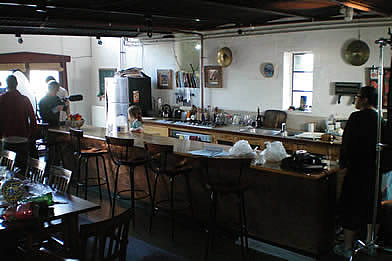
For his short, milk-related film, Ben, who studies film at RMIT, found a very upscale kitchen in an extraordinary house built into the shell of an old brewery in Collingwood. The place was bursting with beautiful furniture, objets and what have you. There was an internal balcony looking down from a bedroom onto the living area you see beneath, two vast old brick chimneys beautifully integrated into still another sprawling living space, and a roof top deck with a view of all northern inner-city Melbourne. I don’t often get the chance to see inside places like this …

Maybe one day ... I can only dream.


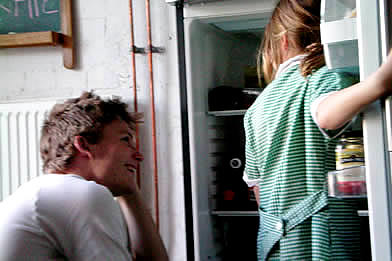
Ben had a bigger crew than I expected and a load of equipment, including tracks. Into this complicated scenario walked the tiny six year old Polly in her school dress. I know she hates being in front of crowds and the concentrated attentions of an eight-strong film crew must have worried her, but she showed no sign of nerves. Ben took just the right tack. He was sweet, patient and gentle, but he’s that sort of guy anyway, so it wasn’t much of a stretch.


Polly discovered the meaning of the words action and cut. She saw her first clapper. She learned that sometimes shots need to be done again and again, even if the actor has done her job perfectly. As I mentioned in a previous post, all she had to do was get a bottle of milk from the fridge, take it to the kitchen bench, pour a glass and drink it. It sounds simple, I know, but it wasn't.

I was amazed – and proud – of how precisely she obeyed the director’s instructions, and how well she remembered all the little subtleties she was asked to add.

They’d chosen one of those big 3 litre plastic bottles, so it took all Polly’s strength to heft it, but the real killer was the milk itself. So many takes, so much drinking, and I don’t really think she was pacing herself. Then came a shot in which she accidentally poured a huge quantity into the glass and proceeded to swallow it down. The camera kept rolling and the room held its breath. Would Polly obey her directions and try to drink it all before looking up and smiling at the camera? Or would she work around the excess in some way? Trooper that she was, she attempted to do what she’d been told and continued taking gulp after gulp. Everyone there was feeling that milk go down. Ben and I were exchanging worried glances. I was concerned that she’d damage herself in some way, internally, or perhaps vomit …


In the end, thank god, the director broke in to say she didn’t have to drink it all. Such a determined little creature, focusing so hard on getting it exactly right

From that point on, she mimed as much of the milk-drinking as was possible, and, inevitably, began to complain of a sick stomach. After about two hours of hard concentration, she slipped, banged her tooth on the bench, and let go all the pressure with a long cry. Then a short break, one more shot, a wrap, and a round of applause for a fantastic effort.

It so happens that the camera they were using was the same one used in the filming of Brideshead Revisited. What about that? The work of Sir John Gielgud, Sir Laurence Olivier, Jeremy Irons, Anthony Andrews has passed through that device…


And now that of Polly Sejavka.

Stumble Upon Toolbar DiggIt!

Monday, November 3, 2008

~ serpentine dream theory

Southland Tales: the newish film by Richard Kelly, [Donnie Darko]. It’s very entertaining, a sprawling futuristic comedy not unlike Idiocracy; more vaudeville than high art, and different in nature to Kelly’s previous film.

I mention it because of a seemingly casual reference made to the ‘self-destruct switch’ of an SUV.

An interesting idea, no? It flows with the essence of the device, does it not? Fictional spacecraft tend to be fitted with them. And I’m sure the driver of, say, a Hummer would think it was right on ... the power to annihilate himself in an exploding ball of fire ... right there, at his fingertips ...

Rather than mandate it, authorities would automatically frown on such a thing. Too much collateral damage for a start. But if we are capable, as a society, of inviting such monstrous devices into our streets, then surely the sight of them detonating should not appall us that much? In a frightening greenhouse future, things that may once have seemed shocking may become commonplace. It’s just a question of emotional perspective.

Like seat-belts and air-bags, the self-destruct system would naturally have to pass stringent regulations and be of the highest quality manufacture – yet it’s still difficult to see how extraneous damage to other vehicles, infrastructure, onlookers [and their emotions] would ever be avoided.

Does this kill the idea? I don’t think so. Designated zones might be created, even thunderous death arenas; but my instinct is that a high percentage of self-annihilators will be acting on the spur of the moment - and the world would not want to lose those precious seconds in which a noxious parasite was prepared to voluntarily wipe itself from the face of the Earth.

What we require is implosion, rather than explosion. In a necessary riot of harmless light and sound, the vehicle would safely crumple in upon itself, leaving a small recyclable cube or sphere. Crumple zones are already incorporated into car design, they just need more development.

The SD switch, required by law for all personal vehicles over a certain weight and fuel consumption.

Southland Tales also mentions something called Serpentine Dream Theory. Whatever it is – and the explanation just washed over me - it could never be as good as it sounds.

Stumble Upon Toolbar DiggIt!

Tuesday, October 21, 2008

~ m night shyamalan

I have a such a thing for M Night Shyamalan. It flies in the face of the critics – and there seem to be a whole lot of them – who have canned every movie he’s done since The Sixth Sense. I can see where they’re coming from – or, rather, It doesn’t surprise me that people miss the point, or fail to react to the magic at the heart of his films.

I’ve just finished watching The Happening on video. I saw it in the cinemas and loved it - but with reservations, as it had that slightly flawed feel that a lot of his films do. On second viewing, I was surprised that I enjoyed it nearly as much. I managed to suppress my annoyance that – in the face of a microscopic airborne threat – too few people were masking their faces. I think, if you stumble on details like that, you will never enjoy his films. I don’t think Shyamalan is unaware of these things; I suspect he deliberately lets them fly loose, as a reminder that we are expected to suspend our disbelief, that we are to look elsewhere for the meaning of the work ...

Sure, it’s a kind of artistic vanity; the same as his inevitable Hitchcock-style cameos, but I find it very easy to forgive him, as, along with Guillermo del Toro, he sits very high among the leading exponents of the horror/fantasy film genre. Even at his most indulgent – and I guess Lady in The Water stands accused – what he creates is both fascinating and moving. Lady in The Water – the story of a fantastical water nymph who appears in the swimming pool of a routine apartment block – is one of my favourite films. It’s one of those works which explore the meaning of narrative and are sometimes called post-modern. Think of Italo Calvino’s If On A Winter’s Night A Traveller. Lady in The Water is unique, beautiful, sweet, inspiring and, inevitably, flawed. It puts on display Shyamalan’s flair for showing what it might really be like for something incontestably magical to blossom in the everyday banality of our lives. It’s pure Magic Realism.

I think this talent, more than anything else, is the reason his films work so well. Sure, he’s a past master of the long con; his twists are very good, (though The Happening was lacking in this respect), but in the end these are plot devices; they’re in with the nuts and bolts he uses to construct his films.

Then why, as the ring bounced in The Sixth Sense, and the film slowed - allowing time for the viewer to process what he was seeing - did I, like so many others, feel not only a shiver but an emotional charge. What made it more than just an ‘uh-huh-moment’?

Because Shyamalan knows that we have to care about characters if we are to really travel with them. The people in his films are nearly always sympathetic; we understand the way they behave and feel - so that when the queer shit starts, it’s as if we are there ourselves ... Mel Gibson’s priest in Signs ... Mark Wahlberg and the gorgeous Zooey Deschanel in the Happening ...

Indeed, the human element of his plots is almost strong enough to support the film in itself, magic or no. It is never secondary to the special effects, and often the mundane and the eldritch are inextricably entwined. Think of the extraneous drama in a porn flick – well, this is the diametric opposite. Shyamalan has a real knack in this regard. I think it’s the core of his talent. It’s what really raises his work above the quagmire of bad horror that lines the shelves of our video stores. That and the novelty of his scenarios.

That news flash in Signs: the home video of the children’s birthday party in which the world gets its first glimpse of the alien menace. The abyssal horror emerges in the most pleasant, comfortable surroundings we can imagine, where our precious children are happy and protected. I found it profoundly creepy. I went cold all over. Not like the fright I got from the hand in Carrie, nor the sickening fear of Alien. Something a lot closer to home.

The Happening is replete with similar incidents. In fact, it’s an orgy of them. Again and again, the unspeakable tears apart the contented illusion of day to day life - and to watch is horrifying. Repeatedly, characters seek to kill themselves as expeditiously as they can, as if the act is no more unusual than tying a shoelace ...

So, now that I’ve consumed a couple of valuable hours ruminating on this random topic, know this: the next time you read one of those negative reviews on a new M Night Shyamalan film, claiming that he reached his peak with the Sixth Sense, be warned. The critic probably didn’t get it.

Stumble Upon Toolbar DiggIt!

Thursday, August 21, 2008

~ the road

I haven’t often cried finishing a novel. It has happened, but I can’t recall the particular titles… Love in The Time of Cholera, possibly. Perhaps after One Hundred Years of Solitude [Gabriel G Marquez] … J G Ballard’s The Kindness of Women

But last night I finished off The Road by Cormac McCarthy. For brute emotional force it trumps everything - at least everything I can bring to mind. It’s the long nightmare from which you are unable to wake, a frozen, pared-down hell in which nothing remains - save for a few desperate humans and their various brands of humanity. The crumbling black bones of Nature. Some scavenged goods. A few improvised tools and a world of wet ash. What these survivors do, in order to persist, ahead of the inevitable void, becomes a flat expressionless judgment of humankind.

I’m sure a tremendous amount has been written about The Road. I won’t go on. I’ll just say that I think, for this time, for the current version of the human race , it’s the best book I’ve read - and that the final couple of paragraphs come down on you with the weight of every single word prior.

(I wonder if the movie will hold true? It’s in post-production, directed by John Hillcoat, [The Proposition, Ghosts of The Civil Dead and, incidentally, the clip for The Finer Things by Beargarden]. Viggo Mortensen plays The Father, of which I’m glad.)

Stumble Upon Toolbar DiggIt!