Pages

Showing posts with label DRUGS. Show all posts

Wednesday, September 28, 2011

~ arm in python


I heard a story the other day about a girl who, being thoroughly wasted, passed out on the couch in an unfamiliar house - to wake with her arm swallowed to the shoulder by an overly ambitious pet python.

When people intersect with drugs, when the safe day-time world is penetrated by heavy-lidded Morlocks on Kronic or Crack, on Krank or Can-D, bizarre complications often ensue – a phenomenon I'm quite certain is news to no reader of this blog. At present, I'm trolling the far oceans of abnormality for the best and most unlikely pharmacological tales as
I'm editing a few issues of Whack Magazine - 'Whack' being the official (and mischievously named) 'organ' of Harm Reduction Victoria, the drug-users' advocacy group.

If you have one of these stories (or any interesting
drug-related writing - fiction or not) I'd love to see it. Email it to sam.sejavka@gmail.com. If you dare. I'm also seeking imagery on the same theme. Payment is on publication (etc) and almost - but not quite - at normal commercial rates.

On Friday next week, Polly and her friend Ocean are performing in Snatches at RMIT's Kaleide Theatre . It's just a small piece - but an important (perhaps even critical) continuation of The Goitre Bird Cycle - in which the girls, while innocently fishing beneath a sewage outlet, encounter the baffling Starched Penultipope, and proceed to divest him of a fabulous treasure ...

As for me, life writhes and slithers ... like a tunneling snake of quantum uncertainty. For every tragedy, there is a boon, and though I still have plenty of good reasons to crumple myself like a piece of used tinfoil, other more mysterious, more beautiful and bountiful influences have eased the general havoc of my life.

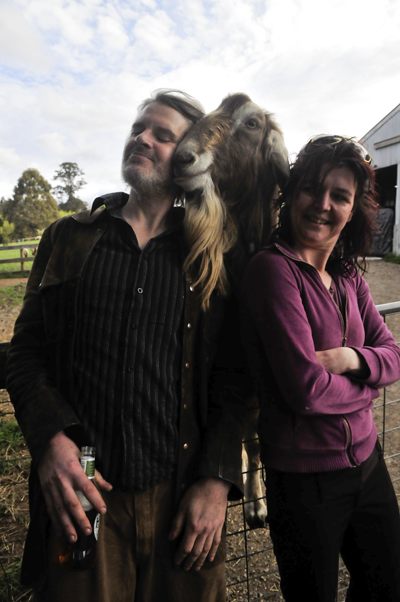
Take, for example, Henry, the estimable and very musky billy-goat pictured below (with myself and Heronymous Posh, photographed by Suzi Q P Dhol). The pupils of his eyes are disturbing to behold: uncanny, ur-satanic, horizontal rectangles, the like of which I'd never before encountered. What's more, in rutting season, the hairy rump of of every nanny-goat in the paddock is reliably worn to bare hide by
this proud, insatiable beast.

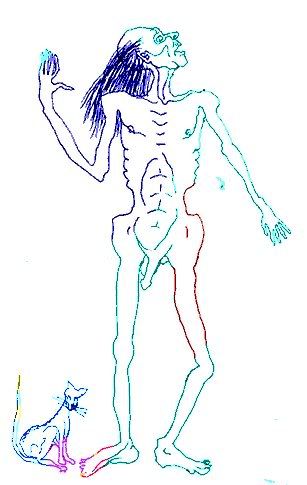
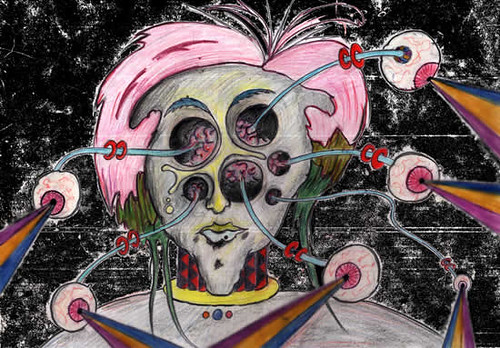
nb: the art at the top of the post is by Jenny Gameson.

Stumble Upon Toolbar DiggIt!

Thursday, February 3, 2011

~ my intimate blood-borne saboteur.

For better or for worse, I’ve enrolled myself in the trial of a new drug which may be a potent HCV inhibitor. It’s a triple therapy: as well as the study drug, I’m on the standard-of-care - peg-interferon and ribavirin: a toxic cocktail which tends to cause anaemia, flu-like symptoms and a genocide of the neutrophils, those fundamental elements of the innate immune system which are seen most often as a constituent of pus.

I’m desperate to shrug off the virus. It’s not killing me yet. For a fifty year old my liver’s in pretty good shape - according to the painful biopsy I had a few weeks ago. And my level of ALT (an indicator of inflammation) is within the normal range. However I’ve had the accursed invaders for upwards of a quarter of a century and there are rather a lot of them: at last count nine million viroids per millilitre of blood. The moment age begins to weary me, to weaken me, I fear they will grasp the opportunity to scour me from the surface of the planet - like a fastidious girlfriend with a box of tissues, scrupulously seeing to a clumsy boyfriend’s spilled red wine

Weird simile, I know. I’ll trust my subconscious and leave it there. Oh, and I was stung by a bee the other day. The hottest of those recent days. In Bruce Butler’s pool. A bee, of all things. There I was, lounging peaceably in one of Bruce’s vast and colourful collection of floatation devices when, lo, the underside of my upper-arm descended upon a bee. When did this last happen? Was I six? Younger perhaps? Of course, even a painful incident like this will not undermine my love and admiration for bees. The creature was acting purely out of instinct. I know that. Though I admit to taking a soupçon of pleasure in what must have been a painful, extended demise.

Polly, however, was out of the pool in a flash, pale as a sheet, trembling in the corner furthest from the water, demanding that we leave immediately. She is terrified of bees. And wasps. Snakes too, I think. (About a fortnight ago, I was walking with her and her friend Megan by Scotchman’s Creek when I spied what I believe to be a tiger snake side-winding across the path. I was a child when I last saw a snake down there.)

Just to finish up on the subject of bees ... Robert - as I have explained previously - cannot stop himself feeding the surly, obese, ill-humoured local population of brush-tailed possums. He built a beautiful possum box for them to inhabit - put it atop the shed in the hope they would cease forcing up the tiles and sleeping in the roof. Robert knows the ways of these possums. Intimately. He can tell them apart as they come for their nightly serving of putrid bananas. They seem to trust him too; he alone is allowed to stroke the fur of the matriarch’s offspring peeking from her pouch ...

Unfortunately, before the possums even noticed Robert’s labour of love, a swarm of honey-bees appeared and automatically made it their home. They became a fixture in the yard. During the Winter,
for a time, the hive disappeared and shortly after we found pieces of depleted honeycomb amongst the dried leaves and the dust beneath the box. With Spring the bees returned, and they remain there now ...

I would love to steal a little of their honey... but I dare not risk it.

But back to the point ... this is my fourth attempt to flush the (stubborn genotype 1a) virus from my system. The first was a a monotherapy: interferon-alpha on its own (I responded, but barely). The second was trial of something called Rebif: interferon-beta, typically used for MS patients (The injections hurt like hell, I felt like shit and it did nothing). Then came the double-therapy - still in use - interferon-a and ribavirin (my viral load dropped from 10,000,000 to 1200, but then, like the Borg, the virus adapted and resumed its deadly replication).

Each of these attempts have excised more than six months from my life. It’s simply impossible for me to operate as usual while on these drugs. I’m not myself. I’m reduced, functioning at a minimum.

It’s a gamble: surrender these swathes of time in the hope that, later in life, I will avoid cirrhosis, or liver cancer - or else take a chance and let the virus do its evil work. Always a hard choice. And Polly must be considered. I don’t want to be sickly and weak when the time comes to wield an axe - or machete, or shotgun - when suitors come a-calling ...

I have benefited from the treatments. The most recent, though technically a failure, has caused my liver to show signs of improvement - despite my viral load careering back up to nine million.

This time round, at three weeks in (I’ve just had my fourth weekly injection of interferon-a) the side effects have been milder than I recall. The initial fortnight was bad - I might have had a poisonous creeping ague caught from some queasy, debilitated swine - but since then I’ve been normalising. There is the anaemia of course. It gets in the way of the exercise I rely on to bind my body and soul. But if this is the worst of it - this and the fatigue and the fogginess and the low-mood - then I will plough through the twenty-one weeks remaining with ease.

Perhaps the virus is already gone? The new drug - BMS 790052, which directly attacks a protein necessary for HCV replication (NS5A) - is supposed to work very rapidly. Perhaps I’m feeling better because I’ve cast it out at last. My dark passenger, as Dexter might put it. My intimate blood-borne saboteur.

Or perhaps I’m one of the unlucky ten percent who, instead of the new drug, are receiving a placebo?

Stumble Upon Toolbar DiggIt!

Tuesday, April 27, 2010

~ a third column

I started this blog because, like everyone who gets into blogging, I wanted to add a third column to my ... template.ThreeColumnBlogger

Over the next week or so, health willing, I’m going to make an effort to update the Sails of Oblivion layout, so please excuse me if the page looks strange from time to time. I really want that third column ... mainly for the twitter feed and all that stuff which gets lost at the bottom. And I think it’s time for an improved header. And a fresh new look all round.

I saw a little wattlebird yesterday. Similar to the common red wattlebird but devoid of wattle and yellow-stained chest, and blessed with a distinctive, possibly even more demented range of vocalisations. Today there were some masked lapwings on one of the Monash Uni ovals. In the Valley Reserve I witnessed the wonderful display of a flirty grey fantail and, briefly, I think, an eastern spinebill.

As long as I can remember, there have been tiny brown and grey chirruping birds living outside the window of my study. Like all species, they have their own specific character - a thing which birders (unfortunately) call their ‘jizz’ - but until recently their identity has remained mysterious. Despite their abundance, it was a hard job pinning them down - even with the help of my new field guide. They do not look spectacular; they are not an imposing bird in any way, yet they colour the ambience here with their twitters and trills, and the flickering they do among the leaves. I am sure I would notice their absence.

I learned that they are brown thornbills - and with this knowledge a world opened up, just there, outside my window, of which I had no real prior awareness. Now I know their preferences, the months they breed, the kind of nests they make and the extent of their range. It’s all so ... fascinating. A name is a key - and never more so now we have the internet.

I am beginning to see the hot churning black hole at the centre of the birder’s mind; I am beginning to feel its irresistible attraction ...


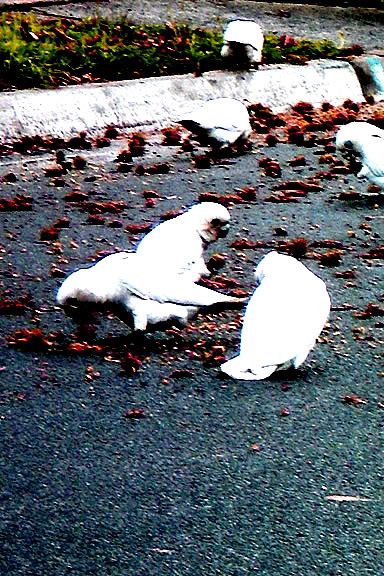
This is the long-billed corella. The last few mornings I have heard the harsh, grating voices of a flock passing high above the house. The bird often looks scruffy because it has a habit of digging for tubers, including, helpfully, the bulb of the hideous onion weed. The individual above, (photographed by Noodle Snacks) is, however, perfectly presented, though
the bloody bib suggests (falsely) that it may recently have been gnawing at something’s throat.

Yesterday, Polly imprisoned a daddy long legs in a small lidded container together with a snail in the hope that by morning they would have ‘mated’. Also, she’s acquired a device called an R5 which holds eighty games and can be plugged into the back of her DS - this will settle her for the next week or two


Speaking of mating, did you hear about the transgenic pig-sheep? I was excited for a while - and hopeful, thinking it might have some advantages for the environment. We farm pigs anyway; if they could grow wool as well as bacon, then there's got to be some kind of energy saving. Perhaps some of our sheep pastures could be turned to forests roamed by woolly free-range pigs? Disappointingly, the abomination turned out to be the Mangalitza, a rare porcine breed from Austria with no apparent sheep genetics. Still, the idea is there. There's no reason to give up hope entirely.

And if only there were a substance that was neither illegal nor poisonous which you could have just a little of as night begins to fall. Something to make you laugh and forget how tired and sick you feel, something to elevate the spirit and anaesthetise some of the wounds acquired during the day - and which did not give you a hangover. Is Big Pharma working on something like this? Would they be allowed to? And if they succeeded, would it be legal?


This is a an old car that burned in the black Saturday bushfires. It was part of a collection of valuable Australian antiques and was donated to the Melbourne Museum in the condition you see. The chassis of most modern cars warped, even melted in the terrible heat, but older cars, with heavier steel bodies, seem to have been able to hold their shape. Mind you, the insides were a charred and melted melange.

Stumble Upon Toolbar DiggIt!

Saturday, July 4, 2009

* June 14 1981 Sunday 8.00pm

I’m auditioning for an Ovaltine ad. Small Kate arranged this. There are photos tomorrow.

On Friday, after coming back from Franca’s and the most potent trip I’ve ever experienced, I took heroin and went to the Seaview. Afterwards, I went back to Kate S---‘s.

The following night I passed out at Phillipa White’s house. Our first practice is tomorrow.

I’m still very determined.

*

A laconic yet evocative entry.

First, the Ovaltine ad. I wouldn’t want to upstage any later posts, but it’s safe to say that the exact product was Ovaltine flavoured milk in a carton, that the ad had a ‘Blitz’ theme, and that I got the part.

I recall going to Franca’s. I was with Gus, at his place in Punt Rd across from The Office Hotel. His friend Simon dropped by driving a taxi and proceeded to flatter me on my talents as a frontman. This taxi-driving sycophant turned out to be Simon Polinski, who wound up joining Beargarden on bass, and ultimately became a legendary, Aria-winning producer/engineer.

Franca lived in the hills, in a place called The Patch. I can’t remember why we wanted to go there - surely it wasn't for the mushrooms - but I’ll never forget how astonished I was that Simon happily drove us in his Taxi and then went back to work. It must have been fifty kilometres, at least.

And the first practice? This was the band that would become Beargarden, though I don’t think we had the name yet. There was still a chance that we might have called it something else … that we wouldn’t make that fateful decision.

Stumble Upon Toolbar DiggIt!

Tuesday, June 16, 2009

~ the passing of immaculata

I’ve spent much of the last three weeks writing an article on naltrexone implants. Too long for a simple article. I get buried in the research, and in polishing the text, and lastly in reducing the text by half because I inevitably write twice as much as what’s needed. I should be quicker by now, but I’m not.

Naltrexone is a drug that blocks the effects of opiates. Usually, it’s taken in tablet form by recovered junkies to prevent relapse, but there’s also a slow-release delivery module that is inserted under the skin and which can last months. It’s unproven and unsafe, but many desperate users are turning to it as a last resort. A lot of politics are wound up in this story, a lot of overdoses too, and a lot of infected incisions.

If you’re interested, the article will hopefully be in the next issue of Whack!, the magazine of Harm Reduction Victoria. Perhaps along with another article I’ve written on the shamanic drug ibogaine.

On the ornithological front, it is my sad duty to report the disappearance of the white duck Immaculata. She has been missing from the Grey Creek for at least a month now, and I fear the worst. The last few times I saw her, she seemed uninterested in food and I think she was already fading as winter descended.


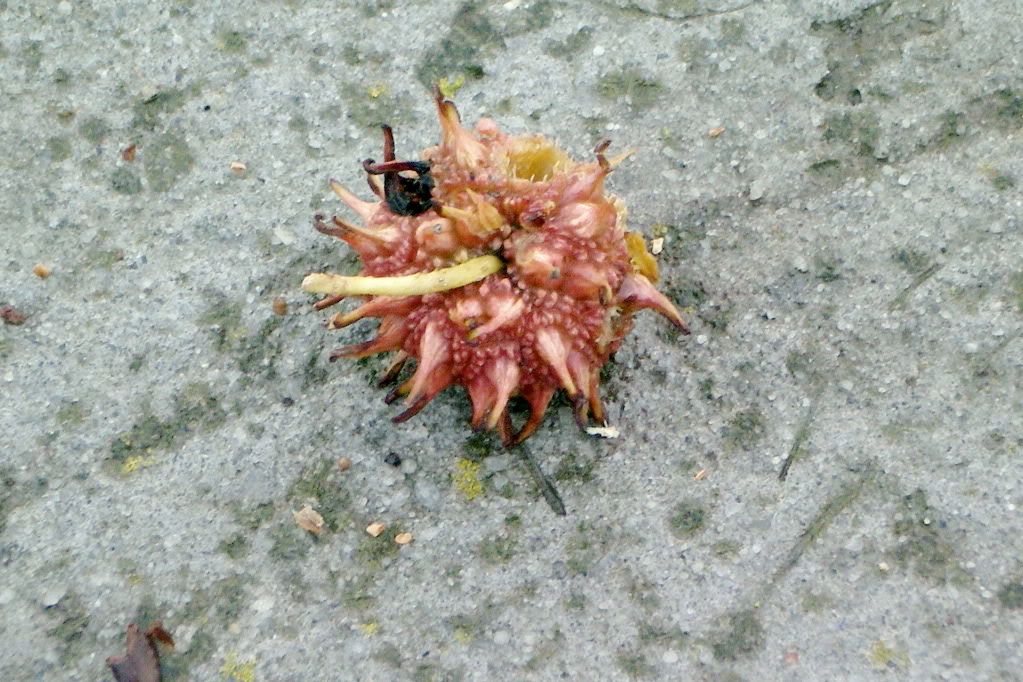
Lat week, there was a huge flock of sulphur crested cockatoos feasting on the spiky balls that fall from the liquid amber trees at this time of year.


But more exciting by far was my sighting of about a dozen black cockatoos by the grey creek. Identifying them has been hard.. There are five types of black cockatoo. Glossy black cockatoos don’t live here. They weren’t gang gangs. Red and yellow tailed black cockatoos do live in Victoria but I didn’t see enough colour to tell … It must have been one of these two.

The Sails of Oblivion Gig surges on. Dolores, the promoter is a force to be reckoned with. We’ll have facebook and myspace pages set up within the next few days.

Stumble Upon Toolbar DiggIt!

Saturday, April 12, 2008

~ my brain on drugs in the year 2045


For those of you with access to the Vivaids magazine ‘Whack’, my article ‘The Mysteries of Opiophobia’ has appeared in the latest edition.

The magazine has announced a cover design competition and the prize is $200. What you see above is my first effort.

Stumble Upon Toolbar DiggIt!

Sunday, April 6, 2008

~ the curing

On Sunday at Camberwell Market, feeling wretched and foolish, I lost a beautiful facsimile edition of Poe’s Tales. Just mislaid it. As I do so often with so many things. Twice I’ve left my phone on the roof of my car. I’ve left my coffee there at least… on a googolplex of occasions. Like my mother – even in her non-declining years – I put inappropriate things in the fridge: TV remotes, laundry powder, money, bills, scissors, face cream, turpentine … I could never remember all the things I forget.

Is it dementia? My mother exhibited signs before she died at the age of seventy-two, but she’d been putting shoe-polish in the Frigidaire even when I was small. I haven’t started doing crosswords yet, trusting that my line of work provides sufficient neural exercise. I just hope that my chronic absent-mindedness is not a symptom of something dreadful on the horizon.

I was at Camberwell Market, wasn’t I? Losing things … Becoming disheartened … After all, I was there to make money, to find books to hawk on ebay, not to leave lying about. Because of the daylight savings shift, I arrived early and didn’t have a good morning. Stall-holders were still hoping for the prices they’d imagined.

For me it’s best to go after I’ve metabolised my Spasmo-Nemigron, after my system has normalised. Then I can enjoy the process.

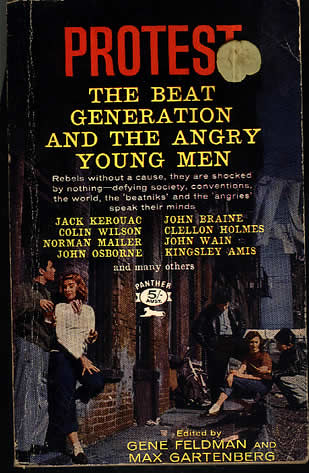
I found one particularly interesting thing: an old paperback in good condition called ‘Protest: the Beat generation & The Angry Young Men”. These were ‘rebels without a cause, they are shocked by nothing – defying society, conventions, the world, the ‘beatniks’ and the ‘Angries’ speak their minds’.


A bit iffy, comparing these two movements. The Beats were something wild and new, the Angry Young Men were comparatively polite and, well, British. Colin Wilson was the only truly interesting one, and mainly because of his marvellous erudition and his ability to present his subversive ideas in a manner that didn’t too badly offend public decorum. He was not tearing at the very fabric of society as the Beats most assuredly were. The other ‘Angries’ – John Braine, John Osborne, Kingsley Amis, J P Donleavy – were distinguished writers, but we certainly don’t associate them with literary revolution. Indeed they appear starchy and wan compared to Burroughs, Ginsberg and Kerouac, who were the principal Beat contributors.

The book was published in 1960, early enough for William S Burrough’s contribution to still fall under his original nom de plume ‘William Lee’:

A scion of one of America’s most illustrious families, he has not transgressed against established law because of poverty or lack of personal opportunity … Yet ‘by his own description, the author is a drug addict, thief, pusher and pimp.

What follows is an except from his first novel ‘Junkie’, [later to be retitled ‘Junky’]. It’s been ages since I last read it and I encountered a short passage that piqued my curiosity …

“To me, teaheads are unfathomable.

“There are a lot of trade secrets in the tea business, and teaheads guard these trade secrets with imbecilic slyness. For example, tea must be cured, or it is green and rasps the throat. But ask a teahead how to cure weed and he will give you a sly, stupid look and come-on with some doubletalk. Perhaps weed does affect the brain with constant use, or maybe teaheads are naturally silly.

“The tea I had was green, so I put it in a double boiler and set the boiler in the oven until the tea got the greenish-brown look it should have. This is the secret of curing tea, or at least one way to do it.”

I’ve also noticed a certain mythology associated with the curing of pot. It is always spoken of vaguely; one can never get clear answers, yet some will claim it is of critical importance - but as far as I have been able to judge all that is necessary is to let the vegetable matter dry slowly and naturally in a well ventilated room. Upside-down is good, as the leaves dry to form a natural protective sheath for the delicate heads. Various subtle techniques can be employed during the drying, but in the end they make little or no difference, [although practices like ‘sweat-curing’ can help speed things up].

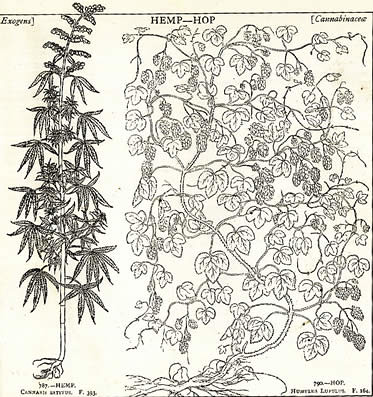
So That’s all there is to it. No great secret. Curing is more or less a synonym for drying. People also speak of immersing the root ball in a sugar solution, but that’s just piffle on a level with the very tempting myth that hops, a near relative of cannabis, can be grafted onto cannabis rootstock and made to produce THC – so creating the appearance of a perfectly innocent, legal crop.


During WW2 the US Government attempted to create a ‘cannabis strain that would yield a superior quality fibre … that would tie up ships without turning on the troops’*. A man named H E Warmke was front-man for the project, which also unearthed a useful means of producing polyploid plants by soaking seeds in colchicine [the toxic derivative of a beautiful flower bulb]. It was Warmke who claimed that hop flowers grown from cannabis roots contained equal levels of THC to standard weed.

A pipe dream, if ever I heard one

* From The Connoisseur’s Handbook of Marijuana

Stumble Upon Toolbar DiggIt!

Sunday, March 30, 2008

~ a ukrainian girl with an altered consciousness

Some of us - perhaps most of us - naturally seek out altered states. To quote Andrew Weil’s classic book The Natural Mind...

"The desire to alter consciousness periodically is an innate, normal drive analogous to hunger or the sexual drive."

And now a concept which may possibly be familiar to you – and which almost certainly, found its origins in this particular study …

"Anyone who watches very young children without revealing his presence will find them regularly practicing techniques that induce striking changes in mental states. Three and four-year-olds commonly whirl themselves into vertiginous stupors …"

For me – and, I think, for a great many others – this ‘innate drive’ gathered steam during my teenage years. Because real drugs – heroin, acid, pot etc. – were not within reach, or barely understood, necessity became the mother of invention. I have no idea how the information filtered down, but we learned that ephedrine , a low grade speed, was easily obtainable over the counter, if you had the right story for the pharmacist.

To our sweet, naïve minds ephedrine seemed like a pretty decent high.

On some nights, I would steal one of mum’s cigarettes, sneak out to the carport and smoke it like a joint. Until I caught the habit, this practice would pleasantly spin me out for about twenty seconds. It was thrilling but pungent, and surprising thoughts would jangle through my brain.

Once, just as my mind was clearing, I heard a monstrous noise in the shadowy dark - a noise I could only equate with the utterances of degenerate mutants or bog monsters from shows like The Outer Limits. I couldn’t believe my ears. The noise came again, and again. Guttural. Deep-throated, phlegmy. Threatening. Hovering between disbelief and terror, I backed away and made haste into the brightness of the house.

Later, I learned it was a brush-tail possum. Before that period – the mid-seventies – the species had been unknown in our zone.

But back to altered states…

I’ve always been prone to fainting – not the neurasthenic crumpling of Victorian England, but the blood-draining kind that occurs when you stand up too quickly after sitting for too long. As you regain consciousness, your brain is suddenly awash with freshly oxygenated blood and the world, briefly, seems vibrant and seething with fresh possibilities. It can feel like waking from a deep and healing sleep to a brand new beautiful day.

With practice, I found I could kick off a fainting spell pretty much whenever I liked. A big long stretch, hanging from a door – these were reliable techniques.. I came to use it - along with the ephedrine – as a revitalising study aid. There still remains an indentation in the kitchen door where my head impacted after a particularly gratifying collapse.

Of course, my parents used to worry. I explained what I was doing, but they tut-tutted and worried still more. They pointed out that there were dangers in passing out all over the place. My mother thoughtfully advised me to clear any sharp objects from the vicinity before I applied the technique.

Sometimes she could be very practical, my mother. Allow me to give you an example

I recall a sunny, somnolent afternoon in Mt. Waverley. It was the dawn of the Nineties and I had moved back there after breaking up with my girlfriend Charlotte, who chose this day to rock up in a condition which could reasonably be described as insane.

Recently, there had been an agreeable but drug-fuelled and ultimately false resurgence in our relationship. Nothing had been solved from previously and things very quickly turned sour. Only weeks prior, after the premiere of my play The Hive, she had lain like the Vitruvian Man on the bonnet of my mum’s kingswood, gripping a windscreen wiper with each hand, while I accelerated before braked hard in an effort to throw her off onto the road. To my drunken amazement, I could not dislodge her.

My mum was first to notice the wiper-damage. I spent some days recovering from the excesses of that night, both in Mt Waverley and in the lock-up at the Carlton police station. Mum, despite her ingrained, depression-era respect for property, managed to see the humour in it, god bless her. She just couldn’t figure out how those wipers had come to be fixed at ninety degree angles to the glass. Of course, I couldn’t reveal that Charlotte had been grasping them for dear life as her unchecked momentum threatened to launch her onto the macadam - so I lied, explaining that evil Charlotte had vandalised them out of spite.

Then she reeled into that quiet afternoon like a drunken harpy seeking bloody vengeance. Observing her approach, I locked the doors, closed the windows, but it was not enough. She found the back gate.

Although it was not locked, she proceeded without pause to scale the five foot hurdle.

Now, Charlotte has refined tastes and very good fashion sense. She wore a tight knee-length black skirt, a white silky blouse with frilled edges and a black velvet jacket. Characteristically, she was bedizened with beautiful Ukrainian jewellery – golden heirlooms gifted by her mother, strewn with diamonds, alexandrites and rubies. But as gate-scaling wear goes, it didn’t rate.

I can still see the image in my mind’s eye, as clear as day. Charlotte, the flashing curls of her dyed cinnamon-red hair framing a lead-white complexion. One leg, in fishnet stocking and black high-heeled boot, thrown over the top, along with a shoulder, one arm and a raging head.

Seeing my mother emerging from the back door, [probably with the intention of offering tea and biscuits], Charlotte immediately seized upon the opportunity to embarrass me. She ramped her invective: Your son fucks prostitutes, Mrs Sejavka! Did you know that?

For the record, it was not true. Charlotte was so infuriated by my betrayal that she had cast her breeding and decorum wholly to the wind – and was just spitting out the worst kind of poison she could cook up. My mother – a trained nursing sister, but nearing seventy years of age - assessed the situation and with a caring expression advanced towards the girl.

Gently, she took Charlotte’s hand, softly stroked it, calmly told her to remember who she was, to think about what she was doing. I can’t recall the words exactly, but they were effective; it worked. My mother had been a nurse all her life and would have had tricks up her sleeve to soothe a savage patient.

Charlotte was dumbstruck, as was I. Then she exhumed her rationality - at least partially. After that, my memory fails…

I realise I've strayed a long way from my intended subject. But I couldn’t resist the sharing of such a nutritious tale, and, Charlotte, if you’re reading, I trust you can look back fifteen years to see the funny side.

Oh, and my original subject? Next post.


Stumble Upon Toolbar DiggIt!

Monday, March 24, 2008

~ the legs of the mighty

Days pass. Little changes. I clutch at my routines as if they are all that prevents my fall into the abyss.

Since I’ve been attempting to correct my financial situation by selling on ebay, I’ve had to actively search for stock. Books. My wife is incredulous about my need to keep buying, when the house is littered with ziggurats of piled books. She doesn’t understand. Those great mounds are composed of incomplete trilogies or series, which I am waiting to complete. You get a better result that way. There are also an awful lot of books on which I’m undecided. They look like they might sell… but I need to do a little research… and rarely do I have time… What I really need is have a market stall to clear everything out…

Then there are the books I want to keep. Every time I’ve abandoned or sold my library down the years, I’ve bitterly regretted it. I feel peace in a house full of books. A library has an aura, it emanates a gentle bookish radiance. It is a great seam of potential, there for the realisation. I love scanning shelves, head tilted sideways, waiting for a title or author’s name to leap out at me. I love it most when the books are mine, and I know that every one of them was chosen for a reason. I love having so many books that I can’t keep track of them. I love being surprised by what I’ve forgotten.

But, of course, it’s also a burden. A great weight of material for which I am responsible and which I must keep in order. At present there’s anarchy. I have nowhere near the amount of shelving I need. My ebay stock bleeds through my personal collection. The kitten knocks over the teetering columns, and time turns my neat arrangements into kipple.

I didn’t mean to talk so much about books.

Currently, my wife has a debilitating virus. Of course, I’m suspicious, but my instincts are telling me it’s not the kind of ‘virus’ one gets from consuming too much [or too little] of the soporific honeycomb.

Indeed, she’s been reasonably controlled of late. I believe I have managed to expunge the Romanian’s phone number from her phonebook – though in the past he has shown a nasty tendency to ring out of the blue, just because ‘he’s in the area’. Thankfully, without his number, her ability to ‘just pop out for a second’ is massively reduced.

Strangely, with the easing of my own enslavement to drugs, I find it increasingly difficult to ascertain my wife’s state. I have hacked my way clear, I think, to another plane, where priorities and potentials are very different. Perhaps that’s why my first knowledge of any flare up on my wife’s part comes only when the problem has gotten out of hand. Mind you, she is now on a mind-numbing dose of Spasmo-Dromoran - meaning she needs a hell of a blast of high-grade honeycomb to become visibly stoned. She openly admits feeling little or nothing when she does it - so why does she do it? Such are the mysteries of addiction – though needle fixation and simple habituation I’m sure play a part.

But trust is a problem. Since I can no longer rely on my senses, I find myself automatically assuming the worst, assuming that any explanation is a lie, that any trip to the supermarket is a scoring expedition …

*

Depending on luck, Camberwell market can be a good place to find the kind of books I sell. I’ve taught myself to ignore the things I might be at risk of purchasing for myself, [ie stuffed animals, general grotesquerie], and concentrate on my task. It’s frustrating how prices vary. One or two dollars is the normal market price for a paperback, but there are stallholders who charge over ten…

Yesterday was the first time in ages I’d been at the market. I encountered two faces from Erin and Hendrik’s wedding – Kerry and Linda – working a small conceptual jewellery stall. Seated comfortably in the shade with drills, snippers and glue they do all their work on site, creating freaked-out accessories from materials sourced only at the market itself.

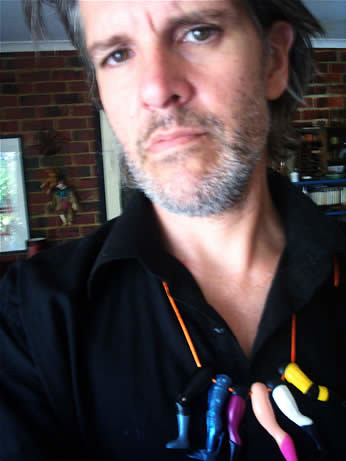
They were kind enough to present me with a necklace recombobulated from the legs of plastic superheroes.


Stumble Upon Toolbar DiggIt!

Wednesday, February 20, 2008

~ night of the bullet

It was some time in the early eighties. We were at Inflation, I think. Or it could have been The Underground. I was with Gus, sitting on a staircase.

Looking down, through the railing, we could see a well-attended bar. I remember Gus’s excited voice in my ear.

- You see that guy buying a drink? The one with the bullet belt?

- Yeah.

- Those bullets, see them? Each one is full of cocaine.

- No shit?

Gus explained that the guy was a friend of his brother Darren, and had bought the bullet belt, complete with shells, from an army disposals store in the city, obviously thinking it was kind of cool.

Upon getting it home and inspecting it with more care, he noticed something fishy about the shells. They were, naturally, supposed to be empty, but these seemed just a little too heavy. He opened one to find a white crystalline powder. Then he donned the belt and went for a night out at a Blitz club.

I didn’t really believe Gus’s story, but I went along with it, on the off chance …

From the beginning, the substance in the shells was referred to as cocaine. Why it wasn’t thought to be heroin, I don’t know. Presumably the belt had been in service overseas and used as a smuggling tool. Vietnam came to mind, and it was heroin not cocaine that predominated in that region.

Gus and I agreed that we should acquire one of these bullets, and the belt owner surrendered one without a quibble. Rumour spread quickly among our friends that we had a bullet full of coke.

But we couldn’t open it there. We didn’t have the tools.

I think there were about five eager inebriated souls who wound up at Gus’s place afterwards. One was a girl called Luisa, who wore striped leggings. Either Gus or I was going out with her at the time. Many years later, I was walking up Acland St when I was approached by a private detective. He showed me a picture of someone's daughter. It was Luisa. I don’t know her parents ever found her.

We converged on Gus’s dad’s toolshed. I remember being wary of that bullet. Bullets could explode, I knew that. And we couldn’t be completely certain this one was not live.

With as much care as a party of drunken revellers could muster, the shell was secured in a vice. We remembered to face it upwards, so that none of the powder would fall onto the floor. I watched from a distance, from behind whatever shelter I could find. With pliers, whoever was in charge grasped the pointed end of the bullet and tugged it free of the shell.

Though we knew what to expect, it was still a surprise. Free drugs, as if from heaven.

The powder was very crystalline. I had not seen anything that quite resembled it, but my experience was limited, particularly with cocaine which has never been my drug of choice. I recall insisting that no one shoot it up, and on this point everyone agreed. Luckily. It would have had a poor outcome.

So, beginning with small sensible lines, we snorted it up. It was very harsh, sharp, cutting. The second time round it was worse, jagged. But, lo and behold, there was an effect - and the effect seemed to be that of coke.

Unfortunately, it hurt too much getting it in. Probably, it had lost potency over the years spent in its steel casing, and definitely it had been cut with something unfortunate. Gus, I remember, thought it might be alum. Whatever it was, it was bad for the nose. We all developed large unsightly scabs around our nostrils, and our nasal chambers were tender for some time after. And none of us ever got really wired.

I wish I knew the history of that bullet belt. Where was its owner when he had the bright idea? Did Australia ever have troops in South America? Why was the belt [or belts] abandoned? I imagine it was inexperience that led to its being cut with the wrong stuff. Over the years I’ve encountered much good gear that has been ruined in this way. [Consider the story of ‘the mud’]. Anyway, there were to be no more bullets. To our astonishment, the owner of the belt surrendered it to the police, who then visited the disposals store to make certain there were no more.

I gave up after a few lines of that cruel powder. It felt damaging. And the pain outweighed the pleasure. But others, including Luisa and Gus, were not so scrupulous. Their scabs grew in length and breadth as, over the following days, they polished off the contents of that mysterious shell.

Stumble Upon Toolbar DiggIt!

Tuesday, February 12, 2008

~ the pharmacopoeia of imaginary drugs #2

[… continued from the previous post]

Then there are the literal opiates of the masses – drugs utilised by the powers that be to control or homogenise society. First that comes to mind is Soma, from Brave New World by Aldous Huxley. Used across the board by citizens of a putative utopia, Soma seems to enhance every aspect of life, distracting the populace with unrestricted pleasures, deliberately short circuiting the possibility of discontent.

Huxley borrowed the name Soma from the divine drug of the ancient Vedic scripts. Knowledge of the plant from which the original Soma was extracted has been lost and it’s true nature is debated to this day. It was believed to have been a drink which, like the Greek ambrosia, endowed the deities with their god-like powers. It is also said to have been an elixir of immortality. William Burroughs speaks of it as the ultimate opiate, comparing its effects to a cool blue ocean, but academic opinion suggests it was probably an hallucinatory entheogen, Today it is the brand name of a muscle-relaxant called Carisoprodol.

Whilst on the subject of substances reserved for gods, it might be worth mentioning The Food of the Gods and How It Came to Earth by H. G. Wells. In this novel scientists develop an artificial food which they name Herakleophorbia IV. The substance proves to be a growth accelerator and giant laboratory specimens break free to ravage the countryside. Humans who take it grow to massive proportions and become, in effect, gods.

For Island - the utopian companion to dystopian Brave New World - Huxley invented Moksha – a psilocybin like drug derived from mushrooms. Intensifying religious experience and inducing mystical insights, Moksha is the very definition of an ‘entheogen’. In real life, Huxley experimented widely with the hallucinogens and saw a benefit for humanity in their use.

In the film Equilibrium, a drug called Prozium was used to subdue the emotions of the populace. Delivering society from ‘the deepest chasms of melancholy and hate’, it was described as ‘the great nepenthe’.

Nepenthe is a beautiful word, sometimes used today to describe soporifics or opiates. It originated in Homer’s Odyssey. Literally ‘the one that chases away sorrow’, nepenthe was consumed by Helen, the daughter of Zeus, ‘to lull all pain and anger, and bring forgetfulness of every sorrow’. Weirdly, the passage was quoted as a form of ‘evidence’ during the passage of the 1937 Taxation of Marijuana Act in the US.

An interesting subset of the imaginary pharmacopoeia is the drug that wakes you up to how things really are. Consider: we are under attack from Lizard Men from Venus [or Blue Lobster Men, whatever the case may be] but none of us are aware because a subtle drug has been introduced into the water supply, [or perhaps because we’d rather just not know]. Defenders of the Earth develop a counter agent, a yellow pill that reacquaints us with reality and gives us the motivation to resist. There are plenty of tales with such a plot, or similar.

In Silverberg’s Downward to Earth human colonists find that the venom of an alien snake can assist in the regeneration of body parts. But taken in high doses it transforms one into a kind of sentient elephant that proves to be the planet’s dominant species. And remember those pills in The Matrix which wake the user to the nightmare of humanity’s future?

One interesting drug came from a book the name of which I cannot recall. I am not even sure they were referred to to Death Eggs, but they were scary enough to lodge in my mind. I think they were found in an abyss that had formed beneath an urban building site; they were ovoid, black, smooth and matte. They took you to a place that was shadowy and deep. And users usually died after only a few doses.

It’s hard to imagine why you would even take some of these drugs. But then people are full of surprises. I, for one, have ill-advisedly consumed some very unlikely things in the quest for oblivion. Substance D, at the heart of Philip K Dick’s A Scanner Darkly fragments the consciousness to such an extent that its appeal is difficult to see. Schismatrix, [the source of Green Rapture], also includes Shatter, a drug procured from the alien Outsiders. In a contest of wills, two characters use the drug to generate a folie a deux. They enter the unspeakably alien minds and bodies of an extinct race of cyclopean beetles – and there do battle. Even the victor takes years to recover.

Some authors have created drugs that entwine the user with predominant social trends and new technologies. In White Noise, Don DeLillo posits a drug called Dylar, which is taken to remove the fear of death - but proves to have side-effects linked inextricably with the watching of television. In Neal Stephenson’s Snow Crash, the eponymous drug is more than just a drug. In cyberspace it manifests as a computer virus but develops the ability to cross the barrier into reality – where it causes mind-altering effects in the minds of hackers. These effects comprise an attack on the nature of our communal reality – and have a weird ancient Sumerian flavour.

MDT-48 appears in The Dark Fields by Alan Glynn and brings its user up to speed with the ceaseless flood of data that assails us in the information age – later turning him into a homicidal maniac.

Perhaps the most comprehensive futuristic drug scenario is proposed by Iain M Banks in his Culture cycle. Citizens of the Culture are genofixed for beauty, health, sexual talent and longevity. Additionally, they are gifted a suite of drug glands at the base of the skull which they may ‘gland’ at will. Secretions include Snap! [the Culture’s favourite breakfast drug] Diffuse, Crystal, Quicken, Gain and Somnabsolute.

The nineties UK mocumentary series Brass Eye investigated a terribly terribly dangerous drug from Czechoslovakia called Cake. A potent disturbile cranabolic amphetamoid called Dimesmeric Andersonphosphate, it acts upon the area of the brain known as ‘Shatner’s Bassoon’. Under its influence, one may cry all the water out of the body or puke up ones own pelvis. Another effect may be the gradual swelling of the neck which, according to Rolf Harris, can expand ‘to engulf the mouth and nose’ and ultimately shatter the skull. In one horrendous incident ‘thirteen teenagers were trampled to death in a cow field on the stuff’. On the street it is also known as Loony Toad Quack, Rustledust and Ponce on the Heath.

For writers of the fantastic, drugs are a useful tool, a magic wand to bend their characters or their worlds in whatever way they wish. It’s no wonder there are so many of them out there. In science-fiction particularly the sophistication of the drugs represents the sophistication [and the possibilities] of science. As Robert Silverberg would put it, ‘by offering his characters a vial of green pills or a flask of mysterious blue fluid the author is able to work wonders as easily as a sorcerer’.

In Larry Niven’s Known Space drugs per se are disposed of entirely. Hedonists connect their brains to ‘tasps’ which directly stimulate the seat of pleasure.

Because science-fiction is invariably a mirror to the society in which it is produced, it is tempting to wonder at the greater significance of many of the drugs described above - the attitudes they reflect, the hopes they engender - but this is just a list, and by no means complete. I’ll save the analysis for some other time.

Hope you enjoyed it.

Stumble Upon Toolbar DiggIt!

Monday, February 11, 2008

~ the pharmacopoeia of imaginary drugs #1

After recounting the fantastic properties of Green Rapture in the previous post, I began to realise just how vast and wonderful a pharmacopeia of imaginary drugs has been described by the fantasists of this Earth.

Of course, there are lists. There are lists of everything on the internet. This time I think I’d like to do my own.

As is to be expected, most fictional drugs are merely elaborations u
pon drugs with which we are already familiar. Consider nuke in Robocop – it’s just future coke with a snappy name. Or omegendorph in Kim Stanley Robinson’s Martian series – the ultimate opiate engineered out of a comprehensive knowledge of human endorphins. Outland [the movie starring Sean Connery] featured a drug called polydichloric euthimal - a ravening giga-amphetamine, like tetrameth in Richard Morgan’s Altered Carbon. Malajusted Alex and his droogs. from the classic A Clockwork Orange, visit Milk Bars for Drencrom or Synthemesc ‘to sharpen the senses for the old ultra violence’. And longbottom leaf? Well, that was just pot, wasn’t it?

And Slurm, from the planet Wormulon? It was just Coke, wasn't it?

My play Lord of Misrule was premised upon the exudate of an illicit fungus, [similar to kom-bu-cha], which was socially and in physical effect directly analogous to heroin, but possessed of its own intelligence. And whether it’s the extract of a giant centipede, bug powder or the cerebro-spinal fluid of the mugwamp, all of William Burroughs’ marvellous addictive chemicals are essentially heroin, or facets thereof.

Remember this? ‘Hank’s on junk; he doesn’t come. I’m on bug powder; I don’t need to come.’

But beyond the simple metaphors, there are a host of imaginary drugs with truly novel effects.

Philip K Dick was responsible for some of the best. Can-D and Chew-Z feature in The Three Stigmata of Palmer Eldritch. Chew-Z, the instrument of a sinister alien power, allows the user to leave his body and spend an indefinite period of time in the environment of his choice – returning to find no real time has passed. [I used to fantasise about this one as a teenager.] After consuming Can-D one enters what was called a ‘Perky Pat Layout’ – this commercially acquired tableau resembled a doll’s house occupied by a scaled-down cast of The Bold and The Beautiful. Martian colonists, living in hellish conditions, spent all the time they could immersed in the normality [and hypersexuality] of Perky Pat’s virtual world.

In Dick’s Now Wait For Last Year, JJ-180 is in effect a time-travel agent, allowing the consciousness of the user to navigate in either direction through time, settling in whatever era takes his whim for the duration of the trip. We can Remember It For You Wholesale, [filmed as Total Recall], includes the hypnotic narkidrine, used to install false memories in the human brain.

Time travel drugs crop up repeatedly in fantastic literature. In a tale from 1964, Doris Pitkin Buck describes the use of Protoceratops Tabs, which transport the mind back through time into the dim consciousness of a saurian in the Mesozoic Era.

Then there are drugs with grosser effects. Like Pallidine in Thomas Disch’s Camp Concentration. Derived from syphilis spirochetes, it boosts intelligence and turns users into short-term supermen, who eventually succumb to disease. Herogyn from Norman Spinrad’s Men in The Jungle is similar. The protagonist/dictator employs it to fan his troops into a frenzy before action. Battle drugs are a category in themselves, and not all of them are imaginary.

Probably the most well-known of all science-fiction drugs is Spice, or Melange - the cinnamon-like secretion of the great sand worms of Dune. In Frank Herbert’s universe it is as valuable as gold and its addicts have ‘blue within blue’ eyes.

But the effects are hard to put a finger on - even after reading most of the series. Largely, it’s almost a shamanic, entheogenic thing. One may see into the future, the past. If you are Muad’Dib you can prophesy. If you are a Space Guild Navigator you can ‘fold space’. Spice increases the lifespan, raises awareness and general vitality. Since it is largely a metaphor for oil, the political effects tend to be more interesting than the physical. Dune also mentions sapho juice, used by mentats to multiply their cerebral processing power, and colouring their lips with a distinctive cranberry stain.

During the sixties, with the advent of psychedelia, many forward-thinking writers began to imagine drugs that went beyond the effects of the known hallucinogens. Another book by Herbert - actually my favourite of his - is The Santaroga Barrier. In an isolated village, somewhere in America, the residents all consume a substance named Jaspers which is mined from the surrounding countryside [rather like The Stuff]. They form an uncommonly well-balanced society, but it is their immunity to marketing of all kinds that leads to their notice by the outside world. An investigator discovers that Jaspers has united them on a subconscious level, and that they have developed a highly-evolved understanding of the world and its underpinnings.

In Robert Silverberg’s A Time of Changes (1971) a drug acquired from a native culture on an alien world proves to have telepathic qualities and ultimately transforms an uptight society into a caring sharing near-utopia. Another drug, in R A Lafferty’s story Skyprovide sensations of mastery and union-with-cosmos’, but ‘especially during parachute drops’. Deaths occur when users try freefall for the ultimate high. The far more recent novel ‘Vurt’ by Jeff Noon describes an England in which the habit of sucking variously coloured Vurt Feathers is widespread. To put it simply, Vurt allows users to descend communally into the shared unconscious of humanity, investing our dreams with a certain objective reality.

[This article continues here]

Stumble Upon Toolbar DiggIt!

Sunday, February 10, 2008

~ green rapture: the king of imaginary drugs

‘Lindsay’s attention was sharpened to a cutting edge by a drug known …. as Green Rapture … without volition, his eyes glazed over. a long moment passed in which he was silent, empty, thinking nothing at all … at last, blinking, he came back to himself. He reached reflexively into his jacket pocket and produced an enamelled inhaler. Two long whiffs of Green Rapture brought interest back into the world ..

Green Rapture washed gently over Lindsay, a tingling wave of curiosity. Green Rapture was the ultimate anti-boredom drug, the biochemical basis of wonder boiled down to its complex essence. with enough gr a man could find a wealth of interest in his own hands. Lindsay smiled with unfeigned delight.

‘Marvellous,’ he said.

From Schismatrix by Bruce Sterling

*

There have been many outlandish substances described in books and film - but if I was given the chance to actually consume one, it would be Green Rapture.

Bug powder? I can take it or leave it.

Melange? Vurt feathers? Polydichloric euthimal? Mandrapordeum? Hellflower? Omegendorph? Drencrom? Nuke? Can-D? Certainly, they sound intriguing …

But I want Green Rapture.

Curiosity is the air that I breathe. If I lose it, as I often do - in the grey days after using heroin or too much alcohol, or after some catastrophe - I feel worthless, an ineffectual husk. Indeed, my level of interest in things is a good indicator of my health overall. When I suffer depression, nothing is worth investigation; if I read, I read to escape not to learn. When I’m sprightly, then the world gets fascinating.


Early in the nineties I began to hear the first whispers of Prozac. I crossed my fingers. Could they really have developed a drug that did nothing else but make you happy? I bought a hardback copy of Kramer’s ‘Listening to Prozac’ and read it cover to cover. I nodded with approval at the cries of outrage from the CCHR [Citizens Commission for Human Rights]: if the Scientologists were so worried, then it was a good sign. They consider effective psychiatric drugs [and psychiatrists] a threat to their bottom line and will do anything in their power to malign them.

Thoroughly inculcated by Roche’s pre-publicity, I organised a medical appointment. I recall Lynne’s amused expression as I assumed a mantle of deep depression before entering the doctor’s room, where I was to obtain the precious script for a drug which at that time required special authorisation.

Ten days later, the effects kicked in. I woke on the grey couch in my office and the world was glistening with wonder. It was much like a trip, but without the paranoia, or any heavy physical effects that might leave you with a hangover. A subtle, clarifying filter had been placed over the world.

In this state, I wandered out of my office, on to the street and down to river where Moomba was in full flight. I must have spent hours there, exhilarated by the colour and the noise, fascinated by faces, trees, and scintillating metallic balloons.

Oddly, the only actual image I recall is that of a man putting something in a rubbish bin …

But with each day the effect faded, until I felt normal. Better, but normal. I could never achieve that same state again with Prozac or its cousins. I use Zoloft at the moment, and every so often, upon waking, I feel an echo of that fantastic morning.

I hadn’t found my Green Rapture, and I doubt I ever will. I’ll have to rely on natural means to generate the curiosity I need.

I worry about my wife, though. So often, she complains of being unmotivated, of not being interested in anything, of jealousy at how obsessed I get by things. Generally, she seems to prefer physical over mental pleasures - and the more easily come by the better. I worry that if she cannot develop a life of the mind – beyond the phantasmagorical world of her fantasies – then she’ll never be able to fully exploit her tremendous talents as an artist. Certainly, she is more intuitive than cerebral with her work; it comes from the heart and soul rather than the mind – but the heart and soul have interests too. And if she’s interested in nothing, then how will she even get brush to paper?

Depression has a lot to do with it; but depression can work both ways. It can lead to the loss of engagement, but when it’s resolved and things seem normal, then realising you have no abiding interests in life can lead you straight back into the black room.

She needs Green Rapture as much as I crave it. Curiosity is an elemental human quality; it led us to become what we are. Lose it and you lose an element of your soul.

Stumble Upon Toolbar DiggIt!

Saturday, February 2, 2008

~ hark! a fusty old cupboard moth!

In the latest episode of Counterpoint on ABC radio there is an extraordinary interview with a sententious old arch-conservative named Theodore Dalrymple, [a nom de plume. His real name is Anthony Daniels]. He is interviewed by global-warming sceptic and ‘right-wing Phillip Adams’ Michael Duffy on a programme that sprang from the Howard government’s push to dilute the perceived leftist culture of the ABC. Dalrymple himself is aligned with the Manhattan Institute, a US conservative think tank, and his ideas are frighteningly atavistic.

For fourteen years, he has been treating addicts in British prison hospitals and feels the need to speak out regarding certain myths which he believes are misleading public policy on drug treatment.

In his book, Romancing Opiates, he argues that opiate withdrawal is neither severe nor dangerous and ‘not much worse than the flu in a healthy person’. He claims to have seen long term addicts stop using with ‘no adverse effects whatsoever’.

I must admit, from personal experience, that the fear of physical withdrawal has sometimes been worse than the experience itself. Nevertheless, the night sweats, the horrific dreams, the bone aches and muscle cramps, the misery, the whole body discomfort, the crawling skin and mind-fucking restiveness add up to something a considerably worse than your average flu. And from what I have heard of others’ experiences, I can count myself lucky.

I get the feeling that Dr Dalrymple has been taking blood pressure, checking body temperature and a few other gross physical indicators, then using these to understate and oversimplify the condition. However, I do agree with his contention that the physiological aspect of withdrawal tends to be overstated in popular literature.

When asked where these exaggerated ideas about addiction and withdrawal came from, he moves into a scathing attack on heroin-related literature. ‘Self-serving liars’ DeQuincey and Coleridge began a trend that has continued without pause ever since. William Burroughs [a ‘psychopath’ and ‘obviously a bad man from the beginning’] is singled out. We hear of films like The Man With The Golden Arm and more recently Trainspotting.

I have no difficulties with the claim that certain works of art attract people to drug use. How can I disagree? I am one of those people myself. I have seen many people acting out their romantic fantasies in heroin addiction [again, myself included]. I have even heard many people claiming to be addicts who weren’t. I suppose it is one way of getting a life, of defining yourself - as something dark, forbidden and dangerous.

But to generalise the function of art and creativity, as he does, is weasel work. Drugs have historically played a part in artistic creation, contributing to some of the greatest works of the human imagination. In much the same way as they are used in Shamanic religions, drugs have inspired and guided certain artists and thinkers. Creative types are far more likely to experience manic depression and other ‘personality disorders’, art can be their expression and their release and our benefit. The use of drugs and the description of drug use by arts contributes to a very complex social equation which cannot be effortlessly explained away in a slow reasoned tone by the fusty old Mr Dalrymple.

As regards the question of how heroin withdrawal, [and addiction generally], became so exaggerated and feared – I would answer it rather differently. Throughout the twentieth century, manipulation of the drug issue was systematically used by politicians and other leaders in the USA to stimulate fear in the community. Again and again it was evoked to distract voters from embarrassing scandals, to paint candidates as uncompromising, and to prepare the public for more draconian control. It has even been selected as an issue by politicians who had nothing else with which to characterise their campaigns. Because drugs were railed against repeatedly down the decades, the effect became cumulative. Heroin entered the mass subconscious as a ravening demon. Parents became terrified for their children. The meme became self-sustaining throughout the world – and an element of it was the nightmare of withdrawal. Certainly, the popular arts play their part – but the buck really stops in the corridors of power.

After evoking Quincy and Coleridge, Dalrymple speaks of how the overwhelming majority of addicts are from the undereducated lower class. There are problems with this contention because it’s really an assumption. Nobody knows the figures. Poorer addicts are the most visible addicts; richer addicts can hide their usage. But how many of this underclass [or the general population for that matter] have read or even heard of Coleridge or Burroughs? There is not much awareness of the classics out there. How else could a bed sold for little girls at Woolworth’s in the US have been branded a ‘Lolita’? If they are influenced, it is by very different media in which the idea of drug-related illumination of the mind and spirit is absent.

Though not everything he says is rubbish, it is all painted with a tone of condescension. He makes the point that people from desperate circumstances often turn to addiction as a way of filling their lives, and indeed ‘the life of an addict is full of incident…. In a sense it imposes regime and routine; they like it, dismal as it is.’ Well, as they say, children crave structure. I think Mr Dalrymple should think further on this point; youths in desperate circumstances are not just being drama queens in taking heroin, sometimes it offers some sweet respite from an unendurable reality.

Heroin does of course impose a routine. With an iron fist. ‘The Algebra of Need', as Burroughs would put it. [‘Burroughs was a criminal long before he became a Junkie’.]

Not that I’m advocating this, but Mao Tse Tung was the greatest therapist in the history of drug treatment because he threatened to shoot people if they didn’t give up – and lo and behold twenty million people did give up.

Dalrymple goes on to say that this wouldn’t work with, say, bowel cancer; seeming to think this proves that addiction is a choice, not a disease.

Because addiction to a large degree is rooted in the workings of the mind, it is not disqualified as a disease. You cannot divorce the body from the head. A lot of very complex changes occur in the brain of an addict, physical changes which researchers are only beginning to understand. Dalrymple, the old cupboard moth, is attempting to turn back the tide on our evolving comprehension of a very complicated condition. He views are deeply right-wing, immediately appealing to the conservative thinker. It is the addict’s fault. He can stop if he wants. He chooses to commit crimes. And elite arty-farty types are responsible for all our misconceptions ….

I’m not wholly against rehabilitation, as long as it’s understood it’s not a medical procedure. As long as you don’t treat it as an illness.’ He suggests some form of ‘asylum’ in which the recovering addict can build up their lives again after the wasted years. Again, he shuns the idea of addiction as a disease – a concept that our best informed practitioners have spent decades working to illuminate in the public eye, and to include in social policy.

He coughs up a number of other hot potatoes. He claims ‘the inclination to criminality causes addiction, not the other way round.’ He has learnt from prisoners in jails that the vast majority of addicts were criminals long before they turned to heroin. [He did not say anything about whether it was in jail that they began taking it.]

He tells us it is a myth that drugs are filling our prisons. I’m no expert on this, but I feel strongly about legalisation, and I’ve known plenty of otherwise law-abiding people who have broken the law to feed their habits. I couldn’t begin to count the number of girls [and boys] I’ve seen use prostitution for the same reason.

My instinct here is that his contention is wrong, but again laced with fragments of truth. I also resist, even resent, his using the words addict and criminal in the same breath. There are bad thieving junkies in this world, and it’s sensible to beware of them. But there are those who would never in a million years commit a crime against person or property just for a fix.

Dalrymple is petrified in a previous age where mind and body were disassociated. He cannot abide the fact that addiction is holistic. It is true that the mind is a very prominent component, but that does not disqualify it from medical attention - it merely makes it harder to understand and treat. It is also a social disease, channelled and fuelled by inappropriate laws and attitudes, which the opinions of Dr Dalrymple can only serve to exacerbate.

God forbid this is the leading edge of current conservative thinking!

Stumble Upon Toolbar DiggIt!

Wednesday, January 30, 2008

~ the discombobulated genius

We have all heard stories about the genius guitarist, who lives out his days muddling away in a bedroom, unknown to the world at large, subsisting at some shit job when he could be benefiting the universe with his talent.

Robert is a whole lot like that. Robert, the scientist who inhabits my carport together with his antique industrial machinery. Who also happens to be an historian of aviation and shipping, a metalworker, a carpenter, a chemist, a sailor… the list is long, but very specific. As Lynne suggests, tunnelvision is one of the symptoms that makes unique minds so brilliant. They’re crap at most things, but startlingly talented at others.

Take movies for example. Robert has real trouble dealing with logical inaccuracy, anachronism and discontinuous narrative. If things don’t happen according to a natural timeline, he gets bewildered. Any sort of clever artistic affectation confuses him. Myth Busters is one his bugbears. It was good in the beginning, he says, but its sold out. They’re addressing myths that everyone knows are bunkum. He has zero tolerance for scientific inaccuracy and he invariably sniffs it out, even if something is set thousands of years in the future.

Politicians can’t get a word in edge way. He doesn’t believe a word they say. He despises police too. I put it down to his early days in the Young Socialists – unfortunately it’s impossible to convince him to move on. I've tried to bribe him to register as a voter but, because he claims to remain an anarchist, he refuses.

Moving out of Park Towers in South Melbourne, where he lived with long time female accomplice Lorraine, he found a place in a nearby rooming house. Robert can be difficult to house owing to his packrat-like habits. With no car, he’ll arrive home on his bike with lengths of scaffolding, pumps torn from washing machines, damaged solar panels, sheets of galvanised iron, worn out machine tools, random appliances, all on his back or in his long suffering bag.

Every few months he falls off. It’s obvious why. On sultry summer nights he rides all the way home from Mt Waverley, just because he enjoys it.

We keep finding new bags for him, but they don’t last long, given the industrial-grade use they endure. Shoes too, and clothes, but he’ll never look neat. Lorraine looks after his long hair, trimming and plaiting it. He buys cheap over-ripe fruit from South Melbourne market, if he can’t find anything bin-diving. He’s a vegetarian; we’re always reminding him to watch his protein intake, since he’s so very active, but he still has that vegan-style pallor.

Funny thing. I was at Science Works with Polly one time, watching a time lapse movie of some decomposing bananas. We played a game, guessing at what point Robert would turn up his nose. A vegetable can travel a long way down the track before Robert will judge it putrescent.

Anyway, wherever he settles, there also settles a huge pile of junk which, of course, according to him, is nothing of the sort. Lately, since his latest obsession is metal-work, the salvage has been largely metallic. Obviously, Lorraine reached a point where she was forced to move him on. He’s far worse an accumulator than me. I see it in his eyes as we pass nature strips strewn with hard rubbish.

The rooming house is good for Robert. They won’t let him pile things in the grounds, which is a restriction he requires. He spends little of his pension on rent, little on food, so that every few months he can afford to buy a new piece of heavy machinery to dote over and restore in the carport. His tiny room is jam packed with tools, chains, bearings, cowlings, housings, chucks, finials, meat hooks, beakers, aging computer peripherals and antique machine manuals. There is just room enough left for his futon.

Once, needing to score, Robert pawned his oscillator. Has anyone ever in the universe pawned an oscillator before? I don’t think so. Once Robert spent half a day turning a solid steel flush button on his lathe, because the plastic one in the communal toilet had failed.

Every so often, given the nature of the rooming house, trouble brews. The place is home to old alcoholics, divorced migrant husbands and crinkled thin-lipped junkies. Everyone there has some sort of issue, whether it be mental, physical or circumstantial. Lately it’s been calm, but recently the management - part-timers with nice cars pulling down a full time wage - thoughtlessly sent three red-hot junkie crims along to fill some vacant rooms.

The result was turmoil. They treated the place like a jail. They tried to establish jail-like hierarchies of power with threat and intimidation. They stood over people for money, cigarettes. Robert described them as submorons, who would get pissed and roam noisily downstairs, breaking anything they could find while the house was trying to sleep.

But worst was their treatment of the old blokes. They stole and made threats to kill. Consequently, these poor shattered wrecks began to live in fear. A pall descended on the building.

There were communal meetings and a myriad of complaints were made to the people who
, without thinking twice, had cast these spitting vipers into a peacefully functioning home - and then gone on holidays.

Finally, very late one night, a couple of these dickheads were stomping about in the TV room, complaining noisily of having no money, cigarettes or booze; [having blown their cheques on ice]. They’d already knocked on everyone’s door demanding money. When the answer was no, they’d insist the person tell them why. Why don’t you have any money? What have you done with it? The more courageous ones asked what business it was of theirs.

Then they started talking loudly about killing Peter, an old man with only a few months to live; so loudly that Peter would be sure to hear. That was when Robert lost his patience. He stepped out of his room and told them to go out, find some butts on the footpath and roll them up. [I’ve done it, Have you?] But the behaviour downstairs did not abate. Robert emerged again, angrier this time – if you want money go out on the fucking street and sell your arse, then shut the fuck up.

- What did you fucking say, mate?

Robert repeated himself. One of them, Alan, a quintessential crim with feeble mind and tracksuit pants, leapt up the stairs and challenged him. Robert made the mistake of turning his back to re-enter his room. Alan sucker punched him in the head. [A week later the bruises are still bright and crimson] And Robert retaliated.

Because Robert does so much bike riding and heavy lifting - among a thousand other arduous activities - he has a lot of whole-body strength. Alan was shocked to find himself in a headlock, getting his skull pummelled. Robert then braced himself, forced Alan’s body against a wall, and used his feet to compress his chest. Alan was immobilised and gasping for dear life. That was when his mate, Ian, the dominant of the two, crept up and kicked Robert in the head.

The fight must have broken up then, but Robert had a 5 mm tear to his cornea which took three days to heal. Alan was in far worse shape.

Sordid stuff isn’t it? But the upshot was good. The eruption got things moving. One guy was taken off by the cops. The other, due to enter jail in a couple of weeks, went on the lam. The third and most sensible one was given another chance. And management pulled their head out of the sand.

So goes life in the underbelly of South Melbourne. I wonder if the yuppies see much of it? The house of one neighbour is plastered with fascistic signs about trespassing and a number of those false security cameras.

The boarding house has calmed and Robert is functioning again, which is good because basically we couldn’t get by without him. He’s the king of handymen; he can fix just about anything. Show him a random piece of machined metal or plastic and he’ll tell you its precise provenance. It’s unbelievable. We’re blessed to have him. Often, I tell him he should start a business, but he’s too busy restoring his Deckel tool mill.

Living where he does, and having the weaknesses he does, he has encountered vampires. Mindless arseholes who’ve effectively tried to imprison him, believing he can turn pills into heroin, [it wouldn’t surprise me if he could]. Once, I chopped down an invasive camphor laurel tree and he explained to me exactly how to process it into ecstasy. His lifelong dream is to make a single batch of fentanyl [among the very strongest of the synthetic opiates] to last him the remainder of his life.

Because he can’t say no, he’s always fixing people’s TVs and microwaves, and blenders. Though most people don’t pay him, he continues to do it. He’s genuinely sweet, thoughtful, kind. I saw him crying during the long death of Lorraine’s cancerous pet rat.

Robert is utterly unique. Viva Robert! Why does he have to put up with what he does, when he should be raised high upon a golden pedestal?

'the swarf that penetrates' - an introduction to the Weird of Robert

Stumble Upon Toolbar DiggIt!

Sunday, January 27, 2008

~ the high echelons

It seems that Heath Ledger had his problems with drugs. Well, so what?

As the information leaked out about his sad demise, one could sense the efforts, on one side, to play down the sordid elements. Scattered pills found their way back into the bottle. A rolled up note was found to have no residue. From the other side – that of the ravenous and voyeuristic – we learned that he had just left rehab, was battling addictions to heroin, xanax and stilnox, that he was distressed and sleep-deprived.

Tasty. But why do drugs so often become the centrepiece?

Well, some of us like to watch the mighty descend into the abyss. It reassures us to learn that they are as weak and as freaked out as us. It makes us feeler closer to them. And, of course, we love scandal for its own sake. That’s simply in our nature.

We’re ghoulishly curious when it comes to the stars – those public assets in which we all have a stake. Every detail of Ledger’s death scene has been described in the media, interpreted, analysed and spin doctored by publicists. But with the mention of drugs our interest ramped to a whole other level. This betrays us, just as drugs betray the personal struggles of the famous.

During the Heath Ledger coverage, I read the comment that fame is a sort of mental illness. Perhaps the sensitive, troubled Ledger turned to drugs as a way of self medicating this illness. Perhaps that’s the reason so many celebrated people do take drugs.

It’s like having Alzheimer’s Disease. You don’t know anyone, but they all know you,” said Tony Curtis. But that’s just part of the story. There’s pressure, stress, loss of freedom, alienation, loneliness, and a tendency for people to become friends with your fame, not with you.

In David Gritten’s book ‘Fame’ he claims that ‘celebrity behaviour is rooted in a type of personality disorder’. Histrionic Personality Disorder to be exact, defined as ‘a pervasive pattern of excessive emotionality and attention seeking’. Some of the symptoms are the ‘display of rapidly shifting and shallow expressions of emotions’, behaviour ‘being directed towards obtaining immediate satisfaction, with no tolerance for the frustration of delayed gratification,’ and ‘a style of speech that is excessively impressionistic and lacking in detail [e.g. when asked to describe mother, can be no more specific than “she was a beautiful person”’.

You have your Britney Spears, and her sordid public fall from innocence. She’s a red raw case of the fame disease. You have all those actors – Owen Wilson, Steve Coogan, Brad Renfro, River Phoenix, Robert Downey Junior etc., who have or have had relationships with heroin. Musicians in even greater numbers, writers too, models and sportsmen. And I’m not including cocaine.

It’s so rife, this affliction of our idols and role models, that ‘rehab’ has somehow evolved into a pretty cool concept. In the hip crowd, among the high echelons, and on the press release, well it’s getting kind of groovy, isn’t it?

It would be good to shrug off the prejudice and the stigma associated with drug use, but that’s not really what happening here.

On one side you have the prohibitionists and on the other you have people who admire drug use in their heroes because it’s a la mode. Both are in error. And of all the reasons for taking drugs, imitating the beloved famous is one of the most insidious. I have a particular dislike for it because that’s pretty much what started me off

Hearing that an artist has a drug history, automatically perks my interest. Even now. I can’t help it. And I’m not the only one.

[No matter how great a song it was, I really wish that Lou Reed had never written ‘Heroin’.]

I won’t get into details now, but the creative soul is far more likely to experiment with mind altering drugs. Sometimes, it’s just part and parcel of the thing: the quest for new vistas, for an undiscovered viewpoint, for mystery – and sometimes the result of a painful sensitivity to a crass and blaring world.

It’s true. Often the most interesting ones are the ones who engage with drugs. And when they get famous, we imitate their behaviour.

And when they are infected with fame – well, that can push them deeper. The artistic temperament can be overfed, the ego may rear like the Whore of Babylon. Money and freedom and reputation can increase creative freedom, but expectations, fear of failure and commercial pressures can close it down. Doubts can arise over ones integrity. I’m not sure if Hollywood-grade fame is ever good for an artist, unless he’s one of the few that it actually suits.

Give me Emily Dickinson any day.

The reputation of Heath Ledger will not suffer by his exposure as a drug addict. People will understand how sensitive an artistic soul he was, how troubled, how he missed his daughter, and was deeply disturbed after immersing himself in the role of The Joker. [a claim only a Hollywood actor could make, no?] Probably the only truly damaging revelation was that he was friends with Mary-Kate Olsen.

Lynne suggested that his lack of classical training may have been an influence. A lot of actors, these days, become so deeply immersed in a role that they cannot dissociate themselves. They engage in intense research, force massive weight changes, and wind up misplacing their sense of self. They don’t isolate a personal centre to keep themselves sane.

Anyway, what about the man on the street? Being exposed as drug addict is a entirely different thing for him, isn’t it? We don’t quite get the same level of compassionate understanding.

Our gods of Mt Olympus are not subject to the same laws as we. If they are revealed as drug addicts, we create a moving backstory with which to enrich their posthumous biographies [and the lurid pages of the gossip mags].

[And, by the way, how do they get these drugs? Do they see a doctor? Or is it all done by a PA? Do you think they get their hands dirty like the rest of us?]

There are also the prominent users who are never exposed in the tabloids; who need to keep it quiet and are rich enough to do so. But sometimes rumours filter down. James Packer and Laughlin Murdoch; tight friends who spent a good swathe of time on heroin. Kate Fischer got in on it too, it is said, and only when Packer divorced her and married ‘ex-escort’ Jodhi Meares did he clean up. [Scientology was a factor there too, it is said.] Then you have Elle McPherson, cleanest of the clean, who wouldn’t do a photo shoot unless the coke was laid on. It is said. And Sonia McMahon? Well it’s not relevant at all, but I’ve been told that before she became our first lady, she was an escort too. [I couldn’t resist putting that in.]

All ‘rumours’ of course, but among certain of the high echelons hard drugs will always be de rigeur. The modern aristocracy is isolated from petty considerations that the ordinary populace has to face – like. say, waiting for hours in dark carparks, or doing without for lack of money. Occasionally, the vices of a luminary will be bared to a voracious public, but again you’ll have the backstory and once more our considerate understanding.

Stumble Upon Toolbar DiggIt!