Pages

Showing posts with label CLIMATE CHANGE. Show all posts

Monday, July 18, 2011

~ do you believe in the pink and plump?

This morning I heard Rob Oakeshott phrase something rather eloquently on the science of Climate Change. To paraphrase, he asked would you take your child to the doctor if they were sick? Wouldn't you be negligent if you did not? If your car was malfunctioning, wouldn't you take it to a mechanic?

This is to say that we rely, sensibly, on experts to inform and advise us on subjects in which we are not conversant.

Why most of Australia - seemingly - wishes to dispute the overwhelming evidence provided by specialist authorities on climate science and economics beggars belief. The well has been poisoned, that is clear. Fearmongers are at large, conspiring with other agents of unreason. I see sallow-faced pamphleteers smacking their thin lips in sordid anticipation. And merchants, pink, corn-fed, redolent of baby powder, lining their wallows with profit ...

All of it working to muddle our heads on this most critical of issues. For all her faults, I feel deeply for Julia Gillard at this moment. She is facing a storm of sheer madness, the outrage of the greedy, the vitriol of the hateful - yet she is refusing to back down. I wish there was more I could do.

Science is science. It is method not opinion. The science that gives us life-saving drugs, microwave ovens, iphones, sophisticated crash-restraints, plastic, podiatry, GPS systems, X-ray machines, Predator drones and Zhu Zhu pets is the very same science that has been advising us, firmly, for decades, to act on climate change.

The scientist observes, measures, experiments and records. He or she examines the data, shares it with other scientists, and may draw conclusions. An hypothesis may result. The process is then repeated as many times as necessary. If there is sufficient evidence, a theory may be presented to the scientific community. The theory is then subject to review by peers and, if it is a good one, may be published in a journal.

But, no matter how much evidence accrues to back it up, it will only ever remain a theory - for in science nothing is certain. Will the sun rise tomorrow? It is not certain. Just very very likely.

This is the scientific (or empirical) method. It has brought us from the dark ages of fear and superstition to unparalleled levels of civilisation.

If we ask ‘do you believe in climate change’ we are asking ‘do you believe in science’.

Do you believe in science?

Stumble Upon Toolbar DiggIt!

Friday, June 24, 2011

~ earth stars

This morning on the ABC News Breakfast show, Mal Brough presented us an old chestnut which seems to be coming back into its own : why should Australia lead the world in reducing its carbon emissions (and why should we bother, as we're such a small polluter on the global scale). When Barry Jones responded, I was hoping he'd give the right answer. It would be good to hear the right answer clearly articulated on the airwaves, just once.

By my book, he did pretty well. Among the developed nations, Australia is the world's largest per capita producer of greenhouse gases. While most of the world subsists on trotters and belly pork, we are living high on the hog. Plainly, this places a moral burden upon us, more so than any other nation, to curb our negative influence on the environment. For their own reasons - largely selfish - many conservatives and the much of the business sector do not subscribe to this thinking - but most of us, I feel, would agree that ethically speaking we have an obligation.

Thus Barry Jones replied, adding that Australia has been a world leader in the past and is perfectly capable of being so again.

It is an position of integrity and right. Though certainly nothing Australia does in isolation with its emissions will curb the global pollution problem, it can act to secure the future by influencing the world at large. Australia – unlike the USA - is in no position to strongarm, but it is sufficiently large that its actions are noticed. It can pave the way that others may follow.

As well as the high-minded moral argument, I would not have complained if Barry Jones couched his response in more selfish terms. People are afraid of the coming change. They are confused by the clamouring voices, raised against each other, crying contradictory predictions and positions. And it is the way that when danger looms, humans look to their own.

If the current generation of Australians wish to provide a rosy future for their children and grandchildren, they can act personally but to little overall effect. Yet if they act as one to reduce their emissions, establishing new standards and new economic mechanisms, then they are lighting a beacon for other nations, who might act in turn - until sufficient of us are united in the cause to positively influence the future of the planet.


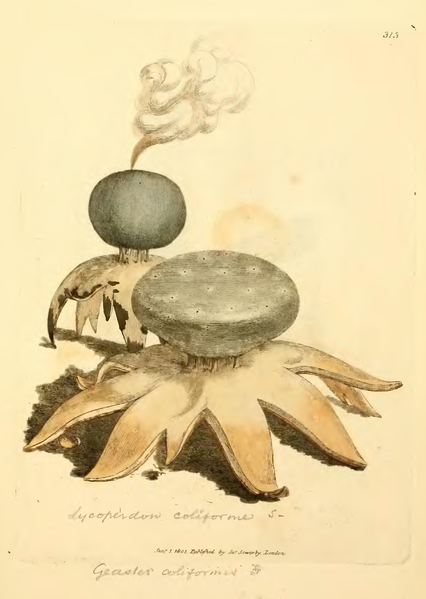
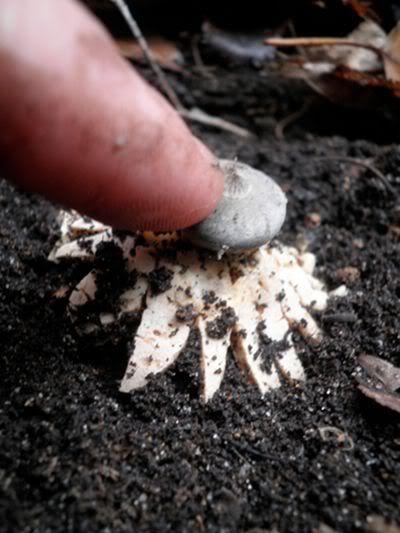
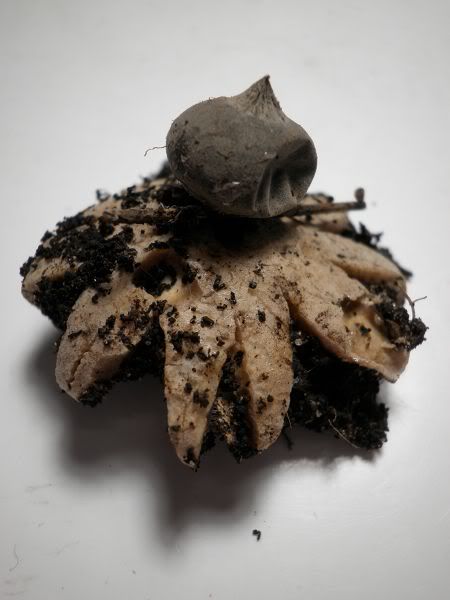
Yesterday, more importantly, while scraping up some mulch for my potted anemones I unearthed what I thought to be some old, partially digested plastic daisies. On closer inspection, I discovered they were ripe earth stars, their 'stomach-shaped sacs' bursting with spores. I've trawled for about half an hour, but can't identify the species, though the family is certainly Geastrum. Over my many decades of turning the earth in Mt Waverley, I have never before encountered earth stars.


Stumble Upon Toolbar DiggIt!

Sunday, March 28, 2010

~ dominion

After many failed attempts, Robert has at last identified and plugged the hole through which our possums were gaining ingress to the roof. Around dawn, the noises of frustration began and continued for hours. Perhaps the creatures have at last accepted that the well-appointed possum-box - carpentered for them lovingly by Robert - is a more sensible choice of lair. Perhaps not. Yet for a while at least, there will be no scratching and squalling in the walls around sunset, and Polly - whom the noises freak out - will sleep easier.

I can remember the things that used to terrify me at night. I remember tensing for the touch of the skeleton approaching me in the dark. Or the vampire. The nagging fear that something deadly, perhaps a tiger, was lurking beneath the bed. The indistinct forms of dinosaurs in the foliage outside the window ... I guess that’s what Polly’s going through at the moment, but the intensity of her fears is beginning to worry me. The sight of a spider on the couch is enough to elicit screams of primal terror. Thunder and lightning drive her into wild panic ... if she picks up a storm warning on a television forecast, she will be nervous and wary throughout the following day.

*

Sometimes I find myself ignoring the dreadful things that are happening to our world. Sometimes I need to take a break from the unremitting gloom. Likely it’s a self-defensive action, as to focus without pause on such things is a recipe for depression.

But lately, wherever I look I’ve been faced with outrageous scenarios in which humans are carelessly and criminally exploiting the Earth and its less fortunate inhabitants. After reading into Coke-a-Cola’s behaviour in Plachimada, India, I have - in an admittedly futile gesture - eschewed my morning Diet Coke for Pepsi. The actions of Coke, who set up a plant in an impoverished region of India and proceeded to suck free water out of the ground until the locals’ wells went dry, is not only inexcusable but depressingly predictable. Thank goodness the victims seem to have achieved some success on the legal front.

Then there is the noxious, criminally evil notion of Human Achievement Hour. I was scarcely able to believe my eyes when reading about this alternative to Earth Hour in The Age during the week. Inspired by climate-change denying Australian senator Cory Bernardi and championed by extreme right wing think tank Competitive Enterprise Institute, this wildly irresponsible concept formed icicles in my heart. There are people who truly believe that climate change is a left wing conspiracy. There are people who pay venal scientists to uncover hiccups in the data and inflame them into ClimateGates. There are people who believe it is a political issue not a scientific one. There are people who truly do not care about future generations. There are people who truly believe that man sits above nature and that he has, by right, Dominion over the earth.

Then I watched Mike Moore’s Capitalism - A Love Story and, although all his characteristic biases were in evidence, if even half of what he presented was accurate then we live in a miserable world indeed. The leaked Citibank plutonomy documents were near beyond belief. There is a 1% elite, at least in the US, who, in controlling 95% of the wealth, believe Dominion is theirs and bemoan their command of only 1% of the vote. Not a word about climate change. Collapsing fisheries. Animal extinctions.

God said to them, "Be fruitful and multiply, and fill the earth and subdue it; and have dominion over the fish of the sea and over the birds of the air and over every living thing that moves upon the earth".

Stumble Upon Toolbar DiggIt!

Friday, September 11, 2009

~ in the wake of the fires, ignorance triumphs

Sometimes, news of the outer world is almost too depressing to bear. And frustrating. Frustrating beyond belief. Sometimes, I think I would rather not know.

In the paper there is a photo of an industrious landowner from a bushfire-ravaged region of Victoria. A post-catastrophe ruling has allowed him to scour his property of vegetation. It allows the culling of trees within ten metres of homes and four metres of fence lines without approval from the council. Small land owners who have a poor relationship with nature can now raze their blocks with impunity.

Never mind that in the face of such mega-fires such a measure would have little effect. Never mind that trees can protect a dwelling by ‘dissipating fire energy’. Tree-culling is the first, most obvious response that comes to these simple minds. They see a pseudo-solution at the end of their nose and they act on it.

Being able to project our thinking beyond the immediately obvious is part of humanity’s brilliance, but too few of us bother to employ that ability. And stupid, destructive decisions result.

A dangerous assumption is being made by these people. They believe we have the right to put ourselves above nature, as if we are somehow separate from it, as if - as the bible would put it - it is our 'dominion'. Never mind that the air we breathe is generated by these trees. Never mind that as a species we are interwoven into a complex ecology of which these trees are a part. T
hese people do not factor the big picture into the equation. That is the province of whinging greenies.

Then there are those who look to apportion blame for the mega-fires and are seeking damages in court - as if any human agency could have stood against such a potent natural force. Certainly, if we bury the power-lines there will be less chance of electricity causing fires. And better organisation might have saved lives. But the fires of February this year in Victoria were near to inevitable. In Australia, fires are a part of nature, no humans are required to start them. This is proven by the fire-adapted ecology of the Australian bush. But these litigators, perhaps, would sue nature for damages if they thought they could get a result.

Human agency is expected to control the fires, and if it fails it is damned. Again the presumption that we are apart. Again the ‘dominion’ paradigm. Rather than adapt [or re-adapt] to nature, we will control it, dominate it. This thinking lies at the root of many bad attitudes towards the earth.

“The ocean is my kitchen freezer," I saw a guy say on a TV fishing show as I flicked past. “When it’s time to eat, I just fish one out.”
I hope so this was his way of saying we should look after the oceans...

Dualism – the concept that the soul is separate from the body – lies deep in the heart of these problematic attitudes. To the religious orthodoxy, who espouse ‘dominion’, the Earth is just a waiting room for the heaven-bound; it is there to feed us, clothe us as we demonstrate our goodness to god’s spy satellites. It is to god that we owe an obligation, not to nature. The religious do not have to worry about their children inhabiting a wasteland, because their children will ultimately be joining them in paradise. No wonder the needs of our base, temporal, sublunary earth are so often ignored in favour of human comfort.

Others subscribe to a milder form of Dualism. They consider the soul and body to be separate, but are not necessarily religious. Perhaps you are one of them? I know I used to be. It seemed impossible that my mind, my being, was nothing more than a sac of jelly between my ears. But the evidence - or lack of it - convinced me otherwise and with this realisation came a greater appreciation of the beauty and complexity of the natural system to which I, and my offspring, are inextricably bound.

To discard Dualism is to accept that the material world is the only world we will ever have and that we must respect it as thoroughly as we do each other.

*

Though no specific human agency can be blamed for the day of bushfires, humanity as a whole perhaps has a case to answer.

Do you think climate change might have had a bearing on the intensity of these fires? I do. It was the first thing that came to mind when I learnt of the devastation. In point of fact, it was already on my mind as I sweltered in the unprecedented heat.

Surely I was not the only one putting two and two together? I mean, extreme weather events are exactly what the climate scientists are predicting ...

But Kevin Rudd did not mention it in his speech of consolation. No one mentioned it. Indeed, it wasn’t until days afterwards that it was openly considered as a contributing factor. Weird, I thought. Later, a politician criticised another politician for bringing it up, saying it was disrespectful to politicise such tragic circumstances. Politicise? Politics? Climate change has deep political repercussions, but in itself it is as political as a blade of grass. It is the air we breathe. The food we eat. It is a fact of life which we ignore at our peril.

Why did they not draw reference to it? Would it really have made them seem as if they were taking political advantage? Or did it seem too tenuous and remote a thing to factor into the circumstances? Might it have offended the presumed backward sensibilities of the block-clearing country-dwellers? Whatever the case, don’t things have to change? Climate change will have to become a front and centre thing if we are ever to meet to successfully.

Clearing trees and increasing fuel burns may or may not offer some localised protection, but in the larger scale will make catastrophic bushfires more likely because they add carbon to the atmosphere and weaken nature’s mitigating effect on climate.

Stumble Upon Toolbar DiggIt!

Monday, March 23, 2009

~ boots on throats

There have been some disturbing things appearing in the news lately. [And when are there not. I ask?]

We are being informed repeatedly that once the new carbon trading regime is instigated, individuals’ efforts to reduce their emissions will only serve to take the boot off the throats of the big emitters – because the nation’s reductions will be calculated as a whole. Check today’s Age, if you want an example.

What a cynical, disingenuous tack to be taking. For a start, Prime Minister Rudd has stated that households will be excluded from the calculations – so the whole idea, probably generated by his political opposition, is likely to be a piece of very unhelpful and meaningless political manoeuvring.

But forget the minutiae. Now is hardly the time to be reading in the newspaper that individual efforts are futile. My God! It’s the very last, last thing people ought be told. I hate trotting out clichés, but there is a whole lot of truth in the maxim: ‘think globally, act locally’.

We, the people, the mass of civilisation, composed entirely of – yes - individuals, are the producers of one hundred per cent of the country’s anthropogenic air pollution. The big emitters are big emitters because an agglomeration of individuals employs their services. If those individuals bought green electricity, hydrogen fuel cell cars and stopped eating beef etc, then those big emitters – if they still existed – would no longer be big emitters, would they?

There is no ‘big emitter’ in this world, [bar volcanoes and bushfires], which does not depend on the choices of individuals for its existence. So, please, you purblind, suicidal nutcases out there, stop getting in the way of people’s efforts to save our civilisation!

Stumble Upon Toolbar DiggIt!

Tuesday, March 10, 2009

~ a clear path through the maelstrom

Hello, once more, again, after so long.

There have been all kinds of reasons why I’ve been silent, but probably most importantly I’ve been rethinking what this blog is about. I’ve learnt the hard way that more delicacy is required when discussing personal matters, so for better or worse, I’m going to steer away from them. I have a tendency to say imprudent things at inappropriate times, and it appears that I’ve carried it along with me into this medium … in spades …

That aside, I’m going to keep my posts shorter this time around. That way the blog won’t weigh too heavily on my other writing responsibilities. Single topic. Not too much digression.

My novel is going well by the way. I’m just about adhering to my page a day regimen. And I’m immersed. Living half my life here, half in the strange world of Nonesuch.

*

Some worrisome attitudes have been revealed in our reactions to the apocalyptic Victorian bushfires. In the aftermath, with some celerity, and true to human nature, people sought someone or something to blame. Arsonists, naturally, were the first to come into their sights. Those arrested were afforded special protective measures.

A clear second were the ‘environmentalists’ in local councils who prevented landowners from clearing native vegetation in proximity to their dwellings. I read of the outrage of one person who was not allowed to cut back grasses along the front of his property. Another, who had had been fined tens of thousands of dollars for illegally felling hundred of trees on his land, claimed to the media that he was vindicated and should be returned the money. One more suggested that, as a future rule, vegetation be cut back to however many metres from all public roads. [Recall that many roadside easements provide a refuge and throughway for native flora and fauna].

As victims, they could speak from a high moral ground. Suddenly, they no longer felt constrained by political correctness and, in emotional extremis, brought their bugbears to light. But these opinions are no less thoughtless or misguided because their owners have suffered. Demands such as these, coming from devastated people, ought never be appeased at the expense of a correct response. I sincerely hope that terrible decisions are not made in response to these people’s terrible sufferings.

To paraphrase The Age, climate change did not cause the bushfires, however it did make them more likely to happen, and to be more severe. As part of our response to climate change, the environmental lobby seeks to minimise our destructive effect on the environment. We must learn to live peacefully and equitably with the natural world, as we depend on it and are naturally a part of it.

If we are to house ourselves beyond the cities, in the midst of nature, as did the people of Flowerdale or King Lake, then rather than gouge out a sterile safe zone, we should seek to have as little impact as possible. What is the point of living amongst that beauty if your presence is a defacement? Rather than alter or destroy the flora and fauna in order to shield ourselves against a natural process such as fire – we should be building structures that are either fireproof or disposable, and making sensible plans for our own safety.

Idealistic, I suppose, but the truth as I see it. No human action could have prevented or caused the holocaust that day, fed by extreme winds, unreasonable heat and a bone dry land. Lessons are sure to be learned in time, but no credence should be given uninformed opinions or short-sighted prejudices. The environmentalists are not putting trees above people – in working to preserve the ecology which sustains us, they are working to preserve the future, the common good.

It is wrong to lay blame at their feet.

Stumble Upon Toolbar DiggIt!

Monday, November 3, 2008

~ serpentine dream theory

Southland Tales: the newish film by Richard Kelly, [Donnie Darko]. It’s very entertaining, a sprawling futuristic comedy not unlike Idiocracy; more vaudeville than high art, and different in nature to Kelly’s previous film.

I mention it because of a seemingly casual reference made to the ‘self-destruct switch’ of an SUV.

An interesting idea, no? It flows with the essence of the device, does it not? Fictional spacecraft tend to be fitted with them. And I’m sure the driver of, say, a Hummer would think it was right on ... the power to annihilate himself in an exploding ball of fire ... right there, at his fingertips ...

Rather than mandate it, authorities would automatically frown on such a thing. Too much collateral damage for a start. But if we are capable, as a society, of inviting such monstrous devices into our streets, then surely the sight of them detonating should not appall us that much? In a frightening greenhouse future, things that may once have seemed shocking may become commonplace. It’s just a question of emotional perspective.

Like seat-belts and air-bags, the self-destruct system would naturally have to pass stringent regulations and be of the highest quality manufacture – yet it’s still difficult to see how extraneous damage to other vehicles, infrastructure, onlookers [and their emotions] would ever be avoided.

Does this kill the idea? I don’t think so. Designated zones might be created, even thunderous death arenas; but my instinct is that a high percentage of self-annihilators will be acting on the spur of the moment - and the world would not want to lose those precious seconds in which a noxious parasite was prepared to voluntarily wipe itself from the face of the Earth.

What we require is implosion, rather than explosion. In a necessary riot of harmless light and sound, the vehicle would safely crumple in upon itself, leaving a small recyclable cube or sphere. Crumple zones are already incorporated into car design, they just need more development.

The SD switch, required by law for all personal vehicles over a certain weight and fuel consumption.

Southland Tales also mentions something called Serpentine Dream Theory. Whatever it is – and the explanation just washed over me - it could never be as good as it sounds.

Stumble Upon Toolbar DiggIt!

Saturday, November 1, 2008

~ the cloud of unknowing

On Thursday I took the long road to Langwarrin in order to console Kylie, who broke four ribs falling off a fence. Interestingly, she claims to have been only slightly intoxicated - at least in comparison to her personal precedents.

Kylie is one of my dearest friends and near to qualifying as a nurse. I cannot think of a person more suited to the job. She is almost pathologically empathetic, particularly when it comes to animals. She is feared by local vets, to who she regularly brings near-dead possums scraped from edges of roads. She keeps a blanket in the back of her car expressly for this purpose.

It’s been a while since I’ve been down that way and it was unrecognisable. Indeed, I got lost. What was once pleasant and semi-rural is now undergoing rapid change.

Housing developments are spreading like a necrotising rash, an untiring cloud of unknowing. These are the fabled mcmansion estates, which may only be visited by converting large amounts of gasoline into poisonous exhaust. Other means of transport are either impractical or non-existent. The children who grow up here will struggle to avoid alienation in their cavernous, appliance-filled houses. Perhaps the internet will be their saviour. Perhaps there will be helicopter airlifts.

I saw no solar panels. No water tanks. I imagine the large developers have lawyers to sleaze them out of those annoying obligations. Do these houses have double glazing? Solar hot water? I wonder just how ugly they really are? When carbon trading begins, just how difficult will it be for the dull sublunary occupants of these macmansions?

At least the financial ‘meltdown’ will slow the carbonators down a little.

I do go on.

I’ve got a stall at Camberwell Market tomorrow, in case any one is in need of vast quantities of ridiculously cheap books. It’s been a while since I’ve culled the distributed tumour that is my book collection. The blame rests with my embarrassing second life as Lampsucker the ebay seller - and with what my wife calls my ‘Asperger’s syndrome’.

Admittedly, I do have trouble disposing of objects. I am a recovering hoarder. And I am subject to sudden consuming obsessions. And I have a well-established reputation for saying inappropriate things in social situations. And I have been accused of lacking emotional reciprocity. And I do react with abnormal intensity when others interrupt my routines ...

Aspeger’s is a ‘spectrum’ now, not a ‘syndrome’ – so perhaps I lie somewhere in the very mild reaches. Personally, as the occupant of my own mind, I think it’s possible. Others, excluding my wife, say it’s just eccentricity. But these days even things like eccentricity seem to need a medical description. So be it. After all, Einstein has apparently been post-diagnosed with Asperger’s.

Stumble Upon Toolbar DiggIt!

Monday, October 6, 2008

~ The Den of Nargun


I know, another long hiatus, but this time the reasons are entirely different. For one, it’s been school holidays. I made another trip to Bairnsdale, this time just with Polly, and this time I remembered to bring my spasmo-nemigron …

We didn’t see a great deal of Tosie; she’s abandoned her work as a goat-wrangler and is picking broccoli in Lindenow. One of her close friends works at a vegetable packing facility in Bairnsdale proper, where salads are wreathed in plastic for the great supermarket chains. To my disappointment, I learned that produce grown near Perth arrives in Bairnsdale by truck, is packed and sent back out, by truck, to supermarkets in Perth. I shake my head. Even when it’s in their own financial interest, the combines can’t get it together to be efficient. At least, when emissions trading arrives they will have a of fat to trim.


They were a cool few days in the country … my fascination with birds is widening, intensifying, and there were many, many birds to enjoy. We spent a day wandering through a vast morass, where we saw sea eagles, swamp harriers, a giant nesting colony of straw-necked ibises, mallards, coots, shelducks, black ducks, swans. We smuggled out an impressive pelican skull, which Polly is taking to show-and-tell tomorrow. According to my beautiful new Encyclopaedia of Signs and Symbols, birds are symbols of the human soul, “representing goodness and joy, standing for wisdom, intelligence and the swift power of thought.” I am certain my latest obsession is entwined with this symbolism … dissolution into the upper air … severance of the bonds that hold me to the ground …


We detoured on the way home to Melbourne, visiting an aboriginal site called the Den of Nargun. It is a cave, hidden in a dark mossy valley just off the Mitchell River, where a ravening beast – equal parts stone and flesh – lies in wait to steal careless children.


Wednesday night is the opening night of Llareggub, an adaptation of Dylan Thomas’s Under Milk Wood. It’s playing every night until Saturday at the Kaleide theatre at RMIT. It is directed by Lynne Ellis, who is the Director-in-Residence at the University.

There is a huge cast of characters. I am playing a Priest, an Undertaker, an Amorous Sailor and a Poisoner. I’ve been absolutely loving taking the trip into town and rehearsing, though, this late in the day, the stress is beginning to equal the enjoyment.

This may seem surprising, but I purchased my first ipod a couple of weeks ago. It’s a fabulous thing, a metallic blue nano, and I’ve been running it hot, reading to M83, walking to Duffy, riding to Beirut, falling asleep to William Burroughs reciting Junkie ... There’s an element of truth to what they say – it is like having a soundtrack to your life…


Since my last post, I’ve been on the most enduring health kick of my life. It started with Lee’s funeral, where I found my own mortality staring me in the face. And, as is my way, I’ve become obsessed. Not a drop of alcohol is passing my lips. I’ve been swimming, walking, drinking water, watching my diet with a gimlet eye … and I think it’s beginning to show. My wife says my moods are better, that I look better … well, I’m in a play with a couple of dozen spritely youth, I have to make an effort … but I’ve yet to find a balance, I don’t feel settled in my new self, I feel impermanent, and last night I had a dream in which I, and all my old friends, all with failing livers, were gathering together to make a final trip into a damp, cold concrete bunker half buried in the earth, and there to die. It was a horrible nightmare.

Things are a lot sweeter than that.

Stumble Upon Toolbar DiggIt!

Thursday, August 21, 2008

~ the road

I haven’t often cried finishing a novel. It has happened, but I can’t recall the particular titles… Love in The Time of Cholera, possibly. Perhaps after One Hundred Years of Solitude [Gabriel G Marquez] … J G Ballard’s The Kindness of Women

But last night I finished off The Road by Cormac McCarthy. For brute emotional force it trumps everything - at least everything I can bring to mind. It’s the long nightmare from which you are unable to wake, a frozen, pared-down hell in which nothing remains - save for a few desperate humans and their various brands of humanity. The crumbling black bones of Nature. Some scavenged goods. A few improvised tools and a world of wet ash. What these survivors do, in order to persist, ahead of the inevitable void, becomes a flat expressionless judgment of humankind.

I’m sure a tremendous amount has been written about The Road. I won’t go on. I’ll just say that I think, for this time, for the current version of the human race , it’s the best book I’ve read - and that the final couple of paragraphs come down on you with the weight of every single word prior.

(I wonder if the movie will hold true? It’s in post-production, directed by John Hillcoat, [The Proposition, Ghosts of The Civil Dead and, incidentally, the clip for The Finer Things by Beargarden]. Viggo Mortensen plays The Father, of which I’m glad.)

Stumble Upon Toolbar DiggIt!

Thursday, August 7, 2008

~ red in tooth and claw

My small family succeeded in breaching the psychological barrier constraining movement beyond the city of Melbourne. We traveled east with Emely McCord to a region near Bairnsdale and a house of mud brick and galvanised iron occupied by her mother Tosie and her younger brother Kyowa.

Inevitably, when Tosie sees Kyowa playing with Polly, she smiles dreamily and says, “They will grow up to be lovers”. Her tone… sounding not like a prediction… but a natural truth…


In recent years, the Rainbow Lorikeet has become common in my zone and I am continually surprised by the beauty of its plumage. But I had forgotten that the Eastern Rosella can be equally as striking - and there were plenty of these at Tosie’s, perched along the barbed wire fences, coats plumped up in the cold. They are tremendously beautiful birds.


Also, there were Welcome Swallows, darting and weaving over the bracken and the long dry grass, snatching up insects on the wing. Such is the manner of its flight, it is almost impossible to get a decent look before the bird spirals, dives or immelmanns in precisely the least expected direction. They flutter more than fly, like supercharged butterflies.

[If it isn’t obvious by now, I’m engaged in a bird obsession. I can tell you that in the wetlands adjoining the Grey Creek there are Purple Swamphens, Eurasian Coots, Pacific Black Ducks, Chestnut Teals and Dusky Moorhens. In the habitat at the end of the street I’ve seen Australian Wood Ducks, Laughing Kookaburras and Crested Pigeons. In our yard, somewhere high in a huge peppermint gum, there is a Tawny Frogmouth and in a park not two kilometres distant, so it is said, there resides a Powerful Owl.]

Walking through the fields surrounding Tosie’s property, we encountered the deep workings of dour wombats, the skeleton of a cow and the freshly dismembered carcass of a wallaby; [on the end of one bloody, discarded leg, there was a talon worthy of a velociraptor].


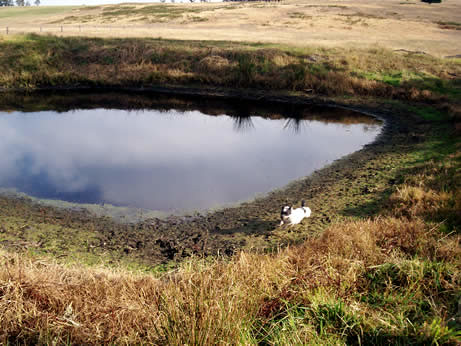
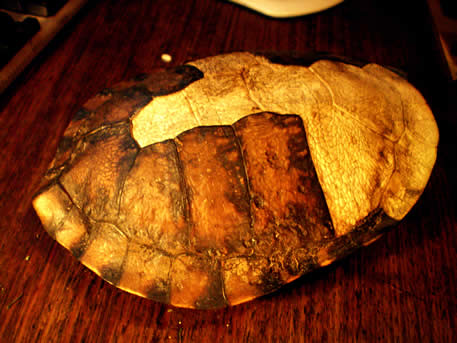
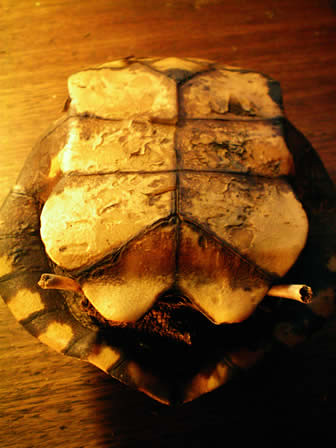
By a remote near-empty dam, we discovered two turtle shells, not far from each other. Each was about six inches in length. Desiccated leather curled away to reveal sutured white bone. Little white stumps extruded where the legs and head had been. Naturally, we brought them back home.


“Oh, you found those guys,” was Tosie’s reaction.

It transpired that the turtles had a history.

Emely had been first to discover them, shortly after their demise. Tosie had passed by their remains more recently.

Now, the important thing about Tosie is her deep affinity with Nature. She is in league with it, coiled within it, witness to its cryptic secrets. When she speaks, she sometimes sounds like a flaked out hippy, but her understanding of the bush and its underlying principles is profound. One would be foolish to discount her opinions on the subject.

I asked if the turtles - akin to some testudinal Burke & Wills - had almost made it to the dam, only to perish on the brink. Or had they died shortly after departure?

Drought in the region, Tosie explained, had caused the few remaining bodies of water to become overcrowded. With turtles. Conditions in the dam would have been very poor. Few resources. High levels of disease, toxicity. Our two ill-fated specimens would have been asked to leave by the others. To find somewhere else, or die. To sacrifice themselves for the survival of the community.

“Do turtles mate for life?” asked my wife, characteristically.

“I don’t know,” answered Tosie.


“What language did the turtles use?” I asked.

“The language of the forest,” answered Tosie.

Immediately, I thought of M. Night Shyamalan’s The Happening. And of The Swarm by Frank Schätzing.

I accept that it is within the realm of possibility for the forest to have a language, and certainly I would like it to have one …

Subtle chemical signals in the currents of the air, passed from leaf to caterpillar, from wombat bolus to dung beetle and thence to the blind nuzzling head of the earthworm …from gnarled parrot beak to witchetty grub … from pollen cloud to the tarsal combs of the bee … from diatom to rotifer to amoeba … from water-skimming spider to - at last - the murky consciousness of the turtles.

“Honourable citizen of the terrestrial biome. It has fallen to you [and your husband] to make the ultimate sacrifice.”


A signal, a demand, an imperative to which all creatures submit, which every organism, sentient or not, may interpret. To actually term it a language may be a superposition of our own thought patterns over something very different. Anthropomorphism may be the applicable word. Perhaps, the turtles were subject to something more simply described as the law of nature, red in tooth and claw.


The following week, Polly took one of the turtle shells to school for show-and-tell.
Doing her best to explain ‘the language of the forest, my wife penned a short explanatory note for Mrs Hobson to read aloud. I sealed the shell in plastic, predicting a possible violation of Education Department hygiene strictures. Indeed, it was redolent with ongoing decay and I didn’t want to unnecessarily put the children off turtles. Perhaps forever …

ps: Tessie, the little dog in the picture of the dam, was run over and killed a week after we left. She had gotten herself under the wheels of Tosie's car as it backed out the driveway. Tessie was one of the sweetest dogs I think I've ever met.

Stumble Upon Toolbar DiggIt!

Tuesday, August 5, 2008

~ the dreams of charles dellchau

With the inexorable rise of fuel prices, airlines have been doing all they can to survive – shearing baggage allowances, reducing in-flight services, ramping fuel levies - now, according The Age, there is talk of aircraft ‘flying in geese-like formation’.

There is so much to look forward to on a Post Carbon Earth.

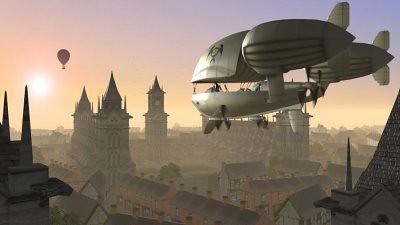
Recently, I read of an upswing in the blimp industry. And, at last, Germany is once more manufacturing Zeppelins.

I’m not getting too excited yet, but this could be a marvellous thing. Brute subsonic flight releases staggering amounts of CO2, it makes intuitive sense that the slow, leisurely, meandering ways of the dirigible would be cleaner, better for the planet and for our souls. They can be whimsical and bumbling. They can be smooth, sleek and romantic

One thing in the way of an airship comeback is, of course, the Hindenburg disaster. That graphic news footage has permeated into the racial subconscious making us leery of airship travel, [not forgetting the perceived Nazi underpinnings of the Zeppelin]. But, needless to say, airships these days are pretty safe; what’s more, they use non-inflammable helium.

In the future, when we look up, we will not see speeding bullets of raw function, but beautiful near-silent bubbles sedately following the winds. Airship design is limited only by the imagination. Streamlining and general airworthiness naturally play a part, but perhaps we will say goodbye to wind-tunnels and no nonsense aerodynamics.

There have been some lovely airships portrayed in film. Off the top of my head, I think of Nausicaa: Valley of The Winds, The Golden Compass and a very peculiar piece of tokusatu entitled Casshern, which incorporated a universe of marvellous gas filled invention.

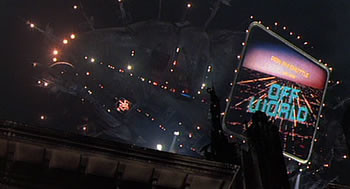
I should also mention Blade Runner, but that famous blimp was primarily an advertising platform and I wouldn’t want my beatific vision ruined by a sky crammed with commercial speech bubbles.


A new life awaits you in the off-world colonies … Oh, if it were but true …

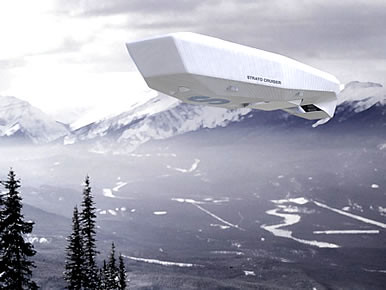
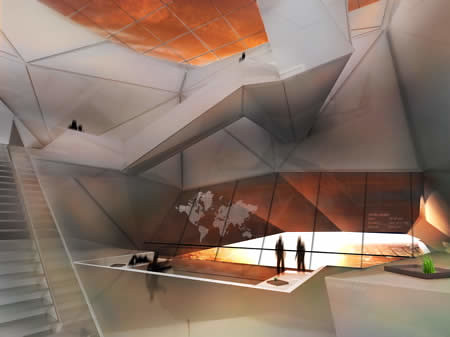
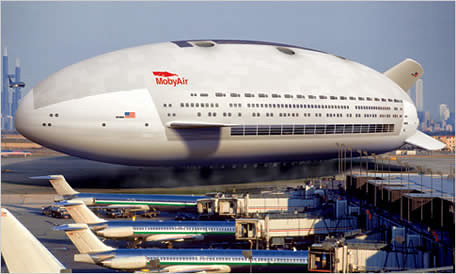
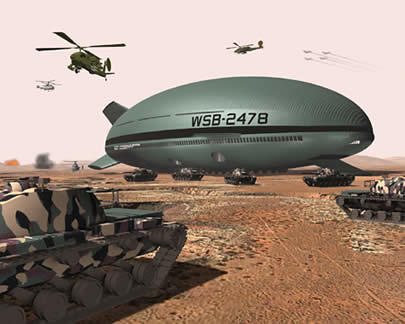
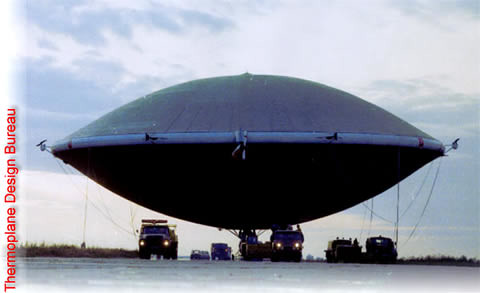
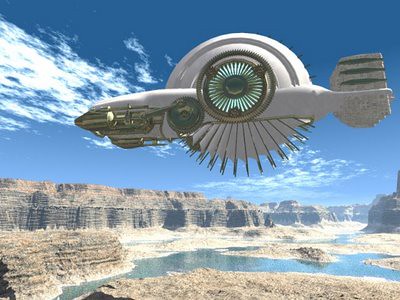
Some creative, forward thinking souls are already at work. Consider the Strato Cruiser by Tino Schaedler ...


The Aeroscraft


And some Russian designs with a pleasingly soviet edge


Once I started searching for bizarre airships on the web, as with most things, I couldn't find an end to it. The Steampunk genre delivers an embarrassment of beautiful fantastical lighter than air craft. Click for more.


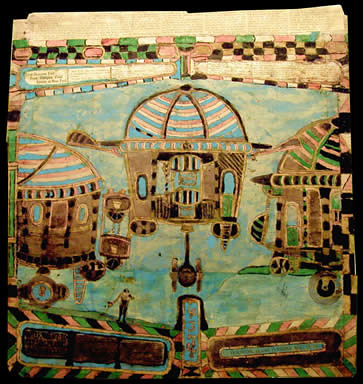
As is to be expected, the emphasis in functional airship design is still on smoothness and economy of form. The airship has many rivers to cross before it can achieve a true renaissance. But later, when there’s room to move, might we see a realisation of the wilder designs, perhaps even the visions of that absolute master, the enigmatic Charles Dellschau of the putative Sonora Aero Club, [which probably existed only in his own mind,] who produced 13 notebooks full of whimsical airships between the years 1899 and 1922.

His notebooks were rescued from the bin after his death and became an early example of outsider art. I, for one, find something cheering about them; they speak of innocent boyish dreams and an unalloyed romance of the air – as well as being more than satisfactorily outlandish. [Prior to powered air travel, UFOs commonly took the form of airships and some of Dellschau’s works include pasted on newspaper references to this.]

One day soon, let us all hope, such things shall be seen shambling through the sky outside our triple-glazed windows.

Stumble Upon Toolbar DiggIt!

Monday, March 17, 2008

~ greyish blackish

The heatwave - not so bad in Melbourne as Adelaide but bad enough - began last week.

I continued, as is my way, sorting the pieces of my life, adding here, subtracting here - like a watchmaker in his dotage, dithering on, yet to completely abandon hope that a tightened screw there, some tinkering here will miraculously transform his clock into a time machine…

The first few days I barely noticed. It was hot, but surely not in the high thirties as they said. Then came the school fete, where I toiled with Jenny at the face-painting stall. My system began to slow. I hovered in the shade drinking water, wondering how I came to be there…

Then yesterday, Polly and I drove to Lynne’s to pick up the new kitten, Greyish Blackish. Lynne is ‘rattled’ by the heat. She has a hot house, a crisp cardboard box that provides shade but little more. Here I really did begin to feel the heat. Mitch, Nell, and Fenella, the Canadian exchange student, perched on the big squarish grey couch, their faces illumed a faint blue by the screens of their laptops, all of us huddling against the bleaching radiation that was steadily, silently softening the bitumen outside, leaching the life out of everything. I didn’t want to drive Greyish Blackish home in that heat, so I waited, fell asleep on the floor watching Deathproof and when I woke it seemed even hotter…

I slept a long time last night, rose just in time to get the kitten-crazy Polly to school, and then – as is my habit – I put myself to work in front of the computer.

Half an hour later I was asleep again. Now I’m awake, only marginally rested, still with an inclination to stare blankly at cups and pencils. I had a lot of plans for today. The best I can do is write this.

It’s Autumn and this is unseasonable heat. My part of the world is changing. As you drive down the freeway, you see that the rugged shrubs and trees planted on the margins, chosen for their hardiness, are browning. In cracks in the concrete. indomitable weeds are yellowing and breaking away …

Oh, and here is Greyish Blackish. [Because she’s greyish blackish she’s rather hard to photograph.]


Stumble Upon Toolbar DiggIt!

Monday, February 25, 2008

~ the evil in our midst

It’s one thing for the patriarchs of the tobacco industry to swear under oath that smoking is harmless - it was an odious and immoral thing to do, certainly - but nothing compared to the crimes of the oil industry in funding climate change denial. I am beginning to think that a special place ought be reserved in hell for politically or financially motivated climate change sceptics.

Even if we are misreading the data, there remains an obligation on us to take all the possibilities seriously. If climate change impacts on us financially, then we must address it; it will not disappear if we ignore it, or rail against it, or donate money to organised naysayers. This is the reason there has been positive movement in the business world ahead of government policy.

If the loudest voices come from the left of politics, those on the right do not automatically have to take an opposing stance. As unpleasant as it may be, the issue must be embraced universally. Debate can be healthy, but denial by any opinion leader, at this point, is an absolute wrong. As opposed to terrorism, this is a real war and those who undermine our efforts for selfish motives are as guilty of sedition as any saboteur or fifth columnist. Worse, for there is more at stake. The future of everything we know.

I just wish people could get that into their heads.

In the last week, I have heard a conservative speaker comparing climate change to the Y2K bug, I have seen Andrew Bolt on the ABC Insiders programme, with his mocking smile, belittling the concept as if it was nothing more than the whining of tree-hugging pinkos, claiming that, even if climate change was real, why should we move against it if the big emitters did not?

If we do not act and the world descends into nightmare, where does that leave the stubborn, short-sighted opinions of Andrew Bolt? Does he become, with his like, a figure of historical infamy? In the future, when the question is asked, if you could travel back in time, what would be the first thing you would do? will the automatic answer be, kill the mothers of all the Andrew Bolts of this world?

And the mothers of the men who caused the demise of the EV1? I’ve just finished watching, ‘Who Killed The Electric Car?’. Less than a decade ago General Motors produced a viable electric car – the EV1. It was a success, it was there on the streets in America, it was the future. But it was destroyed by greed. By shadowy monsters at the helm of Big Oil, who brought about the recall and subsequent compaction of every vehicle. An extreme measure to meet an extreme threat to their vested interest. I wonder if history will hold these criminals accountable?

Consider this article by hater of life Jennifer Marohasy. Consider the style of her argument. She refers to climate change ‘hype’. She uses the release date and the lack of a bibliography in an attempt to undermine the veracity of a report. Then she launches a sly rhetorical attack on those who take the safety of our world seriously. ‘For those who enjoy the thrill of the more extreme doomsayer predictions, the 21-page summary will be a disappointment.’ Oh yes, we were disappointed. The world is not about to end tomorrow, damn it.

It’s not much use pulling her article apart in detail. Let’s just say she goes on to misrepresent Al Gore and put her own mischievous and very unscientific slant on the figures revealed by the report.


Why? What is motivating her to reduce a dire global threat into a political punching bag? Is she ignorant, or merely evil?

It is revealing that her Courier Mail article reappears on the site of the extreme conservative think tank The Institute for Public Affairs, [where Marohasy gets her pay cheque]. If there was ever a gaggle of treasonous wretches to be put up against the wall come the revolution, these are they.

Consider their knee-jerk reaction to the recent Garnaut report on climate change. Penned by Alan Moran, it rolls out all the old chestnuts. To dramatically cut emissions would be to return to ‘living standards to similar as those currently experienced in the developing world’. Two points here. a] I would rather have third world living standards than none at all, and b] it is widely agreed by thoughtful commentators that, if action is taken now, living standards need only suffer marginally, if at all.

In response to Garnaut’s suggestion that trade pressures be used to reinforce developing countries sense of public spirit, [Moran’s paraphrasing], he wails that this ‘would destroy the world trading regime and retard all countries' living standards’. Money money money. When will they get it into their heads? It’s about a lot more than money.

I won’t go on about this article, either. It’s full of the same old stuff. Solar power has no future as a baseload generator. Denial of fossil fuels to developing countries will create ‘intense political tensions’ [and extreme climate change will not?]. At times, you almost get the feeling that Moran is aware of the absurdity of his own argument: Garnaut’s targets are impossible to meet, so let’s not bother.

These climate change sceptics are, by this stage, on a level with creationists - yet their motives are far, far more malignant. They are driven by venality, greed, fear or, at best, obdurate stubbornness. But the future is at stake. This is only a political and financial problem by extension. The real problem rests with the continuance of life as we know it. It will take a massive, unified effort to save our future. There will come time when we should no longer tolerate this species of malefactor in our midst - or at least name them for what they are: evil.

Stumble Upon Toolbar DiggIt!

Friday, February 8, 2008

~ dormitory zone

Having inhabited the dormitory zone of Mt Waverley off and on for most of my life, I have come to consider it a refuge of aging wage slaves, Lathamesque aspirants and cashed up bogans.

In my childhood it was a nursery suburb. The streets overflowed with kids. But as the years passed, the young departed, the parents ripened and Mt Waverley became sleepy, secure, a bastion against change. Behind the shopping centre, near the railway station, fifties brick-veneers are routinely obliterated and replaced by multiple one storey units for those who time has rendered decrepit; who can no longer tolerate stairs, and whose daily exercise can be effected by shambling a few hundred metres to the shops.

I have always felt an outcast. Though I doubt there is any real community here, I’ve always thought I was precisely the kind of person it would shun. Not because I’m vicious or criminal, but because my habits and appearance, my house and its yard, for some may be strange and alarming.

Whatever the reality, for years I’ve been content to keep to myself. Contact or familiarity means exposure – perhaps to disapproval - and I treasure the asylum I have forged here. I’ve expunged the kind of trivial social contact that can devour precious time. I am far happier than most to spend my life in solitude, installed in my ancestral seat, babbling freakishly on my meagre plot – my pinprick of lunacy on the tumescent map of conformity and deadly tedium.

My friends and colleagues all live elsewhere. Aside for the odd neighbour, or shopkeeper, or fellow slave of Spasmo-Nemigron, I know precisely no one here.

But then Polly was born, and in time Polly went to school. And if there is one thing with an ability to magically generate a sense of community, it is children.

And, as the ageing population of Mt Waverley falls from the vine, there are more and more of them about. And they make friends. And these friends have parents, who you wind up having to talk to, and invite into your house.

It seems conceivable, though perhaps far-fetched, that friends may even be made in such a manner. It has not happened yet, but my wife is well down the track in a number of cases. It is always the women who build the social links, who bring people together, who breed connection – while the men … well I’m not a normal man, so I don’t know what they do exactly. Perhaps you could look it up on Wikipedia? As for me, I read and write and generate lugubrious piles of matter.

Last night, we made the wildly optimistic decision to attend a cocktail party at Polly’s school, a gathering designed to bring parents together socially. [As my wife was getting dressed I heard Polly say the following in a commanding tone: You have to wear a dress to a cock party! Polly is proving a useful source of sartorial advice. I've also learnt that ballerinas never wear undies.]

Our low expectations may have had something to do with it, but we wound up having a pretty stimulating evening. I spent the first half hour speaking with a web designer and an event organiser with a background in theatre. The subject was climate change and these guys - with kids in Polly’s class - were amazingly up to speed. Perhaps there is hope for us yet if this is any indication of how the middle suburbs are thinking. Promisingly, environmental concerns slithered in and out of most conversations last night. Alarmingly, I picked up some dire new statistics.

I found all this connection quite rewarding – though I have to say that for an ethnically diverse school, the Anglos were over represented. My wife made fast friends with Polly’s rather attractive teacher, and – in a sign of improving health - offered to help with the face-painting stall at an upcoming fete. Remarkably, I even heard her discussing a possible trip to Confest with one of the mothers. The local possum lady was in attendance too - always good value - and soon she’s going to bring a baby wombat to school.

But where were the greedy renovators and daft prattling airheads? Where were the frowning Presbyterians and beer-swilling boors? I think, in my isolation, I’ve failed to notice that the suburb has changed in more than just land value. I came away from that party feeling just a little optimistic. Perhaps I won’t be isolating myself quite so much anymore.

Both my wife and I have always been paranoid about other parents thinking we were freakish, and so disadvantaging Polly. At least some of those fears were put to rest last night. Even the parent who recognised me as the guy who doesn’t wear shoes when he goes shopping thought it more funny than frightful. Am I rationalising, or has Mt Waverley, in the fullness of time, become a bearable, even interesting place to live?

Hmmn. Hard to get my head around.

Time will tell.

Stumble Upon Toolbar DiggIt!

Saturday, January 19, 2008

~ a fresh infestation

Part of the advantage of having a jungle for a garden is the occasional unexpected appearance of new flora and fauna.

In recent times, there’s been unusual activity in the natural world of Mt Waverley: nightmarish earwig infestations, the rise of the native cockroaches, an invasion of revolting black caterpillars which I have been unable to identify - and now a brand new spider.

I’ll leave moot the issue of climate change, though to my mind it is certainly in play.

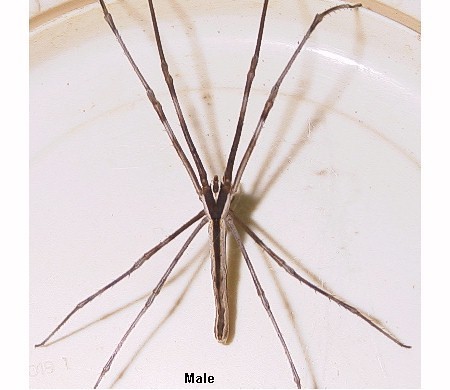
Like any house in this region, we have our resident daddy long legs and huntsmen, but over the last month in various rooms we have noticed, in corners, clinging to walls, a spider that looks exactly like this:


I don’t have a good enough lens to capture something as small as a spider, so I had to borrow the image.

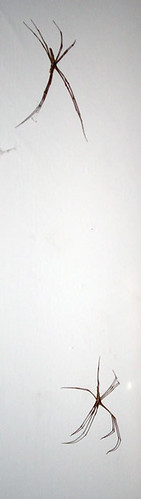
My photo looks like this:


As you will notice, there are now two of the spiders. They are handsome-looking things, clean, having a kind of design affiliation with the stick insect.

The species is Deinopsis subrufa, the net casting spider, named after its distinctive means of snaring prey. It waits with a unique rectangular net grasped in its four front legs. When potential prey passes – either arachnoid or insectile – it casts the net to effect capture; its victims tangling themselves in the non-sticky silk or cribellate. I haven’t seen this happen, of course, but could these spiders have been feasting on the local daddy long legs, moving from room to room, methodically clearing out our age old co-inhabitants…?

These individuals are male. I have not seen any females, which seem to be almost orange in appearance…

I have not found any mention of these spiders colonising the inside of houses. Have they been forced inside, I wonder, or is this an isolated occurrence? Whatever the case, who could be anything but proud to share his domicile with such a charismatic lifeform?
Stumble Upon Toolbar DiggIt!

Monday, January 7, 2008

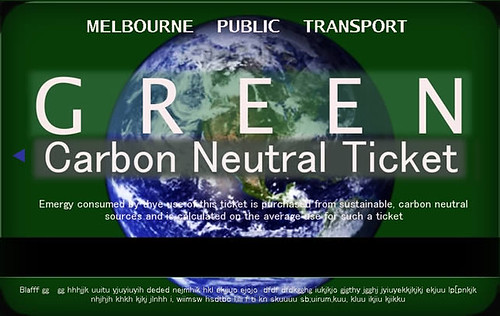
~ the green ticket


Now this may seem like an obvious idea, but I have yet to hear it suggested.

Could not the Melbourne public transport authorities - or those of any city on the globe - provide the option of a Green Ticket?

All they would have to do is divide their energy use/carbon emissions by the number of tickets sold, and arrive at some sort of figure for the carbon cost of each ticket. Then, with each purchase of a green ticket, they would undertake to either offset [in the case of buses etc.] or purchase accredited green energy [trains, trams etc] to that arrived at value.

The Green Ticket would be a little more expensive, but every purchase would reduce greenhouse gas emissions. And the government might even see fit to cover that extra expense itself…


Stumble Upon Toolbar DiggIt!

Thursday, December 20, 2007

~ the swollen grey creek

Today’s weather made the last post seem almost prescient.

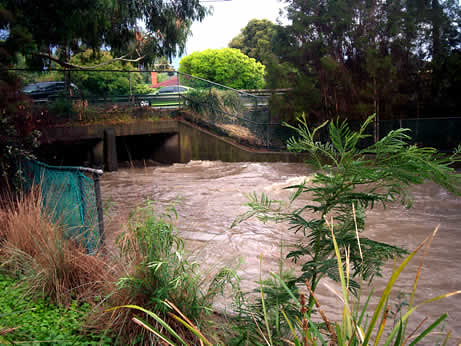
We were hit by thunderstorms of extraordinary ferocity. I was stranded on the roads, trying to speed past sparking powerlines, avoiding flooded depressions and fallen trees, before my beloved Renault 12 stationcar gave up the ghost. I was on my way to retrieve Polly from her last ever day at crèche. I rang my wife then, and sent her into the fray….

I swear that there has never been a storm such as this - at least in my memory.

Below is Scotchman’s Creek swollen to ten, perhaps twenty times its normal size.


Stumble Upon Toolbar DiggIt!

Saturday, November 17, 2007

~ I am the lorax. I speak for the trees

Thoughts on the looming election.

We are exceedingly complex organisms, evolved from an exceedingly complex biological system. It is said the human brain is the most complicated thing in the universe, but the brain itself is a component of a thing far more intricate and vast: nature, the totality of life on this planet considered as a whole - on which we remain entirely dependent for our continued survival.

As we have proliferated and developed as a civilisation, we have increasingly isolated ourselves from our ecological matrix, from nature. We have acquired tastes, desires, needs that exist in a place apart from nature, and which are sometimes directly at odds with it. Consider electricity, computational power, mechanical assistance, recreational assistance, medical technology. We are so deeply immersed in this artificial superstructure that we frequently forget that we are, as ever, as always, wholly, of the Earth.

When we travel off-world in our magnificent machines, however briefly, we must take a portion of our atmosphere, food from the soil, the bacterial flora in our gut, the microscopic monsters that tend our eyelashes….

Some of the instincts that served us in pre-history have found new focus in a civilised world. They have transmuted into such things as greed, the urge to acquire far beyond one’s actual need. Many of us consume simply to be seen consuming more than our neighbour. We expect, almost as a right, a standard of living which would have astonished our forbears. In a world of gross unrestrained consumption, the pack instinct, refocused, can lead to the rape of the Earth.

The urge to power leads to ultra-violence - against each other, against other animals, against the fabric of nature herself. And it can lead to slavery in everything but name. And discrimination. Prejudice. The loss of contact with the fundamentals of our existence can lead to the perversions of torture and the tools of mega-death …

In the last decade, we have acquired sufficient evidence to know, without doubt, that our civilisation is destroying its foundation. Nature is no longer swinging with the punches. Soon, our planet, our mother, will be a hostile place that will no longer abide our excesses. Of course, I am speaking of climate change here, the greenhouse effect, the mass extinction of species... Humanity, we have learnt, is literally a plague upon the Earth.

I ask the reader to keep the above in mind, if you are voting in the upcoming [Australian] federal election.

The SBS programme Insight, in a recent episode, corralled an audience of undecided voters. I did not see it all, but over the period I watched not one of them counted environmental degradation among their concerns. They spoke of house prices, interest rates, taxes, the economy … they spoke for themselves, for themselves only, not for the community, and not for the ultimate provider of the air they breathe, the food they eat, the body and the mind they inhabit - though that provider is under dire threat. To my mind, hip-pocket voting is an abomination. The act of indulging the hip pocket voter is an abomination. [Certainly the suffering of many people could be eased by better government policy in the economic realm, but not at the cost of the planet]

We have come to a time in which only one issue counts - and beneath its rubric, the sub-issues of social equity, education, research/development which may give us the ability as a community to save ourselves.

Stumble Upon Toolbar DiggIt!