Pages

Showing posts with label CURIOSITY. Show all posts

Tuesday, April 27, 2010

~ a third column

I started this blog because, like everyone who gets into blogging, I wanted to add a third column to my ... template.ThreeColumnBlogger

Over the next week or so, health willing, I’m going to make an effort to update the Sails of Oblivion layout, so please excuse me if the page looks strange from time to time. I really want that third column ... mainly for the twitter feed and all that stuff which gets lost at the bottom. And I think it’s time for an improved header. And a fresh new look all round.

I saw a little wattlebird yesterday. Similar to the common red wattlebird but devoid of wattle and yellow-stained chest, and blessed with a distinctive, possibly even more demented range of vocalisations. Today there were some masked lapwings on one of the Monash Uni ovals. In the Valley Reserve I witnessed the wonderful display of a flirty grey fantail and, briefly, I think, an eastern spinebill.

As long as I can remember, there have been tiny brown and grey chirruping birds living outside the window of my study. Like all species, they have their own specific character - a thing which birders (unfortunately) call their ‘jizz’ - but until recently their identity has remained mysterious. Despite their abundance, it was a hard job pinning them down - even with the help of my new field guide. They do not look spectacular; they are not an imposing bird in any way, yet they colour the ambience here with their twitters and trills, and the flickering they do among the leaves. I am sure I would notice their absence.

I learned that they are brown thornbills - and with this knowledge a world opened up, just there, outside my window, of which I had no real prior awareness. Now I know their preferences, the months they breed, the kind of nests they make and the extent of their range. It’s all so ... fascinating. A name is a key - and never more so now we have the internet.

I am beginning to see the hot churning black hole at the centre of the birder’s mind; I am beginning to feel its irresistible attraction ...


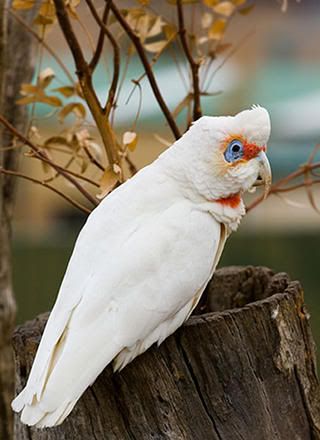
This is the long-billed corella. The last few mornings I have heard the harsh, grating voices of a flock passing high above the house. The bird often looks scruffy because it has a habit of digging for tubers, including, helpfully, the bulb of the hideous onion weed. The individual above, (photographed by Noodle Snacks) is, however, perfectly presented, though
the bloody bib suggests (falsely) that it may recently have been gnawing at something’s throat.

Yesterday, Polly imprisoned a daddy long legs in a small lidded container together with a snail in the hope that by morning they would have ‘mated’. Also, she’s acquired a device called an R5 which holds eighty games and can be plugged into the back of her DS - this will settle her for the next week or two


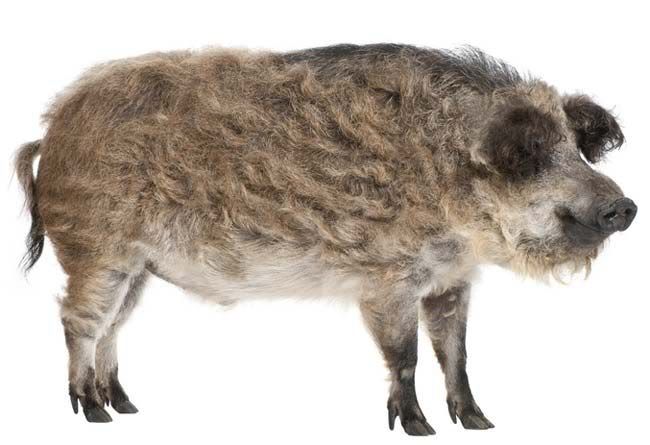
Speaking of mating, did you hear about the transgenic pig-sheep? I was excited for a while - and hopeful, thinking it might have some advantages for the environment. We farm pigs anyway; if they could grow wool as well as bacon, then there's got to be some kind of energy saving. Perhaps some of our sheep pastures could be turned to forests roamed by woolly free-range pigs? Disappointingly, the abomination turned out to be the Mangalitza, a rare porcine breed from Austria with no apparent sheep genetics. Still, the idea is there. There's no reason to give up hope entirely.

And if only there were a substance that was neither illegal nor poisonous which you could have just a little of as night begins to fall. Something to make you laugh and forget how tired and sick you feel, something to elevate the spirit and anaesthetise some of the wounds acquired during the day - and which did not give you a hangover. Is Big Pharma working on something like this? Would they be allowed to? And if they succeeded, would it be legal?


This is a an old car that burned in the black Saturday bushfires. It was part of a collection of valuable Australian antiques and was donated to the Melbourne Museum in the condition you see. The chassis of most modern cars warped, even melted in the terrible heat, but older cars, with heavier steel bodies, seem to have been able to hold their shape. Mind you, the insides were a charred and melted melange.
Stumble Upon Toolbar DiggIt!

Thursday, April 8, 2010

~ ambergris in the raw

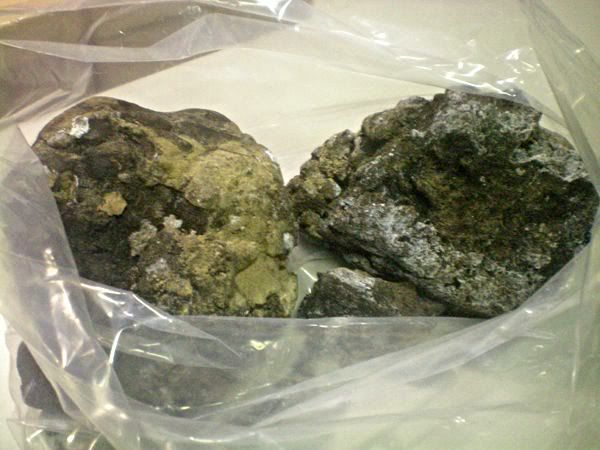
With the kind patience and assistance of the staff at the Moreland annexe of the Melbourne Museum (particularly my dear friend Nurin) I was at last able to have my first certified look feel and smell of ambergris, the waste product of the sperm whale which holds a rarefied place in the perfume industry - and which is central to my current work.

I was expecting something like the warehouse at the end of Raiders of The Lost Ark, and I wasn’t so far off the mark. It’s a large unmarked rectilinear building on an unprepossessing corner in an unexceptional suburb, yet within there are wonders.


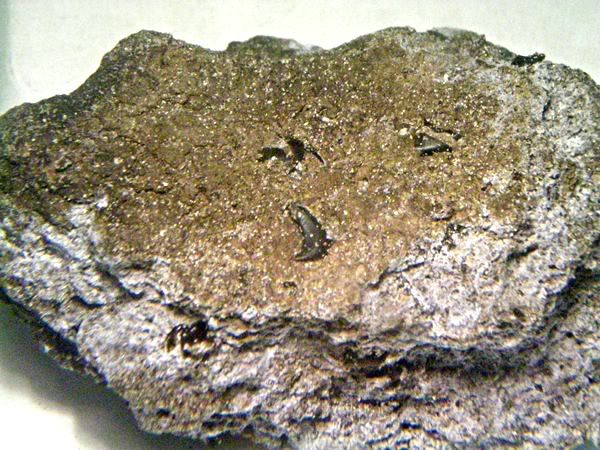
So let me tell you about their marvellous sample of ambergris. For a start, unsurprisingly, those tasked with locating it were unimpressed by the appearance and the odour - without question, it had the ‘humid’, ‘earthy’, ‘marine’, ‘animalic’ fragrance I’ve so often read described. It was a huge crumbling bolus, covered with patches of concreted sand and what may have been the roots of long dead seaweed. It was indexed as an amalgam of ambergris and non-descript matter, possibly faeces - but upon inspection the tell-tale squid-beaks were evident throughout - and the hot-needle test I was allowed to perform on a tiny smidgeon came up a strong positive.


I love this kind of thing. It drives me on through life. Polly, who I took along, was a touch bemused by the whole process ... but at least she knows what ambergris is now, and she was more than a little interested in some of the other exhibits we passed along the way.


This pig, we learned, had come from the Austin hospital. It had been genetically modified as part of an effort to make porcine organs compatible with humans needing transplants. (xenotransplantation). From the fact it was preserved in such a way, I can only assume it held - or perhaps still holds - great significance.

(please excuse the unfamiliar formatting - something strange seems to have happened with the Blogger interface)


Stumble Upon Toolbar DiggIt!

Thursday, April 1, 2010

~ red rumped parrot

In these lean times, its rare for me to come into possession of precious things, but yesterday, using a book voucher I received for Christmas, I acquired a copy of Pizzey & Knights’ highly respected Field Guide to The Birds of Australia. Since then it has barely left my hands.

I know. My prognosis is doubtful. I may have traveled so far down the birding path that my chances of returning are poor.

But let me share with you some of my ornithological excitement. According to the twitchers, Melbourne is home to many parrots - not just your rainbow lorikeets,
galahs and eastern rosellas - but more obscure varieties like the musk lorikeet, the purple crowned lorikeet and the little lorikeet. My failure to sight any of these has been a source of enduring frustration, but today, at last, things changed ...


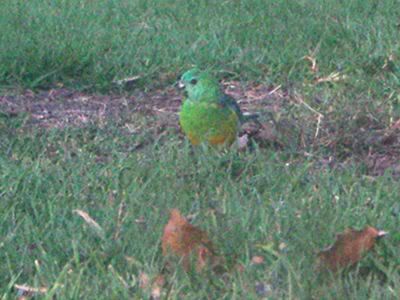
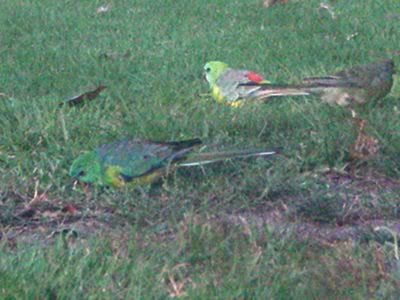
During a break from reading at Vision Australia, one of the workers noticed me poring over my new bird book and informed me that a family of red-rumped parrots was living in the park right next door. Once I’d finished with my work, I walked down to have a look and was far from disappointed.


Please excuse the quality of the photos. My camera is not only cheap but somewhat wonky and I had to take these shots at full zoom. Typically for the bird kingdom, the dull version of the bird is the female. Red-rumped parrots (Psephotus haematonotus) are also known as grass parrots.

Stumble Upon Toolbar DiggIt!

~ the goa stone, byssus and the pyxis

If there’s one thing that's guaranteed to stall the progress of my work, it’s research. If I cast aside my figurative pen and submerge myself in the vast reference tool that is the internet, then the hours slip by without friction and I emerge with a head full of fascinating arcana, little of which is relevant to the job at hand. To wit: the play I'm working on called Ambergris.

In the last week, I've learned more about ambergris the substance than I could ever hope to employ, but I've
also been lured down snaking tributaries ... overhung with rare crystalline fruit ... ripe to the point of bursting ... which I could not help but pluck ...

I learnt of shilajeet, an uncommon tar that seeps from hidden cracks among the Himalayan mountains during the summer thaw. Even the apes of this region know of its restorative properties for - together with humans - they sup from these mysterious wells and are known to age at half the rate of their fellows.

I discovered the noble pen shell, a massive Mediterranean mussel which secretes extremely fine golden threads with which it affixes itself to rocks. In antiquity, these threads were collected and woven into an exceptionally sheer fabric named byssus or sea-silk, which - owing to its
utter luxuriance and its tremendous price - was favoured by Pharaohs, Satraps, Caesars, Padishahs and any potentate worth his salt in the ancient world. Only one human still practices the art of weaving byssus. The noble pen shell is on the brink of extinction.

I made a note of lacryma cervorum - the stag’s tear - a viscous substance found in the corner-pit of the animal’s eye and possessed of magical properties similar to those of the bezoar.

But let me reveal some secrets of the ambergris ... that ‘marine sulphur, found at the sea-shore’ ..., which has broken from the ‘fountains and caverns of the sea’ ... Which ‘is grey, sweet and smooth' ... and which, when ‘pricked with a needle sweats out fatness, softens in the heat, and when moist appears black’.

If it is true, as tradition dictates, that ambergris is most likely to be found in the hindgut of the sickest whales, then it is no shock that the following individual, taken by whalers, contained the precious substance ...

There was ‘an unusual combination of lesions and ... behavioural abnormalities’ in a bull whale ‘taken... off Iceland’. There was ‘heavy combative scarring of the head, grossly roughened and thickened skin on the lower left flank, cutaneous maculae, genital papillomatosis, partial duodenal obstruction by plastic debris, colo-rectal obstruction by ambergris, cystic degeneration of the right kidney, and a deeply ulcerative gastric nematodiasis. Sealskin was found in the stomach. Gross and histopathologic observations suggested that the disease complex in this animal may have been related both to habitat degradation and health risks naturally associated with its ecology and age.’

I
gnorance of its origins have in the past spawned some curious tales ...

Ambergris is not the scum or excrement of a whale, but issues out of the root of a tree ... which shoots forth its roots towards the sea, seeking the warmth of it, thereby to deliver the fattest gum that comes out of it, ... otherwise by its copious fatness [the tree] might be burnt and destroyed ... [the] fat gum it is so tough that it is not easily broken from the root, unless [by] its own weight and the working of the warm sea. . . . If you plant the trees where the stream sets to the shore, then the stream will cast it up to great advantage.'

In [a] ridiculous and wholly fictional account of a ... sea journey in search of the lost Capt. Jacob Cole, Clifford describes using a diving suit to find ambergris on the bottom of the sea and digging it out of the sediments with a pick axe.’

At one time it was ‘assumed that the sperm whale was a hunter rather than a manufacturer of ambergris, and that he swam ... about the broad ocean, gobbling up the treasure wherever he could locate it.” “In vain it was to rake for ambergriese in the paunch of this leviathan’ ... as ‘they sometimes swallow great lumps thereof in the sea’ before vomiting it out.

Marco Polo was the first Western chronicler to [correctly connect ambergris with sperm whales, but he ] also thought [the whales] vomited it up after having eaten it in the depths of the sea.’ Current wisdom has it - as far as I can tell from my readings - that the ‘morbid concretion’ exits not from the mouth but the anus [or its cetacean equivalent].

Ambergris was an article of imperial trade in Audoghast in northwest Africa before 1,000AD. In the 10th century Ibn Haukal, an Arab trader, classed it in value with gold and black slaves and referred to its reputed aphrodisiac properties.

Avicenna ascribed its formation to the belchings of undersea volcanos. Kublio thought it was bird guano. Nero's wife Poppaea Sabina is reputed to have had oil of ambergris poured in her bath in 54AD.”

The Crusaders, "who will not be suspected of effeminacy," were largely responsible for its introduction to Europe from their contact with the Arabs.” Louis XV is said to have used ambergris to flavour his favourite dishes. The favourite dish of France's King Charles II was eggs and ambergris.

Ambergris is used in the manufacture of cassolettes, little perforated ivory boxes made to contain powdered odoriferous substances to carry in the pocket or reticule. It was also used in the production of peau d'Espagne, or Spanish Skin, used for perfuming writing paper and envelopes. Queen Elizabeth I is said to have worn a cape made of peau d'Espagne.’

The ‘pasty pathological growth’ also had pharmacological uses ...

It was ‘sealed up in a vessel hermetically, and digested for forty days. The ripened blend, we are informed, perfumes forever what it touches, eases the headache, takes away defluxions from the eyes, comforts cold and aged people, prevents apoplexy and epilepsy, strengthens all parts of the body, and causes fruitfulness’.

And as I've quoted in an older post ...

It is ... an excellent Corroborative; it is discutient, resolutive, alexipharmic, and analeptic; it strengthens the heart and brain, revives and recreates the spirits natural, vital, and animal. Its sweet Sulphur is ... a good preservative against the Plague". From The Art of Healing and Praxis of Chymistry.

Then there is the curious Goa Stone ... It was ‘a universal remedy introduced in seventeenth century England, originating ‘from Goa and ... found in the form of oval balls weighing up to one pound ... [they were] generally encased in decorated gold or silver spheres. The formulation consisted of a number of powdered ingredients which included precious stones, bezoar, musk, ambergris and gold leaf, levigated into a fine, impalpable powder and formed into oval balls with mucilage’.

And the Pyxis, ‘an ivory box fashioned from the natural cylindrical shape of a tusk, probably used to hold gifts of ambergris, musk and camphor’. One example ‘is carved with a host of elaborate scenes, including one showing two horsemen, accompanied by cheetahs and birds, picking dates off a tree’.

In 1912 the discovery of a 450 kg. lump of ambergris saved a Norwegian whaling company from liquidation.

During the writing of my last play Mysterium I deliberately indulged myself. The work ‘sweats’ with strange archaic language and is bursting with fascinating anecdotes and obscure details. It was an unusual play with an unusual style, and its richness and density was generally well received - but with Ambergris I am planning for the narrative, the characterisation, and all those other elements which traditionally make a play a play, to be paramount.

The play is progressing wonderfully, but it is stretching into infinity. I am at page one hundred and ten with miles to go before I sleep.
Fortunately, I now have Sails of Oblivion - the perfect repository for all the fascinating little gewgaws I encounter along the way.

[Please excuse me for not attributing the quotes and sources in this post. It was simply a matter of time.]

Stumble Upon Toolbar DiggIt!

Thursday, September 3, 2009

~ knowledgeporn

These days, as I may have previously mentioned, I cannot imagine getting into bed of a night (or an afternoon) without my ipod and the growing store of utterly fascinating wisdom contained within. Constantly, I am discovering new podcasts by brilliant commentators and thinkers. Constantly, I am driven to my books or to the net to research things I’ve never heard of before. The universe is an utterly fascinating place, if you are interested in it, if you are in your manic phase and not weighed down by the leaden disinterest of depression.

I’ve added new list of links to the Sails of Oblivion sidebar. It includes all my current favourites like Reasonable Doubts (anyone conflicted about religion should listen to this – the mental agility of these guys is sometimes breathtaking), Skeptoid (The slow pitiless torture and execution of urban myths, alternative health nostrums, historical shibboleths and general wrong-headedness by the infuriating Brian Dunning), and Skeptics’ Guide to The Universe (the predominant sceptical podcast which, besides being rather entertaining, updates the progress of scepticism-related issues and advises on critical thinking).

I realised yesterday, when the new episode of The History of Rome appeared in my pod, that I’d been looking forward to it at least as much as the latest True Blood. There’s something about ancient Rome that does it for me. Simple as that.

And similarly with The Bible. Having been brought up a strict Catholic, The Bible was first presented to me as immutable, flawless and sacred. Consequently, in these latter days, I love seeing it picked apart and revealed as the imperfect work of fallible human minds. The related history and mythology is also captivating, as is the language - and in these regards, The Bible Geek is uber-knowledgeable, a talking concordance.

Sometimes, I wonder if anyone else is having the same experience as me. My delight in this newfound voluptuary of knowledge is a solitary vice, yet the net is a social phenomenon. There should be other lazy brains out there being driven to thought …

As regards the New Scepticism (or ‘Freethought’ as it is often described in the US) this really seems to be the case. There is a bone fide movement fomenting over there, spawned in the dark years of the Bush administration - when science found itself beholden to the madnesses of the extreme Christian right - and then set free to prosper with the rise of Obama. The nation’s freethinkers have organised themselves and are raising a loud, clear, measured voice against the powerful kooks that plague that country, be they conspiracy theorists, the anti-vaccination lobby or young Earth creationists.

Predictably the effects are spilling over into our fair land - despite our tendency to apathy and our lack of hugely influential maniacs against which to fight. Sceptic and atheist groups in Australia are feeding off the clamour in the US and consequently finding their feet. New web presences of a sceptical bent are always appearing, often produced by students. The Skeptics In The Pub phenomenon is catching on. And, excitingly, Melbourne is hosting The Global Atheist Convention in 2010. Its rubric is ‘The Rise of Atheism’. Let’s hope there's truth in that title.

As a young teenager, shortly after I lost my faith, I looked forward to many things: flying cars, the colonisation of Mars, and a world free of religion. Naively, I believed that by the turn of the century humanity would have developed sufficient intelligence to abandon such childish comforts as faith in an afterlife and a caring omnipotent god.

Naturally, as the years passed, my hopes were dashed. I had to recalibrate my opinions regarding humanity.

But now, I wonder, I just wonder, whether we might be seeing the glimmerings of a new Enlightenment.

Stumble Upon Toolbar DiggIt!

Sunday, September 14, 2008

~ extraordinary things

Life used to be flush with excitement. Awesome things used to happen all the time.

But these days, not only is my existence monotonous, predictable and unexceptional, but I would fight tooth and claw to keep it that way. Sure, those ever advancing years are at least partly to blame. And yes, my life is probably a little more interesting than I make it out to be – but reasonable certainty that tomorrow will be pretty much like today is a large part of what keeps me together, helps me stave off depression, be a consistent father, obey the orders of my beautiful wife - and work.

If you’re writing a novel, you need to work pretty much every day, and for hours – in my case at least four. The days go by. The words get written. And I find I’m spending a good part of my mental life in the chaotic fantasy world of Nonesuch.

That’s how I’ve replaced the madness of my youth. That’s how I get my jollies these days. In the mind. The mind.

In Nonesuch. In Alastair Reynolds' space opera House of Suns. In David Mitchell’s Cloud Atlas. In my library, where thousands of books, accumulated over decades, emanate an aura of profound comfort and potential … I can go anywhere … what's more, in the next room, the internet, and you ...

Did you read the article about cognition and exercise last week? An experimental study strongly suggests that regular daily exercise leads to improved mental function. It makes sense to me, gives me even more impetus for my exercise regime. What's more, a few days ago I discovered
Dr Norman Doidge and the concept of neuroplasticity. The act of thinking actually involves synaptic growth and can even turn genes on and off. Believe me, I’m back doing my crosswords. I'm an immediate convert. No doubt, cerebral exercise is at least as important as physical. Particularly – as I repeat myself like a weary, warped, worn-out record – if the years are accumulating behind you.

They say your mind goes as you die from liver cancer. What a harrowing thought. I’ll have to put something in my will about that. I want to be turned off before my wits go. Just pump me to the eyeballs with morphine and let the sisters of mercy call down the birds ….

Lately, you see, I've had this thing with birds … And I feel I’m about to have a thing with fungus … It’s my way of going deeper, finding the Breugelian phantasmagoria beneath every rock, brick and decaying log … Imagine how much there is to learn about those strange growths … imagine knowing the name of even the humblest toadstool ... Who cares if they’re a hundred feet from the Monash freeway … My god, I’m shivering with excitement!

There’s a whole boring old suburb out there, full of boring old people; there are mundane parks and common species … but when you get into the detail, well, it can transform into a wonderland… That’s what I started out trying to say. I’ve learned to take delight in the little things. I'm learning to find community in the place I live, rather than where I go mental.

Howard Arkley, the artist who lived and died not far from here, was unearthing something similar in his work. Lounge suites, common as muck, burning with neon intensity. But when drugs intervened, then his sense of wonder was whisked away - and he was left with shabby old furniture and a rafter from which to hang himself.

Here are the lyrics to a song I wrote in the nineties. It was for Lynne, the woman who taught me that ordinary could be astonishing.

*

extraordinary thing

she likes terrifying things.
she likes death-defying things
beware her paperclip and her useless piece of string.
beware the texture of her skin.

he loves convoluting things
he loves interwoven things
M.C. Escher folds his hands under his chin
enthralled by the deployment of her limbs

that girl who lies beside you -
has got the strangest idols

she likes ordinary things,
but she’s no ordinary thing.

she likes mortifying things.
she likes nauseating things.
beware her laser beams and her paralysing sting.
beware her vanities and sins.

she likes aggravating things
she likes modifying things
she wants a murky world where logic is a sin
and where confusion reigns, she’s king.

that girl who lies beside you -
has got the strangest idols

she likes ordinary things,
but she’s no ordinary thing.

extraordinary thing
extraordinary thing

(From Sweet Secretions by Fact. Available in your local remainder bin or op-shop.)

*

A final note. I've added an important update to the post titled Blue Streaks of Paranoia


Stumble Upon Toolbar DiggIt!

Sunday, August 17, 2008

~ recommended product #2


Please afford me the pleasure of recommending another curious product from the mysterious Orient.

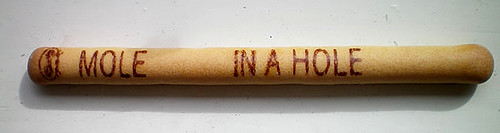
This snack comes in a number of flavours. The package contains two compartments: one a small reservoir of
creamy, honestly delicious dip, the other containing biscuit sticks, each one branded with an enigmatic animal-related message ...

Giraffe - Tallest Mammal
Fox - Beware of Lies
Cow - Muuuu
Starfish - Star + Fish
Bat - Only in The Night
Mole - In a Hole
Goat - You are Lucky Today
Rabbit - Eat More Carrots
Chicken - Kokekokko!
Chick - Lucky Colour Yellow
Beetle - Lucky Colour Brown
Sheep - Wool Sweaters
Owl - Active at Night
Zebra - Herbivore
Frog - Amphibian
Cat - Say Meow
Horse - Gallop Away
Octopus - Lucky Number: 8


Is this copywriter seriously out of tune with nature, or what? No, I'm being deliberately unfair. It's a language thing... Or is it?

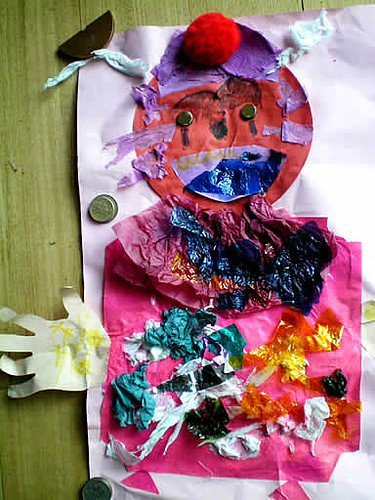
Congratulate Polly on the discovery of Yan Yan - and for this magnificent clown which she brought home from school on Friday


Stumble Upon Toolbar DiggIt!

Thursday, August 7, 2008

~ recommended product


Allow me to eagerly endorse this product.


Stumble Upon Toolbar DiggIt!

Saturday, April 5, 2008

~ the toxic shrub

[… continued from earlier post]

Returning to those improvised demi-drugs which a certain character-type may consume before he or she can access or afford grown-up drugs…

- Bulbs, for instance, [which I never tried].

- Pure & Simple, [which I'm ashamed to say I did].

- Nutmeg, said to be used by ‘drug-starved prisoners’ and sailors at sea in the absence of alcohol, [I never tried it, not seriously].

- And poppy seed tea, [which I did not try because, thankfully, I had not heard of it
at the time].

My HSC literature teacher, Brother McCarthy, a furious, opinionated Christian Brother, [who was certain an unattributed painting in the school lobby was a Tintoretto,] was speaking in class one day on the subject of intoxicants. I can’t recall the context, though certainly he would have been forbidding their use.

He made mention of the shrub ‘oleander’. He told us it was used in classical times to induce hallucinations and my ears pricked up. I knew the location of an oleander bush. It was right outside my parents window.

That night, predictably, I plucked some of its deep-green, leathery leaves. How many to consume? Circumspectly, I decided on just two – at least for starters - which I minced up and cooked with rice and vegetables.

Heaven knows where Brother McCarthy got his information, but he should have been more mindful before broadcasting it. Or perhaps it was a subtle policy conceived in the deep and ancient vaults of the Order, designed to rid the Earth of people like me before they reach maturity.

I was lucky I didn’t die. No, really. Down the track, I learned that oleander was a deadly poison. Consider these snippets from Wikipedia:

Oleander is one of the most poisonous plants … contains numerous extremely toxic compounds, many of which can be deadly to people … especially young children … The entire plant including the milky white sap is toxic … in some cases only a small amount can have lethal or near lethal effects … Oleander bark contains rosagenin which is known for its strychnine-like effects … There are innumerable reported suicidal cases of consuming mashed oleander seeds …

What I experienced was wracking nausea. Throughout the night, I vomited green bile out my bedroom window as my digestive tract roiled and spasmed. I told my parents that I’d eaten something that disagreed with me – and that was nothing less than the truth.

So, as you can see, from an early age I sought out any and all forms of altered consciousness with determination and ingenuity. As my body matured, I sought oblivion as avidly as I sought out sex.

My parents weren’t big drinkers, but they had a humble bar, consisting of various spirits and liqueurs. Of late, through lack of use, this had been removed to the shed.

On a few occasions, I had purloined bottles of my father’s beer, but had never really succeeded in getting a decent buzz on. What I wanted was to get solidly, thoroughly spiflicated - so one night, after my parents retired, I procured an empty milk bottle, crept out to the shed and filled it with just a little vodka, just a little Drambuie, a little vermouth, a little Benedictine and so on – so that the theft would go unnoticed

I left the house and made my way down to the region my friends and I had named The Quagmire. This was a zone of clay pits, degenerate plant life, rampant blackberries and mounds of dirt and building materials. Through it meandered the Grey Creek, which at that time was stodgy with effluent, sudsy with detergents, and which infused everything in its vicinity with a sweet faecal aroma.

I chose a dreadful mound of earth and perched myself upon it.

As I forced myself to drink the monster cocktail, I gazed out on the wasteland which was to become the Monash freeway, my mind constructing romance out of the reeking desolation. At that time in my life, I did everything with a sense of drama. As I drank I envisioned myself as a lonely, alienated teenager, stark under the nearby streetlamps of Foster’s road, betrayed by the dull monotony of the city, an unknown hero wrestling with conformity, deranged by his own genius …

Of course, this time I succeeded in rendering myself legless. I staggered home, crawled in my bedroom window and vomited my guts back out the way I came. Never again would I be able to bear the odour of Benedictine …

But once more this subject has proven itself too meaty for a single post. I’ll be back with more on gutter-drugs before you can say Jack Robinson.

Stumble Upon Toolbar DiggIt!

Thursday, March 27, 2008

~ benign girl

Today, I was trolling a two dollar shop, seeking some super-glue to fix my swim-goggles, when I encountered a most extraordinary product. I had no choice but to purchase it. It spoke to me in a way I could never hope to express in mere words.


Stumble Upon Toolbar DiggIt!

Sunday, March 9, 2008

~ the phlegom


Scientists are outraged at the lack of quarantine employed by Australian security services at the first official meeting between an Earthly leader and ambassadors of the alien race calling itself The Phlegom. Dr Amelia Rogerson of MIT claimed, ‘such a wanton display of sheer ignorance could easily lead to the extinction of the human race. Has Mr Rudd not seen The War of The Worlds?

This aside, the meeting was deemed a success. Though the Phlegomatic language remains impenetrable to linguists, [some even claiming that the entities’ constant wet squeezing sounds are not vocalisations at all, but a simple by-product of their physiology,] some communication seems to have been achieved through simple mathematical exchanges involving coloured blocks. When presented with a laptop computer, their leader became profoundly alarmed and - in what we are told was a benevolent act of mutual defence - obliterated the device with the enormous bone that designates his authority. When confronted with a pencil and paper, his reaction was similar but xenobiologists warn not to make the mistake of judging The Phlegom by our standards. Dr Rogerson said that ‘to underestimate The Phlegom merely because they appear obtuse or perhaps absurd would be a grave, potentially fatal mistake’.

Although the Phlegomatic craft, which landed in Central Australia on Tuesday, remains at the epicentre of a tight military cordon, some second hand reports have filtered through. There is general agreement that it is constructed of a material resembling leaves and that it has visibly decayed over the past days with huge cracks appearing in its fuselage. There is also said to be an accompanying odour variously described as that of decaying food scraps and burning hair.

Dr Jackson Smith of Parkes Observatory in NSW has suggested that it may be a single-use vehicle and that if The Phlegom decide to depart they may simply construct another. Other sources have suggested that the race appears to lack the necessary scientific and cultural sophistication to have developed a star-faring culture – although this is somewhat belied by their astonishing ability to raise vast rotating donuts of wet mud high into the atmosphere by power of thought alone.


Stumble Upon Toolbar DiggIt!

Monday, February 18, 2008

~ my substance of choice

It is a marine Sulphur, found at the Sea-Shore … which breaks from Fountains and Caverns of the Sea. It is gray, sweet and smooth; pricked with a needle it sweats out fatness … it is … an excellent corroborative; it is discutient, resolutive, alexipharmic and analeptic … Its sweet Sulphur is an excellent perfume; it is a good preservative against the Plague, and preserves the Spirits from infection.
from Art of Healing and Praxis of Chymistry [1691]


Ambergris is one of my favourite substances. I am compelled by its mysterious, exotic history, by its strange journey from whale gut to perfume, by the slim but real possibility that an observant beachcomber might become rich overnight, if he is fortunate enough to stumble across it.

It is also the title I have chosen for the play I’m [slowly] working on. Its sudden appearance on the shores of a particular island serves as a catalyst for the drama, and hopefully will cast a certain magical aura over things.

Ambergris is also a particularly luscious word, heavy with romantic associations. It is French for grey amber, and refers to a waxy substance secreted by the sperm whale, probably as an aid to digestion. Commonly, ambergris is found embedded with squid and cuttlefish beaks, and its purpose may be to encase these sharp, hard, indigestible things, allowing them to be conveniently either vomited up or excreted. Here the literature is hazy. It has been called '
dung of the whale', yet one reads of whales ‘regurgitating’ the substance - and of it being found in the whale’s lower intestines. Perhaps this issue has yet to be resolved.

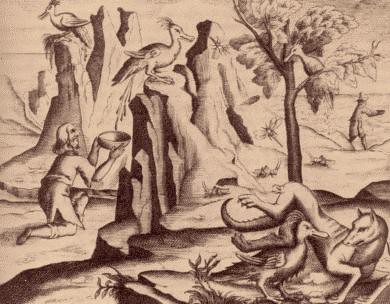
Indeed, for much of history the true source of ambergris was unknown. Sinbad the Sailor, marooned on a treacherous shore, by a mountain ‘composed of rubies, crystals and other precious stones’ observes that ‘a kind of pitch or bitumen distils from the rocks into the sea, and the fishes which eat it return it in the form of ambergris, which the waves leave on the shore.’ The ancient Chinese said it was derived from the spittle of dragons. Others held that it was collected from the cloacal orifices of what may be a pelican.


Our ancestors had an interesting way of treating the unknown. If a mystery presented itself, often it was solved by the imagination - and these imaginings regularly entered the literature as fact. Consider the Vegetable Lamb of Tartary. Consider the gods that were created to make sense of existence. We tend to do things differently today, but today we live more safely, in a less perilous, less terrifying world.

Ambergris is valued primarily for its unique odour, which is described variously as musky, humid, marine, sweet and faecal. Often one reads of the scent being ‘elusive’ Once processed into a tincture It has an enduring, ‘involving’ quality. Perfumiers prize it as a base note with which to smooth out and add structure to the marriage of other scents. It is also said to add a lasting quality to a perfume. Its extraordinary value – comparable to that of gold – is due to its scarcity and its desirability in the perfume industry.

Outside western culture, its use extends beyond perfume. It is considered by some to aid in sexual health and fertility. It is [or has been] used as a straight-up aphrodisiac, as a flavouring in chocolate, tea and alcoholic beverages, and as a medium for jewellery. Ambergris was treasured by the ancient Arabs, who burnt it as an incense, and used it as a spice in food and drink and even smoked it. Ambergris is still treasured in the Middle East today.

In its raw state, torn from the intestines of the whale, ambergris is unpleasantly pungent and dark in colour, often black, [coloured, some suggest, by squid ink]. Only after long exposure to the elements does it ripen into the material of legend. The essential ingredients of ambergris are very durable; the substance may bob around in the ocean for decades without losing its scent. Mature ambergris is usually of a greyish or whitish hue, rather like pumice, though it comes in many shades. Wave motion may have worn the pieces into smooth forms. The material has a certain waxy, fatty quality.

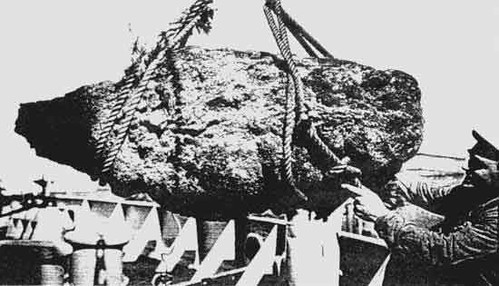
the largest recorded single find of ambergris [netstrider]


Mature ambergris is the more valuable, but raw ambergris was harvested direct from the source for a tidy profit. Whalemen of yore, after processing the whale for meat, oil and precious spermaceti, would systematically poke through the intestines with cutting-spades, inspecting the blades after each jab for a pungent residue. It was rare to hit pay dirt. According to Herman Melville, [in an oft quoted passage from Moby Dick], old or sick whales that would have little value for oil were checked thoroughly for ambergris, as these were thought more likely to bear ‘the morbid secretion’. But, though it has been described as originating in ‘the often morbidly distended gut of sick sperm whales’, current thought has it that even healthy whales expel it from time to time.

The essential ingredient of ambergris, ambrien, is an uncommonly complex molecule. There have been many attempts to synthesise it for the perfume trade, [Ambrox is one example], but none match the real thing.

“As a test for ambergris the hot wire or needle test is the most simple since it requires no special apparatus. A wire or needle is heated in a gas or candle flame for 15 seconds and then pressed into the sample to a depth of one-eighth of an inch. If it is genuine ambergris, a dark brown to black opaque resinous liquid will form around the wire and appear to boil. Touch the material with the finger before it cools and if the sample is true ambergris it will leave tacky, pitch-like "strings" sticking to the skin. When the wire, which retains portions of the melted material, is again heated in the flame, true ambergris will give off a white fume having the same characteristic odour as the solid, and then burn with a luminous flame. The odour of the smoke when the flame is extinguished should be that of burning rubber. Another quick and simple test is to dissolve a little piece of the sample in a small quantity of hot wood alcohol (methyl alcohol), then allow it to cool. True ambergris will crystallize as the alcohol cools.”

Since the prohibition on whaling, dealing is ambergris is illegal in many countries, yet a brisk trade continues. Every few years one hears of fortuitous finds on remote beaches.

Though the sperm whale is the most plentiful of the great whales and its numbers are slowly recovering, ambergris remains rare, a strange and singular treasure of the oceans. In the taxonomy of my imagination, I place it among the bezoars, those mysterious stones found in animals, which were thought to be proof against poisons and highly efficacious in the working of magic.

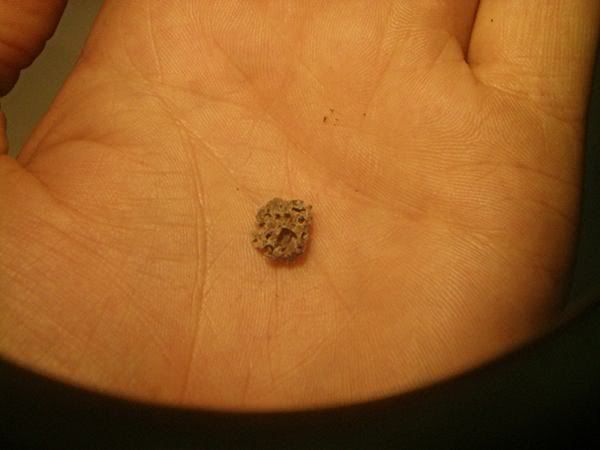
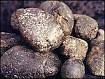
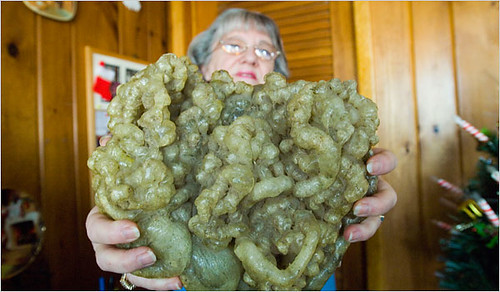
this is not ambergris


further reading ...

netstrider – ambergris
laputan logic – ambergris
the romance of ambergris

Stumble Upon Toolbar DiggIt!