Pages

Showing posts with label HEROIN. Show all posts

Saturday, February 6, 2010

* Sunday 12 July 1981 7.30pm

Little as happened. There’s something wrong with my voice. I’m getting fatter and drunker. The Ovaltine advertisement has been completed.

It involved many hours of idleness.

I’m getting sick of P---. Gus is particularly dissipated. I’m getting sick of this diary and of spending all my money on heroin.

*

It’s been a while since I’ve pulled out the old green diary. Pity the next entry in line wasn’t more interesting.

But since, at some time in the future, my character will be judged by a jury of my peers, I wonder how wise it is to mention drugs? I can only hope that, if they happen to read this, they will see it in context.

During that Ovaltine shoot, the director had a lot of difficulty getting me to smile. Perhaps it was because I was wearing a frilly white shirt and jodhpurs. More likely, I just didn’t consider myself the kind of person who would voluntarily smile in front of the camera.

There was a gorgeous, olive-skinned female model working with me that day. I almost fainted, in my innocence, when she began swanning around the dressing room utterly naked.

The art director didn’t like my silver Latvian ring - the one my recently deceased father had given me. I took it off, gave it to someone on set for safe-keeping, then forgot to ask for it back at wrap time. Despite my frantic phone calls to the producer over the next week, the identify of the ring-bearer was never ascertained.

I was so angry with myself - and with the anonymous thief. My solution was to pretend it didn’t happen. I acquired another ring not too long after, made by a little Latvian handicrafts outfit run by smiling old ladies on the second floor of an old building in the city. (Rings are very important in Latvian culture.) My girlfriend of the time, Michele Hallgren, gave it to me as a gift, and to anyone who asked I would explain it had been given me by my father a long time ago.

Later, two and a half decades later, a guard at the Melbourne Remand Centre ground it off in a shower of sparks with an electric cutting tool.

I have yet to replace it.

Diaries - 1981

(Don’t forget to come to Poetica at the Carlton Courthouse on Monday night)

Stumble Upon Toolbar DiggIt!

Monday, March 24, 2008

~ the legs of the mighty

Days pass. Little changes. I clutch at my routines as if they are all that prevents my fall into the abyss.

Since I’ve been attempting to correct my financial situation by selling on ebay, I’ve had to actively search for stock. Books. My wife is incredulous about my need to keep buying, when the house is littered with ziggurats of piled books. She doesn’t understand. Those great mounds are composed of incomplete trilogies or series, which I am waiting to complete. You get a better result that way. There are also an awful lot of books on which I’m undecided. They look like they might sell… but I need to do a little research… and rarely do I have time… What I really need is have a market stall to clear everything out…

Then there are the books I want to keep. Every time I’ve abandoned or sold my library down the years, I’ve bitterly regretted it. I feel peace in a house full of books. A library has an aura, it emanates a gentle bookish radiance. It is a great seam of potential, there for the realisation. I love scanning shelves, head tilted sideways, waiting for a title or author’s name to leap out at me. I love it most when the books are mine, and I know that every one of them was chosen for a reason. I love having so many books that I can’t keep track of them. I love being surprised by what I’ve forgotten.

But, of course, it’s also a burden. A great weight of material for which I am responsible and which I must keep in order. At present there’s anarchy. I have nowhere near the amount of shelving I need. My ebay stock bleeds through my personal collection. The kitten knocks over the teetering columns, and time turns my neat arrangements into kipple.

I didn’t mean to talk so much about books.

Currently, my wife has a debilitating virus. Of course, I’m suspicious, but my instincts are telling me it’s not the kind of ‘virus’ one gets from consuming too much [or too little] of the soporific honeycomb.

Indeed, she’s been reasonably controlled of late. I believe I have managed to expunge the Romanian’s phone number from her phonebook – though in the past he has shown a nasty tendency to ring out of the blue, just because ‘he’s in the area’. Thankfully, without his number, her ability to ‘just pop out for a second’ is massively reduced.

Strangely, with the easing of my own enslavement to drugs, I find it increasingly difficult to ascertain my wife’s state. I have hacked my way clear, I think, to another plane, where priorities and potentials are very different. Perhaps that’s why my first knowledge of any flare up on my wife’s part comes only when the problem has gotten out of hand. Mind you, she is now on a mind-numbing dose of Spasmo-Dromoran - meaning she needs a hell of a blast of high-grade honeycomb to become visibly stoned. She openly admits feeling little or nothing when she does it - so why does she do it? Such are the mysteries of addiction – though needle fixation and simple habituation I’m sure play a part.

But trust is a problem. Since I can no longer rely on my senses, I find myself automatically assuming the worst, assuming that any explanation is a lie, that any trip to the supermarket is a scoring expedition …

*

Depending on luck, Camberwell market can be a good place to find the kind of books I sell. I’ve taught myself to ignore the things I might be at risk of purchasing for myself, [ie stuffed animals, general grotesquerie], and concentrate on my task. It’s frustrating how prices vary. One or two dollars is the normal market price for a paperback, but there are stallholders who charge over ten…

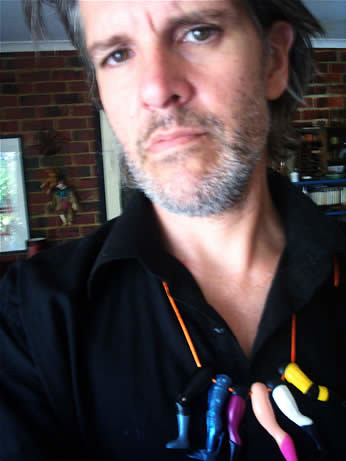
Yesterday was the first time in ages I’d been at the market. I encountered two faces from Erin and Hendrik’s wedding – Kerry and Linda – working a small conceptual jewellery stall. Seated comfortably in the shade with drills, snippers and glue they do all their work on site, creating freaked-out accessories from materials sourced only at the market itself.

They were kind enough to present me with a necklace recombobulated from the legs of plastic superheroes.


Stumble Upon Toolbar DiggIt!

Thursday, February 7, 2008

* 13 April 1981 Monday 3.00pm

I have not been home to my mother’s house since I last wrote. I have been very drunk; taking speed against my better judgement – even heroin. I’ve been cavorting with women - Jane M----, Carol L---- and, significantly, Cathy D----. But sex is like food for me – something is gone.

On Friday, for the first time in my life, I saw red. After finishing our gig at the Jump Club, we were required to go back on stage to fill the time quota on our contract. We did so reluctantly. I walked into the band room afterwards and lost control. I kicked in a door, ripped another half off its hinges, then punched holes in a third. I wound up in a toilet cubicle. Some guy had tried to stop me without effect. The band will have to pay for the damage.

This incident frightens me. I am not experiencing one of my more sane periods.

[We received our first record contracts on Friday.]

*

I had completely forgotten this before reading it back – but it doesn’t surprise me. During the months after Christine’s death, I grieved in some very strange ways, some of which I’m sure will emerge in later posts

Long after the fact, I learned that extreme promiscuity is not that unusual a reaction to the death of a lover. After losing her physically, it seemed like I wanted to kill Christine’s memory through sex.

The record contracts would have been with Missing Link.

More diaries from 1981

Stumble Upon Toolbar DiggIt!

Saturday, February 2, 2008

~ hark! a fusty old cupboard moth!

In the latest episode of Counterpoint on ABC radio there is an extraordinary interview with a sententious old arch-conservative named Theodore Dalrymple, [a nom de plume. His real name is Anthony Daniels]. He is interviewed by global-warming sceptic and ‘right-wing Phillip Adams’ Michael Duffy on a programme that sprang from the Howard government’s push to dilute the perceived leftist culture of the ABC. Dalrymple himself is aligned with the Manhattan Institute, a US conservative think tank, and his ideas are frighteningly atavistic.

For fourteen years, he has been treating addicts in British prison hospitals and feels the need to speak out regarding certain myths which he believes are misleading public policy on drug treatment.

In his book, Romancing Opiates, he argues that opiate withdrawal is neither severe nor dangerous and ‘not much worse than the flu in a healthy person’. He claims to have seen long term addicts stop using with ‘no adverse effects whatsoever’.

I must admit, from personal experience, that the fear of physical withdrawal has sometimes been worse than the experience itself. Nevertheless, the night sweats, the horrific dreams, the bone aches and muscle cramps, the misery, the whole body discomfort, the crawling skin and mind-fucking restiveness add up to something a considerably worse than your average flu. And from what I have heard of others’ experiences, I can count myself lucky.

I get the feeling that Dr Dalrymple has been taking blood pressure, checking body temperature and a few other gross physical indicators, then using these to understate and oversimplify the condition. However, I do agree with his contention that the physiological aspect of withdrawal tends to be overstated in popular literature.

When asked where these exaggerated ideas about addiction and withdrawal came from, he moves into a scathing attack on heroin-related literature. ‘Self-serving liars’ DeQuincey and Coleridge began a trend that has continued without pause ever since. William Burroughs [a ‘psychopath’ and ‘obviously a bad man from the beginning’] is singled out. We hear of films like The Man With The Golden Arm and more recently Trainspotting.

I have no difficulties with the claim that certain works of art attract people to drug use. How can I disagree? I am one of those people myself. I have seen many people acting out their romantic fantasies in heroin addiction [again, myself included]. I have even heard many people claiming to be addicts who weren’t. I suppose it is one way of getting a life, of defining yourself - as something dark, forbidden and dangerous.

But to generalise the function of art and creativity, as he does, is weasel work. Drugs have historically played a part in artistic creation, contributing to some of the greatest works of the human imagination. In much the same way as they are used in Shamanic religions, drugs have inspired and guided certain artists and thinkers. Creative types are far more likely to experience manic depression and other ‘personality disorders’, art can be their expression and their release and our benefit. The use of drugs and the description of drug use by arts contributes to a very complex social equation which cannot be effortlessly explained away in a slow reasoned tone by the fusty old Mr Dalrymple.

As regards the question of how heroin withdrawal, [and addiction generally], became so exaggerated and feared – I would answer it rather differently. Throughout the twentieth century, manipulation of the drug issue was systematically used by politicians and other leaders in the USA to stimulate fear in the community. Again and again it was evoked to distract voters from embarrassing scandals, to paint candidates as uncompromising, and to prepare the public for more draconian control. It has even been selected as an issue by politicians who had nothing else with which to characterise their campaigns. Because drugs were railed against repeatedly down the decades, the effect became cumulative. Heroin entered the mass subconscious as a ravening demon. Parents became terrified for their children. The meme became self-sustaining throughout the world – and an element of it was the nightmare of withdrawal. Certainly, the popular arts play their part – but the buck really stops in the corridors of power.

After evoking Quincy and Coleridge, Dalrymple speaks of how the overwhelming majority of addicts are from the undereducated lower class. There are problems with this contention because it’s really an assumption. Nobody knows the figures. Poorer addicts are the most visible addicts; richer addicts can hide their usage. But how many of this underclass [or the general population for that matter] have read or even heard of Coleridge or Burroughs? There is not much awareness of the classics out there. How else could a bed sold for little girls at Woolworth’s in the US have been branded a ‘Lolita’? If they are influenced, it is by very different media in which the idea of drug-related illumination of the mind and spirit is absent.

Though not everything he says is rubbish, it is all painted with a tone of condescension. He makes the point that people from desperate circumstances often turn to addiction as a way of filling their lives, and indeed ‘the life of an addict is full of incident…. In a sense it imposes regime and routine; they like it, dismal as it is.’ Well, as they say, children crave structure. I think Mr Dalrymple should think further on this point; youths in desperate circumstances are not just being drama queens in taking heroin, sometimes it offers some sweet respite from an unendurable reality.

Heroin does of course impose a routine. With an iron fist. ‘The Algebra of Need', as Burroughs would put it. [‘Burroughs was a criminal long before he became a Junkie’.]

Not that I’m advocating this, but Mao Tse Tung was the greatest therapist in the history of drug treatment because he threatened to shoot people if they didn’t give up – and lo and behold twenty million people did give up.

Dalrymple goes on to say that this wouldn’t work with, say, bowel cancer; seeming to think this proves that addiction is a choice, not a disease.

Because addiction to a large degree is rooted in the workings of the mind, it is not disqualified as a disease. You cannot divorce the body from the head. A lot of very complex changes occur in the brain of an addict, physical changes which researchers are only beginning to understand. Dalrymple, the old cupboard moth, is attempting to turn back the tide on our evolving comprehension of a very complicated condition. He views are deeply right-wing, immediately appealing to the conservative thinker. It is the addict’s fault. He can stop if he wants. He chooses to commit crimes. And elite arty-farty types are responsible for all our misconceptions ….

I’m not wholly against rehabilitation, as long as it’s understood it’s not a medical procedure. As long as you don’t treat it as an illness.’ He suggests some form of ‘asylum’ in which the recovering addict can build up their lives again after the wasted years. Again, he shuns the idea of addiction as a disease – a concept that our best informed practitioners have spent decades working to illuminate in the public eye, and to include in social policy.

He coughs up a number of other hot potatoes. He claims ‘the inclination to criminality causes addiction, not the other way round.’ He has learnt from prisoners in jails that the vast majority of addicts were criminals long before they turned to heroin. [He did not say anything about whether it was in jail that they began taking it.]

He tells us it is a myth that drugs are filling our prisons. I’m no expert on this, but I feel strongly about legalisation, and I’ve known plenty of otherwise law-abiding people who have broken the law to feed their habits. I couldn’t begin to count the number of girls [and boys] I’ve seen use prostitution for the same reason.

My instinct here is that his contention is wrong, but again laced with fragments of truth. I also resist, even resent, his using the words addict and criminal in the same breath. There are bad thieving junkies in this world, and it’s sensible to beware of them. But there are those who would never in a million years commit a crime against person or property just for a fix.

Dalrymple is petrified in a previous age where mind and body were disassociated. He cannot abide the fact that addiction is holistic. It is true that the mind is a very prominent component, but that does not disqualify it from medical attention - it merely makes it harder to understand and treat. It is also a social disease, channelled and fuelled by inappropriate laws and attitudes, which the opinions of Dr Dalrymple can only serve to exacerbate.

God forbid this is the leading edge of current conservative thinking!

Stumble Upon Toolbar DiggIt!

Sunday, January 27, 2008

~ the high echelons

It seems that Heath Ledger had his problems with drugs. Well, so what?

As the information leaked out about his sad demise, one could sense the efforts, on one side, to play down the sordid elements. Scattered pills found their way back into the bottle. A rolled up note was found to have no residue. From the other side – that of the ravenous and voyeuristic – we learned that he had just left rehab, was battling addictions to heroin, xanax and stilnox, that he was distressed and sleep-deprived.

Tasty. But why do drugs so often become the centrepiece?

Well, some of us like to watch the mighty descend into the abyss. It reassures us to learn that they are as weak and as freaked out as us. It makes us feeler closer to them. And, of course, we love scandal for its own sake. That’s simply in our nature.

We’re ghoulishly curious when it comes to the stars – those public assets in which we all have a stake. Every detail of Ledger’s death scene has been described in the media, interpreted, analysed and spin doctored by publicists. But with the mention of drugs our interest ramped to a whole other level. This betrays us, just as drugs betray the personal struggles of the famous.

During the Heath Ledger coverage, I read the comment that fame is a sort of mental illness. Perhaps the sensitive, troubled Ledger turned to drugs as a way of self medicating this illness. Perhaps that’s the reason so many celebrated people do take drugs.

It’s like having Alzheimer’s Disease. You don’t know anyone, but they all know you,” said Tony Curtis. But that’s just part of the story. There’s pressure, stress, loss of freedom, alienation, loneliness, and a tendency for people to become friends with your fame, not with you.

In David Gritten’s book ‘Fame’ he claims that ‘celebrity behaviour is rooted in a type of personality disorder’. Histrionic Personality Disorder to be exact, defined as ‘a pervasive pattern of excessive emotionality and attention seeking’. Some of the symptoms are the ‘display of rapidly shifting and shallow expressions of emotions’, behaviour ‘being directed towards obtaining immediate satisfaction, with no tolerance for the frustration of delayed gratification,’ and ‘a style of speech that is excessively impressionistic and lacking in detail [e.g. when asked to describe mother, can be no more specific than “she was a beautiful person”’.

You have your Britney Spears, and her sordid public fall from innocence. She’s a red raw case of the fame disease. You have all those actors – Owen Wilson, Steve Coogan, Brad Renfro, River Phoenix, Robert Downey Junior etc., who have or have had relationships with heroin. Musicians in even greater numbers, writers too, models and sportsmen. And I’m not including cocaine.

It’s so rife, this affliction of our idols and role models, that ‘rehab’ has somehow evolved into a pretty cool concept. In the hip crowd, among the high echelons, and on the press release, well it’s getting kind of groovy, isn’t it?

It would be good to shrug off the prejudice and the stigma associated with drug use, but that’s not really what happening here.

On one side you have the prohibitionists and on the other you have people who admire drug use in their heroes because it’s a la mode. Both are in error. And of all the reasons for taking drugs, imitating the beloved famous is one of the most insidious. I have a particular dislike for it because that’s pretty much what started me off

Hearing that an artist has a drug history, automatically perks my interest. Even now. I can’t help it. And I’m not the only one.

[No matter how great a song it was, I really wish that Lou Reed had never written ‘Heroin’.]

I won’t get into details now, but the creative soul is far more likely to experiment with mind altering drugs. Sometimes, it’s just part and parcel of the thing: the quest for new vistas, for an undiscovered viewpoint, for mystery – and sometimes the result of a painful sensitivity to a crass and blaring world.

It’s true. Often the most interesting ones are the ones who engage with drugs. And when they get famous, we imitate their behaviour.

And when they are infected with fame – well, that can push them deeper. The artistic temperament can be overfed, the ego may rear like the Whore of Babylon. Money and freedom and reputation can increase creative freedom, but expectations, fear of failure and commercial pressures can close it down. Doubts can arise over ones integrity. I’m not sure if Hollywood-grade fame is ever good for an artist, unless he’s one of the few that it actually suits.

Give me Emily Dickinson any day.

The reputation of Heath Ledger will not suffer by his exposure as a drug addict. People will understand how sensitive an artistic soul he was, how troubled, how he missed his daughter, and was deeply disturbed after immersing himself in the role of The Joker. [a claim only a Hollywood actor could make, no?] Probably the only truly damaging revelation was that he was friends with Mary-Kate Olsen.

Lynne suggested that his lack of classical training may have been an influence. A lot of actors, these days, become so deeply immersed in a role that they cannot dissociate themselves. They engage in intense research, force massive weight changes, and wind up misplacing their sense of self. They don’t isolate a personal centre to keep themselves sane.

Anyway, what about the man on the street? Being exposed as drug addict is a entirely different thing for him, isn’t it? We don’t quite get the same level of compassionate understanding.

Our gods of Mt Olympus are not subject to the same laws as we. If they are revealed as drug addicts, we create a moving backstory with which to enrich their posthumous biographies [and the lurid pages of the gossip mags].

[And, by the way, how do they get these drugs? Do they see a doctor? Or is it all done by a PA? Do you think they get their hands dirty like the rest of us?]

There are also the prominent users who are never exposed in the tabloids; who need to keep it quiet and are rich enough to do so. But sometimes rumours filter down. James Packer and Laughlin Murdoch; tight friends who spent a good swathe of time on heroin. Kate Fischer got in on it too, it is said, and only when Packer divorced her and married ‘ex-escort’ Jodhi Meares did he clean up. [Scientology was a factor there too, it is said.] Then you have Elle McPherson, cleanest of the clean, who wouldn’t do a photo shoot unless the coke was laid on. It is said. And Sonia McMahon? Well it’s not relevant at all, but I’ve been told that before she became our first lady, she was an escort too. [I couldn’t resist putting that in.]

All ‘rumours’ of course, but among certain of the high echelons hard drugs will always be de rigeur. The modern aristocracy is isolated from petty considerations that the ordinary populace has to face – like. say, waiting for hours in dark carparks, or doing without for lack of money. Occasionally, the vices of a luminary will be bared to a voracious public, but again you’ll have the backstory and once more our considerate understanding.

Stumble Upon Toolbar DiggIt!

Monday, January 21, 2008

* 25 March 1981 thurs 2.30pm

I’m Sam Sejavka. I’m a writer and a singer. I’m twenty years old, but in one week’s time I’ll be twenty-one. Allow me to briefly describe my life up to this point.

Half way through my HSC year at St Kevin’s College, I left home and school and took a flat in St Kilda. I was seventeen. Shortly after that, suffering from nervous tension, I spent some weeks in a private psychiatric hospital. Though I never returned to school, I did sit my exams and managed to do pretty well, particularly in English.

I lived a reckless life in St Kilda, spending time with the basest of the creatures who abide there. I wrote all this time, though the results were dubious. I was young and over-stimulated by my new found freedom. I was seeing a girl called Irene, but broke up with her around the turn of the year …

I was evicted for general rowdiness and spent a week or so wandering in St Kilda, staying at hotels. I was undergoing another personality crisis, but this time it was not quite as severe.

I took up a new flat in Armadale and attended university, which I loathed. After two or three months I left, again undergoing a kind of crisis. I had done not a skerrick of work in this time. I found myself completely uninspired.

I moved to Sydney, found a flat in Kings Cross and wrote. I viewed myself as something like the protagonist from Orwell’s Down and Out in Paris and London - but under a shadow of inexperience and pretension the work I did was pretty well unreadable. [Woe the day I first read William Burroughs]

I made no friends there. I never went out. I became a lonely bum, trying to live his twisted idea of a dream. I must say though that I was brave. I’ve never had quite the same attitude to food since I found myself starving up in Sydney. At times I would go to a nearby homeless shelter to partake of the disgusting food they served there.

Eventually, I could stand it no longer and returned to Melbourne. I rented a house with George in Richmond and lived there six months, leading a wasteful sort of life. We had trouble with hoodlums in that place and left suddenly with the house in a wreck. Though I pined for female company, George and I enjoyed ourselves concocting and realising all manner of eccentric schemes.

I left for a new flat in Armadale. I was determined to write as diligently as I could - and I did for while, but it was forced, meaningless stuff.

Inspired by William Burroughs, and much to alarm of my parents, I joined The Church of Scientology Though my involvement was pretty marginal, [probably because I had no money,] it still remains omne of the stupidest things I’ve ever done.

In September, for five days, I camped out for David Bowie tickets. This was to be a turning point. I was introduced to heroin and LSD, though I’d had my fair share of other drugs previously. I made many friends and by the time of the next queue – this time for actual seating – I could almost have been described as gregarious. I spent those three weeks stoned in as many ways as it is possible to be. This is where the idea of the band was born.

The night of the concert, my basement flat flooded and I could no longer live there [I’d forgotten to turn on the pump]. I moved home and around the turn of the year, The Ears began to practise. In January 1979, I went to a science-fiction writer’s workshop in Sydney where, among others, I met George Turner and a young Lucy Sussex.

I moved into a house with Mick Lewis and Tim McLaughlan [keyboards] and The Ears developed. We played for the first time in February. I returned to Melbourne Uni and could stand it this time only because I found a girl, Elise Valmorbida, with whom I fell madly in love. But I was far too immature to make something like that work and the relationship had decayed to nothing by the end of the year.

The group was playing regularly now. I rented another flat in Armadale, where I decided to once more quit university. Soon after, I moved to a house in Richmond with Mick and Richard Lowenstein. I was a night bird, going out as much as possible and living a life of debauchery. They were the days of the Champion Hotel. The end of the year came and I had frittered it agreeably away. It was 1980, I was nineteen. I was in a group and things were fine in a twisted sort of way.

I stayed in Richmond till March, then moved to Elwood, to the flat where I began this diary. I turned twenty. Our first single was released. I pursued girls. We got a manager, then a different manager. I went to parties. And in August I met Christine.

There followed the most rewarding period of my life thus far. I was not prolific, I was not together, I was just unreasonably happy. We slept together almost every night. I was totally, without qualification, in love. And love was what was most important.

Soon after I met Christine, my father died. But that just healed with time. Then on the twentieth of March, Christine overdosed.

And now it’s the twenty fifth of March; I’m sitting out the front of Milton St, watching some placid old people mulling over the detritus of their lives. Mine is a pain equalled only by the pleasure that it echoes.


*

As you can imagine, this was a hellish period for me. I was wracked with grief and life seemed drained of all value – so forgive me if the above entry has a rather sententious tone.

It was interesting to read though. A lot of memories sparked. A lot of things forgotten.

After Christine’s death I woke in Troy’s flat next door with no memory whatsoever of the night before. It was barely daylight. I had a terrible sense of impending doom, but my mind was too foggy to work out why. I found my way to the front door; I could see Peter Walsh walking up the path from the back yard where he’d lain unconscious all night. He looked like a zombie. I caught his eye, but there was no reaction. I tried to open the door, but it was locked. I couldn’t think how to open it. I made my way back to the bed and again fell unconscious.

I awoke several hours later in full realisation that something had gone terribly wrong. I looked around frantically and saw Craig McGee in the doorway. Where’s Christine, I asked? She’s dead, he said.

Craig took me to his and Laura’s house, where I slept on the floor for a few days, before going home to my mother’s and doing the same for a fortnight. The heroin, fresh from Thailand, had been unreasonably strong and I took a long time recovering. I’ll never forget that pain and desolation. The last image I had of Christine was slapping her face, trying to wake her. It was just a flash in my memory of that night

To make matters worse, not long after, I began to receive a certain amount of police harassment. This was due to Christine’s father being the head of the police union, and her brother a member. In reflection, it was bound to happen. A fellow named Colin, a keyboard player who I think once burnt down someone’s garage, had been round to Milton St. The police had stopped him, hassled him severely. He said he had the strong impression that they were looking for someone with bright red hair, but not him. [I had bright red hair]. Then, after a gig at the Crystal Ballroom, a couple of cops pulled me into a corner and threatened to kill me if they heard of my further involvement with drugs. I wish I’d taken them more seriously.

Christine’s father, though, was understanding. He called me to the Harding family home and talked to me, not with anger but compassion. The family was less understanding towards the hapless Craig Elrick, who was a reckless spirit, doomed to forever get himself and others into strife …

Stumble Upon Toolbar DiggIt!

Tuesday, January 15, 2008

* 25 March 1981 Thurs 7.00am

Christine has died of a heroin overdose. One part of my life has also come to an end.

My mother, strangely enough, is singing in the bath.

I am ailing. Since the Friday night she died, my voracious appetite has ceded its place to a cruel inability to eat.

My heart is like a man tensing as the guillotine blade slips towards his neck. It has fallen a thousand times since Friday.

I and Peter Walsh also overdosed – but we woke up. Craig Elrick, who procured the drugs, has been put to blame by Christine’s family. Perhaps they are right, but I can blame no one.

Scraps of my sanity survive. This entire experience is a thousand times more sunken in terror, in horror than my father’s passing six months ago.

I do the crossword – Yearn: to long – Promise: to pledge – Stir: to try and wake that marvellous heart, so warm between her breasts.

The smell of sex from that Friday afternoon was still with me on the Saturday.

Nothing I look at, nothing I do is without her memory. I cannot really face that sliding blade. The hair in her brush, which I have kept …

Clearing out my flat … there was a nightmare of memory under every item of rubbish …

So ends the happiest, most content and oblivious time of my life. There was a funeral, a wake, even a rosary. I can’t believe she’s gone … wearing a black bow, as she slumped against the door … Good god, what shall I do …? My love is dead …

I am very quickly reorganising my life. Soon I will have my house and perhaps the flavour will return to my food.

I’m so scared of ghosts …

mt waverley


Stumble Upon Toolbar DiggIt!

Thursday, January 10, 2008

~ the mind parasites

The human race, unbeknownst to itself, is under the complete control of a race of repulsive parasitic entities, who drink our mental energies and prevent us from evolving into super-beings.

Every few years, I find myself rereading Colin Wilson’s The Mind Parasites. I’m half way through it as I write. It’s a very odd novel. Unique. Genuinely peculiar. Badly flawed by any reasonable standard. But really interesting.


Wilson is a bone fide thinker. He first came to prominence with ‘The Outsider’ a philosophical work that established him as one of the so-called Angry Young Men of the late fifties literary scene in England. [John Osbourne [Look Back in Anger] was another of these].

But from that point on Wilson’s ideas grew stranger - though never any less well thought through or researched.

I became a fan after reading The Occult – the big green paperback that was half history of the paranormal and half philosophical treatise. Then I swallowed up his back catalogue and attended his lectures whenever he came to town.

[Allow me to diverge. It was John Murphy, the brilliant and arcane drummer of such bands as WhirlyWirld and The Associates who really put me onto Wilson. Now, John, at this time, had the most pungent odour problem I have ever experienced. I saved a seat for him at the Northcote town hall where Wilson was due to speak. He arrived, sat down and, slowly, one by one, the people around us began to relocate, creating a buffer zone of two or three empty chairs around the wellspring of an astonishing stench. I don’t know if John even noticed]

Wilson was perfect for me. I’ve always been a disappointed sceptic. I’m too rational to believe in superstition or higher powers but, nonetheless, I am drawn, inexorably, to the mystical and paranormal. Almost like Mulder: I want to believe – but not if the evidence is lacking

Wilson is similar - but he has reasoned his way into a conviction that there is a untapped reservoir of possibility in the human mind. In the realm of instinct and intuition. Or, in his words, Faculty X. He believes we are so immersed in the day to day, in habitual life that we can never realise our true potential - or find what the psychologist Maslow would call ‘Peak Experience’.

He has pointed a finger at the bicameral mind, suggesting that the two very different hemispheres of our brains are consistently out of sync, and that to bring the creative and the rational sides into harmony would force our whole lives into focus. We would see the beauty radiating from every moment of our existence. We would never feel tired. We would instinctively make the right decisions. And even have access to paranormal powers.

The Mind Parasites, on first glance, appears to be a shoddy little science-fiction paperback. It’s set in a very roughly drawn future in which there is rocket flight between continents and people holidaying on the Moon. Here, Wilson is a little like Philip K Dick; he uses a populist genre to present original, quite complex ideas.

Interestingly, it has a Lovecraftian edge too. The protagonist, Austin, an archaeologist, is an expert on pre-Hittite civilization and is digging in Turkey at a place called The Black Mountain. Impossibly deep beneath the Earth, he discovers a vast stone city built by giants and compares it openly with the cyclopean ramped cities of The Great Old Ones described by Lovecraft. Indeed, the book describes Lovecraft as a visionary, who has somehow accurately predicted the future. Perhaps The Mind Parasites ought be considered a peculiar, rather tangential addition to the Cthulhu Mythos.

Austin comes into possession of the papers of a colleague who suicided in peculiar circumstances. The papers describe a race of beings, not of flesh but mental energy, who, around the time of Beethoven and Goethe, took residence in the human mind and proceeded to control it utterly. These ‘Tsathogguans’ feed off our life force, preventing us from realising our true potential by deliberately nurturing depression and perversion. We are a slave race. The work of artists such as De Sade, described as warped in the book, are a direct consequence of the Parasite’s short-circuiting of our natural intellectual and sexual energies.

The book tracks Austin’s bizarre efforts to defeat the Parasites using Husserl’s techniques of Phenomenology. He trains his mind to fully understand itself – and in the process he and his colleagues develop parakinetic talents, telepathy, mind-control and the ability to sync up their consciousnesses. They come to live their lives as one continuous Peak Experience. In effect, they become super-beings doing battle with a cunning extraterrestrial adversary.

Though most of the book is either dissertation or situated deep within the mind, it is still a weirdly pacy read - as these urbane scientists try and ultimately succeed in convincing the world of this madness and then set about defeating it.

I do wonder about these Mind Parasites. It would explain a great deal. If they were real.

I know I have something lurking in the depths of my consciousness, advising me to do things which could have no conceivable benefit. I know I’m always tired. I know I have difficulty thinking clearly. And I can only guess when I last had a Peak Experience.

Could it be these Tsathogguans, who urge me go out and get on – despite the fact that the heroin experience is no longer a pleasurable one for me. Not only have I ceased to enjoy the drug itself, but taking it wracks me with guilt and makes me sick for at least a week afterwards. Yet the urges, the cravings continue – reasonlessly, with nothing but self-destructive intent.

Are the Parasites in residence? Deep in those murky waters? it would make sense.

That oleaginous voice begs most when I am at my weakest. When I am alone in the house and have money. When it’s a certain temperature outside. When I go to Richmond or St Kilda. When I see someone using on the TV. When I go to funerals, or to a band … At these times it is raised its loudest. It knows when I am vulnerable.

The craving voice, researchers say, is the result of a rewiring in the brain of addicted persons. No longer is the pleasure-related dopamine system in play, but the excitatory glutamate system. One uses not for pleasure, but to stop feeling pain. And later, when the whole issue seems resolved? The voice keeps barking out its hollow commands.

Perhaps I could counsel myself in the techniques of Phenomenology, enter the country of the mind and root out this babbling idiot who distracts me from my life? But if long habit has hard-wired it in, what am I to do? At least, if it was an malign alien entity, then I would have something obvious to fight.

And who’s to say that it is not?

Who’s to say The Deadly Spores themselves are not under malign alien control?

Stumble Upon Toolbar DiggIt!

Thursday, December 20, 2007

~ she had a dream

They have agreed that he should look after the money when it comes every second Wednesday – as the lure of the glistening honeycomb is too strong for her to bear. She loses control of herself too easily and surrenders to the dark vicissitudes of the Deadly Spores. She spends money she does not have. Money that ought be directed toward better purposes.

By Tuesday night, her mind is already probing the psychic net the Spores hold in place above the city. Her eyes are closed; she is seeking inspiration. How can his hold on the money be loosened? Can he be tricked? She hates herself for thinking this way. But it is not her thinking, it is the Spores, who have gained control of a section of her brain known as the nucleus accumbens.

On this night in her dreams there is a shallow puddle with a fish in it. And a rock. She turns the rock over to discover it is, indeed, an ancient turtle-like creature. Disturbed from its sleep of centuries, it begins to feed, voraciously, immediately consuming the nearby fish. Once satisfied it transforms into a different creature and begins to feed again, to grow again. This cycle is repeated, until she sees a monstrous pigeon approaching the house. At first, she is daunted by its terrible size, but then she consoles herself – it is only a pigeon and even if gigantic could not possibly be a threat. But then, she wonders, will it peck her family, unthinkingly, as it would peck at worms…?

Wednesday begins badly. He is busy with his work, but must also distribute her money quickly before he is outsmarted. He is tense because he is fighting a vast adversary in the guise of his lover; he knows she will leap at any hint of weakness, so he must be stern. She is tense because there is a battle inside her, and because she wants her honeycomb, but cannot get it.

Bickering breaks out, scattered flares of nastiness; she cannot control her tongue when she feels like this … he becomes frantic and cannot think straight …

But the day is a success. Almost all the money lands in the correct places, save a little that is kept aside for basic survival over the coming fortnight. He allows himself to relax. He walks the cat around the block with his daughter. He allows himself a glass of wine or two ... And then the Deadly Spores strike with the force of a hammer in his face

She wants honeycomb and now she will not let him keep it from her.

She becomes undeniable, yet he remains strong. He will not give her the food money. Or the the bill money. She will not accept refusal. She will not give up. He will not give in. The process takes about an hour, but the battle is lost when the first germ of desire enters his heart…

Ten minutes later, or so, he relents. They will share this vicious product of the spores … and ignore the consequences …

There is only one way I can do this, he thinks. I must become like steel. I cannot lapse. When the sweet voice of the Deadly Spores begins to issue from her mouth, I must leave and not return until I know am powerful enough to resist it.

Stumble Upon Toolbar DiggIt!

Tuesday, December 18, 2007

* 21 February 1981, 11.13am

The following appears to have been written under the influence of amphetamines – therefore I’ve made an editorial judgment to amend some of the crazed grammar that fizzed from my young mind.

Speed was then amphetamine sulphate, not the methamphetamine we have today. Traditionally, it came in small translucent red
capsules worth twenty dollars. Heroin came in half clear/half red capsules referred to as double oh’s. The caps were sourced, I think, from a cold medicine and if the smack was not served up in a double oh, it was instantly suspect. Later, foil and paper folds came into fashion. Later still, balloons. In 1981 a ‘cap’ was fifty dollars – and, unless things have changed just recently, the price remains the same.

*


I went off to the Crystal Ballroom last night, though I can remember little of it. Afterwards, we visited Constance at his petrol station, and some friends came over to Milton St. – Jane, Leia & Cathy [a visitor from Adelaide]. We drank a huge amount of vodka and wound up being very sick. At about 9.00 we awoke from our stupor …

The Ballroom was full of friends. Even Warren Coleman was there - he dropped by with [Paul] Storm at four yesterday morning and yapped… and yapped …

I found myself in a very lurid mood. The girl Tobsha was giving me the eye, I’m sure, and I was returning it. My recollections of the night are full of skirt-filled flashes … Sometimes I’m like that; most of th
e time in fact, but never wholeheartedly. When I think of Christine, I lose any active interest.

I am on speed and have not slept a wink.

It was probably a foolish thing to do, taking it, but it was kind of fun.

There’s a lot I have to say, but I’ve little inclination to say it.
I’m experiencing that dreadful speed state in which you are forever teetering on the edge of a ghastly chasm*, waiting for your life to crumble around you…

Somebody asked me to write a story for a magazine last night… Mmm … perhaps ... It will feature a pallbearer and be called ‘The Pallbearer’.

Christine is going to live here for a month, she thinks, before
she moves in with Craig Elrick. In my paranoid state I can’t help being worried about that… We may be going to Adelaide. That visitor I mentioned, Cathy, she would be arranging it.

Wally is sweeping the path outside. A slow fly is on this book. Christine is in bed, awake, and probably grumpy….

*


Paul Storm, a school friend, was living around the corner around this time. I remember running to borrow money off him for a cab, after cops – called by my mother - came to my door and alerted me to my father’s terrible stroke. It was only a few months previous to this diary that he died.

I see Paul often these days.
He has a daughter Polly’s age, Caitlyn, and as we’re all Sainters, we catch quite a few games together.

1982 beargarden

Constance working at a petrol station … I believe he would die if he knew this information was publicly available. He’s a serious [and I think successful] visual artist now - whom I last encountered at Troy’s wake.

Warren Coleman was another school friend. He was one of the boys in The Devil’s Playground and a co-writer, I understand, of Happy Feet. I don’t know much of what fell between, but we used to share very similar tastes and it was he who came to school with an Aladdin Sane haircut and he who introduced me to The Three Stigmata of Palmer Eldritch, and thence to Philip K Dick … My parents hated him, blamed him for the incident when I took Bowie’s Young Americans record cover to the hairdresser and asked them to duplicate it. [The Gitane I could arrange myself.]

And Tobsha. Hmmn… A strange game of sexual chess stretched for years before burning out sans consummation. Then a VCA sculptress living at the end of the street, now she lives in LA and writes erotic novels with names like Quiver and Tremble and The Witch of Cologne. I’ve always been jealous of her success, principally because once I was far superior at spelling.

* Wasn’t someone teetering on a brink in my last post? I wonder how often I use that metaphor? Possibly a lot – I always seems to be treading the edge of some abyss or chasm or whatnot ...

Diary of 1981 - index

Stumble Upon Toolbar DiggIt!

Tuesday, December 4, 2007

* 17 February 1981 2.15am

I don’t know if my Queensland holiday did me any good at all. The Slammerkin came down hard that Saturday night. I was delirious with glee and forever holding out my wineglass to the gaggle of drunken teenagers in Nikki’s backyard – who were only too happy to ply me with their poisonous Southern Comfort. I was well past the point of making sensible decisions and paid for it by spending the last week of my holiday in bed. My liver is not what it was and behaviour like this could literally kill me.

I’m back on line now, however. Back in the psycho-dome that is my house in Mt Waverley. No whiff of the Deadly Spores, thank goodness, but plenty of other unpleasant challenges to occupy my time. Jenny stormed out of the house Sunday after riling me up with a nastily phrased litany of my inadequacies. She called back today and told me she’d had her period. We compared notes and realised the exact same thing had happened exactly twenty-eight days previously.

So, to resume transcription of my ancient diaries …

*

This afternoon after practice, I purchased some heroin and took it back home to Christine. We locked ourselves in the flat and fucked ourselves sore … She is asleep now.


My love for her is frighteningly strong. She assures me this is also true for her. We assured each other, in fact, continuously, very self-indulgently all evening.

I’ve heard that Keith Glass said I was either stupid or a genius for writing the lyrics to Triple Treat. Well…?

Our new song should be called Green Food For a Queen. I have found a pseudo-religious poster to use on our drum skin... Put in a handbill to be printed… I have so very much to do.

Last night Christine and I fucked madly to the listening ears of her sister Anne. We are such ostentatious lovers. Christine’s father asked her if she was going to marry me. Hah! I am the first of her boyfriends he has seen and he is confused.

That’s all I feel is worth recounting on this excellent night

*

Green Food For a Queen turned out to be one of the best Ears songs …

green food for green queens tonight
and gruel for the black and the white


Triple Treat? Well there was a particularly tasty ice-cream available at the time with a slab of nice soft pink nougat-like material sandwiched in vanilla ice cream and coated in chocolate. I don't know if the song was related specifically to the ice-cream, but it went something like this ...

it was a triple treat, a triple treat
and triple tigers perish on the hour

Christine and Annes’ father, at this time, was the head of Victoria’s police union

Diary of 1981 - index

Stumble Upon Toolbar DiggIt!

Friday, November 9, 2007

Ω the starman is summoned to elixesse quaternary

The shadows are oppressive tonight. The spiders move with caution – one eye on the bundling of the prey, seven alert for danger… The air itself portends the coming of the Spores.

At times like these - with Polly’s big party on Sunday, and two days later my departure for Queensland - when change is afoot, when time wrinkles - cracks will sometimes open into the country of the Spores.

Disruption serves them well. In periods of flux they mount their challenges. In their deepest nature they are opportunistic and willset upon their victims with the smooth reliability of German engineering...

Compare the bull-sharks that loiter in the drowned cars that lie scattered, half buried in sand, between Morton and Stradbroke Islands. At the changing of the tides, water flows at fantastic speeds through this narrow channel, and the sharks lie in wait, their black eyes cold and expressionless - to lurch out and seize whatever flashes by.

The tide is changing tonight … Who felt it first? She? I? Does it matter? Polly is five today. When she falls asleep and we slump before the television, then the current quickens

*

From time to time, the Ørn will sense trouble brewing in a distant system, and request our assistance.

Tonight, the vast mineral intelligence of Elixesse Quaternary lies on the brink of annihilation. The roughly earth-sized planet orbits the K4 supergiant Elixesse, and such is its peril that The Ørn has urged me to abandon my negotiations with the ever-obstinate Dilobites and leave immediately.

In rough translation, the Dilobites refer to themselves as Those Who Would Gorge Upon The Universe. As their moniker suggests, they are a wolfish, squamous race - though not without cunning and an advanced physics-to-technology ratio.

I have sat through many long, tedious sessions with these gastropods, and I am certain that if it were not for my time-displacement field and the balloon that floats at my shoulder emanating lethal potential, they would have attempted to destroy me on first contact.

When I announced my imminent departure, their stubborn demeanour shifted to one of relief.

I warned them that the Terran system and its surrounding volume is held in indefinite escrow for the future use of humanity - when and if it chooses to redefine itself as a space-faring civilisation.

Mastocrease, their charge d’affaires, burbled humorously at this possibility. “Before that happens, you will despoil your planet and die starving in its festering corpse.”

The conference pod was filled with the loathsome, glutinous sounds of Dilobite laughter. Not for the first time, I explained that Earth’s property was defended - down to the last tumbling pebble in the Kuiper Belt.

I harboured no doubt that with our departure they would begin mining operations – so blind is the arrogance of Those Who Would Gorge Upon The Universe. Before we left, I made certain their every act would be recorded. Their doom was inevitable, but perhaps the data will be of use when the next set of invaders seek to pillage the birthright of humanity.

With the miraculous technologies available to The Ørn, our journey of 1.3 gigaparsecs would take less than a week. I make no claims to full understanding, but I believe its propulsion system involves the rapid-fire creation and destruction of micro-universes in a virtual cascade of folded dimensions.

The Ørn used the time to brief us on our mission.

The entity we were to encounter was without name. It was an inorganic intelligence that occupied – or rather, comprised – Elixesse Quaternary. Over the mega-years, harnessing the energy of its molten core and the radiation of Elixesse, this ‘being’ had redistributed the constituents of the planet into a matrix of exceeding complexity - achieving a vast, but somewhat naïve sentience.

Veins of copper, sheathed in sodium, web its interior like the circulatory system of a human being. Deviously blended alloys are layered from crust to core, indexed with zircon and emerald, moist with the condensation of iodine… Heat sinks of glossy hematite breach the rocky surface like towering weather vanes… Mysterious dodecahedrons of refined osmium rise and fall from bottomless shafts, seemingly impervious to gravity… Sublime star-like forms - like dandelion clocks of braided tin, uranium and mica - travel with obscure purpose through the deep molten regions: mineral synapses contributing to the planetary consciousness, A mind of native wisdom, says The Ørn. A singularity of innocence. A galactic citizen of immeasurable beauty under dire and imminent threat.

“In order to communicate - explained the Ørn - you must learn a language of breath. Short breaths and long. Deep breaths and shallow.”

With limitless patience, The Ørn instructed us. Expire. Inspire. Expire. Inspire.

The deck was perfused with the sounds of breathing


And soon, I slept.

To wake. To Polly. Standing on the end of the bed in her pink pajamas, declaring she was five.

Five!

Stumble Upon Toolbar DiggIt!

Monday, November 5, 2007

* 11 February 1981

I’ve had the most agonising pain in my right eye. For days now. And, lord, have I been irritable. These new contact lenses. They’re brilliant vision-wise, but merciless if you fall asleep in them…

Again, we return to the distant past …

*

My nerve endings are raw. This heroin thing is a real nuisance. Still waiting. Still going over every so often. I hope it comes before I have to go to the studio.

All day. Whole day wasted. [And how many to come?] I was pottering again, between walks at hour intervals – in the kitchen, the bathroom – I’m getting into some extraordinary detail. I cleaned the art nouveau tiles in the living room with excessive care. Didn’t Lenny Bruce, before he died, go paranoid on speed and wind up spending so much time on detail he made no progress at all?

I’m really anxious. Can’t control it. Will go again soon. My need is building. Why? I’ll dwell upon it later – when I have some clarity of mind.

Seven minutes to go before my next trip. They are stringently timed.

There’s a nice looking man waiting there too, on the step, reading a paper, eating a pizza, each time I call around …

Since then, events have transpired to make it seem to my mind unlikely … I don’t care now, anyway… Thank God I’ve got the recording studio tonight – and Mark to take me there in a taxi.

We are mixing down Scarecrow,

*

I actually remember the house I was visiting. It was around the corner in Tennyson St. A beautiful wooden mansion with gables and trellises, painted in gay colours and set back from the street. Today it would be worth a fortune, back then it was in charming disrepair and populated by hippies. My connection with the occupants was extremely tenuous, through Leigh Hooper I believe, and it wasn’t until they’d seen me drain every last drop of gear from a spoon that they fully trusted me.

“No cop would ever do that,” I heard one of them say.

If only it was still that hard to get your hands on drugs.

Diary of 1981 - index

Stumble Upon Toolbar DiggIt!

Friday, November 2, 2007

§ the junky dream


Once

I was lured, in a dream.
To that dark webbed territory
where pale, seeking fingers
offer sticky grey honeycomb
from the shadows.

Where sweet honey oozes
From the teat-like glands
Of vast slave creatures
in the shadows.

There I wandered.
Endlessly t
hrough the Devil's Hexagons,
Marveling at the abundance
And then was torn away,

Before I could taste.

To be be there again
To be torn away
Again.
And once again.


Each time more despairing,
More agonising than the last.
Each time my lips a little closer
to that atramental cup -
That poisoned mead
a little closer to my lips.

To wake, in sweat
From a dream peculiar to those
Devilled by their deadly master

A dream of wild goose chases,
Through striated city-scapes,
With treacherous collaborators,
And eyes staring from the ditches.
Slithering without limbs or hair,
Through a brown, hazy chaos,
Deprived of senses
Shrinking with panic.

Centipedes are milling on the powerlines
Polishing the copper with mucilage,
Bitter pearly drops, fattening
On the wires...

Rarely, do I have this dream today.
It is replaced by another,
Which wakes me as remorselessly,
Crabbed, in knotty sheets.

I am a powerless onlooker,
As she washes, barely conscious,
Upon those reasonless shores;
As she ventures without will,
Or strength,
Into those same starving marshes,
Into those same lethal mists;
Returning changed
And defiant:
Outwardly vigorous, inwardly helpless.

There is damage to her feet
From stumbling there,
From the stinging insects of the waste ground.
Crusts and lesions, bites and stings.
Wounds that become scabs,
Then falling leaves,
Which evaporate to sewer gas.


My paralysis is a nail through the heart.
And I feel the future dithering,
Truncating. Before me,
The beautiful machine in which her soul resides,
Spits and crackles
Shudders to a halt.
And by its slow ruination
Returns to the earth.

When the horizontal hold is lost,
Her body flattens to a slash of light.
When the vertical hold is lost,
She is a mote,
glowing,
that will take time to fade.

Stumble Upon Toolbar DiggIt!

Tuesday, October 30, 2007

* 10 February 1981, 11.10pm

Generally, I don’t have much truck with censorship, but I have to be careful with this ancient diary [and, indeed, the current one] – especially when names are mentioned. Basically, I don’t want to hurt or abhor relatives and friends who nurture sweet memories, nor do I necessarily want to freak out any net readership.

Upshot is, I’m going to blank out some ‘sensitive’ passages. Use your imagination…

I’ve also corrected some uses of uncouth US spelling.

This second diary entry was made late on the same day as the first.

*

And so I rush to the kitchen and frantically paint, feverishly adding to my
film jungle, not daring to stop and think what else I could be doing – what other constructions I could be involved in – forever thinking of phrases to supplement this diary.

I don't think this cataloguing of myself is self-indulgent. I take far too little time, of late, to examine my actions. The diary will hopefully help me keep an eye on myself – rejuvenate my hold on myself, my vision of myself.

Or is that all passed now, with my adolescence? I suspect it may be, though I cannot be sure.

My memory for instance. Once, when I fashioned a sentence... I cannot remember having the trouble I have now of forgetting how the terrible thing began as I came to its conclusion…

Grammer! There
must be something wrong...

As my group [
The Ears] becomes more recognised, so do I. And in this way I learn to recognise myself... Again, after first I lost my dignity... my self-esteem... when I bared my naivety to those naïve faces... But only music. Not even that, I suppose…

[
? The above paragraph may refer to some event my earlier self was so embarrassed by he could not bear to put it into words.]

I am tired and I am confusing myself.

Today we practised without [
bassist] Cathy. It was not a fulfilling rehearsal. We drank in The Office afterwards, frustrated. We played some pool and I left, determined to achieve something – I don’t know what. Christine and I tried to buy some heroin, but it seems at this stage that we’ve failed. She ___ ___ as we watched TV with Troy.

I completed a crossword, but faked two words.

I’m considering using the World Series Cricket theme in the group. The melody, though, is hard to figure out …

*

What a marvellous idea …

At least it seemed to be at the time and, who knows, maybe it was? Gus, the best technical musician in the band, sorted out the notes and, for at least a year, the Ears opened their set with a highly orchestrated cover of Channel Nine’s theme for the Wide World of Sport. It did seem cool, somehow.

In this period, I had cultivated at least half the kitchen with a ‘film jungle’. Strips of 35mm film hung thickly from the ceiling like vines. It was a good effect, if I remember correctly. You could sit at the kitchen table and examine frames by staring through them at the light …

George - my best friend in secret craziness – was always my partner in projects like this. He was, at that stage, a photographer, and his maxim was – if you get enough of a thing, it’s going to always look good. We collected a lot of a lot of things. Cats, kitchen chairs, roast chickens… In crimson, we painted the word ‘photo’ on the ceiling in Milton St so many times, it did, indeed, look good. But I’ll talk about George in a later post …

The Office was a pub across the road from Gus Till’s house, in the basement of which we rehearsed. Gus's was a double storey terrace that has long since disappeared under a widening Punt Rd. The Office has transmuted into a Seven-Eleven.

One last note. Though there’s much mention of heroin, it was still a recreational thing for most of us. We were innocents. The real slaughter was yet to come.

Diary of 1981 - index

Stumble Upon Toolbar DiggIt!

Sunday, October 21, 2007

* 10 february 1981.

Over the course of my life, I have kept diaries. Sometimes in beautifully bound journals with marbled endpapers, sometimes on butcher’s paper. I start them, stop them, and start them again. Most I have preserved, and all, to my [almost] certain belief, have been read by no eyes save my own.

From time to time, I will include them in this blog. I’ll edit them as little as necessary, and provide an epilogue to put them in context.

I will begin 26 years ago. I am 20 years of age and in love.

*

February 10 1981.

It's nine in the morning; I am tired and disinclined to leave my bed. Christine has recently departed for her job. She is a nurse. I am contemplating what I can do with my day - perhaps paint? My bathroom's gaudy colour scheme is almost complete ... Perhaps I’ll call my mother and go shopping with her.

I am obsessed, to a degree, with my flat. I think that somewhere, deep down, I believe my mental and social state will improve as it improves. As Dick Hamer furnishes Victoria with Olympic bids, Art Centres and underground rail loops, so I will furnish my rooms.

Most likely I'll ring Lewis [Mick] and arrange a band practice, but first I shall certainly lie in bed and finish Deus Irae [by Dick & Zelazny]. Existentialists believe we may infer our states from our actions. Mine must be a ghastly and dissipated state indeed; unrelated actions leading to no common goal, executed with no conviction. But then, 'What takes place in love is beyond good and evil' And I am certainly in love. More intensely and more bewilderingly than ever before.

It has initiated some confusing changes in me. I am now a victim of such frustrating emotions as jealousy & masculine pride. [Not since my times with Margaret Waldron in the sandpit, have I felt driven to shield a girl from danger] Christine [Harding] is actually Margaret’s cousin and knew her well. Margaret is recently married. [She couldn’t have been more than twenty]

I more or less live with Christine at the moment - a new experience which has thrilled me, but also caused me to doubt. It's been so long since August 30, 1980 - almost 6 months have passed. So, thenceforth this shall be known as my longest and most important relationship…

… I have been contemplating writing a story, perhaps this diary is my way of getting round to it... But Terry has bookings already for after Cathy's return, and we're mixing down our tape on Thursday - things will start rolling again soon.

Last night I cooked a meal and my hands still smell of curry. I do things like this for Christine. My manners, my personal habits, are becoming vastly more sophisticated.

The day before yesterday, I came home sweating, and cleaned the whole flat in anticipation of Christine’s return from work. As I cleaned the fireplace, I continually glanced over my shoulder, hoping she would not come till I was finished

Where is the old scrambled, confused, palpitating Sam? He is still there, I think. Only he is happy.

But he’s neglecting his god-given gifts.

*

I can actually remember how good I felt the day I wrote that. And I am still trying to make women happy by doing housework. It is a technique that has rarely failed me.

The flat was in Milton St, Elwood. I moved there from the Berry St house immortalized in Dogs in Space. A friend, Leigh Hooper had been the previous tenant

Leigh was in with the Turkish Book Club who imported Turkish language books with the centres cut out and filled with heroin. One time, someone on the Turkish end mixed the gear with something brown that became a silty gloop when mixed with water. Strictly speaking, it was uninjectable, but that stopped no one. It became known as The Mud. For a time, peoples arms were covered with hideous weeping sores, Leigh’s more so than anyone’s. She appeared to have advanced leprosy. [Those interested in strangely adulterated drugs, click here.]

Anyway, the flat was on the ground floor of a once magnificent mansion. It was in pretty bad shape and the odour of Elwood Canal emanated from the sink, but I loved it. A gay couple lived at the back, and Troy was my immediate neighbour. Troy, I will speak of again, and soon. [He has recently perished from AIDS]. A warlock lived in the mansion next door and his crow could often be seen, perched at the front of our drive.

The band referred to is The Ears. Cathy McQuade was the bass-player. Terry Rogers, the manager. The fireplace had beautiful green art deco tiles. All gone


Diary of 1981 - index

Stumble Upon Toolbar DiggIt!