Pages

Showing posts with label CONSUMERISM. Show all posts

Sunday, January 31, 2010

~ murine tears

murine - of, pertaining to, or characteristic of, the mouse, rat or (more generally) any mammal of the family Muridae. (Wiktionary).

In the English language, most living creatures [or groups thereof] have a particular adjective which refers to them. Hence murine for mice. Corvine for crows. Caprine or hircine for goats. (Hircine may also mean ‘libidinous; lustful; excessively and overweeningly desirous’). Pavonine for peacocks. Columbine for pigeons. Nestorine for the New Zealandish Kea ... and so on.

At the foot of my file of interesting words (my ‘onomasticon’ to use the appropriate [and sesquipedalian] word) I have a list of these adjectives which I add to as I encounter them. I’ve always had a fairly voracious interest in the English tongue and this is one of the ways it manifests. It’s also a useful tool when writing.

So, imagine my uneasiness when I encountered the following in a Priceline catalogue ...


Might they host tours of their production facility? I would be curious to see weeping mice, to learn what is done to make them cry - and in such numbers and to such an extent as to maintain a successful product on the open market.

Stumble Upon Toolbar DiggIt!

Saturday, December 12, 2009

~ drawing nigh

For Polly the end of the school year is drawing nigh. Her report has come home and she appears to be doing rather well, particularly in English and art. Her spelling is atrocious, mind you, but I'm reasonably sure it's at least average for a seven year old. Polly's 'interpersonal skills', in the language of today's educators, were singled out for particular praise.

To tell the truth, it's a relief - the tumultuous nature of our 2009 led to a slump in parental participation when it came to homework and assignments and all that slumbers beneath the silky rubric of Extra Curricular Activity.

You see, when it comes to ECA, some parents do. Some parents don't.

With a commitment bordering on the religious, do-bees paint fairy faces, attend Monday morning assemblies and trudge the suburb selling raffle tickets. They sweat through every working-bee. They man the sausage sizzles and the op-shops. And I doubt the school could operate without them.

In the Season of the Yo-Yo, it is they who appease their pleading children - young minds still reeling from a brutal detonation of colour, sound and spectacular skill enacted by some fly-by-night Yo-Yo Demonstration Team. I wonder ... since I still live in the same area ... could it be the same team - many generations of yo-yo prodigies removed - that visited my school when I was six?

Could there be a manager, nearing retirement age, who has eked out a living cynically reigniting the Ancient Greek fad across the primary schools of the city? Has he - like some very lightweight, commercially-minded
Ahasuerus - been working without respite for millennia? Is he indeed something akin to the Wandering Jew? Or might he be part of a guild which meets each century to negotiate operational borders and corporate sponsorship?

The yo-yos are brighter these days - ours had a white rim and bore a simple red Coke-a-Cola logo. The new ones are fatter and the plastic is different. Lighter. Ours were of a denser material, an archaic polymer now rarely seen - in my time, if one strayed into a robust attempt at Round The World then injury would certainly result.

Once the yo-yos were made in Japan, now they hail from China. Possibly, the string is all that remains the same. And possibly that devious, calculating, long-suffering YYDT manager is a deserving subject for a short story...

And I have strayed too far from my subject ...

Does the
school community have an opinion on the parents who don't engage in ECA? Is a subtle ostracism employed? Is there a suspension of that nod of recognition at eight-thirty each morning? Not to my knowledge... But I know little of such things ...

Both my partner and I help out when we can. But is it enough ...? Let me swear now, on my Honour, that the fruit 'shazliks' I prepare for Polly's end-of-year class party tomorrow will be sufficient. And edible. Even for children.

On Friday mornings this year, when circumstances permitted, I would go into the school and do reading with the kids. It's a thing the parents are encouraged to do, and I think I might have been the only volunteer for Polly's class. It's a useful way of keeping an eye on her reading, and it's interesting too; children are always interesting. Polly brought home a couple of cards from her fellow pupils thanking me for my efforts. It was nice. It was no big thing, but it made me feel appreciated for a few moments there ...

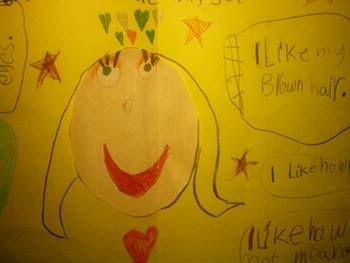
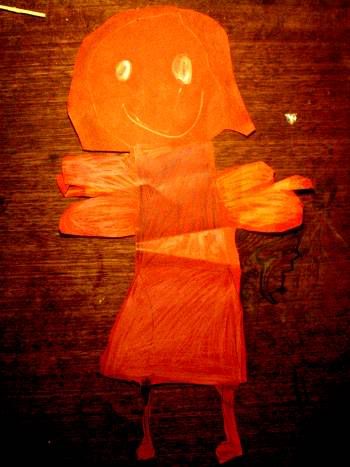
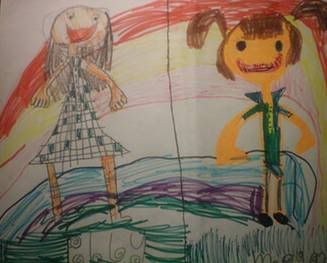
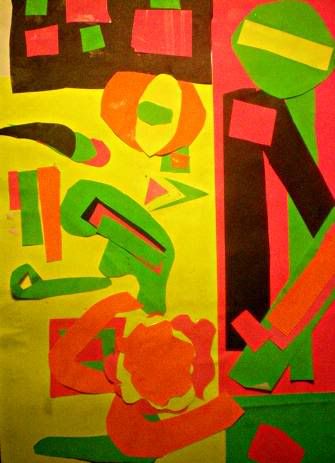
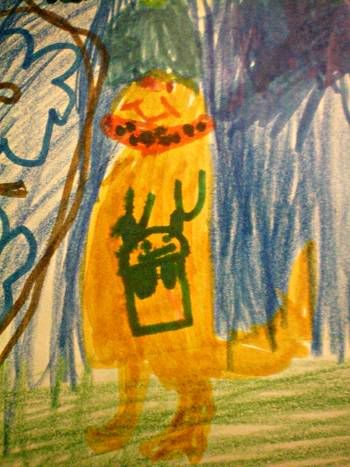
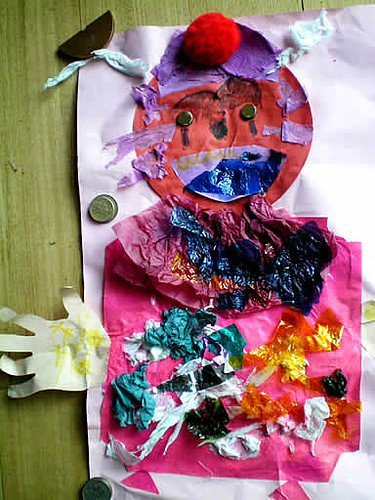
She also brought home a stack of artwork - to which, I'm afraid, you will now be subjected. (The final image is, I believe, a kangaroo.)


Stumble Upon Toolbar DiggIt!

Friday, July 31, 2009

~ a sceptic of the skeptoid

I listen to Brian Dunning’s Skeptoid podcast every week, but sometimes he drives me crazy. The episode entitled ‘SUV phobia’ is a good example

To quote:

Let's spend some time on the trendy fad of looking for villains to blame for global warming. My flavour of the week is SUV's, those evil gas guzzling, ozone destroying, unethical, politically incorrect, Nazi family soccer wagons. Only let's not do it the trendy way, let's look at the issue sceptically.

He argues articulately that the SUV is a style of car rather than a mechanical category - and fair enough. He berates city councils for banning this ‘style’ of car rather than specifying fuel-inefficient or over-large cars - and fair enough. He lets us know that ‘the majority’ of SUVs are neither bigger nor less fuel-efficient than the average car - and, if this is true, fair enough. What’s more, the SUV ‘style’ obeys modern emission laws, so is generally cleaner than many older cars.

But isn’t he missing the point somewhat?

It is only recently that the American term ‘SUV’ has begun to replace the Australian descriptor ‘Four Wheel Drive’ and half way through the podcast I began to wonder exactly what kind of car Dunning was referring to. Was there a definition discontinuity? Certainly, there seem to be a great many of the small SUV types on the road, but these are not the ‘villains’ fuelling the issue.

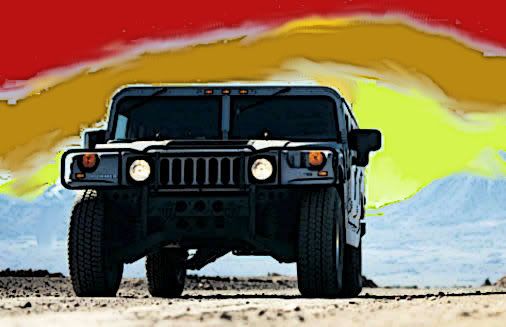
Hummer 2s, Range Rovers and Canyoneros (whatever) are heavy vehicles - there are no two ways about it. To move their considerable mass, a larger engine and more fuel is required. What people are complaining about is the use of such vehicles in situations and environments in which they are unnecessary and in which their fuel use is therefore excessive. People also complain about of the ability given their owners, who may lack a certain sensitivity, to access areas of the planet which require just this sensitivity to survive. And this aside from the clumsiness in the parking lot, the dangers these vehicles create as an obstacle to clear vision on the roads ,and their poor ‘crash compatibility’ with normal sedans.

Face it. They’re jet-skis.

It is natural for thoughtful, caring people to recoil against what appears to be a flagrant waste of resources and a font of unnecessary pollution. Therefore, inevitably, the large ‘SUV’ has become a symbol of excess, an icon for just the kind of behaviour that is threatening our world. If city councils have banned them, then huzzah! They are underscoring a basic human moral. They are helping remind the populace that it is gross and offensive to shit where you live.

If, as Dunning argues, there is a by-catch of small, low polluting cars, then that can surely be addressed, though it is, I would contend, a secondary issue. That the military Humvee [H1] and the Hummer 2 do not share a single component is indeed ‘another example of why you should be sceptical of marketing labels’ but it should not divert attention from the barbaric nature of the vehicle itself. I have seen an H2 and there is no way anyone is going to convince me it is a city-appropriate, fuel-efficient, planet-friendly vehicle. Even its advertising slogan ‘Get Lost’ seems to admit this, having a sub-text aimed at those who would criticise the unashamedly boorish artifact.


The angle Brian Dunning takes on the SUV issue is certainly sceptical. Logical too. But I would draw the line at humanist. I have noticed this kind of thing on other occasions too, as I tread the vasty deeps of the sceptisphere. The new sceptics can sometimes get so enthusiastic with their critical analysis that they discard the human element. Even Richard Dawkins is sometimes a culprit.

Certainly, as Dunning says, container ships produce carbon emissions equivalent to 300,00 cars and are not subject to emission laws, but there are many more cars than container ships.* And without the billions of stuff-hungry people those ships would be mothballed. And there’s the rub. A simple confusion over categorisation should not stop or discourage us reducing excess in our daily lives. Like many, I hold strongly to the credo ‘think globally, act locally’.

* Are there 300,000 cars for each container ship in the world? I would guess there are a lot more. But it’s only a guess, and I’m flirting with sceptics here.

Stumble Upon Toolbar DiggIt!

* June 28 1981 Sunday

I’ve got myself the leading part in the Ovaltine (flavoured milk) ad. The payment is $1,000. They’re contracting me for a year, I think – and part of the fee will go as their percentage.

I don’t quite understand why I was chosen. Personally, I thought I looked ugly on the video, and I still had a shadow on my face, even though I took great pains in shaving.

It has the same air as a Big M advertisement [almost]. I felt embarrassed by some of the things I had to act out … prowling after girls … drinking the stuff … simulating satisfaction …

That Carol’s going to get it! I’m moving in regardless of those godforsaken druggies.

Lots of time with Phillipa & Gus. Lots of booze etc. Lots of wasted time. I’m going to become (the) retiring (type) for a while, I think.

*

I wonder if anyone recalls this ovaltine advertisement? I’d be curious to see it. I think I’m old enough not to be embarrassed. The agency were trying to get ahead of the trend by using a ‘blitz’ theme. I was wearing these bespoke leather pants and a semi-frilled white shirt, wandering down a forced perspective hallway opening doors. There was a cow behind one. There was a surfeit of ovaltine flavoured milk cartons behind another, and behind still another there was a rather hot female model, probably with Eighties hair, sipping ovaltine flavoured milk through a straw. I know she was hot because she’d stripped naked about two feet from where I was sitting having a semi-conscious morning coffee in the dressing room. The effect was instant paralysis. These model types …

The money, by the way, was huge at the time.

Diaries - 1981

Stumble Upon Toolbar DiggIt!

Saturday, June 27, 2009

~ the black hearted babycino vendor

As you can imagine, my life is currently dominated by preparations for Sails of Oblivion: The Gig. Our promoter Dolores is a whirlwind. Things are progressing swimmingly and at speed. There's a lot of interest out there. Already we have 85 confirmed guests on our Facebook events page.

But the general air of excitement has not stopped my ire being raised on the issue of babycinos.

I don’t know exactly when they first appeared, but when Polly was tiny they seemed like a new thing, at least here in Melbourne. They were a nice, efficient way of including her at a
café table. A small, sweet, warm treat to concentrate upon, to delay the onset of boredom, to defer the impulse to whine or crawl over her parents. And they remain useful to this day. And they were free. Always free. And fair enough. A meagre quantity of milk-froth sprinkled with chocolate would probably not break the one cent barrier in production costs. And I suspect they’re good for business too. Mothers often like to chat at cafés and can do so with more amenity if their children are preoccupied.

But then, as time passed, café proprietors would occasionally charge. A dollar. A dollar fifty. Perhaps, as the babycino became more popular, they wearied of making it for no reward. Or perhaps they couldn’t get their heads around providing a service for free. As for me, I began to judge the moral tone of an establishment on whether or not they charged for the babycino.

It all reminds me of what happened when they first introduced cat licences. Every Melbourne council had to start providing these licences, and because it involved paperwork a fee was to be charged. My own Monash council charged about ten dollars a year, (though this has risen over time to about twenty-five). Other councils asked for as little as six dollars, but some, if I recall correctly, charged more than a hundred.

You see, there were no precedents. Nobody knew what an appropriate fee might be, so they they flew on instinct and did not bother to confer with each other. And the greedier and more venal the council, the more they charged. Their ethical fibre was exposed. It was an object lesson in human nature.

Now the other day, my wife returned grumbling from a coffee session with her friends. She had been billed three dollars for a babycino - around the price of a real cino. My hackles rose. Deplorable, unforgivable, extortionate pricing. Worse even than the outrageous mark-ups on beer and chips at the football. Or popcorn and choc-tops at the cinemas. And I can tell you, with a high degree of certainty, that the individual who priced that babycino has a black heart

Here is a link that further explores this dismaying issue.

*

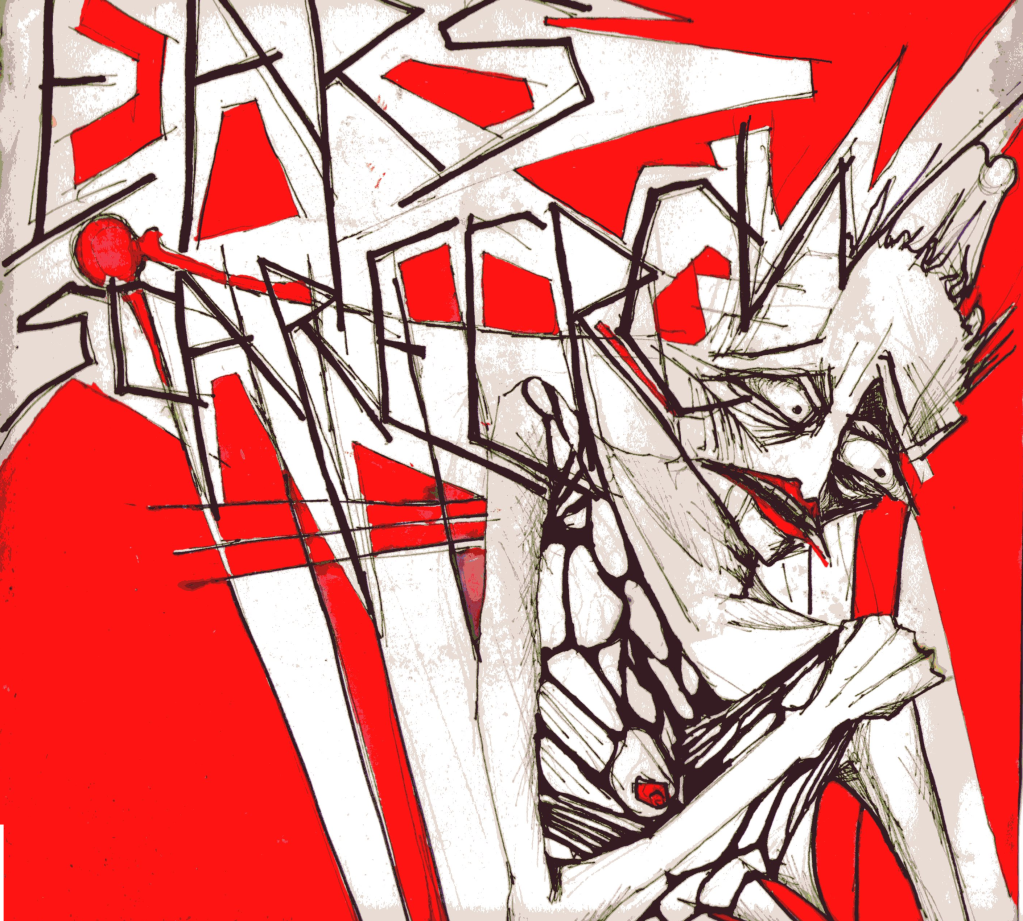
While burrowing through old boxes in the shed today, in addition to dust and house spiders and possum skeletons, I found a couple of unused designs for Ears single covers. I can’t work out why we didn’t choose the first one. It's brilliant. I think it’s by Tony Harding, brother of Christine and Anne. The other’s by Gus Till.


Stumble Upon Toolbar DiggIt!

Friday, December 19, 2008

~ a mould of note

These last weeks, my mentality has been feverishly occupied.


Many of my ideas have sunk, slowly, like a poisonous dustfall through the Glimmung’s phantasmagoric ocean, past the sunken cathedral of aeons past - and still deeper to that place where bad thoughts go to die.

But some have served to feed the ever burgeoning Encyclopaedia of Nonesuch. Choices for the name of my protagonist have been whittled down from about twenty to two: Alsus and Alsace. At present I am leaning towards the latter.

Alsace has a new tutor, a tall unsmiling man named Northy, who is more bodyguard than pedagogue - sent from afar by Alsace’s father, Ashen, as the political situation rapidly deteriorates. Touched while still a babe, Northy is formed from canon-tree wood. Another new character has emerged: Jequirity Pea, a girl from a local tribe of Emeraldim whose tattoos - with their eldritch geometries - strike to the heart of Alsace's’ sexual instinct. Jequirity is the only person with the ability to perceive Almathea, the blue spirit who walks behind Alsace. Jequirity, like all women of the Emeraldim has pale green teeth and an intriguing tablier Egyptien ...

But now, to the point:

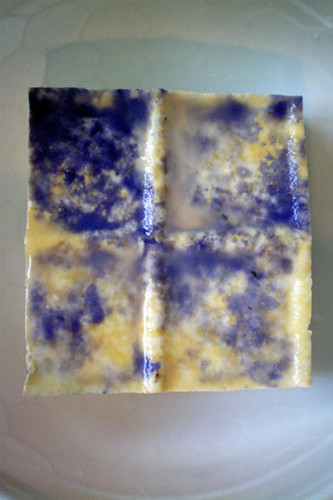
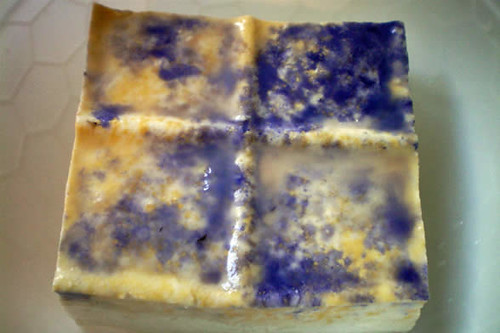
Please observe this section of soft refrigerated tofu, abandoned for an indeterminate period in a zone reserved for non-preferred mustards, 99% fat-free French salad dressing, blue cheese salad dressing and Outback Brand lime, chilli and ginger sauce.


Mould comes in many colours - green, grey, blue etc. – which are often specific to the substance on which it grows. But upon this block of tofu there appeared an outcrop of almost fluorescent purple, which my camera could not perfectly reproduce. I made repeated attempts with different backgrounds, in various light conditions, but you’ll have to trust me that it was even brighter, even more purple and iridescent than it appears in these images.

Purple mould. Livid ultraviolet mould. Perhaps I have seen too little rancid tofu in my time, but I do find this extraordinary.

I ask myself, since the species appears so unnatural, could it perhaps be unnatural. Might some outrageous additive have spurred a providential mutation?

Further to the dreadful food-industry practices I described in a previous post, some recently announced Chinese food safety protocols have outlawed a swathe of other stomach-turning activities. Boron (among other things, an insecticide) has been used to increase the elasticity of meatballs and noodles. Formaldehyde and/or lye are routinely ‘added to water in which seafood is soaked to make the produce appear fresher and bigger’. Also banned, interestingly, is the traditional use of ‘an addictive substance made from the poppy plant ... used in hot pot, a Chinese dish where meat, vegetables and tofu are cooked at the table’.

In a culture where food colourings seem interchangeable with industrial dyes, increased regulation is certainly good news but, typically, I have veered from the subject of my post: this novel and uncommonly beautiful mycelium.


I won’t prattle on further, except to pose a series of questions.

Is the steady increase in the size of the strawberry a reflection on our society? Perhaps even on our humanity? What is the meaning behind our urge to force the species so far beyond its natural size? This very day, if one wished, one could go out and purchase a strawberry approaching the size of an apple. Why have we worked so hard to grant ourselves this dubious boon? What lies behind this strange imperative?


As the strawberry bloated under the devious hands of the food-scientists, initially the flavour did not keep pace – but now this hurdle seems to have been overcome. The hydrocephalic supermarket strains are becoming as sweet and densely-flavoured as the strawberries of yesteryear – though not, of course, the wild strawberry, which now tastes like an entirely different species.

As the concept of the punnet becomes increasingly ridiculous, broad trays of strawberries are becoming more common. Soon perhaps, we will purchase them in something akin to egg-cartons. Commercial Fruit Behemoths will develop a hardier skin, allowing the strawberry to enter the aisles, if not of golden delicious and fuji, then of the stone-fruit which it has already begun to dwarf.

And, as their genomes are mapped and turned inside-out, will raspberries and blueberries also become subject to the same process of forced gigantism?

Stumble Upon Toolbar DiggIt!

Monday, December 8, 2008

~ melonette

How would you feel if you woke up one morning and everyone was calling the orange a florida? Amid streamers and bunting, posters in the supermarket aisle announce the arrival of a brand new taste sensation – the florida. The same sweet spherical orange citrus fruit as before, but now it is a florida.

Somewhere, in the high boardrooms of Big-Fructo a decision had been made and acted upon. Celebrity chefs have been enlisted as ambassadors, deals arranged with fruiterers, juice-merchants, vitamin and lolly-manufacturers, Microsoft spell-check has been suborned ... and before you know it the coup d’etat is a fait accomplit.

But consider their perspective: the orange isn’t going anywhere. It’s hard to excite someone with such an ancient and fundamental flavour and a fruit which – in a monumental slap in the face of human imagination – is blandly named after its colour. Sales are growing at the pace of the population and to an economist this means stagnation. Something needs to be done. The orange needs to surge. The orange needs a makeover.

So, let’s rebrand it. Let’s rename it after something everyone associates with sunny weather, leisurely retirement and water-sports ... consumers in benighted Belarus and Liberia can suddenly purchase a sweet slice of paradise ...

An impossible scenario? Perhaps, but I experienced something very similar at the age of about seven. It was my first personal experience of the crushing impotence of an individual in our society. The venue: Chadstone.

And a very different Chadstone to the one we know today. A proto-Chadstone if you like. The germ-plasm of the monstrous entity that exists currently - which still shows no signs of slowing its inexorable growth - like a reptile shedding its old skin every few years to re-emerge larger and shinier than before.

At the time, I was learning about fruit. I was fascinated by the variety of brightly-coloured, strangely shaped botanical products – and this was nearly twenty years before I tasted my first avocado, (thank you, Anne Harding,) Mango and Macadamia. I was learning their names from my mother and then memorising them. (In a prelude to the machinegun–like frequency of my obsessions in later life.)

Of the fruits available at that time, the Chinese Gooseberry was one of the more exotic. By way of education, my mother bought me one and I loved it. I loved being able to say the name. Perhaps I could even spell it. I looked forward with great enthusiasm to my next Chinese Gooseberry.

But then a pall descended on my child’s excitement.

On out next visit to the fruiterer at Chadstone, I saw the streamers and bunting; the posters in bright colours espousing a brand new taste sensation. And a new word. A strange unfamiliar word ...

Kiwifruit.

A thing has a name. Adam walked through the garden of Eden and he gave everything a name, and one of those names was Chinese Gooseberry. When my mother explained to me that this kiwifruit was not something new but a new name for my Chinese Gooseberry I was bewildered and disappointed.

And before long, outraged..

I questioned my mother, who must have acquitted herself admirably. She helped me understand that businessmen and advertisers had decided that 'Chinese Gooseberry' was not a good enough name, and that more money could be made if it was called a 'kiwifruit'.

How could you rename something as fundamental as a fruit? My young brain swirled. And why a kiwi fruit?

She explained the connection between New Zealand and the Apteryx or Kiwi bird - though I am uncertain how widespread that link was in the public imagination at the time.

But it’s a Chinese Gooseberry, I complained. Well, now it’s a kiwifruit, she answered. I began to understand that a bunch of NZ fruit-farmers had stolen the fruit’s identity for the sake of profit. And they had named it after themselves, or at least their country. The gall. Had they even asked the Chinese for permission?

Jaded as I am, an act like that would barely ruffle my feathers these days. But at the time, the lesson sank deep. It still riles me to call the Chinese Gooseberry a kiwifruit, though I am aware that it is not strictly a gooseberry. But it is very Chinese. It was first exploited there about 800 years ago. Indeed, the yang tao is the official Chinese national fruit.

What I am attempting, belatedly, after learning of the fruit’s history, is to revive the name melonette. This was a transitional term. It appears that US importers were dissatisfied with 'Chinese Gooseberry' and, being Americans, they called for something snappier. The first shipments arrived under the new name 'melonette', which caused the product to attract high duties ascribed to the melon and berry category.

'Kiwifruit' was their second try and the Americans were satisfied, though these days they simply call it 'kiwi'. Wikipedia says that we add the ‘fruit’ to avoid confusion with the bird and the people. Hmmn. Others say that the name is connected to the fuzziness and flightlessness of the bird.

To quote the Purdue University site in the US: the name has been widely accepted and publicised despite the fact that it is strictly artificial and non-traditional.

Melonette ... Melonette ... charming, perhaps inaccurate ... but inoffensive and sweet. Unlike another of the fruit’s names: the sheep peach.

Wherever you are, whoever you are, why not give the finger to those greedy Antipodean gardeners and their American clients? Just say melonette. Or Chinese gooseberry, if you’re traditional. If you want to give due to the fruit’s Chinese heritage, then say Yang Tao. Or Strawberry Peach. Or Hairy Wood Fruit. Anything but kiwifruit.

Stumble Upon Toolbar DiggIt!

Saturday, November 1, 2008

~ the cloud of unknowing

On Thursday I took the long road to Langwarrin in order to console Kylie, who broke four ribs falling off a fence. Interestingly, she claims to have been only slightly intoxicated - at least in comparison to her personal precedents.

Kylie is one of my dearest friends and near to qualifying as a nurse. I cannot think of a person more suited to the job. She is almost pathologically empathetic, particularly when it comes to animals. She is feared by local vets, to who she regularly brings near-dead possums scraped from edges of roads. She keeps a blanket in the back of her car expressly for this purpose.

It’s been a while since I’ve been down that way and it was unrecognisable. Indeed, I got lost. What was once pleasant and semi-rural is now undergoing rapid change.

Housing developments are spreading like a necrotising rash, an untiring cloud of unknowing. These are the fabled mcmansion estates, which may only be visited by converting large amounts of gasoline into poisonous exhaust. Other means of transport are either impractical or non-existent. The children who grow up here will struggle to avoid alienation in their cavernous, appliance-filled houses. Perhaps the internet will be their saviour. Perhaps there will be helicopter airlifts.

I saw no solar panels. No water tanks. I imagine the large developers have lawyers to sleaze them out of those annoying obligations. Do these houses have double glazing? Solar hot water? I wonder just how ugly they really are? When carbon trading begins, just how difficult will it be for the dull sublunary occupants of these macmansions?

At least the financial ‘meltdown’ will slow the carbonators down a little.

I do go on.

I’ve got a stall at Camberwell Market tomorrow, in case any one is in need of vast quantities of ridiculously cheap books. It’s been a while since I’ve culled the distributed tumour that is my book collection. The blame rests with my embarrassing second life as Lampsucker the ebay seller - and with what my wife calls my ‘Asperger’s syndrome’.

Admittedly, I do have trouble disposing of objects. I am a recovering hoarder. And I am subject to sudden consuming obsessions. And I have a well-established reputation for saying inappropriate things in social situations. And I have been accused of lacking emotional reciprocity. And I do react with abnormal intensity when others interrupt my routines ...

Aspeger’s is a ‘spectrum’ now, not a ‘syndrome’ – so perhaps I lie somewhere in the very mild reaches. Personally, as the occupant of my own mind, I think it’s possible. Others, excluding my wife, say it’s just eccentricity. But these days even things like eccentricity seem to need a medical description. So be it. After all, Einstein has apparently been post-diagnosed with Asperger’s.

Stumble Upon Toolbar DiggIt!

Tuesday, September 2, 2008

~ mysterious space girls


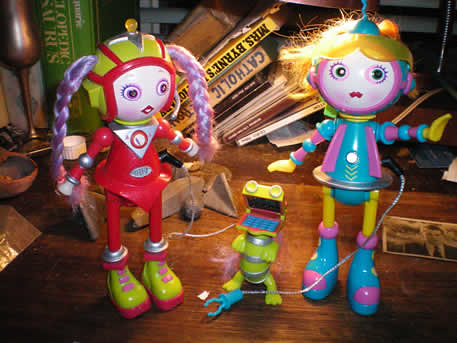
We have these uber-cool space-girl dolls, but cannot discover their names or if there are more to the series. They appear to have been made by Irwin in 2002.

They talk and have some awareness of their body positioning, complaining of boredom when they're sitting or lying down. They each have a plug-in pet. The one on the left is clever and has an alligator/keyboard colleague. The other is daft and just wants to go shopping. She has a cat, but we're missing that. If you plug in the wrong cord, they tell you, ie: That's not Nizu!

If you know anything about them, please, do tell.

Stumble Upon Toolbar DiggIt!

Sunday, August 17, 2008

~ recommended product #2


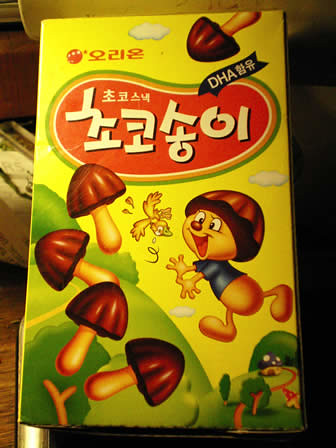
Please afford me the pleasure of recommending another curious product from the mysterious Orient.

This snack comes in a number of flavours. The package contains two compartments: one a small reservoir of
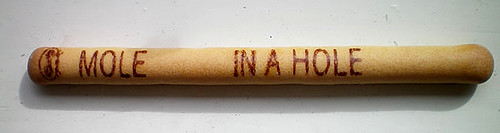
creamy, honestly delicious dip, the other containing biscuit sticks, each one branded with an enigmatic animal-related message ...

Giraffe - Tallest Mammal
Fox - Beware of Lies
Cow - Muuuu
Starfish - Star + Fish
Bat - Only in The Night
Mole - In a Hole
Goat - You are Lucky Today
Rabbit - Eat More Carrots
Chicken - Kokekokko!
Chick - Lucky Colour Yellow
Beetle - Lucky Colour Brown
Sheep - Wool Sweaters
Owl - Active at Night
Zebra - Herbivore
Frog - Amphibian
Cat - Say Meow
Horse - Gallop Away
Octopus - Lucky Number: 8


Is this copywriter seriously out of tune with nature, or what? No, I'm being deliberately unfair. It's a language thing... Or is it?

Congratulate Polly on the discovery of Yan Yan - and for this magnificent clown which she brought home from school on Friday


Stumble Upon Toolbar DiggIt!

Thursday, August 7, 2008

~ recommended product


Allow me to eagerly endorse this product.


Stumble Upon Toolbar DiggIt!

Thursday, July 31, 2008

~ dragons, pandas and shipping containers

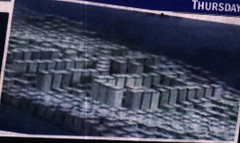
On the front page of The Age today there are some indistinct pirated images of rehearsals for the Beijing Olympics opening ceremony. One of them appears to show an enormous stack of rectangular white boxes.


Could it be that the hyper-sensitive, deeply paranoid nation of China has shrugged its profound humorlessness?

Do these boxes represent shipping containers?

The universal instruments of trade which would so accurately typify China’s relationship with the rest of the world.

A vista of anonymous oblongs, reaching to the horizon …

Bursting open, theatrically, before a global audience, to reveal cheaply manufactured goods of almost infinite variety …

The irresistible current of plastic gew-gaws and gaw-gews which serves to make our lives in the Western World so comfortable, so cheap, so unsustainable …

What could be more appropriate at this ceremony? What better to symbolise China’s victorious exploitation of our greed?

Indeed, the likeness of a shipping container would not be out of place on the Chinese national flag. Forget dragon dancers, peonies and giant pandas, in this modern age the shipping container trumps them all.

The image above immediately brings to mind a dockland scene. Every large port in the world has stacks of shipping containers which look like this. Mind you, these ones, though of the correct proportions, are standing on their heads, but there could be a million explanations for that… [to make them look less like shipping containers, perhaps?]

If these boxes are indeed containers - and, sadly, I doubt they are - wouldn’t it be a great leap forward for this somewhat retarded global citizen - stressed by gigantism, delusions of grandeur, issues of trust, behaviour and perceived inferiority – to portray itself to the world with some genuine wit?

PS: I’ve recently finished reading William Gibson’s 'Spook Country', so it could be I’ve got shipping containers on the mind.

Stumble Upon Toolbar DiggIt!

Tuesday, May 13, 2008

~ thoughts of the tadpole

There is so much entrenched greed in this world that I wonder if anything short of a revolution will put an end to it.

Staring blearily out of my shadowy room, I am overwhelmed by its extent and by my own impotency. I am a tadpole with big gloomy eyes and a scrunched up mind, there is little I can do.

When I heard that ebay were banning all forms of payment save those through its wholly owned partner Paypal, I began to feel spiritually ill. One person told me their profits will double overnight. My own profits as a [possibly ex] ebay seller will almost evaporate. There’s a reason I don’t use Paypal – the fees take too large a bite out the little I do make to justify the drudgery involved.

There is no good justification for it. ‘Safety’ is all they could come up with and if people want that, well, they can use Paypal already, can’t they? Ebay have a submission with the ACCC, asking for an exemption, as their plans are technically illegal. Yet they’ve already announced the commencement date. How does that work? How do they know what the ACCC will say? For the record, I made a submission detailing my thoughts, but I’m sure that if Ebay has gone to all the trouble they have, then they’re pretty sure the verdict will go their way. Even the Reserve Bank of Australia is complaining, but no matter, Ebay will have their way. Their profits will double.

They will have an even larger cash pile to invest on the short term money markets, much of it gotten by deliberately delaying payments. Like the banks do. I thought internet banking might extinguish that nefarious habit - holding onto funds in order to invest them - but no. The money disappears from your account and reappears in the other account a few days later. Where does it go? Why, it’s put to work.

I don’t see how this can be legal, but it’s been happening as long as I can recall. The banks will tell you they’re ‘validating’ or ‘checking’ or some such nonsense, but it’s all a lie.

On the David and Kim show the other morning an Ebay rattlesnake was trying to sell their case, but his body language was wrong. It made his words seem apologetic, as if he was fully aware how thick and rich was the crock of shit he was spouting. Ebay Australia is the unfortunate test case. Obviously, they’re taking orders from on high. The Ebay gnomes in the US have chosen their Australian minions to make the Paypal scam float. From here, it will radiate out into the world, and thence to America.

Ripples of greed, consuming the world.

Stumble Upon Toolbar DiggIt!

Thursday, March 27, 2008

~ benign girl

Today, I was trolling a two dollar shop, seeking some super-glue to fix my swim-goggles, when I encountered a most extraordinary product. I had no choice but to purchase it. It spoke to me in a way I could never hope to express in mere words.


Stumble Upon Toolbar DiggIt!

Thursday, February 28, 2008

~ eddie groves’ evil empire

For some time now - probably since I became a father - I’ve been tracking the fortunes of baby-faced, sports-car-driving Eddie Groves, the ‘high profile’ unconscionable bastard who prides himself, with his wife Le Neve, on making millions out of early child care with his company ABC Learning.

Now it looks like his evil empire is turning to shit. It seems the hedge funds, sensing his vulnerability to the current debt crisis, have invoked various arcane stock market mechanisms to bring him down. The sharks are eating the sharks.

In the beginning, Eddie must have scanned the business horizon, looking for a place to stake his claim. He chose to make his millions out of early childhood development, not pausing to consider that it might be inappropriate, that there might be just a few ethical considerations to take into account, that it might make him a vulture …

The image of Mr Burns taking candy from Maggie Simpson comes to mind. What caring person would deliberately set out to become a child care mogul? And if he’s suspect in this way, I doubt not, with the current crisis, that it will be too long before more putrescence comes to light. Already the spectre of HIH has been evoked.

My daughter Polly spent two years at Brandon Park child care centre. It was a terrific place, community owned and run, but I was left with the distinct impression that money was always tight. This is what makes me wonder what Eddie Groves is doing to extract his profits.

Rumours abound and none of them are good. Brandon Park had its own cook and food was prepared on the premises, but at ABC, it is said, canned or frozen foods are used and children are allowed two slices of bread, but never a third.

They try too hard to make it look like this big colourful, educational centre but lack in the caring, friendly personalities they should have.’

Some parents who send their children there think they’re great, but you will never come across a former staff member who would agree. Perhaps because one of the worst things about them is that staff are consistently instructed to lie and hide things from parents.

There’s too much emphasis on making things look good for the parents; they seem to have lost track of the fact that they are there to provide high quality care to the children. It’s all about keeping the parents happy; what they don't see won't hurt them.

I know one woman who took a demotion from Director of an ABC to Group Leader of a not-for-profit centre just to get away from the stress of constantly lying and covering up to both parents and certification authorities.

'I'm an early childhood teacher and have worked in a number of ABC centres and I would never ever send my child there … I have seen babies left crying on the floor or in the cots screaming when they obviously are not ready for bed.

The horrors stories abound. I don’t have room for them all.

As independent centre operator Patricia Wilschefski has said the biggest difference between her centre and ABC's is the personal attention. At Brandon Park, parents were at the helm, involved in board activities, money raising, working bees. At ABC Learning, because it is a listed company, the shareholders are the priority - not the parents, not the teachers, not the needs of the children.

Then there is the Sunshine incident. A child escaped an ABC centre and the company was fined $200. ABC challenged the decision, attempting to set a precedent that it was the worker not the corporation who was responsible. If they had succeeded, this would have allowed them to get off the hook virtually no matter what happened in one of their centres.

All the money, none of the responsibility. That’s the ticket. That’s where they come from.

In 2006, as part of their aggressive expansion, they attempted to buy out independent Sydney centre Moore Park Gardens. The parents waged war against a behemoth that sometimes pays as three times the market price to put its competition out of business.

Director Alice Voigt said she “was worried about the potential impact on staff and children’. A centre she worked at two years ago in inner Sydney changed dramatically after it was bought by ABC. ‘The effects on the staff and the children were quite severe,’ she said. ‘I would feel extremely threatened that our staff numbers would be reduced. I just don't believe in what ABC child-care is about, which is making money."

One parent at Moore Park Garden was quoted as saying "If ABC was actually committed to child-care they would not be operating on minimum staff ratios.” A parent from a different region writes, ’ABC built 3 centres all within a 5 min radius of my home this year. In the process they also bought my son’s centre and 2 others and shut them down in matter of weeks with no respect at all for the parents or children.

I wonder how we would react if a greedy business started taking over primary schools and making them uniformly compliant to their business formula? Not positively, I suspect. Well, guess what? In 2006 ABC established up a satellite company called ‘Independent Colleges Australia’ and began taking enrolments for its first Primary school in Narre Warren. In Caroline Springs - one of the desolate McMansion parks on the outer fringes of Melbourne - property developer Delphin allocated land to ICA ahead of a proposed Catholic school. More schools have followed, most in similar suburbs. ICA claims to be not-for-profit and independent of ABC, but no one believes them.

Basically, it appalls me that anyone could see a profit to be made out of children at such a delicate and crucial stage of their development. To apply brutal unforgiving business models to child-care is capitalism at its ugliest, and if Eddie Groves is about to go to the wall, then I, for one, am mightily pleased.

~ an exercise in physiognomy
~ more pernicious mischief from eddie 'the milkman' groves
~ the sweet death knell of ABC Learning

Stumble Upon Toolbar DiggIt!

Sunday, January 6, 2008

~ the world bag

The loneliness of objects. Their secret lives’ William Gibson.

However banal an object – and few, if any, objects are as banal as this – the human imagination will find a way to use it creatively, to invest it with meaning.


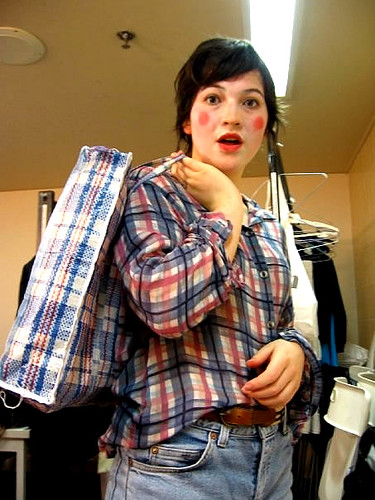
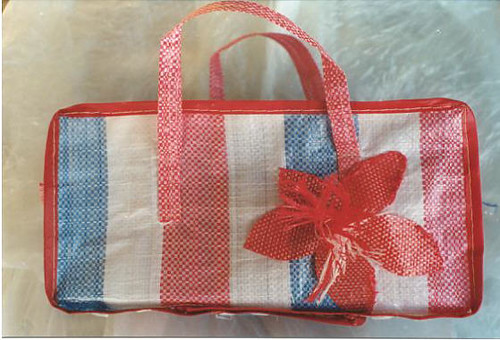
Above, we see Bree modelling an outfit inspired by the breathtaking triviality of the Stripy Bag. Below, the bag elaborately transformed for the market’s higher end [by an artisan from South Melbourne]


Since the mid-eighties, I have been interested in the stripy bag. Lured by the sheer scope of its banality. Fascinated by its everpresence – as the bag. almost certainly, has penetrated every country on this Earth. It has become iconic in the hands and on the backs of refugees. It is a symbol of the uprooted and the dispossessed - and yet there is one, almost definitely, in every second house on the planet.

A few years ago, I tried to write an article on the stripy bag, but I could find out pretty well nothing about it. Befitting, really. Instead, I wrote a short monologue for the theatre which I’ve performed a number of times since…

*

We are the slaves of objects. We require them for comfort, safety, defence, cleanliness, pleasure, for the sense of self-worth, for influence and for money

We work for them. Play for them. Die for them. We use objects to co-ordinate... other objects. We infuse them with meaning.

We see our future selves in the reaching hands of an infant - whom no amount of objects will satisfy.

We are contingent on them. And they on us. They find us in the crowd and offer themselves up, they lodge themselves in the tissue of our lives, they insinuate themselves into our conversations, they hijack our thoughts.

It is simple and understood. Objects are important. They are pivotal to our existence.

I, myself, am unnaturally adhesive to objects. They swarm about me like stinging insects. I hear their emanations, like... remote machinery. They gather in my house and poison my flow. They nourish and cosset me. They starve and torment me. They accumulate to form the compost from which I assemble my lifestyle...

Some objects are simple, others are fantastically elaborate. Some barely change over time, others are modified. Some are ugly but functional, others we place in museums or galleries. Some are discontinued, while others become perennial favourites. Some have intrinsic value. Some are disposable. Some are well-documented, ruminated upon, the subject of commentaries, technical manuals, reviews, but some...

Some cast no shadow. They are ignored, utterly. They are a booming silence that cries its absence to the world.

The object to which I draw your attention is beneath the cloth.

This is an object that slips under the guard of culture and taste. It seems not to even have a commonly agreed-upon name, yet has the kind of product-recognition that would ramp the blood-pressure of any marketing executive.

In this object, we find a concentrated banality of which we should beware - recalling that evil, in its essence, is banal.

Are you curious? Don’t be. Be the opposite of curious. Be disappointed.

If you’ve never seen one of these before, I’m very sorry for bringing it to your attention.

As near as I can place it, the year is 1983. The place China: ancient nation which gave us Rocketry, Chess, Umbrellas and wheelbarrows has refocused its inventive skills. In our time it is the empire of cheap plastic artifacts, disgorging in torrents. An endless landscape dotted with factories, each one injection moulding or thermoforming a different plastic doo-dad or widget to fill the $2 shops of this world.

1983. Woven polypropylene. A material made by weaving polypropylene tapes to form a lightweight breathable fabric. Bags of this material are sturdy, recyclable, suitable for grains, pet food, minerals and other products, and offer superior protection from moisture, mildew and pests.

I have tried to learn more, but... there is no literature on the subject. I have been able to chip barely a single fact off the great wall of silence.

Considered guesses are all I can offer. 1983. Has the material recently been invented? Has a new development facilitated cheap large-scale production?

Was a middle-echelon employee of a large Plastics Concern doing his laundry, when he had a sudden crystal clear insight into the needs of humans on Earth.

Did he make a little sketch on the back of a consignment form?

But... why the stripes?

And why did he choose red blue and white?

Are they auspicious colours? Used in the flags of France, America, Russia, the UK, Australia. Or are they just the cheapest dyes?

Only he could tell us and today he is - of course - unavailable, a billionaire cloistered in his Ming Dynasty style palace, meditating upon golden carp and chrysanthemums as Stygian extruders churn in the valley below.

*

Wherever shopping is done. Where laundry is done. Where bag ladies heft their meagre possessions. Where asylum-seekers mill in the holds of fishing vessels; there you will find them.

The bag proliferates, as if on the wave of a massive, yet invisible, advertising campaign -

With no saturation point in sight...

And tell me, do we really have a choice? Are its cheapness, usefulness and ready availability too much for us to resist? You,who ordinarily would never purchase such a bag. How many of you have been forced, by some annoying circumstance, to buy one?

I doubt if anyone, anywhere has ever really made a conscious decision to possess such a thing, yet, inexorably, the bag ekes its way into our lives. Near to immortal, they gather in carports and sheds. With each passing year we own more and more of these bags, sometimes without ever having purchased one

Yes, it is hard to throw out a bag.

But what does it signify that we all share this bag? It spans religious, cultural and monetary divides. It is truly ecumenical - but is it something on which to build a more harmonious world?

No, of course not.

If you haven’t already thought through the implications... of this bag.

Now is the time. Save yourselves. The news is bad.

Outrage at the spread of McDonald’s on the bow-wave of US cultural Imperialism. Outrage at the global Arms trade, taking the spears from the hands of tribesmen and replacing them with AK-47s...

But for the bag... ?

And its silent global conquest?

No comment. Neither in the Age nor the Herald Sun. No mention in the ‘Socialist Worker’ or the ‘Advocate’. Not a peep from S11. Nothing.

But humans often have interesting reactions to nothing.

It lurks stagnantly beneath the public imagination. It slithers beneath the currents of fashion. The bag has no style. Cannot be pinned down to a period or decade. When a terrorist wants to plant a bomb, this is the bag of choice.

Such things - omnipresent, yet impenetrable to research - can provide fertile ground for conspiracy theorists.

1983. Threatened by a global labour shortage, The Gnomes of Zurich identified a huge labour-pool in the Third World. But these potential workers were settled and unwilling to embark upon the difficult process of moving. Higher wages were out of the question, so the powers-that-be developed and distributed a spacious durable product in which all a indigent’s worldly goods could be stored. Suddenly, a cheap highly mobile workforce was available to the world economy..

And who’s to say it isn’t true?

Twenty years the bag has been with us. It is now produced in Iran, Indonesia, Thailand and India as well as China. It is available in a range of sizes and can be found in different patterns. But has it really changed in that time? No. A stable presence in our lives, unnoteworthy in all its aspects.

But subjectively, things have been happening.

When we use an object, a little of ourselves rubs off, and a little of it rubs off on us. A thousand fleeting contacts, glimpses, shared moments. We form associations. An object begins to give off a distinct emotional scent. It is different for everyone, but...

What do you feel when you look at the bag?

For me, it generates a kind of sucking energy that weakens me at the root. If it is a bad day, the bag can make me hate who I am.

It degrades any landscape on which it is imposed. Yet, annoyingly, the eye is drawn to it. Too late, you realise - your day has been... cheapened. And it trivialises what it contains. And it’s always full.

In contemplating this bag, I experience a sudden anxiety, a vertigo, a dream-falling. Like dried egg filtering my vision of the world. Leering faces forming in the dust of my previous selves. Bad decisions clinging like cobwebs to my clothes. All the useless things, the dead-ends, the endless repetitions of mistakes. It trawls up memories of all the tired pointless things that have dogged me all my life. Suddenly they are what defines me.

At once, the barrier between my daily existence and the Void becomes... transparent - and I know somehow that everything I do, have ever done, amounts to a towering zero.

Yes! Bags are useful. They help us organise and compartmentalise. But this bag takes more than it gives. Fresh from the factory, it is an invitation to squalor. A call to Despair. An portent of the End Times.

It symbolises failure, the utter exhaustion of the imagination. If you can: Don’t abide it. Don’t notice it. Don’t recognise it. Don’t use it.

It is a quietly spoken profanity. Look closely. There is nothing there. It is the end of the universe. In a bag.

Stumble Upon Toolbar DiggIt!

Monday, December 24, 2007

~ Chadstone: a writhing pit of crapulence

I happed to do some driving on the Monash freeway yesterday. Ahead of me, as I approached Warrigal Road, I saw a banking up of traffic and a couple of those big portable signs that scroll important messages.

I quickly ran through the possibilities in my mind. There’s some obstruction ahead. Should I get off the freeway at this exit like everyone else? I must act quickly…

Then the signs swam into focus. I saw the word ‘Chadstone’ and immediately understood. Chadstone: that lodestone of venality.

Both exits – inbound and outbound – were stalled with three lanes of traffic. Presumably the many other approaches to this monolith of consumption were similarly occluded. It is difficult to imagine what it might be like at the actual shopping centre – for there is, with absolutely no doubt, insufficient parking there for so many cars…

But who was in those cars? Why were they going there? They’ve had a year to purchase their Christmas gifts. Supplies they could get at their local supermarket. Were they all so disorganised that they had to pile upon each other in a last desperate giga-scrum to get what they think they need?

Or is it something else entirely? Is it something they may actually enjoy? A cherished custom? Something to which to take the family, to look forward to? Is there some innate drive that pulls them there, to congregate in celebration of gross consumption, to kneel before the belly-god in tacit agreement that the base desire for material objects is actually a good thing; that covetousness is no longer a sin?

Do they yowl together in primitive ecstasy, decerebrated by droning carols, rendered mindless by the devious enchantments of the Advertiser Arch-Mage? Does that tinsel tickle something in their groins? Do those baubles send a shiver down their spines? Do they fall together in a ravening cluster of glitzy bags and cellophane wrap, in a pseudo-sexual bog of want? Do they bow low to the iconography of chain stores, brand names and the latest, most mouth-wateringly desirable manufactured good?

Do they?

I’m sure that lobotomising hellhole is even thicker with worshipers today. Shops stay open till midnight on Christmas Eve, don’t they? I can only guess what sick-making mass-wedding of consumer to consumer item is being enacted there as I write.

But despite that, Happy Christmas to you

cheers,

Sam

Stumble Upon Toolbar DiggIt!

Saturday, November 17, 2007

~ I am the lorax. I speak for the trees

Thoughts on the looming election.

We are exceedingly complex organisms, evolved from an exceedingly complex biological system. It is said the human brain is the most complicated thing in the universe, but the brain itself is a component of a thing far more intricate and vast: nature, the totality of life on this planet considered as a whole - on which we remain entirely dependent for our continued survival.

As we have proliferated and developed as a civilisation, we have increasingly isolated ourselves from our ecological matrix, from nature. We have acquired tastes, desires, needs that exist in a place apart from nature, and which are sometimes directly at odds with it. Consider electricity, computational power, mechanical assistance, recreational assistance, medical technology. We are so deeply immersed in this artificial superstructure that we frequently forget that we are, as ever, as always, wholly, of the Earth.

When we travel off-world in our magnificent machines, however briefly, we must take a portion of our atmosphere, food from the soil, the bacterial flora in our gut, the microscopic monsters that tend our eyelashes….

Some of the instincts that served us in pre-history have found new focus in a civilised world. They have transmuted into such things as greed, the urge to acquire far beyond one’s actual need. Many of us consume simply to be seen consuming more than our neighbour. We expect, almost as a right, a standard of living which would have astonished our forbears. In a world of gross unrestrained consumption, the pack instinct, refocused, can lead to the rape of the Earth.

The urge to power leads to ultra-violence - against each other, against other animals, against the fabric of nature herself. And it can lead to slavery in everything but name. And discrimination. Prejudice. The loss of contact with the fundamentals of our existence can lead to the perversions of torture and the tools of mega-death …

In the last decade, we have acquired sufficient evidence to know, without doubt, that our civilisation is destroying its foundation. Nature is no longer swinging with the punches. Soon, our planet, our mother, will be a hostile place that will no longer abide our excesses. Of course, I am speaking of climate change here, the greenhouse effect, the mass extinction of species... Humanity, we have learnt, is literally a plague upon the Earth.

I ask the reader to keep the above in mind, if you are voting in the upcoming [Australian] federal election.

The SBS programme Insight, in a recent episode, corralled an audience of undecided voters. I did not see it all, but over the period I watched not one of them counted environmental degradation among their concerns. They spoke of house prices, interest rates, taxes, the economy … they spoke for themselves, for themselves only, not for the community, and not for the ultimate provider of the air they breathe, the food they eat, the body and the mind they inhabit - though that provider is under dire threat. To my mind, hip-pocket voting is an abomination. The act of indulging the hip pocket voter is an abomination. [Certainly the suffering of many people could be eased by better government policy in the economic realm, but not at the cost of the planet]

We have come to a time in which only one issue counts - and beneath its rubric, the sub-issues of social equity, education, research/development which may give us the ability as a community to save ourselves.

Stumble Upon Toolbar DiggIt!