Pages

Showing posts with label AMBERGRIS. Show all posts

Thursday, August 30, 2012

~ a public reading of Ambergris


I'm having a reading of my play Ambergris at the Carlton Courthouse on Saturday at 2.00pm. (That's Sept 1, 349 Drummond St, Carlton, about 20 metres from the corner of Elgin.) It's late notice, I know, but... sorry... and perhaps some rough, first-draft playwrighting-in-progress is precisely your idea of how to celebrate the first day of Spring. Do come if it takes your fancy. It will be a casual, low-key affair and we may (or may not ) ask for a gold coin donation so as not to leave the actors out of pocket.

I've been working on this writhing, gargantuan word-squid for a long time. I've been distracted by the joy of child-rearing, by outrageous legal injustices, domestic misery and episodic insanity, by long winters of bewilderment and despair, not to mention the perils of serving as a pharmaceutical guinea pig – but I have at last honed the text to a point at which I'm prepared to brave the court of public opinion.

It's bit scary, to tell the truth. I think it's good, perhaps even better than good, but you simply cannot know until it comes off the page. I could have got it completely, utterly wrong. I could be facing a MacArthur Park dissolving-cake scenario. I just don't know... Though I can promise the sweet, green icing (or its equivalent).

And some esoteric characters - some who promote surreal agendas, others who nourish strange longings in the pit of their souls, still others who care naught for all but mind-numbing drugs.

Why does the mysterious stranger train a dog to bring him chunks of toxic waste? What is the disgraced researcher doing with 200 echidnas in his mobile laboratory? What is that void beneath the kitchen table? Who sells the packaged genitalia of lost marsupials to recreational fishermen? Why is the mute interested in Chux super-wipes? Why does a population with a genetic predisposition to bowel cancer claim instead to be an ancient, unknown species living among us...?

All this and more will be resolved. If you think that's impossible, let me prove you wrong. The readers are: Phil Motherwell, Richard Higgins, Lucy Cowbelle, Anthea Greco, Ben Andrews, molecular biologist Dr Nurin Veis and – owing to a late withdrawal – me. Directing is, of course, the formidable Lynne Ellis.

Stumble Upon Toolbar DiggIt!

Monday, November 1, 2010

~ wry


I’ve had a good week. My grant proposal for Ambergris (the play I’ve been battling with for a few years now) was accepted by the Victorian Arts Ministry. It’s been a long time since I’ve attempted one of these and, towards the end of the tram-ride to Brunswick for the announcements, I’d more or less convinced myself there was no way I was going to get it. As a result, when I found my name on the list (coupled with the descriptor 'Mt Waverley') I practically fainted. I couldn’t have been more excited if I’d won a Nobel Prize.

Speaking of prizes, if you’re in need of some comprehensive entertainment, watch Steve Kilbey’s acceptance speech for The Church’s induction into the Aria Hall of Fame. Quel raconteur! (I could only find it on facebook, but it must exist elsewhere)

Speaking of Mt Waverley, it’s the time of bleating baby magpies. A family of these birds has staked a place in the peppermint gum outside my study window, and their child is incorrigible. Three times I had to go out there today with a broomstick. There is also a nest of brown thornbills, smaller than sparrows, whose trills and tweets are completely charming.

I had what amounted to a panic attack in a crowded Vic Roads office today. I think I was experiencing flashbacks of jail. The guy behind the counter looked like a screw - thick-set and crewcut - and he had me utterly flustered trying to explain the identity of the person from whom I was trying to transfer ownership of my new car... It was horrible. But Polly wants to marry a mango-tree when she grows up, and I suppose that’s positive. Also, there is at least one kid at her school who is allergic to band-aids. Go figure. Additionally, on the radio, I believe I heard an advertisement for a model of car called an Autobiography. If I wasn’t dreaming, that’s got to be strong indicator of the social climate.

On Saturday night, accompanied by my exotic Japanese friend M, I went to The Old Bar to see Harry Howard and The Near Death Experience. It was raining torrentially and the atmosphere in the place was a little wanting, but they were far from. They were kind of... curious, intriguing, definitively offbeat. I couldn’t possibly think of anything with which to compare them. They were far more rhythm than melody, with a kind of weird, elusive 60’s pop influence, or something ... and though their songs were concerned with death, sickness, hate and so forth, the prevailing mood was, well, wry. But then, I guess, any band containing Harry Howard could not fail to be wry. It was also good to watch Claire Moore’s drumming. I haven’t seen her do that for an aeon.

By the way, here's the cover art for the forthcoming CD from The Ears. And yes, after a strictly commercial decision, it's called Dogs in Space.


Stumble Upon Toolbar DiggIt!

Thursday, April 8, 2010

~ ambergris in the raw

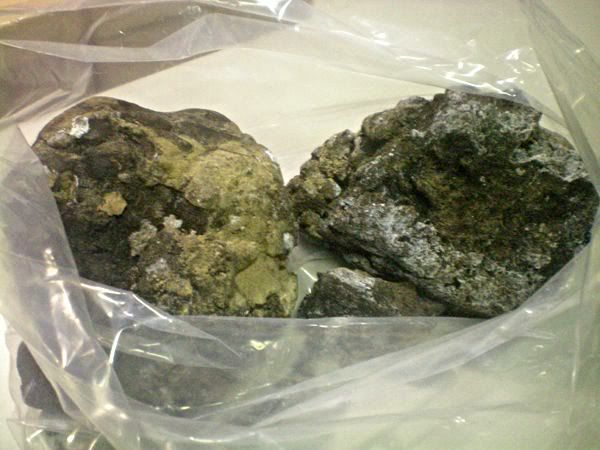
With the kind patience and assistance of the staff at the Moreland annexe of the Melbourne Museum (particularly my dear friend Nurin) I was at last able to have my first certified look feel and smell of ambergris, the waste product of the sperm whale which holds a rarefied place in the perfume industry - and which is central to my current work.

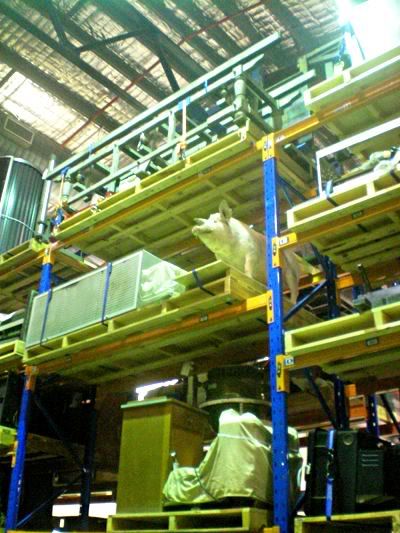
I was expecting something like the warehouse at the end of Raiders of The Lost Ark, and I wasn’t so far off the mark. It’s a large unmarked rectilinear building on an unprepossessing corner in an unexceptional suburb, yet within there are wonders.


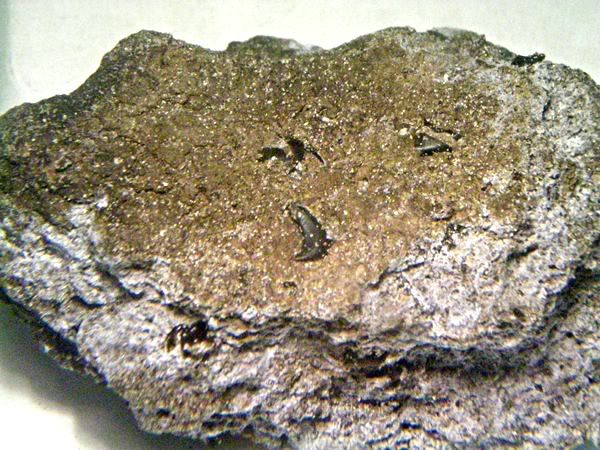
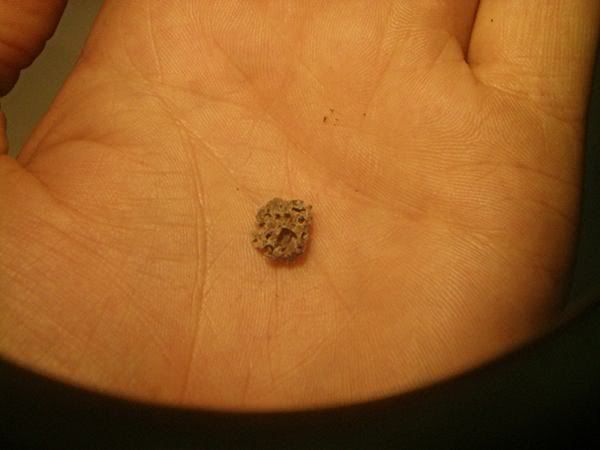
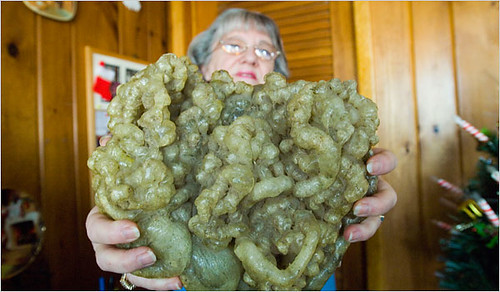
So let me tell you about their marvellous sample of ambergris. For a start, unsurprisingly, those tasked with locating it were unimpressed by the appearance and the odour - without question, it had the ‘humid’, ‘earthy’, ‘marine’, ‘animalic’ fragrance I’ve so often read described. It was a huge crumbling bolus, covered with patches of concreted sand and what may have been the roots of long dead seaweed. It was indexed as an amalgam of ambergris and non-descript matter, possibly faeces - but upon inspection the tell-tale squid-beaks were evident throughout - and the hot-needle test I was allowed to perform on a tiny smidgeon came up a strong positive.


I love this kind of thing. It drives me on through life. Polly, who I took along, was a touch bemused by the whole process ... but at least she knows what ambergris is now, and she was more than a little interested in some of the other exhibits we passed along the way.


This pig, we learned, had come from the Austin hospital. It had been genetically modified as part of an effort to make porcine organs compatible with humans needing transplants. (xenotransplantation). From the fact it was preserved in such a way, I can only assume it held - or perhaps still holds - great significance.

(please excuse the unfamiliar formatting - something strange seems to have happened with the Blogger interface)


Stumble Upon Toolbar DiggIt!

Thursday, April 1, 2010

~ the goa stone, byssus and the pyxis

If there’s one thing that's guaranteed to stall the progress of my work, it’s research. If I cast aside my figurative pen and submerge myself in the vast reference tool that is the internet, then the hours slip by without friction and I emerge with a head full of fascinating arcana, little of which is relevant to the job at hand. To wit: the play I'm working on called Ambergris.

In the last week, I've learned more about ambergris the substance than I could ever hope to employ, but I've
also been lured down snaking tributaries ... overhung with rare crystalline fruit ... ripe to the point of bursting ... which I could not help but pluck ...

I learnt of shilajeet, an uncommon tar that seeps from hidden cracks among the Himalayan mountains during the summer thaw. Even the apes of this region know of its restorative properties for - together with humans - they sup from these mysterious wells and are known to age at half the rate of their fellows.

I discovered the noble pen shell, a massive Mediterranean mussel which secretes extremely fine golden threads with which it affixes itself to rocks. In antiquity, these threads were collected and woven into an exceptionally sheer fabric named byssus or sea-silk, which - owing to its
utter luxuriance and its tremendous price - was favoured by Pharaohs, Satraps, Caesars, Padishahs and any potentate worth his salt in the ancient world. Only one human still practices the art of weaving byssus. The noble pen shell is on the brink of extinction.

I made a note of lacryma cervorum - the stag’s tear - a viscous substance found in the corner-pit of the animal’s eye and possessed of magical properties similar to those of the bezoar.

But let me reveal some secrets of the ambergris ... that ‘marine sulphur, found at the sea-shore’ ..., which has broken from the ‘fountains and caverns of the sea’ ... Which ‘is grey, sweet and smooth' ... and which, when ‘pricked with a needle sweats out fatness, softens in the heat, and when moist appears black’.

If it is true, as tradition dictates, that ambergris is most likely to be found in the hindgut of the sickest whales, then it is no shock that the following individual, taken by whalers, contained the precious substance ...

There was ‘an unusual combination of lesions and ... behavioural abnormalities’ in a bull whale ‘taken... off Iceland’. There was ‘heavy combative scarring of the head, grossly roughened and thickened skin on the lower left flank, cutaneous maculae, genital papillomatosis, partial duodenal obstruction by plastic debris, colo-rectal obstruction by ambergris, cystic degeneration of the right kidney, and a deeply ulcerative gastric nematodiasis. Sealskin was found in the stomach. Gross and histopathologic observations suggested that the disease complex in this animal may have been related both to habitat degradation and health risks naturally associated with its ecology and age.’

I
gnorance of its origins have in the past spawned some curious tales ...

Ambergris is not the scum or excrement of a whale, but issues out of the root of a tree ... which shoots forth its roots towards the sea, seeking the warmth of it, thereby to deliver the fattest gum that comes out of it, ... otherwise by its copious fatness [the tree] might be burnt and destroyed ... [the] fat gum it is so tough that it is not easily broken from the root, unless [by] its own weight and the working of the warm sea. . . . If you plant the trees where the stream sets to the shore, then the stream will cast it up to great advantage.'

In [a] ridiculous and wholly fictional account of a ... sea journey in search of the lost Capt. Jacob Cole, Clifford describes using a diving suit to find ambergris on the bottom of the sea and digging it out of the sediments with a pick axe.’

At one time it was ‘assumed that the sperm whale was a hunter rather than a manufacturer of ambergris, and that he swam ... about the broad ocean, gobbling up the treasure wherever he could locate it.” “In vain it was to rake for ambergriese in the paunch of this leviathan’ ... as ‘they sometimes swallow great lumps thereof in the sea’ before vomiting it out.

Marco Polo was the first Western chronicler to [correctly connect ambergris with sperm whales, but he ] also thought [the whales] vomited it up after having eaten it in the depths of the sea.’ Current wisdom has it - as far as I can tell from my readings - that the ‘morbid concretion’ exits not from the mouth but the anus [or its cetacean equivalent].

Ambergris was an article of imperial trade in Audoghast in northwest Africa before 1,000AD. In the 10th century Ibn Haukal, an Arab trader, classed it in value with gold and black slaves and referred to its reputed aphrodisiac properties.

Avicenna ascribed its formation to the belchings of undersea volcanos. Kublio thought it was bird guano. Nero's wife Poppaea Sabina is reputed to have had oil of ambergris poured in her bath in 54AD.”

The Crusaders, "who will not be suspected of effeminacy," were largely responsible for its introduction to Europe from their contact with the Arabs.” Louis XV is said to have used ambergris to flavour his favourite dishes. The favourite dish of France's King Charles II was eggs and ambergris.

Ambergris is used in the manufacture of cassolettes, little perforated ivory boxes made to contain powdered odoriferous substances to carry in the pocket or reticule. It was also used in the production of peau d'Espagne, or Spanish Skin, used for perfuming writing paper and envelopes. Queen Elizabeth I is said to have worn a cape made of peau d'Espagne.’

The ‘pasty pathological growth’ also had pharmacological uses ...

It was ‘sealed up in a vessel hermetically, and digested for forty days. The ripened blend, we are informed, perfumes forever what it touches, eases the headache, takes away defluxions from the eyes, comforts cold and aged people, prevents apoplexy and epilepsy, strengthens all parts of the body, and causes fruitfulness’.

And as I've quoted in an older post ...

It is ... an excellent Corroborative; it is discutient, resolutive, alexipharmic, and analeptic; it strengthens the heart and brain, revives and recreates the spirits natural, vital, and animal. Its sweet Sulphur is ... a good preservative against the Plague". From The Art of Healing and Praxis of Chymistry.

Then there is the curious Goa Stone ... It was ‘a universal remedy introduced in seventeenth century England, originating ‘from Goa and ... found in the form of oval balls weighing up to one pound ... [they were] generally encased in decorated gold or silver spheres. The formulation consisted of a number of powdered ingredients which included precious stones, bezoar, musk, ambergris and gold leaf, levigated into a fine, impalpable powder and formed into oval balls with mucilage’.

And the Pyxis, ‘an ivory box fashioned from the natural cylindrical shape of a tusk, probably used to hold gifts of ambergris, musk and camphor’. One example ‘is carved with a host of elaborate scenes, including one showing two horsemen, accompanied by cheetahs and birds, picking dates off a tree’.

In 1912 the discovery of a 450 kg. lump of ambergris saved a Norwegian whaling company from liquidation.

During the writing of my last play Mysterium I deliberately indulged myself. The work ‘sweats’ with strange archaic language and is bursting with fascinating anecdotes and obscure details. It was an unusual play with an unusual style, and its richness and density was generally well received - but with Ambergris I am planning for the narrative, the characterisation, and all those other elements which traditionally make a play a play, to be paramount.

The play is progressing wonderfully, but it is stretching into infinity. I am at page one hundred and ten with miles to go before I sleep.
Fortunately, I now have Sails of Oblivion - the perfect repository for all the fascinating little gewgaws I encounter along the way.

[Please excuse me for not attributing the quotes and sources in this post. It was simply a matter of time.]

Stumble Upon Toolbar DiggIt!

Tuesday, December 22, 2009

~ the truth

Since the BFG's school season ended with a fabulous gala night, I've been narrating an audiobook for Vision Australia: 'Truth' by Peter Temple. It's a book I would probably have read regardless, given how much I enjoyed its predecessor 'The Broken Shore'.

It's the first time I've done this kind of work, but it's something I've thought about trying for a long time. It's somewhat imposing, well over three hundred pages and, if there's an accumulation of dialogue, progress can be very slow. I'm averaging thirty pages per three hour session, which I'm told is about average. Initially, the producers were concerned about the intrinsic gravel in my voice - refined over a long lifetime of smoke inhalation and abnormal lifestyle choices - but it was decided that it might be just right for the crime genre. That's how I wound up with Peter Temple - and it's not too bad a fit.

Christmas is approaching with its usual pitiless inevitability. The family has been unexpectedly reunited, but my heart remains deadened by the everpresent weight of my little problem. I've been having trouble generating my usual interest in the world, which, as I may have told you before, is how depression sometimes manifests in me.

When I've had the energy, I've been working on my play, Ambergris, a project I began at least five years ago. I've had some exciting new ideas; so perhaps it was worth putting it on the backburner for a while. I've been slowly working my way through Battlestar Galactica. It's a patchy series, but good on the whole, and, since it's competent science-fiction, I'm content. I've been battling with The Age crossword every morning, with decreasingly satisfying results. I thought brain function was supposed to be improved by crosswords ... But then, I haven't been very diligent with my diet lately, and that could certainly be a factor.

And I wander round the house a lot, picking up plates and cups, replacing the lids of textas, not sure what to do, bored, bewildered, uninterested, scared ...

Stumble Upon Toolbar DiggIt!

Monday, February 18, 2008

~ my substance of choice

It is a marine Sulphur, found at the Sea-Shore … which breaks from Fountains and Caverns of the Sea. It is gray, sweet and smooth; pricked with a needle it sweats out fatness … it is … an excellent corroborative; it is discutient, resolutive, alexipharmic and analeptic … Its sweet Sulphur is an excellent perfume; it is a good preservative against the Plague, and preserves the Spirits from infection.
from Art of Healing and Praxis of Chymistry [1691]


Ambergris is one of my favourite substances. I am compelled by its mysterious, exotic history, by its strange journey from whale gut to perfume, by the slim but real possibility that an observant beachcomber might become rich overnight, if he is fortunate enough to stumble across it.

It is also the title I have chosen for the play I’m [slowly] working on. Its sudden appearance on the shores of a particular island serves as a catalyst for the drama, and hopefully will cast a certain magical aura over things.

Ambergris is also a particularly luscious word, heavy with romantic associations. It is French for grey amber, and refers to a waxy substance secreted by the sperm whale, probably as an aid to digestion. Commonly, ambergris is found embedded with squid and cuttlefish beaks, and its purpose may be to encase these sharp, hard, indigestible things, allowing them to be conveniently either vomited up or excreted. Here the literature is hazy. It has been called '
dung of the whale', yet one reads of whales ‘regurgitating’ the substance - and of it being found in the whale’s lower intestines. Perhaps this issue has yet to be resolved.

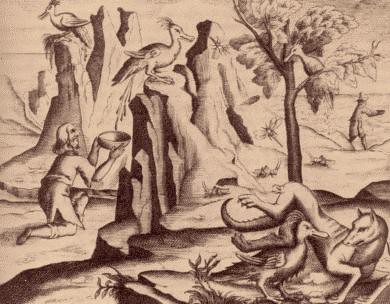
Indeed, for much of history the true source of ambergris was unknown. Sinbad the Sailor, marooned on a treacherous shore, by a mountain ‘composed of rubies, crystals and other precious stones’ observes that ‘a kind of pitch or bitumen distils from the rocks into the sea, and the fishes which eat it return it in the form of ambergris, which the waves leave on the shore.’ The ancient Chinese said it was derived from the spittle of dragons. Others held that it was collected from the cloacal orifices of what may be a pelican.


Our ancestors had an interesting way of treating the unknown. If a mystery presented itself, often it was solved by the imagination - and these imaginings regularly entered the literature as fact. Consider the Vegetable Lamb of Tartary. Consider the gods that were created to make sense of existence. We tend to do things differently today, but today we live more safely, in a less perilous, less terrifying world.

Ambergris is valued primarily for its unique odour, which is described variously as musky, humid, marine, sweet and faecal. Often one reads of the scent being ‘elusive’ Once processed into a tincture It has an enduring, ‘involving’ quality. Perfumiers prize it as a base note with which to smooth out and add structure to the marriage of other scents. It is also said to add a lasting quality to a perfume. Its extraordinary value – comparable to that of gold – is due to its scarcity and its desirability in the perfume industry.

Outside western culture, its use extends beyond perfume. It is considered by some to aid in sexual health and fertility. It is [or has been] used as a straight-up aphrodisiac, as a flavouring in chocolate, tea and alcoholic beverages, and as a medium for jewellery. Ambergris was treasured by the ancient Arabs, who burnt it as an incense, and used it as a spice in food and drink and even smoked it. Ambergris is still treasured in the Middle East today.

In its raw state, torn from the intestines of the whale, ambergris is unpleasantly pungent and dark in colour, often black, [coloured, some suggest, by squid ink]. Only after long exposure to the elements does it ripen into the material of legend. The essential ingredients of ambergris are very durable; the substance may bob around in the ocean for decades without losing its scent. Mature ambergris is usually of a greyish or whitish hue, rather like pumice, though it comes in many shades. Wave motion may have worn the pieces into smooth forms. The material has a certain waxy, fatty quality.

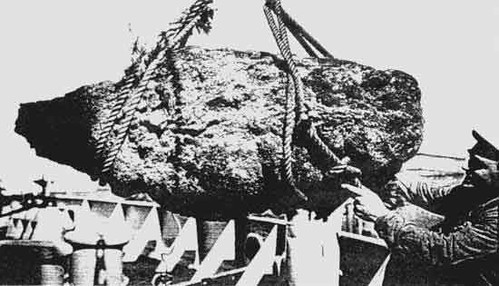
the largest recorded single find of ambergris [netstrider]


Mature ambergris is the more valuable, but raw ambergris was harvested direct from the source for a tidy profit. Whalemen of yore, after processing the whale for meat, oil and precious spermaceti, would systematically poke through the intestines with cutting-spades, inspecting the blades after each jab for a pungent residue. It was rare to hit pay dirt. According to Herman Melville, [in an oft quoted passage from Moby Dick], old or sick whales that would have little value for oil were checked thoroughly for ambergris, as these were thought more likely to bear ‘the morbid secretion’. But, though it has been described as originating in ‘the often morbidly distended gut of sick sperm whales’, current thought has it that even healthy whales expel it from time to time.

The essential ingredient of ambergris, ambrien, is an uncommonly complex molecule. There have been many attempts to synthesise it for the perfume trade, [Ambrox is one example], but none match the real thing.

“As a test for ambergris the hot wire or needle test is the most simple since it requires no special apparatus. A wire or needle is heated in a gas or candle flame for 15 seconds and then pressed into the sample to a depth of one-eighth of an inch. If it is genuine ambergris, a dark brown to black opaque resinous liquid will form around the wire and appear to boil. Touch the material with the finger before it cools and if the sample is true ambergris it will leave tacky, pitch-like "strings" sticking to the skin. When the wire, which retains portions of the melted material, is again heated in the flame, true ambergris will give off a white fume having the same characteristic odour as the solid, and then burn with a luminous flame. The odour of the smoke when the flame is extinguished should be that of burning rubber. Another quick and simple test is to dissolve a little piece of the sample in a small quantity of hot wood alcohol (methyl alcohol), then allow it to cool. True ambergris will crystallize as the alcohol cools.”

Since the prohibition on whaling, dealing is ambergris is illegal in many countries, yet a brisk trade continues. Every few years one hears of fortuitous finds on remote beaches.

Though the sperm whale is the most plentiful of the great whales and its numbers are slowly recovering, ambergris remains rare, a strange and singular treasure of the oceans. In the taxonomy of my imagination, I place it among the bezoars, those mysterious stones found in animals, which were thought to be proof against poisons and highly efficacious in the working of magic.

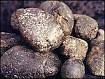
this is not ambergris


further reading ...

netstrider – ambergris
laputan logic – ambergris
the romance of ambergris

Stumble Upon Toolbar DiggIt!

Monday, January 28, 2008

~ preserved in amethyst

I’ve been experiencing a hiccup with Ambergris, the play I’m writing set on an island off the Queensland coast. [You could call it Almost-Stradbroke.] The problem involves the disappearance of a girl, Lily, about seven years old, who ventures off with some hay to feed a horse and never returns. The play is set three years later, and the issue of the girl’s disappearance is important, but not central.

I’ve hammered out most of the plot, but what happens to the girl has been a sticking point. I haven’t been able to work out an appropriate fate. It can’t be too boring. And it can’t be too weird. [I’ve resolved myself to making this play a little less bizarre than my previous work].

There’s a dog named ‘Chunk’ who was with Lily when she disappeared. He knows something; he keeps returning to a certain place, but no one can figure out why. I also want to suggest, only vaguely, that the girl was ‘taken’ by the island. [with no similarity whatsoever to ‘Lost’] She is innocent, a child of nature. You know what I mean. Fodder for The Green Man.

Anyway, I’m getting close now. I’m thinking about the preservation of corpses.

I was at the Melbourne Museum yesterday with Polly and Lynne, attending The Bee Circus – a weird composite of bee information seminar and circus skills exhibition, performed and devised by kids from circus school. [Polly loved it.]

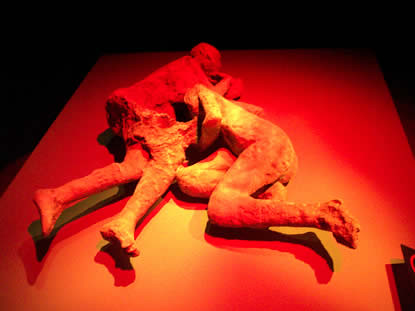
If I am to preserve Lily, I must decide how. At the Museum there was a replica of some corpses from Pompeii, but that’s far too violent a death. There was a mummy too, but that’s artificial – although the natron is a possibility. [Natron is a mixture of sodium bicarbonate and sodium chloride mined by the Egyptians in the Natron Valley. Just as salt sucks red wine from carpets, natron sucks juices from corpses.]


I need something slow and painless. I’m thinking of having her explore a cave system. After falling asleep, she could be gently gassed by some venting of the Earth, some mysterious Gaian afflatus, or else drugged by a dripping mineral opiate.

Then the processes of nature would set to work. Recognising the unique beauty of her spirit, the Earth will opt not to putrefy her, but to preserve her - with moss, limestone, lichen, rust and roots. Or might she be bitten by a snake or a gold and turquoise spider with preservative for venom?

There are a lot of factual options for preservation. Certain soil conditions can be responsible. Aridity. Ice. The twelfth Pandito Hambo Lama achieved preservation through ‘a form of meditation known as shunyata, or emptiness’, [Fortean Times #184], ‘coupled with prolonged starvation and slow self-suffocation using a special belt that connects the neck with the knees in a lotus position’ [Wikipedia]

Doctor Glob’s ‘The Bog People’ is a book dear to my heart. It deals with the marvellously preserved corpses found in European peat bogs. ’There is a strange power in bog water,’ it is said, ‘which prevents decay’.

Perhaps some of the chemical processes may be useful, but not the violence. A lot of these Iron Age preservations were human sacrifices found with garrottes about their necks.


Nowadays we have cryogenics, formalin and Gunther von Hagens' ‘s plastination technique, but perhaps there are natural analogues. My fictional island is rich in minerals, after all …

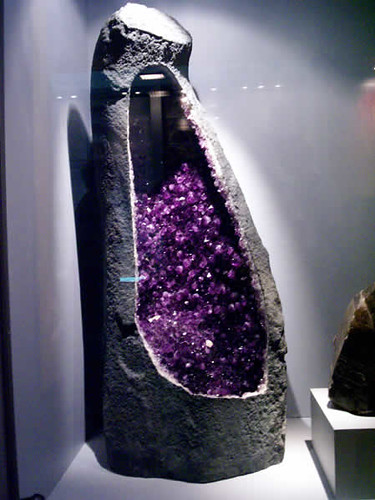
The most intriguing thing I encountered at the museum was this:


Lynne made the connection. Somehow, she has always been able to track the way my mind wanders. I could easily imagine Lily encased in something like this formation of amethyst, flesh transmuted into gemstone, like something from the pages of Ballard’s The Crystal World.

Stumble Upon Toolbar DiggIt!