Pages

Showing posts with label LITERATURE. Show all posts

Sunday, March 7, 2010

~ crystallised magpie

I ought not leave gloomy posts to sitting on my front page for long periods; I’ve had concerned friends ringing to find out if everything’s alright - which it is, now, by the way. Relatively speaking. And it’s heartening to be reminded how caring people can be. Thank you.

I’m buried deep in the meat of Ambergris, working each day, religiously, with the intention of completing this draft by the end of the month, if not by my birthday on April 2. I’ve reached that place where the world of the play - and it’s a complex one - is hovering always in my thoughts, like a shadow of the real world. That’s the main reason you haven’t heard from me: I’m living on a devastated island off the Queenland coast with a community of strange fictional characters. It’s only in this state that I can hold the whole play in my mind - and, in this state, I find that new ideas flow from the real world ... from the personal habits of friends, from weather events, from the contents of rubbish bins, from the attitude of cats ...

Yesterday I borrowed the idea of a crystallised magpie from a poem I was reading for an audiobook. For a couple of days each week, I’m working at Vision Australia, reciting the contents of The Best Australian Poems 2009 [edited by Robert Adamson]. It’s a really agreeable pastime. Though narrating Peter Temple’s crime novel was enjoyable and instructive, there’s something about reading poems I really like. The intrinsic theatre, perhaps. The density. And, of course, the focus on words.

Life at home is comfortable at present, and tranquil, but I’m holding my breath. I find it difficult to believe. Could all the troubles of years past have been solved? I’d be a fool to lower my defences on the basis of a week or so of domestic harmony - but I can always hope.

On the legal front, things trundle on. My matter has been elevated to the county court and will be heard on 24 Jan 2011. Problem is, the judge has asked that my financing be in place by August, so - even though the length, and therefore the cost, of the trial has been reduced (from five days to four) - I’m still under extreme financial pressure. On March 23 it will be a year since the police discovered the plants in my back yard - and what a year it’s been ...

Next weekend: the Global Atheist Convention. It’s been a while since I’ve looked forward to something so much. Richard Dawkins in the flesh ...

Also, it looks like we’re getting the Ears back in gear for a gig in April, I believe - more information forthcoming.

Stumble Upon Toolbar DiggIt!

Monday, January 28, 2008

~ preserved in amethyst

I’ve been experiencing a hiccup with Ambergris, the play I’m writing set on an island off the Queensland coast. [You could call it Almost-Stradbroke.] The problem involves the disappearance of a girl, Lily, about seven years old, who ventures off with some hay to feed a horse and never returns. The play is set three years later, and the issue of the girl’s disappearance is important, but not central.

I’ve hammered out most of the plot, but what happens to the girl has been a sticking point. I haven’t been able to work out an appropriate fate. It can’t be too boring. And it can’t be too weird. [I’ve resolved myself to making this play a little less bizarre than my previous work].

There’s a dog named ‘Chunk’ who was with Lily when she disappeared. He knows something; he keeps returning to a certain place, but no one can figure out why. I also want to suggest, only vaguely, that the girl was ‘taken’ by the island. [with no similarity whatsoever to ‘Lost’] She is innocent, a child of nature. You know what I mean. Fodder for The Green Man.

Anyway, I’m getting close now. I’m thinking about the preservation of corpses.

I was at the Melbourne Museum yesterday with Polly and Lynne, attending The Bee Circus – a weird composite of bee information seminar and circus skills exhibition, performed and devised by kids from circus school. [Polly loved it.]

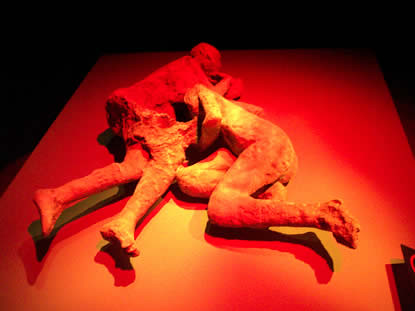
If I am to preserve Lily, I must decide how. At the Museum there was a replica of some corpses from Pompeii, but that’s far too violent a death. There was a mummy too, but that’s artificial – although the natron is a possibility. [Natron is a mixture of sodium bicarbonate and sodium chloride mined by the Egyptians in the Natron Valley. Just as salt sucks red wine from carpets, natron sucks juices from corpses.]


I need something slow and painless. I’m thinking of having her explore a cave system. After falling asleep, she could be gently gassed by some venting of the Earth, some mysterious Gaian afflatus, or else drugged by a dripping mineral opiate.

Then the processes of nature would set to work. Recognising the unique beauty of her spirit, the Earth will opt not to putrefy her, but to preserve her - with moss, limestone, lichen, rust and roots. Or might she be bitten by a snake or a gold and turquoise spider with preservative for venom?

There are a lot of factual options for preservation. Certain soil conditions can be responsible. Aridity. Ice. The twelfth Pandito Hambo Lama achieved preservation through ‘a form of meditation known as shunyata, or emptiness’, [Fortean Times #184], ‘coupled with prolonged starvation and slow self-suffocation using a special belt that connects the neck with the knees in a lotus position’ [Wikipedia]

Doctor Glob’s ‘The Bog People’ is a book dear to my heart. It deals with the marvellously preserved corpses found in European peat bogs. ’There is a strange power in bog water,’ it is said, ‘which prevents decay’.

Perhaps some of the chemical processes may be useful, but not the violence. A lot of these Iron Age preservations were human sacrifices found with garrottes about their necks.


Nowadays we have cryogenics, formalin and Gunther von Hagens' ‘s plastination technique, but perhaps there are natural analogues. My fictional island is rich in minerals, after all …

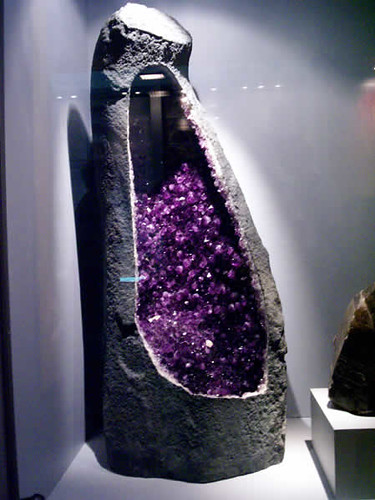
The most intriguing thing I encountered at the museum was this:


Lynne made the connection. Somehow, she has always been able to track the way my mind wanders. I could easily imagine Lily encased in something like this formation of amethyst, flesh transmuted into gemstone, like something from the pages of Ballard’s The Crystal World.

Stumble Upon Toolbar DiggIt!

Thursday, January 17, 2008

~ the lake monster of fagua

From a pamphlet distributed in pre-revolutionary Paris:


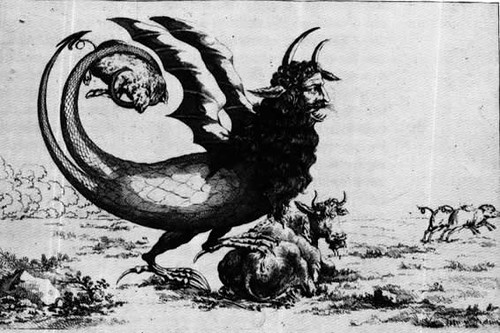
This creature was found in the kingdom of Santa Fe, Peru, in the province of Chili and in the lake of Fagua

It emerged during the night to devour the swine, bulls and cows of the area. Its length is eleven feet; its face is roughly that of a man; its mouth is as wide as its face. It has the horns of a bull and teeth two inches long. Its hair reaches to the ground. It has the ears of an ass, bat-like wings and two tails, one flexible enough to seize prey, the other ending in a dart which helps it kill. Its entire body is covered with scales.

It was netted and brought alive to the viceroy, who each day nourished it with a steer, a cow and three or four swine, [to which it is quite partial].

The viceroy has sent orders along the entire land route to provide for the needs of this unique monster while making it march by stages to the Gulf of Honduras, where it will embark for Havana. From there to the Bermudas, to the Azores. and in three weeks it will disembark at Cadiz. From Cadiz it will be taken by short trips to the royal family.

It is hoped that a female will also be captured so that the species will not die out in Europe. The species seems to be that of harpies, heretofore considered legendary.

*

At present, I’m reading an historical thesis called ‘Mesmerism and the End of the Enlightenment in France’ by Robert Darnton. It tracks the decade immediately prior to the French Revolution, during which science assumed an immense popular appeal.

The citizenry marveled at the flights of hot air balloons and the extraordinary properties of electricity and magnetism. It seemed that the universe was underwrit by all manner of invisible forces and materials.

Science was big news. But the science of that day was a far cry from what it is now. Even the most distinguished thinkers, like Newton, Harvey and Buffon, remained entangled with alchemy and astrology. Beliefs in such things as ‘vegetative forces’, ‘universal mechanisms’ and ‘igneous atoms’ were par for the course – and sat comfortably alongside a fascination for the newly discovered gases: Fixed Air [carbon dioxide], Phlogistinated or Inflammable Air [hydrogen] and Dephlogistinated or Vital Air [oxygen].

Science seemed like magic and vice versa. Paris attracted all manner of mountebanks and charlatans, ready to profit from its popularity. There were water witchers [dowsers], electric eels that cured gout, elastic shoes for walking on water, perpetual motion machines and methods for breathing and traveling underground …

The chimera described above is a product of a time when anything seemed possible. The concept of sexual generation was debated in fantastic style by ‘ovists, animalculists, preformationists and panspermatists’. For a week, the monster was the talk of Paris. The Courier described it as ‘a beautiful opportunity… for the naturalists of the old and new worlds.’ These are sober words, given the prevailing atmosphere, and the widespread belief that Frederick II ‘had produced centaurs and satyrs by experiments with sodomy’.

Mesmerism – the brainchild of the charismatic German Franz Anton Mesmer – fell roughly midway between respected science and utter chicanery. It held that an unseen ‘superfine fluid penetrated and surrounded all bodies’ and was the medium of gravity, heat, light electricity and magnetism. ‘Sickness resulted from an ‘obstacle’ to the flow of fluid through the body, which was analogous to a magnet’. By mesmerising [massaging] the body’s ‘poles’ a crisis was induced – often involving convulsive fits and fainting spells. Thus the obstacle was overcome and natural harmony restored

Mersmerism became a craze, particularly among the upper classes, who flocked to salons where they would connect themselves to a mesmeric tub which emanated ‘fluid’ via ropes and iron rods. Often, by holding hands and presumably massaging each other’s ‘poles’, they would form ‘mesmeric chains’ in order to focus and amplify the healing energies of the universal agent.

Expressions such as ‘mesmerising’ and ‘animal magnetism’ are an echo of how enthusiastically Mesmerism was embraced at the time.

Stumble Upon Toolbar DiggIt!