Circumstances have forced me back into that most cruel of tasks: selling books on Ebay. I have reassumed the identity of ‘Lampsucker’ and am diligently slaving away, as I expect to be for at least the next year.
While burrowing through my stock the other day, I found the egg sack of a spider attached to an Isabel Allende biography. Though it was slightly torn, it seemed quite full, so I investigated further, to find it was filled with tiny spherical eggs of a light green colour.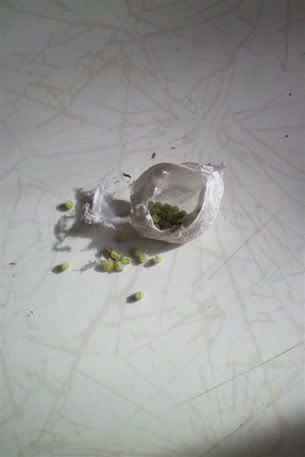
The eggs seemed to have crystallised. If you crush a crystal of sugar under the end of a spoon you are left with the same type of powder residue I was left with when I crushed one of these eggs. Only pale green instead of white.
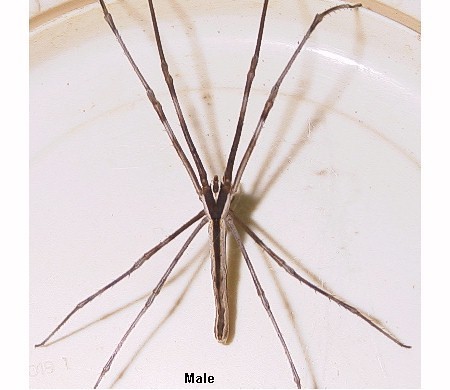
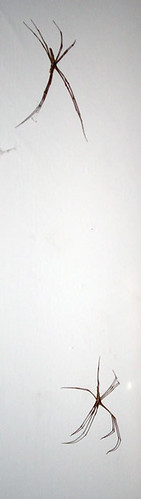
I’m pretty certain the sac was the work of a huntsman of the holconia group – the species which most commonly inhabits houses here in Melbourne. They produce ‘a flat, oval egg sac of white papery silk, and lay up to 200 eggs’. Well there were about fifty eggs in this one, but otherwise it fits the facts. Also the ‘spiderlings are pale brown or green in colour’, so perhaps this was one of the green batches.
I was also surprised to learn that huntsmen have lifespans of about two years.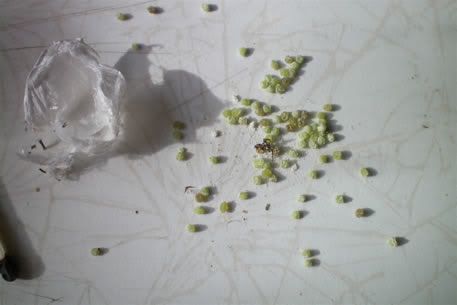
The other possibility was the dreaded white-tail (Lampona cylindrata or Lampona murina). Its saccing habits were described thus: ‘they make temporary silk retreats and spin disc-shaped egg sacs which contain as many as 90 eggs’. I saw no evidence of a silk retreat and there was nothing particularly disc-like about the sac
But I did learn something interesting.
My wife hates white-tails with a passion and is always checking Polly’s sheets for them. (They like clean linen.) Her mother, Di, was bitten once and reacted very badly, perhaps experiencing the necrosis that their bites are said to cause. I have spoken to a woman who claimed a white-tail bite caused her to lose two years of her life in the mists of chronic fatigue syndrome. Without really thinking about it, feeble sceptic that I am, I was quite prepared to believe that these spider bites could cause seeping wounds that never heal – a condition named "necrotising arachnidism". (“Occasionally, the reaction is so severe that the person loses large amounts of skin and needs extensive skin grafts.”)
It appears this is something of an urban myth or at least a vast exaggeration.
I myself first heard of white-tails around the time my wife moved in, around 2000, and it surprised me that I’d been ignorant of such a seemingly perilous threat. And apparently it has only been since the 1980s that reports of severe skin lesions have been reported.
Here are a few random quotes from the web:
A recent study has monitored the medical outcomes of over 100 verified White-tailed Spider bites and found not a single case of ulceration (confirming the results of an earlier study). www.austmus.gov.au
The University of Adelaide’s Clinical Toxinology Resources (www.toxinology.com) have an excellent run down of the venoms of all sorts of Aussie fauna and their effects. The entry on white-tails says that necrosis “does not occur, based on current clinical evidence”. bencruachan.org
Bites from these spiders have been reported to cause necrosis (decomposition of the skin). This has only been verified in 14 spider bites over the past 10 years, and none of the victims could confirm the type of spider responsible. This reaction is considered to be rare. However, bacteria on the fangs of the spiders may cause severe infection or other allergic reactions.
I’m getting the feeling that the white tail thing has been blown out of proportion. In their favour, they’re an arachnovore, hunting other spiders (like red-backs and daddy-long-legs) for food.
*
If you’ve stayed with me this long, you might be interested to know that there’s been some movement on the Save Sam’s Neck effort, coming principally from my guru to the north, Steve Kilbey. I was thinking about arranging a theatrical-style benefit, that being the scene I move in these days, but Steve’s suggested, and offered to be part of, a musical benefit.
It’s early days yet, but it will probably be in August and legendary promoter Dolores San Miguel has offered a hand. Also, unless the sky falls in, The Ears will be doing a reformation.
I’ll leave you with this still by Marc Morel from The Goitre Birds, performed at Snatches a little over a week ago.