Pages

Showing posts with label WILLIAM BURROUGHS. Show all posts

Wednesday, December 24, 2008

~ decompositions of the season

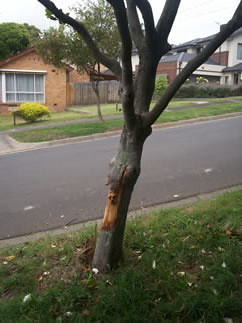
THEYesterday a small car ploughed into the venerable magnolia tree on our nature strip. My wife arrived home from a free solarium treatment, (shared in its entirety with a fluttering moth) to find the car abandoned, two vacant child restraints and the neighbours milling about. Someone called the police, who were at a loss as to how a vehicle could have generated the necessary speed to destroy itself so thoroughly, coming up a steep hill on a perfectly straight, short and narrow suburban street ... A momentary suicidal urge, perhaps?


A lady from Somalia was found at her house around the corner, presumably in shock. The magnolia tree is noticeably canted and almost ring-barked. It’s been there as long as I have, the poor thing, I have seen it flower every year of my life, and to be struck like that ... out of the blue ...


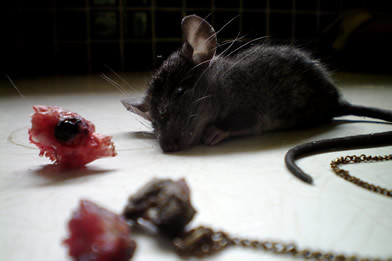
Greyish Blackish seems to have caught her first mouse - though it may previously have been partially incapacitated by Tweety Bird, the Jack Ketch of the household. GB is a very sweet natured cat and appeared unaware that the object of the exercise was to kill.

The mouse in the image below is accompanied by a item of biological refuse discovered by my wife in the shower. Tweety Bird seems to have have chewed off the outer coating of something’s head and left the remains as her customary matutinal gift.


(Just now, as I was writing, my wife called me to see this morning’s offering: another bio-hazard on the shower floor, this one resembling a grub-shaped grey-green kidney. Can’t find the camera ...)

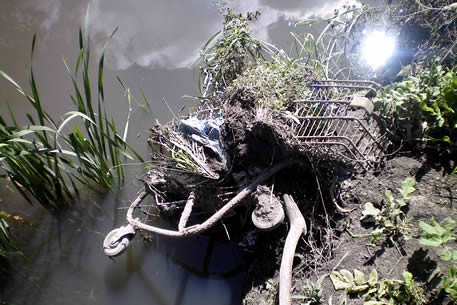
Recent rains have eroded the banks of the Grey Creek, revealing an item of archaeological curiosity. This shopping trolley was surely buried long ago, possibly during earthworks associated with the laying down of the abutting Monash freeway. It might have sedately decomposed down the aeons, but no, the elements have thrust its ghastly corroded form back into the light, to further pollute the habitat of Immaculata, that pure white duck.


I’ll let you know how the supermarket responds, when I report the trolley for collection.

And by the way: the best wishes of this dread season to you all. Thanks for reading, [and commenting upon,] my meandering, probably perplexing diary. I hope you all get as focused and happy and prolific in this next year as I am determined to be. Sorry, as usual, for the unpredictable timing of my posts.Usually, it's concomitant with my state of mind. [William Burroughs despised the word concomitant.) When the the posts dry up, I am either in a slough of despond or so obsessively busy with my life that I can’t pause to reflect ... Anyway ...

I hope you get something really good for Christmas. May the wind fill your sails.

Stumble Upon Toolbar DiggIt!

Sunday, April 6, 2008

~ the curing

On Sunday at Camberwell Market, feeling wretched and foolish, I lost a beautiful facsimile edition of Poe’s Tales. Just mislaid it. As I do so often with so many things. Twice I’ve left my phone on the roof of my car. I’ve left my coffee there at least… on a googolplex of occasions. Like my mother – even in her non-declining years – I put inappropriate things in the fridge: TV remotes, laundry powder, money, bills, scissors, face cream, turpentine … I could never remember all the things I forget.

Is it dementia? My mother exhibited signs before she died at the age of seventy-two, but she’d been putting shoe-polish in the Frigidaire even when I was small. I haven’t started doing crosswords yet, trusting that my line of work provides sufficient neural exercise. I just hope that my chronic absent-mindedness is not a symptom of something dreadful on the horizon.

I was at Camberwell Market, wasn’t I? Losing things … Becoming disheartened … After all, I was there to make money, to find books to hawk on ebay, not to leave lying about. Because of the daylight savings shift, I arrived early and didn’t have a good morning. Stall-holders were still hoping for the prices they’d imagined.

For me it’s best to go after I’ve metabolised my Spasmo-Nemigron, after my system has normalised. Then I can enjoy the process.

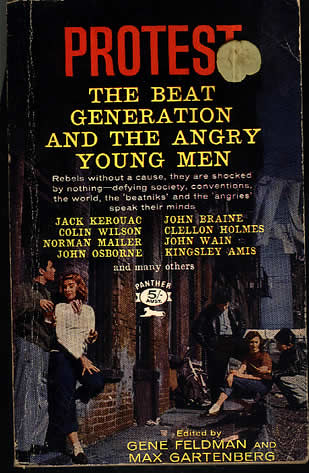
I found one particularly interesting thing: an old paperback in good condition called ‘Protest: the Beat generation & The Angry Young Men”. These were ‘rebels without a cause, they are shocked by nothing – defying society, conventions, the world, the ‘beatniks’ and the ‘Angries’ speak their minds’.


A bit iffy, comparing these two movements. The Beats were something wild and new, the Angry Young Men were comparatively polite and, well, British. Colin Wilson was the only truly interesting one, and mainly because of his marvellous erudition and his ability to present his subversive ideas in a manner that didn’t too badly offend public decorum. He was not tearing at the very fabric of society as the Beats most assuredly were. The other ‘Angries’ – John Braine, John Osborne, Kingsley Amis, J P Donleavy – were distinguished writers, but we certainly don’t associate them with literary revolution. Indeed they appear starchy and wan compared to Burroughs, Ginsberg and Kerouac, who were the principal Beat contributors.

The book was published in 1960, early enough for William S Burrough’s contribution to still fall under his original nom de plume ‘William Lee’:

A scion of one of America’s most illustrious families, he has not transgressed against established law because of poverty or lack of personal opportunity … Yet ‘by his own description, the author is a drug addict, thief, pusher and pimp.

What follows is an except from his first novel ‘Junkie’, [later to be retitled ‘Junky’]. It’s been ages since I last read it and I encountered a short passage that piqued my curiosity …

“To me, teaheads are unfathomable.

“There are a lot of trade secrets in the tea business, and teaheads guard these trade secrets with imbecilic slyness. For example, tea must be cured, or it is green and rasps the throat. But ask a teahead how to cure weed and he will give you a sly, stupid look and come-on with some doubletalk. Perhaps weed does affect the brain with constant use, or maybe teaheads are naturally silly.

“The tea I had was green, so I put it in a double boiler and set the boiler in the oven until the tea got the greenish-brown look it should have. This is the secret of curing tea, or at least one way to do it.”

I’ve also noticed a certain mythology associated with the curing of pot. It is always spoken of vaguely; one can never get clear answers, yet some will claim it is of critical importance - but as far as I have been able to judge all that is necessary is to let the vegetable matter dry slowly and naturally in a well ventilated room. Upside-down is good, as the leaves dry to form a natural protective sheath for the delicate heads. Various subtle techniques can be employed during the drying, but in the end they make little or no difference, [although practices like ‘sweat-curing’ can help speed things up].

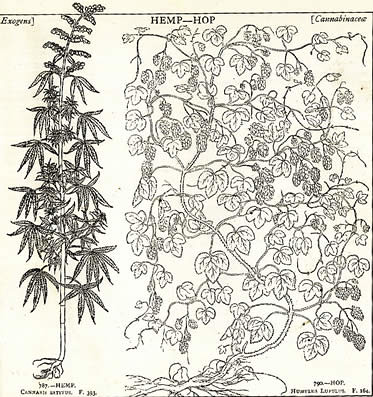
So That’s all there is to it. No great secret. Curing is more or less a synonym for drying. People also speak of immersing the root ball in a sugar solution, but that’s just piffle on a level with the very tempting myth that hops, a near relative of cannabis, can be grafted onto cannabis rootstock and made to produce THC – so creating the appearance of a perfectly innocent, legal crop.


During WW2 the US Government attempted to create a ‘cannabis strain that would yield a superior quality fibre … that would tie up ships without turning on the troops’*. A man named H E Warmke was front-man for the project, which also unearthed a useful means of producing polyploid plants by soaking seeds in colchicine [the toxic derivative of a beautiful flower bulb]. It was Warmke who claimed that hop flowers grown from cannabis roots contained equal levels of THC to standard weed.

A pipe dream, if ever I heard one

* From The Connoisseur’s Handbook of Marijuana

Stumble Upon Toolbar DiggIt!

Monday, February 11, 2008

~ the pharmacopoeia of imaginary drugs #1

After recounting the fantastic properties of Green Rapture in the previous post, I began to realise just how vast and wonderful a pharmacopeia of imaginary drugs has been described by the fantasists of this Earth.

Of course, there are lists. There are lists of everything on the internet. This time I think I’d like to do my own.

As is to be expected, most fictional drugs are merely elaborations u
pon drugs with which we are already familiar. Consider nuke in Robocop – it’s just future coke with a snappy name. Or omegendorph in Kim Stanley Robinson’s Martian series – the ultimate opiate engineered out of a comprehensive knowledge of human endorphins. Outland [the movie starring Sean Connery] featured a drug called polydichloric euthimal - a ravening giga-amphetamine, like tetrameth in Richard Morgan’s Altered Carbon. Malajusted Alex and his droogs. from the classic A Clockwork Orange, visit Milk Bars for Drencrom or Synthemesc ‘to sharpen the senses for the old ultra violence’. And longbottom leaf? Well, that was just pot, wasn’t it?

And Slurm, from the planet Wormulon? It was just Coke, wasn't it?

My play Lord of Misrule was premised upon the exudate of an illicit fungus, [similar to kom-bu-cha], which was socially and in physical effect directly analogous to heroin, but possessed of its own intelligence. And whether it’s the extract of a giant centipede, bug powder or the cerebro-spinal fluid of the mugwamp, all of William Burroughs’ marvellous addictive chemicals are essentially heroin, or facets thereof.

Remember this? ‘Hank’s on junk; he doesn’t come. I’m on bug powder; I don’t need to come.’

But beyond the simple metaphors, there are a host of imaginary drugs with truly novel effects.

Philip K Dick was responsible for some of the best. Can-D and Chew-Z feature in The Three Stigmata of Palmer Eldritch. Chew-Z, the instrument of a sinister alien power, allows the user to leave his body and spend an indefinite period of time in the environment of his choice – returning to find no real time has passed. [I used to fantasise about this one as a teenager.] After consuming Can-D one enters what was called a ‘Perky Pat Layout’ – this commercially acquired tableau resembled a doll’s house occupied by a scaled-down cast of The Bold and The Beautiful. Martian colonists, living in hellish conditions, spent all the time they could immersed in the normality [and hypersexuality] of Perky Pat’s virtual world.

In Dick’s Now Wait For Last Year, JJ-180 is in effect a time-travel agent, allowing the consciousness of the user to navigate in either direction through time, settling in whatever era takes his whim for the duration of the trip. We can Remember It For You Wholesale, [filmed as Total Recall], includes the hypnotic narkidrine, used to install false memories in the human brain.

Time travel drugs crop up repeatedly in fantastic literature. In a tale from 1964, Doris Pitkin Buck describes the use of Protoceratops Tabs, which transport the mind back through time into the dim consciousness of a saurian in the Mesozoic Era.

Then there are drugs with grosser effects. Like Pallidine in Thomas Disch’s Camp Concentration. Derived from syphilis spirochetes, it boosts intelligence and turns users into short-term supermen, who eventually succumb to disease. Herogyn from Norman Spinrad’s Men in The Jungle is similar. The protagonist/dictator employs it to fan his troops into a frenzy before action. Battle drugs are a category in themselves, and not all of them are imaginary.

Probably the most well-known of all science-fiction drugs is Spice, or Melange - the cinnamon-like secretion of the great sand worms of Dune. In Frank Herbert’s universe it is as valuable as gold and its addicts have ‘blue within blue’ eyes.

But the effects are hard to put a finger on - even after reading most of the series. Largely, it’s almost a shamanic, entheogenic thing. One may see into the future, the past. If you are Muad’Dib you can prophesy. If you are a Space Guild Navigator you can ‘fold space’. Spice increases the lifespan, raises awareness and general vitality. Since it is largely a metaphor for oil, the political effects tend to be more interesting than the physical. Dune also mentions sapho juice, used by mentats to multiply their cerebral processing power, and colouring their lips with a distinctive cranberry stain.

During the sixties, with the advent of psychedelia, many forward-thinking writers began to imagine drugs that went beyond the effects of the known hallucinogens. Another book by Herbert - actually my favourite of his - is The Santaroga Barrier. In an isolated village, somewhere in America, the residents all consume a substance named Jaspers which is mined from the surrounding countryside [rather like The Stuff]. They form an uncommonly well-balanced society, but it is their immunity to marketing of all kinds that leads to their notice by the outside world. An investigator discovers that Jaspers has united them on a subconscious level, and that they have developed a highly-evolved understanding of the world and its underpinnings.

In Robert Silverberg’s A Time of Changes (1971) a drug acquired from a native culture on an alien world proves to have telepathic qualities and ultimately transforms an uptight society into a caring sharing near-utopia. Another drug, in R A Lafferty’s story Skyprovide sensations of mastery and union-with-cosmos’, but ‘especially during parachute drops’. Deaths occur when users try freefall for the ultimate high. The far more recent novel ‘Vurt’ by Jeff Noon describes an England in which the habit of sucking variously coloured Vurt Feathers is widespread. To put it simply, Vurt allows users to descend communally into the shared unconscious of humanity, investing our dreams with a certain objective reality.

[This article continues here]

Stumble Upon Toolbar DiggIt!

Saturday, February 2, 2008

~ hark! a fusty old cupboard moth!

In the latest episode of Counterpoint on ABC radio there is an extraordinary interview with a sententious old arch-conservative named Theodore Dalrymple, [a nom de plume. His real name is Anthony Daniels]. He is interviewed by global-warming sceptic and ‘right-wing Phillip Adams’ Michael Duffy on a programme that sprang from the Howard government’s push to dilute the perceived leftist culture of the ABC. Dalrymple himself is aligned with the Manhattan Institute, a US conservative think tank, and his ideas are frighteningly atavistic.

For fourteen years, he has been treating addicts in British prison hospitals and feels the need to speak out regarding certain myths which he believes are misleading public policy on drug treatment.

In his book, Romancing Opiates, he argues that opiate withdrawal is neither severe nor dangerous and ‘not much worse than the flu in a healthy person’. He claims to have seen long term addicts stop using with ‘no adverse effects whatsoever’.

I must admit, from personal experience, that the fear of physical withdrawal has sometimes been worse than the experience itself. Nevertheless, the night sweats, the horrific dreams, the bone aches and muscle cramps, the misery, the whole body discomfort, the crawling skin and mind-fucking restiveness add up to something a considerably worse than your average flu. And from what I have heard of others’ experiences, I can count myself lucky.

I get the feeling that Dr Dalrymple has been taking blood pressure, checking body temperature and a few other gross physical indicators, then using these to understate and oversimplify the condition. However, I do agree with his contention that the physiological aspect of withdrawal tends to be overstated in popular literature.

When asked where these exaggerated ideas about addiction and withdrawal came from, he moves into a scathing attack on heroin-related literature. ‘Self-serving liars’ DeQuincey and Coleridge began a trend that has continued without pause ever since. William Burroughs [a ‘psychopath’ and ‘obviously a bad man from the beginning’] is singled out. We hear of films like The Man With The Golden Arm and more recently Trainspotting.

I have no difficulties with the claim that certain works of art attract people to drug use. How can I disagree? I am one of those people myself. I have seen many people acting out their romantic fantasies in heroin addiction [again, myself included]. I have even heard many people claiming to be addicts who weren’t. I suppose it is one way of getting a life, of defining yourself - as something dark, forbidden and dangerous.

But to generalise the function of art and creativity, as he does, is weasel work. Drugs have historically played a part in artistic creation, contributing to some of the greatest works of the human imagination. In much the same way as they are used in Shamanic religions, drugs have inspired and guided certain artists and thinkers. Creative types are far more likely to experience manic depression and other ‘personality disorders’, art can be their expression and their release and our benefit. The use of drugs and the description of drug use by arts contributes to a very complex social equation which cannot be effortlessly explained away in a slow reasoned tone by the fusty old Mr Dalrymple.

As regards the question of how heroin withdrawal, [and addiction generally], became so exaggerated and feared – I would answer it rather differently. Throughout the twentieth century, manipulation of the drug issue was systematically used by politicians and other leaders in the USA to stimulate fear in the community. Again and again it was evoked to distract voters from embarrassing scandals, to paint candidates as uncompromising, and to prepare the public for more draconian control. It has even been selected as an issue by politicians who had nothing else with which to characterise their campaigns. Because drugs were railed against repeatedly down the decades, the effect became cumulative. Heroin entered the mass subconscious as a ravening demon. Parents became terrified for their children. The meme became self-sustaining throughout the world – and an element of it was the nightmare of withdrawal. Certainly, the popular arts play their part – but the buck really stops in the corridors of power.

After evoking Quincy and Coleridge, Dalrymple speaks of how the overwhelming majority of addicts are from the undereducated lower class. There are problems with this contention because it’s really an assumption. Nobody knows the figures. Poorer addicts are the most visible addicts; richer addicts can hide their usage. But how many of this underclass [or the general population for that matter] have read or even heard of Coleridge or Burroughs? There is not much awareness of the classics out there. How else could a bed sold for little girls at Woolworth’s in the US have been branded a ‘Lolita’? If they are influenced, it is by very different media in which the idea of drug-related illumination of the mind and spirit is absent.

Though not everything he says is rubbish, it is all painted with a tone of condescension. He makes the point that people from desperate circumstances often turn to addiction as a way of filling their lives, and indeed ‘the life of an addict is full of incident…. In a sense it imposes regime and routine; they like it, dismal as it is.’ Well, as they say, children crave structure. I think Mr Dalrymple should think further on this point; youths in desperate circumstances are not just being drama queens in taking heroin, sometimes it offers some sweet respite from an unendurable reality.

Heroin does of course impose a routine. With an iron fist. ‘The Algebra of Need', as Burroughs would put it. [‘Burroughs was a criminal long before he became a Junkie’.]

Not that I’m advocating this, but Mao Tse Tung was the greatest therapist in the history of drug treatment because he threatened to shoot people if they didn’t give up – and lo and behold twenty million people did give up.

Dalrymple goes on to say that this wouldn’t work with, say, bowel cancer; seeming to think this proves that addiction is a choice, not a disease.

Because addiction to a large degree is rooted in the workings of the mind, it is not disqualified as a disease. You cannot divorce the body from the head. A lot of very complex changes occur in the brain of an addict, physical changes which researchers are only beginning to understand. Dalrymple, the old cupboard moth, is attempting to turn back the tide on our evolving comprehension of a very complicated condition. He views are deeply right-wing, immediately appealing to the conservative thinker. It is the addict’s fault. He can stop if he wants. He chooses to commit crimes. And elite arty-farty types are responsible for all our misconceptions ….

I’m not wholly against rehabilitation, as long as it’s understood it’s not a medical procedure. As long as you don’t treat it as an illness.’ He suggests some form of ‘asylum’ in which the recovering addict can build up their lives again after the wasted years. Again, he shuns the idea of addiction as a disease – a concept that our best informed practitioners have spent decades working to illuminate in the public eye, and to include in social policy.

He coughs up a number of other hot potatoes. He claims ‘the inclination to criminality causes addiction, not the other way round.’ He has learnt from prisoners in jails that the vast majority of addicts were criminals long before they turned to heroin. [He did not say anything about whether it was in jail that they began taking it.]

He tells us it is a myth that drugs are filling our prisons. I’m no expert on this, but I feel strongly about legalisation, and I’ve known plenty of otherwise law-abiding people who have broken the law to feed their habits. I couldn’t begin to count the number of girls [and boys] I’ve seen use prostitution for the same reason.

My instinct here is that his contention is wrong, but again laced with fragments of truth. I also resist, even resent, his using the words addict and criminal in the same breath. There are bad thieving junkies in this world, and it’s sensible to beware of them. But there are those who would never in a million years commit a crime against person or property just for a fix.

Dalrymple is petrified in a previous age where mind and body were disassociated. He cannot abide the fact that addiction is holistic. It is true that the mind is a very prominent component, but that does not disqualify it from medical attention - it merely makes it harder to understand and treat. It is also a social disease, channelled and fuelled by inappropriate laws and attitudes, which the opinions of Dr Dalrymple can only serve to exacerbate.

God forbid this is the leading edge of current conservative thinking!

Stumble Upon Toolbar DiggIt!

Monday, January 21, 2008

* 25 March 1981 thurs 2.30pm

I’m Sam Sejavka. I’m a writer and a singer. I’m twenty years old, but in one week’s time I’ll be twenty-one. Allow me to briefly describe my life up to this point.

Half way through my HSC year at St Kevin’s College, I left home and school and took a flat in St Kilda. I was seventeen. Shortly after that, suffering from nervous tension, I spent some weeks in a private psychiatric hospital. Though I never returned to school, I did sit my exams and managed to do pretty well, particularly in English.

I lived a reckless life in St Kilda, spending time with the basest of the creatures who abide there. I wrote all this time, though the results were dubious. I was young and over-stimulated by my new found freedom. I was seeing a girl called Irene, but broke up with her around the turn of the year …

I was evicted for general rowdiness and spent a week or so wandering in St Kilda, staying at hotels. I was undergoing another personality crisis, but this time it was not quite as severe.

I took up a new flat in Armadale and attended university, which I loathed. After two or three months I left, again undergoing a kind of crisis. I had done not a skerrick of work in this time. I found myself completely uninspired.

I moved to Sydney, found a flat in Kings Cross and wrote. I viewed myself as something like the protagonist from Orwell’s Down and Out in Paris and London - but under a shadow of inexperience and pretension the work I did was pretty well unreadable. [Woe the day I first read William Burroughs]

I made no friends there. I never went out. I became a lonely bum, trying to live his twisted idea of a dream. I must say though that I was brave. I’ve never had quite the same attitude to food since I found myself starving up in Sydney. At times I would go to a nearby homeless shelter to partake of the disgusting food they served there.

Eventually, I could stand it no longer and returned to Melbourne. I rented a house with George in Richmond and lived there six months, leading a wasteful sort of life. We had trouble with hoodlums in that place and left suddenly with the house in a wreck. Though I pined for female company, George and I enjoyed ourselves concocting and realising all manner of eccentric schemes.

I left for a new flat in Armadale. I was determined to write as diligently as I could - and I did for while, but it was forced, meaningless stuff.

Inspired by William Burroughs, and much to alarm of my parents, I joined The Church of Scientology Though my involvement was pretty marginal, [probably because I had no money,] it still remains omne of the stupidest things I’ve ever done.

In September, for five days, I camped out for David Bowie tickets. This was to be a turning point. I was introduced to heroin and LSD, though I’d had my fair share of other drugs previously. I made many friends and by the time of the next queue – this time for actual seating – I could almost have been described as gregarious. I spent those three weeks stoned in as many ways as it is possible to be. This is where the idea of the band was born.

The night of the concert, my basement flat flooded and I could no longer live there [I’d forgotten to turn on the pump]. I moved home and around the turn of the year, The Ears began to practise. In January 1979, I went to a science-fiction writer’s workshop in Sydney where, among others, I met George Turner and a young Lucy Sussex.

I moved into a house with Mick Lewis and Tim McLaughlan [keyboards] and The Ears developed. We played for the first time in February. I returned to Melbourne Uni and could stand it this time only because I found a girl, Elise Valmorbida, with whom I fell madly in love. But I was far too immature to make something like that work and the relationship had decayed to nothing by the end of the year.

The group was playing regularly now. I rented another flat in Armadale, where I decided to once more quit university. Soon after, I moved to a house in Richmond with Mick and Richard Lowenstein. I was a night bird, going out as much as possible and living a life of debauchery. They were the days of the Champion Hotel. The end of the year came and I had frittered it agreeably away. It was 1980, I was nineteen. I was in a group and things were fine in a twisted sort of way.

I stayed in Richmond till March, then moved to Elwood, to the flat where I began this diary. I turned twenty. Our first single was released. I pursued girls. We got a manager, then a different manager. I went to parties. And in August I met Christine.

There followed the most rewarding period of my life thus far. I was not prolific, I was not together, I was just unreasonably happy. We slept together almost every night. I was totally, without qualification, in love. And love was what was most important.

Soon after I met Christine, my father died. But that just healed with time. Then on the twentieth of March, Christine overdosed.

And now it’s the twenty fifth of March; I’m sitting out the front of Milton St, watching some placid old people mulling over the detritus of their lives. Mine is a pain equalled only by the pleasure that it echoes.


*

As you can imagine, this was a hellish period for me. I was wracked with grief and life seemed drained of all value – so forgive me if the above entry has a rather sententious tone.

It was interesting to read though. A lot of memories sparked. A lot of things forgotten.

After Christine’s death I woke in Troy’s flat next door with no memory whatsoever of the night before. It was barely daylight. I had a terrible sense of impending doom, but my mind was too foggy to work out why. I found my way to the front door; I could see Peter Walsh walking up the path from the back yard where he’d lain unconscious all night. He looked like a zombie. I caught his eye, but there was no reaction. I tried to open the door, but it was locked. I couldn’t think how to open it. I made my way back to the bed and again fell unconscious.

I awoke several hours later in full realisation that something had gone terribly wrong. I looked around frantically and saw Craig McGee in the doorway. Where’s Christine, I asked? She’s dead, he said.

Craig took me to his and Laura’s house, where I slept on the floor for a few days, before going home to my mother’s and doing the same for a fortnight. The heroin, fresh from Thailand, had been unreasonably strong and I took a long time recovering. I’ll never forget that pain and desolation. The last image I had of Christine was slapping her face, trying to wake her. It was just a flash in my memory of that night

To make matters worse, not long after, I began to receive a certain amount of police harassment. This was due to Christine’s father being the head of the police union, and her brother a member. In reflection, it was bound to happen. A fellow named Colin, a keyboard player who I think once burnt down someone’s garage, had been round to Milton St. The police had stopped him, hassled him severely. He said he had the strong impression that they were looking for someone with bright red hair, but not him. [I had bright red hair]. Then, after a gig at the Crystal Ballroom, a couple of cops pulled me into a corner and threatened to kill me if they heard of my further involvement with drugs. I wish I’d taken them more seriously.

Christine’s father, though, was understanding. He called me to the Harding family home and talked to me, not with anger but compassion. The family was less understanding towards the hapless Craig Elrick, who was a reckless spirit, doomed to forever get himself and others into strife …

Stumble Upon Toolbar DiggIt!