Pages

Showing posts with label SCEPTICISM. Show all posts

Tuesday, April 27, 2010

~ trypanophobia & the anti-vax fools


Why do we believe things despite a lack of evidence - or even in the face of overwhelming proof that we are wrong? Because it suits us to, I think, more or less.

What other reason can there be, down at the bone?

Are we too proud to admit we’re wrong? Too scared to break with our peer group? Or we’re paranoid? We’re making money? We like the idea of certain things being true because they fit with the kind of universe we’d like to live in? Or they feel right? Or they issue from the mouth of someone we admire? Or whom we respect? Or whom we find beautiful?

Generally, it all comes down to the same thing: if we break with evidence, we can, unlike scientists, believe whatever the hell we like. Unless, I suppose, we’re ignorant or mentally incapable of understanding the meaning and the implications of scientific proof.

So what lies behind the choice so many parents make to deny their children vaccination? Why have they chosen to believe that the MMR vaccine causes autism, despite there being not a skerrick of proof?

The luxury of resting ones child’s health on the back of an urban myth is allowed only by the vaccination of other children. And as such it is profoundly decadent. If these parents had lived through the heyday of smallpox or polio, their position would have been untenable - but the horror of those days has apparently been forgotten.

And if the vast majority of today’s children were not vaccinated and there was no establishment of ‘herd immunity’ then epidemics of debilitating often fatal diseases would sweep the country. There would be the same amount of autism but a whole lot more measles, mumps, rubella, chickenpox, tuberculosis and pertussis.

The anti-vax canard is already causing deaths. There have been outbreaks in new age havens like Byron Bay. A four month old baby has died from pertussis because of low vaccination rates. She was depending on herd immunity to protect her until she was old enough to be vaccinated, as are those who are immunologically compromised and cannot withstand a vaccine.

But, again, why choose to fly in the face of established evidence?

I’ve been wondering if it might come down to trypanophobia? (That would be the fear of needles, by the way) I wonder if Jenny McCarthy’s ‘mommy instincts’ were actually roused by the sight of cold steel not only penetrating her child’s pure flesh but pumping arcane scientific fluids into its system? To a parent’s eye it is indeed an apparent violation.

It’s not an insignificant phobia. 10% of us have it. And to quote Wikipedia “thousands of years ago humans who meticulously avoided stab wounds and other incidences of pierced flesh would have a greater chance of survival.” It takes a solid trust in medicine & science to shuck instinct and submit one’s child to such an experience, but at least it is a trust based in good solid evidence - not in quack doctors, net paranoids, and loopy new age energumens.

I think some parents simply choose not to yield their child to the medicated barb. The screaming of the babe trumps any amount of figures and statistics. But when mountebanks like Dr Wakefield give them sets of figures they can happily agree with, they seize on them, and so the thing grows.

However, there is a new delivery mechanism in the chute: a dermal 'nanopatch'
developed by Professor Mark Kendle, from Queensland University's Institute of Bioengineering and Nanotechnology. The patch promises to deliver vaccines far more effectively than the needle and with only a few minutes wear.

If this idea comes to fruition, I wouldn’t be surprised if it pulls the rug out from beneath the anti-vax movement. With the needle gone, there will be no critical emotional response holding up the whole insane edifice, and the nasty business might just crumble away.

People might then realise it was all just a very complicated way for selfish, cowardly parents to avoid having a doctor pierce the skin of their screaming child - for its own good and the absolute good of us all.

(PS. Sadly, I’ve just heard an ad for Channel 10’s 7pm program: To vaccinate or not to vaccinate? I hope to goodness the dangerous nutjobs aren’t getting equal time with the scientists again.)

(PPS. I just realised that I might have called this post 'The Needle And The Damage Done'.)

Stumble Upon Toolbar DiggIt!

Thursday, September 3, 2009

~ knowledgeporn

These days, as I may have previously mentioned, I cannot imagine getting into bed of a night (or an afternoon) without my ipod and the growing store of utterly fascinating wisdom contained within. Constantly, I am discovering new podcasts by brilliant commentators and thinkers. Constantly, I am driven to my books or to the net to research things I’ve never heard of before. The universe is an utterly fascinating place, if you are interested in it, if you are in your manic phase and not weighed down by the leaden disinterest of depression.

I’ve added new list of links to the Sails of Oblivion sidebar. It includes all my current favourites like Reasonable Doubts (anyone conflicted about religion should listen to this – the mental agility of these guys is sometimes breathtaking), Skeptoid (The slow pitiless torture and execution of urban myths, alternative health nostrums, historical shibboleths and general wrong-headedness by the infuriating Brian Dunning), and Skeptics’ Guide to The Universe (the predominant sceptical podcast which, besides being rather entertaining, updates the progress of scepticism-related issues and advises on critical thinking).

I realised yesterday, when the new episode of The History of Rome appeared in my pod, that I’d been looking forward to it at least as much as the latest True Blood. There’s something about ancient Rome that does it for me. Simple as that.

And similarly with The Bible. Having been brought up a strict Catholic, The Bible was first presented to me as immutable, flawless and sacred. Consequently, in these latter days, I love seeing it picked apart and revealed as the imperfect work of fallible human minds. The related history and mythology is also captivating, as is the language - and in these regards, The Bible Geek is uber-knowledgeable, a talking concordance.

Sometimes, I wonder if anyone else is having the same experience as me. My delight in this newfound voluptuary of knowledge is a solitary vice, yet the net is a social phenomenon. There should be other lazy brains out there being driven to thought …

As regards the New Scepticism (or ‘Freethought’ as it is often described in the US) this really seems to be the case. There is a bone fide movement fomenting over there, spawned in the dark years of the Bush administration - when science found itself beholden to the madnesses of the extreme Christian right - and then set free to prosper with the rise of Obama. The nation’s freethinkers have organised themselves and are raising a loud, clear, measured voice against the powerful kooks that plague that country, be they conspiracy theorists, the anti-vaccination lobby or young Earth creationists.

Predictably the effects are spilling over into our fair land - despite our tendency to apathy and our lack of hugely influential maniacs against which to fight. Sceptic and atheist groups in Australia are feeding off the clamour in the US and consequently finding their feet. New web presences of a sceptical bent are always appearing, often produced by students. The Skeptics In The Pub phenomenon is catching on. And, excitingly, Melbourne is hosting The Global Atheist Convention in 2010. Its rubric is ‘The Rise of Atheism’. Let’s hope there's truth in that title.

As a young teenager, shortly after I lost my faith, I looked forward to many things: flying cars, the colonisation of Mars, and a world free of religion. Naively, I believed that by the turn of the century humanity would have developed sufficient intelligence to abandon such childish comforts as faith in an afterlife and a caring omnipotent god.

Naturally, as the years passed, my hopes were dashed. I had to recalibrate my opinions regarding humanity.

But now, I wonder, I just wonder, whether we might be seeing the glimmerings of a new Enlightenment.

Stumble Upon Toolbar DiggIt!

Friday, July 31, 2009

~ a sceptic of the skeptoid

I listen to Brian Dunning’s Skeptoid podcast every week, but sometimes he drives me crazy. The episode entitled ‘SUV phobia’ is a good example

To quote:

“Let's spend some time on the trendy fad of looking for villains to blame for global warming. My flavour of the week is SUV's, those evil gas guzzling, ozone destroying, unethical, politically incorrect, Nazi family soccer wagons. Only let's not do it the trendy way, let's look at the issue sceptically.”

He argues articulately that the SUV is a style of car rather than a mechanical category - and fair enough. He berates city councils for banning this ‘style’ of car rather than specifying fuel-inefficient or over-large cars - and fair enough. He lets us know that ‘the majority’ of SUVs are neither bigger nor less fuel-efficient than the average car - and, if this is true, fair enough. What’s more, the SUV ‘style’ obeys modern emission laws, so is generally cleaner than many older cars.

But isn’t he missing the point somewhat?

It is only recently that the American term ‘SUV’ has begun to replace the Australian descriptor ‘Four Wheel Drive’ and half way through the podcast I began to wonder exactly what kind of car Dunning was referring to. Was there a definition discontinuity? Certainly, there seem to be a great many of the small SUV types on the road, but these are not the ‘villains’ fuelling the issue.

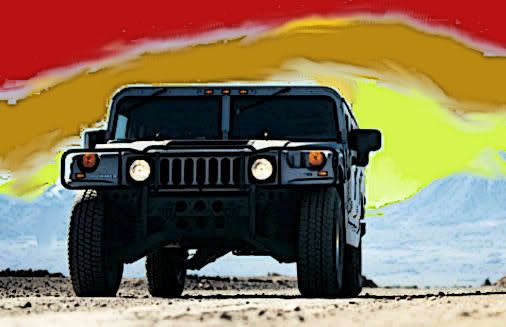
Hummer 2s, Range Rovers and Canyoneros (whatever) are heavy vehicles - there are no two ways about it. To move their considerable mass, a larger engine and more fuel is required. What people are complaining about is the use of such vehicles in situations and environments in which they are unnecessary and in which their fuel use is therefore excessive. People also complain about of the ability given their owners, who may lack a certain sensitivity, to access areas of the planet which require just this sensitivity to survive. And this aside from the clumsiness in the parking lot, the dangers these vehicles create as an obstacle to clear vision on the roads ,and their poor ‘crash compatibility’ with normal sedans.

Face it. They’re jet-skis.

It is natural for thoughtful, caring people to recoil against what appears to be a flagrant waste of resources and a font of unnecessary pollution. Therefore, inevitably, the large ‘SUV’ has become a symbol of excess, an icon for just the kind of behaviour that is threatening our world. If city councils have banned them, then huzzah! They are underscoring a basic human moral. They are helping remind the populace that it is gross and offensive to shit where you live.

If, as Dunning argues, there is a by-catch of small, low polluting cars, then that can surely be addressed, though it is, I would contend, a secondary issue. That the military Humvee [H1] and the Hummer 2 do not share a single component is indeed ‘another example of why you should be sceptical of marketing labels’ but it should not divert attention from the barbaric nature of the vehicle itself. I have seen an H2 and there is no way anyone is going to convince me it is a city-appropriate, fuel-efficient, planet-friendly vehicle. Even its advertising slogan ‘Get Lost’ seems to admit this, having a sub-text aimed at those who would criticise the unashamedly boorish artifact.


The angle Brian Dunning takes on the SUV issue is certainly sceptical. Logical too. But I would draw the line at humanist. I have noticed this kind of thing on other occasions too, as I tread the vasty deeps of the sceptisphere. The new sceptics can sometimes get so enthusiastic with their critical analysis that they discard the human element. Even Richard Dawkins is sometimes a culprit.

Certainly, as Dunning says, container ships produce carbon emissions equivalent to 300,00 cars and are not subject to emission laws, but there are many more cars than container ships.* And without the billions of stuff-hungry people those ships would be mothballed. And there’s the rub. A simple confusion over categorisation should not stop or discourage us reducing excess in our daily lives. Like many, I hold strongly to the credo ‘think globally, act locally’.

* Are there 300,000 cars for each container ship in the world? I would guess there are a lot more. But it’s only a guess, and I’m flirting with sceptics here.

Stumble Upon Toolbar DiggIt!

Sunday, July 19, 2009

~ australian sceptics kow-tow to USA

The sceptic movement seems to have gained a great deal of traction from the rise of the podcast. The Skeptic’s Guide to the Universe, probably the most popular ‘cast on the theme, is certainly my first choice among postcasts and I'm continually meeting people who concur.

The movement has its heartland in the US, that appears obvious, and in the US it is allowable, and indeed correct, to spell sceptic with a 'k'. But why has the burgeoning Australian movement embraced this spelling?

Is it like the Australian ‘Labor’ Party all over again. To quote Wikipedia, “the party was influenced by the United States labor movement and a prominent figure in the early history of the party, the North American-born King O'Malley, was successful in having the spelling "modernised"” [Other reasons are given, but they are minor.]

The Americans, through the pious hand of Noah Webster, performed a lot of English modernisation [rather in the tradition of Orwellian Newspeak]. Hence: color not colour, meter not metre, defense not defence. For good or ill, Webster’s attempt to change tongue to tung failed. Similarly, bred for bread, masheen for machine and blud for blood.

And it’s like disk all over again, though I have noticed that the original tide of US-inspired floppy 'disks' and hard 'disks' has ebbed somewhat over the years and that the correct spelling of disc can now often seen in relation to computers

The Australian Skeptics do it. The young Australian Skeptics do it. The Skeptic Zone, an Australian podcast, does it. These guys are supposed to be critical thinkers. They’re supposed to be accurate. Why are they making this mistake? Is there something I’m not seeing?

Sceptic ‘pre-dates the settlement of the US and follows the French sceptique and Latin scepticus’. Some writers, including Samuel Johnson in his dictionary, spelled sceptic with a 'k', but it never caught on, as it did with, say, ‘skeleton’. The Americans, perhaps via the intercession of Webster, used ‘skeptic’, which was closer to the ancient Greek.

To quote Wikipedia : Australians generally follow British usage (with the notable exception of the Australian Skeptics).

I would really like an answer to this question. I'd hate to think that our sceptic movement is working out of ignorance.

Stumble Upon Toolbar DiggIt!

Wednesday, May 6, 2009

~ the stark light of reason

I can accept that Channel 7 attempted to show both sides in Sunday Night's live debate on the vaccine issue, but I believe that giving any credence at all to the anti-vaccination lobby is a danger. For a start, so bereft of evidence are the claims of loofah-heads like Meryl Dorey [of the Anti-Vaccination Network] that it’s equivalent to putting flat-earthers on the same level of credibility as, well … round-earthers,. What’s more – to quote my favourite podcast A Skeptic’s Guide to The Universe – there’s a death toll associated with their groundless accusations.

I must admit I’ve been of a particularly sceptical cast of mind recently. My ipod is mostly to blame. I began my exploration of podcasting by downloading my favourite radio programmes – The Science Show, All in The Mind etc. - but it wasn’t long before I discovered a huge untapped well of interesting stuff. Lately, at the expense of music, I’ve been listening to The History of Rome, The Material World, Hardcore History, Astronomy Cast and - most avidly of all - a suite of podcasts produced by the global sceptic movement. The Skeptic’s Guide, mentioned above, is fabulous, but there is also Brian Dunning’s Skeptoid, Skepticality and an Australian offering, The Skeptic Zone.

Scepticism is all about critical thinking and the scientific method, and now that I've saturated myself with the wisdom contained in these thoughtful programmes, I've realised that even I, who consider myself a pretty rational guy, have been guilty of a fair bit of fuzzy thinking and – under the stark light of reason - have had to abandon quite a few of my beliefs and preconceptions.

Vaccination is a big issue for the sceptic movement, primarily because of the urgency in countering the disinformation. I won’t get into the nuts and bolts here, you can find the accepted scientific truths at the sceptic sites above (or check Matt’s I like Portello blog which has a sceptical link list.)

Suffice to say it’s a dreadful disappointment that the anti-vaccination people are gaining traction here. In America, I can understand it; over there, mothers are getting their advice from ex-Playboy Playmate of The Year Jenny McCarthy and her partner Jim Carrey. Jenny’s ‘mommy instinct’ seems to trump any number of randomised, double blind clinical trials. I hoped Australians might be more discriminating, but no, Channel Seven’s presentation has proven me quite wrong, and another clutch of worried mothers will probably threaten the health of their own and other children by refusing vaccination. Already there have been fresh clusters of deadly diseases once considered under control. Whooping Cough, for instance, has reached epidemic proportions in Northern NSW. Northern NSW, you say? That would be Byron Bay, no? Second last of 118 divisions in vaccination rates.

I’ve developed a very high regard for the sceptical movement [skeptical in the US]. They’re doing an important job educating us in an era when murky thinking abounds. These days people seem more dismissive of science, even suspicious, when once the scientist was regarded almost with awe. We – the members of an advanced technological society – are increasingly prepared to take the word of kooks and quacks over that of people who are continuously broadening the horizons of humanity and furnishing our increasingly lengthy lives with so many wonderful gifts. Under the rubric of The New Age a cloud of unknowing has descended.

(I know science is responsible for some bad stuff too, but that’s another issue.)

It amazes me the amount of people I’ve encountered who have been fooled by the Hopi Ear Candle scam. Certainly not the Hopi, who had never heard of the things and have litigated to get their name removed from the packaging. We should be ashamed of ourselves.

Another favourite target of the sceptics is homeopathy, a treatment modality which I’ve always been chary of. Take a smidgeon of some agent, say bach flowers, and dissolve them in a cup, say of water. Put a drop of that water in another cup of water, shake, then take a drop of this second cup and put it in yet another cup of water. Repeat this process five or ten times and what are you left with?

Logic would dictate that you are left with little else but water, and with this the homeopaths agree. Indeed, there is often not a single molecule of the original substance remaining, but the homeopaths are comfortable with this too. So what distinguishes the expensive curative you may have purchased from plain old water? Homeopathy claims that the efficacy of the remedy comes down to the water’s ability to hold the memory of the substance it contained.

In scientific terms, this is bunkum. There is not a shred of evidence for water having this ability, and water is something it is fair to say we understand pretty well. By the way, residents of NSW’s North Coast have been urged not to use a homeopathic whooping cough vaccine that has become available.

So, where was I? Proselytising, if I remember correctly. Channel 7! Stop putting ratings over community health. Parents, if you are disturbed by the fulminations of the anti-vaccinationists, take a deep breath and have a careful look at the established facts.

Stumble Upon Toolbar DiggIt!