Pages

Saturday, April 10, 2010

~ saint jacket


At the recent Atheist Convention, Dan Barker - an apostate who was once an evangelist preacher but now runs the Freedom From Religion Foundation in the US - described what it was like being a vessel for god. No challenge could ever penetrate his faith, because - to paraphrase from memory - god was right there with him, a certain presence above and slightly to the rear of his head. How could he possibly doubt when, on stage, the numinous power surged through him, unerring and incandescent, whipping like a high-voltage cable, gathering energy from the swelling emotions of his congregation?

For some people - and it has been suggested the root cause may be genetic, - such levels of spiritual experience are possible. Barker’s experiences were unusual though, even in the very godly context in which he worked. Most of a religious bent merely trudge on, nourished by a workaday relationship with their god, in awe of the Dan Barkers of this world, of the St Bernadettes, the Ezekiels and St Johns with their visionary frenzies and holy ecstasies.

I’ve always suspected, intellectually, that football provides for me what I cannot get from religion - but last night at the Docklands Stadium, like Dan Barker, I felt something above and slightly to the rear of my head - and it wasn’t a drunken Collingwood supporter.

Admittedly, I was primed. A grey pall of depression moved with me as I passed across the city to the ground. Despite all my efforts, the precious things in my life are under renewed threat and, as I walked, I could see no way of saving them that hadn’t failed many times before. I felt as if I’d spent a century in a dark cul-de-sac, squinting at the mortar between the bricks, thinking it was an horizon.

I drank a glass of wine. Another. I took my seat (provided by the generosity of my dear friend Andrew Park) and spent two hours riding the violent emotional ebbs and flows of a truly strange game of footy. I merged with the body of saints fans like a droplet merges with an ocean. I screamed my tonsils out until the final bar of the final iteration of the club song after a truly famous victory. For a while I was immaculate and cleansed. My soul was pruned to a single essential fact: I was a devotee of the St Kilda football club, beyond that - nothing. The brilliant, courageous, harrowing performance of my team against Collingwood - particularly Collingwood - was all the meaning I needed.

It’s good, I suppose, that such feelings are evanescent. After all, there is a lot more to me than that. Let’s just hope that ... Nick Riewoldt’s hamstring doesn’t keep him out of the game for too long.

Above is a picture of Michelle's glorious jacket

Stumble Upon Toolbar DiggIt!

Thursday, April 8, 2010

~ ambergris in the raw

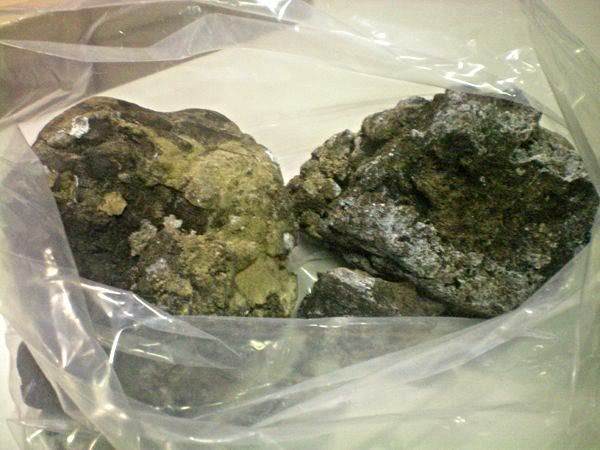
With the kind patience and assistance of the staff at the Moreland annexe of the Melbourne Museum (particularly my dear friend Nurin) I was at last able to have my first certified look feel and smell of ambergris, the waste product of the sperm whale which holds a rarefied place in the perfume industry - and which is central to my current work.

I was expecting something like the warehouse at the end of Raiders of The Lost Ark, and I wasn’t so far off the mark. It’s a large unmarked rectilinear building on an unprepossessing corner in an unexceptional suburb, yet within there are wonders.


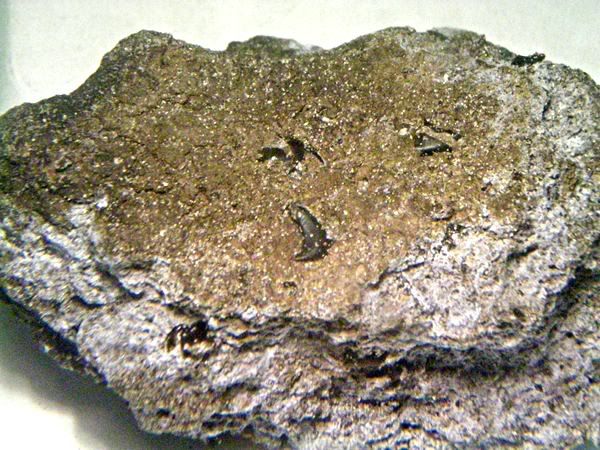
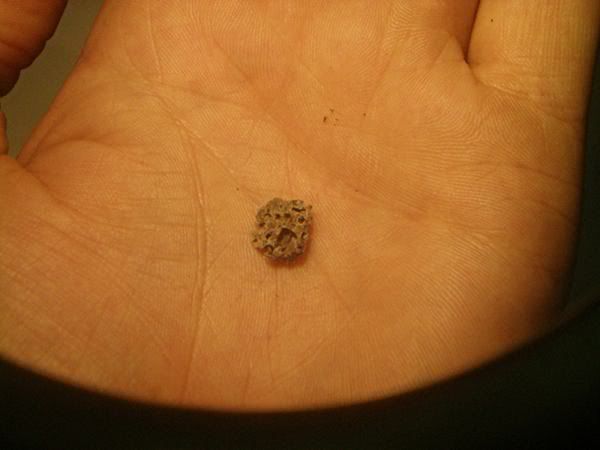
So let me tell you about their marvellous sample of ambergris. For a start, unsurprisingly, those tasked with locating it were unimpressed by the appearance and the odour - without question, it had the ‘humid’, ‘earthy’, ‘marine’, ‘animalic’ fragrance I’ve so often read described. It was a huge crumbling bolus, covered with patches of concreted sand and what may have been the roots of long dead seaweed. It was indexed as an amalgam of ambergris and non-descript matter, possibly faeces - but upon inspection the tell-tale squid-beaks were evident throughout - and the hot-needle test I was allowed to perform on a tiny smidgeon came up a strong positive.


I love this kind of thing. It drives me on through life. Polly, who I took along, was a touch bemused by the whole process ... but at least she knows what ambergris is now, and she was more than a little interested in some of the other exhibits we passed along the way.


This pig, we learned, had come from the Austin hospital. It had been genetically modified as part of an effort to make porcine organs compatible with humans needing transplants. (xenotransplantation). From the fact it was preserved in such a way, I can only assume it held - or perhaps still holds - great significance.

(please excuse the unfamiliar formatting - something strange seems to have happened with the Blogger interface)


Stumble Upon Toolbar DiggIt!

Sunday, April 4, 2010

~ perforated judean zombie

I won’t harp on it, but it was wonderful to be back at the football last night. A whole new season ahead, bright with potential ...

I bought both papers this morning, as I sometimes do when St Kilda has a particularly comprehensive victory - just so I can read twice as much about the game. So I can wallow like a pig in statistics, and linger on descriptions of our consummate skills.


But enough of that. It’s Easter Sunday, the Christian remodelling of the Jewish Passover, and before that a spring fertility feast dedicated to the Anglo-Saxon goddess Ēostre, from which, sayeth the venerable Bede, the word Easter derives. Others paid homage to the Babylonian Ishtar and the Chaldean Astarte (referred to in the Old Testament as ‘Ashtoreth the abomination’). The eggs are an obvious fertility symbol, as are the bunnies. What’s more, Wikipedia tells me that buns marked with a cross symbolising the four quarters of the moon were thought to have been eaten by Saxons in honour of Ēostre.

Currently, Easter celebrates the dubious claim that a man - who may in fact have been fictional - was reanimated after spending three days as a carcass, escaping his tomb to roam Jerusalem like some perforated Judean zombie. Of course this would be sensational news if it were true, but it’s not, and the reasoning behind this unlikely circumstance strains credulity even further. Resurrection - which is normally impossible - was viable in this case because the dead man was the creator of the universe. Bewilderingly, he was also the child of the creator of the universe, if I properly understand the tortuous theology....

Anyway, as a result of this non-event two thousand years ago, it took me ages getting my newspapers Almost everything that is ordinarily open of a Sunday morning was shut. As always, Easter not only inconveniences me, but makes me feel like an outcast.


There was a time when this land was spiritually homogeneous. Credulous adherents to the above mythology dominated so thoroughly that laws were actually passed preventing most things from operating on the anniversaries of Christ’s execution and putative resurrection. But those days are gone. More and more humans are questioning the rationality of such beliefs, and these humans should not be inconvenienced by the communal madness of the indoctrinated. It’s a form of discrimination, not only against atheists but against supporters of other religious brands.

On Good Friday afternoon, Andrew Park and I went seeking alcohol in Richmond. We passed about seven pubs and bottle shops on Victoria Street before we struck pay dirt. Ridiculous! Outrageous! And what was I doing in Richmond with Andrew Park, keyboard player for the miraculously resurrected Ears?

Well, we’re rehearsing again. Our haruspex has performed an augury and there may be a gig on the horizon. It could be related to a facebook group called I Got Drunk At The Crystal Ballroom - but the details are sketchy. If his prophesies hold water, I’ll shout it to the world. Ross Farnell, late of Beargarden, is on bass now and the band is sounding volcanic.

Stumble Upon Toolbar DiggIt!

Thursday, April 1, 2010

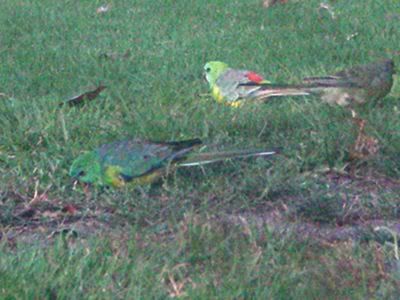
~ red rumped parrot

In these lean times, its rare for me to come into possession of precious things, but yesterday, using a book voucher I received for Christmas, I acquired a copy of Pizzey & Knights’ highly respected Field Guide to The Birds of Australia. Since then it has barely left my hands.

I know. My prognosis is doubtful. I may have traveled so far down the birding path that my chances of returning are poor.

But let me share with you some of my ornithological excitement. According to the twitchers, Melbourne is home to many parrots - not just your rainbow lorikeets,
galahs and eastern rosellas - but more obscure varieties like the musk lorikeet, the purple crowned lorikeet and the little lorikeet. My failure to sight any of these has been a source of enduring frustration, but today, at last, things changed ...


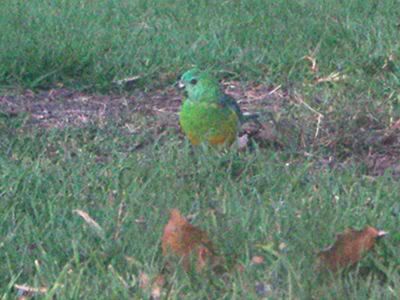
During a break from reading at Vision Australia, one of the workers noticed me poring over my new bird book and informed me that a family of red-rumped parrots was living in the park right next door. Once I’d finished with my work, I walked down to have a look and was far from disappointed.


Please excuse the quality of the photos. My camera is not only cheap but somewhat wonky and I had to take these shots at full zoom. Typically for the bird kingdom, the dull version of the bird is the female. Red-rumped parrots (Psephotus haematonotus) are also known as grass parrots.

Stumble Upon Toolbar DiggIt!

~ the goa stone, byssus and the pyxis

If there’s one thing that's guaranteed to stall the progress of my work, it’s research. If I cast aside my figurative pen and submerge myself in the vast reference tool that is the internet, then the hours slip by without friction and I emerge with a head full of fascinating arcana, little of which is relevant to the job at hand. To wit: the play I'm working on called Ambergris.

In the last week, I've learned more about ambergris the substance than I could ever hope to employ, but I've
also been lured down snaking tributaries ... overhung with rare crystalline fruit ... ripe to the point of bursting ... which I could not help but pluck ...

I learnt of shilajeet, an uncommon tar that seeps from hidden cracks among the Himalayan mountains during the summer thaw. Even the apes of this region know of its restorative properties for - together with humans - they sup from these mysterious wells and are known to age at half the rate of their fellows.

I discovered the noble pen shell, a massive Mediterranean mussel which secretes extremely fine golden threads with which it affixes itself to rocks. In antiquity, these threads were collected and woven into an exceptionally sheer fabric named byssus or sea-silk, which - owing to its
utter luxuriance and its tremendous price - was favoured by Pharaohs, Satraps, Caesars, Padishahs and any potentate worth his salt in the ancient world. Only one human still practices the art of weaving byssus. The noble pen shell is on the brink of extinction.

I made a note of lacryma cervorum - the stag’s tear - a viscous substance found in the corner-pit of the animal’s eye and possessed of magical properties similar to those of the bezoar.

But let me reveal some secrets of the ambergris ... that ‘marine sulphur, found at the sea-shore’ ..., which has broken from the ‘fountains and caverns of the sea’ ... Which ‘is grey, sweet and smooth' ... and which, when ‘pricked with a needle sweats out fatness, softens in the heat, and when moist appears black’.

If it is true, as tradition dictates, that ambergris is most likely to be found in the hindgut of the sickest whales, then it is no shock that the following individual, taken by whalers, contained the precious substance ...

There was ‘an unusual combination of lesions and ... behavioural abnormalities’ in a bull whale ‘taken... off Iceland’. There was ‘heavy combative scarring of the head, grossly roughened and thickened skin on the lower left flank, cutaneous maculae, genital papillomatosis, partial duodenal obstruction by plastic debris, colo-rectal obstruction by ambergris, cystic degeneration of the right kidney, and a deeply ulcerative gastric nematodiasis. Sealskin was found in the stomach. Gross and histopathologic observations suggested that the disease complex in this animal may have been related both to habitat degradation and health risks naturally associated with its ecology and age.’

I
gnorance of its origins have in the past spawned some curious tales ...

‘Ambergris is not the scum or excrement of a whale, but issues out of the root of a tree ... which shoots forth its roots towards the sea, seeking the warmth of it, thereby to deliver the fattest gum that comes out of it, ... otherwise by its copious fatness [the tree] might be burnt and destroyed ... [the] fat gum it is so tough that it is not easily broken from the root, unless [by] its own weight and the working of the warm sea. . . . If you plant the trees where the stream sets to the shore, then the stream will cast it up to great advantage.'

“In [a] ridiculous and wholly fictional account of a ... sea journey in search of the lost Capt. Jacob Cole, Clifford describes using a diving suit to find ambergris on the bottom of the sea and digging it out of the sediments with a pick axe.’

At one time it was ‘assumed that the sperm whale was a hunter rather than a manufacturer of ambergris, and that he swam ... about the broad ocean, gobbling up the treasure wherever he could locate it.” “In vain it was to rake for ambergriese in the paunch of this leviathan’ ... as ‘they sometimes swallow great lumps thereof in the sea’ before vomiting it out.

‘Marco Polo was the first Western chronicler to [correctly connect ambergris with sperm whales, but he ] also thought [the whales] vomited it up after having eaten it in the depths of the sea.’ Current wisdom has it - as far as I can tell from my readings - that the ‘morbid concretion’ exits not from the mouth but the anus [or its cetacean equivalent].

‘Ambergris was an article of imperial trade in Audoghast in northwest Africa before 1,000AD. In the 10th century Ibn Haukal, an Arab trader, classed it in value with gold and black slaves and referred to its reputed aphrodisiac properties.”

‘Avicenna ascribed its formation to the belchings of undersea volcanos. Kublio thought it was bird guano. Nero's wife Poppaea Sabina is reputed to have had oil of ambergris poured in her bath in 54AD.”

‘The Crusaders, "who will not be suspected of effeminacy," were largely responsible for its introduction to Europe from their contact with the Arabs.” Louis XV is said to have used ambergris to flavour his favourite dishes. The favourite dish of France's King Charles II was eggs and ambergris.

‘Ambergris is used in the manufacture of cassolettes, little perforated ivory boxes made to contain powdered odoriferous substances to carry in the pocket or reticule. It was also used in the production of peau d'Espagne, or Spanish Skin, used for perfuming writing paper and envelopes. Queen Elizabeth I is said to have worn a cape made of peau d'Espagne.’

The ‘pasty pathological growth’ also had pharmacological uses ...

It was ‘sealed up in a vessel hermetically, and digested for forty days. The ripened blend, we are informed, perfumes forever what it touches, eases the headache, takes away defluxions from the eyes, comforts cold and aged people, prevents apoplexy and epilepsy, strengthens all parts of the body, and causes fruitfulness’.

And as I've quoted in an older post ...

“It is ... an excellent Corroborative; it is discutient, resolutive, alexipharmic, and analeptic; it strengthens the heart and brain, revives and recreates the spirits natural, vital, and animal. Its sweet Sulphur is ... a good preservative against the Plague". From The Art of Healing and Praxis of Chymistry.

Then there is the curious Goa Stone ... It was ‘a universal remedy introduced in seventeenth century England, originating ‘from Goa and ... found in the form of oval balls weighing up to one pound ... [they were] generally encased in decorated gold or silver spheres. The formulation consisted of a number of powdered ingredients which included precious stones, bezoar, musk, ambergris and gold leaf, levigated into a fine, impalpable powder and formed into oval balls with mucilage’.

And the Pyxis, ‘an ivory box fashioned from the natural cylindrical shape of a tusk, probably used to hold gifts of ambergris, musk and camphor’. One example ‘is carved with a host of elaborate scenes, including one showing two horsemen, accompanied by cheetahs and birds, picking dates off a tree’.

In 1912 the discovery of a 450 kg. lump of ambergris saved a Norwegian whaling company from liquidation.

During the writing of my last play Mysterium I deliberately indulged myself. The work ‘sweats’ with strange archaic language and is bursting with fascinating anecdotes and obscure details. It was an unusual play with an unusual style, and its richness and density was generally well received - but with Ambergris I am planning for the narrative, the characterisation, and all those other elements which traditionally make a play a play, to be paramount.

The play is progressing wonderfully, but it is stretching into infinity. I am at page one hundred and ten with miles to go before I sleep.
Fortunately, I now have Sails of Oblivion - the perfect repository for all the fascinating little gewgaws I encounter along the way.

[Please excuse me for not attributing the quotes and sources in this post. It was simply a matter of time.]

Stumble Upon Toolbar DiggIt!