Pages

Showing posts with label MY LIBRARY. Show all posts

Sunday, September 14, 2008

~ extraordinary things

Life used to be flush with excitement. Awesome things used to happen all the time.

But these days, not only is my existence monotonous, predictable and unexceptional, but I would fight tooth and claw to keep it that way. Sure, those ever advancing years are at least partly to blame. And yes, my life is probably a little more interesting than I make it out to be – but reasonable certainty that tomorrow will be pretty much like today is a large part of what keeps me together, helps me stave off depression, be a consistent father, obey the orders of my beautiful wife - and work.

If you’re writing a novel, you need to work pretty much every day, and for hours – in my case at least four. The days go by. The words get written. And I find I’m spending a good part of my mental life in the chaotic fantasy world of Nonesuch.

That’s how I’ve replaced the madness of my youth. That’s how I get my jollies these days. In the mind. The mind.

In Nonesuch. In Alastair Reynolds' space opera House of Suns. In David Mitchell’s Cloud Atlas. In my library, where thousands of books, accumulated over decades, emanate an aura of profound comfort and potential … I can go anywhere … what's more, in the next room, the internet, and you ...

Did you read the article about cognition and exercise last week? An experimental study strongly suggests that regular daily exercise leads to improved mental function. It makes sense to me, gives me even more impetus for my exercise regime. What's more, a few days ago I discovered
Dr Norman Doidge and the concept of neuroplasticity. The act of thinking actually involves synaptic growth and can even turn genes on and off. Believe me, I’m back doing my crosswords. I'm an immediate convert. No doubt, cerebral exercise is at least as important as physical. Particularly – as I repeat myself like a weary, warped, worn-out record – if the years are accumulating behind you.

They say your mind goes as you die from liver cancer. What a harrowing thought. I’ll have to put something in my will about that. I want to be turned off before my wits go. Just pump me to the eyeballs with morphine and let the sisters of mercy call down the birds ….

Lately, you see, I've had this thing with birds … And I feel I’m about to have a thing with fungus … It’s my way of going deeper, finding the Breugelian phantasmagoria beneath every rock, brick and decaying log … Imagine how much there is to learn about those strange growths … imagine knowing the name of even the humblest toadstool ... Who cares if they’re a hundred feet from the Monash freeway … My god, I’m shivering with excitement!

There’s a whole boring old suburb out there, full of boring old people; there are mundane parks and common species … but when you get into the detail, well, it can transform into a wonderland… That’s what I started out trying to say. I’ve learned to take delight in the little things. I'm learning to find community in the place I live, rather than where I go mental.

Howard Arkley, the artist who lived and died not far from here, was unearthing something similar in his work. Lounge suites, common as muck, burning with neon intensity. But when drugs intervened, then his sense of wonder was whisked away - and he was left with shabby old furniture and a rafter from which to hang himself.

Here are the lyrics to a song I wrote in the nineties. It was for Lynne, the woman who taught me that ordinary could be astonishing.

*

extraordinary thing

she likes terrifying things.
she likes death-defying things
beware her paperclip and her useless piece of string.
beware the texture of her skin.

he loves convoluting things
he loves interwoven things
M.C. Escher folds his hands under his chin
enthralled by the deployment of her limbs

that girl who lies beside you -
has got the strangest idols

she likes ordinary things,
but she’s no ordinary thing.

she likes mortifying things.
she likes nauseating things.
beware her laser beams and her paralysing sting.
beware her vanities and sins.

she likes aggravating things
she likes modifying things
she wants a murky world where logic is a sin
and where confusion reigns, she’s king.

that girl who lies beside you -
has got the strangest idols

she likes ordinary things,
but she’s no ordinary thing.

extraordinary thing
extraordinary thing

(From Sweet Secretions by Fact. Available in your local remainder bin or op-shop.)

*

A final note. I've added an important update to the post titled Blue Streaks of Paranoia


Stumble Upon Toolbar DiggIt!

Thursday, August 21, 2008

~ the road

I haven’t often cried finishing a novel. It has happened, but I can’t recall the particular titles… Love in The Time of Cholera, possibly. Perhaps after One Hundred Years of Solitude [Gabriel G Marquez] … J G Ballard’s The Kindness of Women …

But last night I finished off The Road by Cormac McCarthy. For brute emotional force it trumps everything - at least everything I can bring to mind. It’s the long nightmare from which you are unable to wake, a frozen, pared-down hell in which nothing remains - save for a few desperate humans and their various brands of humanity. The crumbling black bones of Nature. Some scavenged goods. A few improvised tools and a world of wet ash. What these survivors do, in order to persist, ahead of the inevitable void, becomes a flat expressionless judgment of humankind.

I’m sure a tremendous amount has been written about The Road. I won’t go on. I’ll just say that I think, for this time, for the current version of the human race , it’s the best book I’ve read - and that the final couple of paragraphs come down on you with the weight of every single word prior.

(I wonder if the movie will hold true? It’s in post-production, directed by John Hillcoat, [The Proposition, Ghosts of The Civil Dead and, incidentally, the clip for The Finer Things by Beargarden]. Viggo Mortensen plays The Father, of which I’m glad.)

Stumble Upon Toolbar DiggIt!

Sunday, April 6, 2008

~ the curing

On Sunday at Camberwell Market, feeling wretched and foolish, I lost a beautiful facsimile edition of Poe’s Tales. Just mislaid it. As I do so often with so many things. Twice I’ve left my phone on the roof of my car. I’ve left my coffee there at least… on a googolplex of occasions. Like my mother – even in her non-declining years – I put inappropriate things in the fridge: TV remotes, laundry powder, money, bills, scissors, face cream, turpentine … I could never remember all the things I forget.

Is it dementia? My mother exhibited signs before she died at the age of seventy-two, but she’d been putting shoe-polish in the Frigidaire even when I was small. I haven’t started doing crosswords yet, trusting that my line of work provides sufficient neural exercise. I just hope that my chronic absent-mindedness is not a symptom of something dreadful on the horizon.

I was at Camberwell Market, wasn’t I? Losing things … Becoming disheartened … After all, I was there to make money, to find books to hawk on ebay, not to leave lying about. Because of the daylight savings shift, I arrived early and didn’t have a good morning. Stall-holders were still hoping for the prices they’d imagined.

For me it’s best to go after I’ve metabolised my Spasmo-Nemigron, after my system has normalised. Then I can enjoy the process.

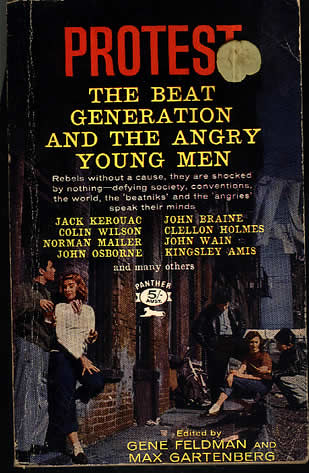
I found one particularly interesting thing: an old paperback in good condition called ‘Protest: the Beat generation & The Angry Young Men”. These were ‘rebels without a cause, they are shocked by nothing – defying society, conventions, the world, the ‘beatniks’ and the ‘Angries’ speak their minds’.


A bit iffy, comparing these two movements. The Beats were something wild and new, the Angry Young Men were comparatively polite and, well, British. Colin Wilson was the only truly interesting one, and mainly because of his marvellous erudition and his ability to present his subversive ideas in a manner that didn’t too badly offend public decorum. He was not tearing at the very fabric of society as the Beats most assuredly were. The other ‘Angries’ – John Braine, John Osborne, Kingsley Amis, J P Donleavy – were distinguished writers, but we certainly don’t associate them with literary revolution. Indeed they appear starchy and wan compared to Burroughs, Ginsberg and Kerouac, who were the principal Beat contributors.

The book was published in 1960, early enough for William S Burrough’s contribution to still fall under his original nom de plume ‘William Lee’:

‘A scion of one of America’s most illustrious families, he has not transgressed against established law because of poverty or lack of personal opportunity … Yet ‘by his own description, the author is a drug addict, thief, pusher and pimp.’

What follows is an except from his first novel ‘Junkie’, [later to be retitled ‘Junky’]. It’s been ages since I last read it and I encountered a short passage that piqued my curiosity …

“To me, teaheads are unfathomable.

“There are a lot of trade secrets in the tea business, and teaheads guard these trade secrets with imbecilic slyness. For example, tea must be cured, or it is green and rasps the throat. But ask a teahead how to cure weed and he will give you a sly, stupid look and come-on with some doubletalk. Perhaps weed does affect the brain with constant use, or maybe teaheads are naturally silly.

“The tea I had was green, so I put it in a double boiler and set the boiler in the oven until the tea got the greenish-brown look it should have. This is the secret of curing tea, or at least one way to do it.”

I’ve also noticed a certain mythology associated with the curing of pot. It is always spoken of vaguely; one can never get clear answers, yet some will claim it is of critical importance - but as far as I have been able to judge all that is necessary is to let the vegetable matter dry slowly and naturally in a well ventilated room. Upside-down is good, as the leaves dry to form a natural protective sheath for the delicate heads. Various subtle techniques can be employed during the drying, but in the end they make little or no difference, [although practices like ‘sweat-curing’ can help speed things up].

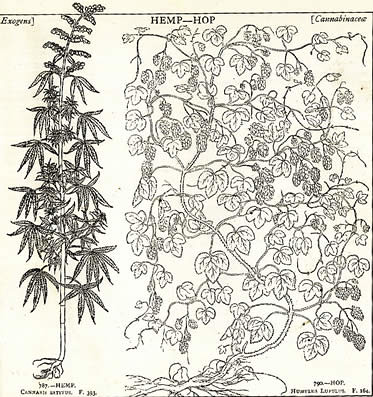
So That’s all there is to it. No great secret. Curing is more or less a synonym for drying. People also speak of immersing the root ball in a sugar solution, but that’s just piffle on a level with the very tempting myth that hops, a near relative of cannabis, can be grafted onto cannabis rootstock and made to produce THC – so creating the appearance of a perfectly innocent, legal crop.


During WW2 the US Government attempted to create a ‘cannabis strain that would yield a superior quality fibre … that would tie up ships without turning on the troops’*. A man named H E Warmke was front-man for the project, which also unearthed a useful means of producing polyploid plants by soaking seeds in colchicine [the toxic derivative of a beautiful flower bulb]. It was Warmke who claimed that hop flowers grown from cannabis roots contained equal levels of THC to standard weed.

A pipe dream, if ever I heard one

* From The Connoisseur’s Handbook of Marijuana

Stumble Upon Toolbar DiggIt!

Sunday, March 30, 2008

~ a ukrainian girl with an altered consciousness

Some of us - perhaps most of us - naturally seek out altered states. To quote Andrew Weil’s classic book The Natural Mind...

"The desire to alter consciousness periodically is an innate, normal drive analogous to hunger or the sexual drive."

And now a concept which may possibly be familiar to you – and which almost certainly, found its origins in this particular study …

"Anyone who watches very young children without revealing his presence will find them regularly practicing techniques that induce striking changes in mental states. Three and four-year-olds commonly whirl themselves into vertiginous stupors …"

For me – and, I think, for a great many others – this ‘innate drive’ gathered steam during my teenage years. Because real drugs – heroin, acid, pot etc. – were not within reach, or barely understood, necessity became the mother of invention. I have no idea how the information filtered down, but we learned that ephedrine , a low grade speed, was easily obtainable over the counter, if you had the right story for the pharmacist.

To our sweet, naïve minds ephedrine seemed like a pretty decent high.

On some nights, I would steal one of mum’s cigarettes, sneak out to the carport and smoke it like a joint. Until I caught the habit, this practice would pleasantly spin me out for about twenty seconds. It was thrilling but pungent, and surprising thoughts would jangle through my brain.

Once, just as my mind was clearing, I heard a monstrous noise in the shadowy dark - a noise I could only equate with the utterances of degenerate mutants or bog monsters from shows like The Outer Limits. I couldn’t believe my ears. The noise came again, and again. Guttural. Deep-throated, phlegmy. Threatening. Hovering between disbelief and terror, I backed away and made haste into the brightness of the house.

Later, I learned it was a brush-tail possum. Before that period – the mid-seventies – the species had been unknown in our zone.

But back to altered states…

I’ve always been prone to fainting – not the neurasthenic crumpling of Victorian England, but the blood-draining kind that occurs when you stand up too quickly after sitting for too long. As you regain consciousness, your brain is suddenly awash with freshly oxygenated blood and the world, briefly, seems vibrant and seething with fresh possibilities. It can feel like waking from a deep and healing sleep to a brand new beautiful day.

With practice, I found I could kick off a fainting spell pretty much whenever I liked. A big long stretch, hanging from a door – these were reliable techniques.. I came to use it - along with the ephedrine – as a revitalising study aid. There still remains an indentation in the kitchen door where my head impacted after a particularly gratifying collapse.

Of course, my parents used to worry. I explained what I was doing, but they tut-tutted and worried still more. They pointed out that there were dangers in passing out all over the place. My mother thoughtfully advised me to clear any sharp objects from the vicinity before I applied the technique.

Sometimes she could be very practical, my mother. Allow me to give you an example

I recall a sunny, somnolent afternoon in Mt. Waverley. It was the dawn of the Nineties and I had moved back there after breaking up with my girlfriend Charlotte, who chose this day to rock up in a condition which could reasonably be described as insane.

Recently, there had been an agreeable but drug-fuelled and ultimately false resurgence in our relationship. Nothing had been solved from previously and things very quickly turned sour. Only weeks prior, after the premiere of my play The Hive, she had lain like the Vitruvian Man on the bonnet of my mum’s kingswood, gripping a windscreen wiper with each hand, while I accelerated before braked hard in an effort to throw her off onto the road. To my drunken amazement, I could not dislodge her.

My mum was first to notice the wiper-damage. I spent some days recovering from the excesses of that night, both in Mt Waverley and in the lock-up at the Carlton police station. Mum, despite her ingrained, depression-era respect for property, managed to see the humour in it, god bless her. She just couldn’t figure out how those wipers had come to be fixed at ninety degree angles to the glass. Of course, I couldn’t reveal that Charlotte had been grasping them for dear life as her unchecked momentum threatened to launch her onto the macadam - so I lied, explaining that evil Charlotte had vandalised them out of spite.

Then she reeled into that quiet afternoon like a drunken harpy seeking bloody vengeance. Observing her approach, I locked the doors, closed the windows, but it was not enough. She found the back gate.

Although it was not locked, she proceeded without pause to scale the five foot hurdle.

Now, Charlotte has refined tastes and very good fashion sense. She wore a tight knee-length black skirt, a white silky blouse with frilled edges and a black velvet jacket. Characteristically, she was bedizened with beautiful Ukrainian jewellery – golden heirlooms gifted by her mother, strewn with diamonds, alexandrites and rubies. But as gate-scaling wear goes, it didn’t rate.

I can still see the image in my mind’s eye, as clear as day. Charlotte, the flashing curls of her dyed cinnamon-red hair framing a lead-white complexion. One leg, in fishnet stocking and black high-heeled boot, thrown over the top, along with a shoulder, one arm and a raging head.

Seeing my mother emerging from the back door, [probably with the intention of offering tea and biscuits], Charlotte immediately seized upon the opportunity to embarrass me. She ramped her invective: Your son fucks prostitutes, Mrs Sejavka! Did you know that?

For the record, it was not true. Charlotte was so infuriated by my betrayal that she had cast her breeding and decorum wholly to the wind – and was just spitting out the worst kind of poison she could cook up. My mother – a trained nursing sister, but nearing seventy years of age - assessed the situation and with a caring expression advanced towards the girl.

Gently, she took Charlotte’s hand, softly stroked it, calmly told her to remember who she was, to think about what she was doing. I can’t recall the words exactly, but they were effective; it worked. My mother had been a nurse all her life and would have had tricks up her sleeve to soothe a savage patient.

Charlotte was dumbstruck, as was I. Then she exhumed her rationality - at least partially. After that, my memory fails…

I realise I've strayed a long way from my intended subject. But I couldn’t resist the sharing of such a nutritious tale, and, Charlotte, if you’re reading, I trust you can look back fifteen years to see the funny side.

Oh, and my original subject? Next post.


Stumble Upon Toolbar DiggIt!